4 Modern Landscape Ideas for Hampton, VA | Zone 8a Coastal Design
Native plants from the Mid-Atlantic US coastal savannas (Zone 8a) — Humid subtropical climate
Why Modern/Minimalist Gardens in Hampton?
Modern landscape design has a quiet advantage in Hampton that most people miss: the city is full of low, horizontal, flat-fronted postwar houses — the 1950s and 60s ranches of Willow Oaks, Farmington, Northampton and Michaels Woods, the split-levels off Big Bethel Road, the long brick officers' housing near Langley — and those are precisely the rooflines that clean-line landscaping was invented to extend. Where an English border fights a ranch house for attention, a straight poured-concrete walk, one wide sweep of grass and a single repeated planting mass finishes the architecture instead of decorating it. The newer contemporary infill going up around Buckroe and along the Hampton River waterfront pushes the same direction with full-height glass and flat overhangs, and even the historic streets in Wythe and Phoebus take a restrained modern back garden happily, because nobody sees it from the street.
Zone 8a is the reason this style works better here than it does two hours north. Winter lows of 10–15°F, a growing season of roughly 230 days and a first frost around mid-November mean the architectural evergreens that give modern gardens their year-round bones actually survive: Sabal minor, the dwarf palmetto native to southeastern Virginia, Trachycarpus fortunei, Rhapidophyllum hystrix, Yucca filamentosa 'Color Guard' and Podocarpus macrophyllus 'Maki' all hold their shape through a Hampton winter. The real constraint is the opposite of the desert-modern cliché. Hampton takes about 47 inches of rain a year, July highs average near 88°F with dew points in the 70s, and the water table sits only three to five feet below a city that averages barely 10 feet above sea level. Agave ovatifolia and Agave parryi will not die of cold here — they die of a wet February in flat ground. Which is exactly why the raised, steel-edged, gravel-mulched bed is not a style choice in Hampton but a survival mechanism: build the bed eight to twelve inches proud of grade, cut the sandy loam with a third expanded slate or coarse granite, and the same rosettes that sell the look in Arizona will hold for a decade.
Soil and salt shape the rest. Hampton sits on Atlantic Coastal Plain sandy loam of the Bojac and Munden series over a slower clay subsoil — fast in the top eight inches, sluggish below, and low in organic matter. Concrete and large-format pavers need a properly compacted crushed-stone base, six to eight inches for a patio and eight to ten under a driveway, because sand that wet will pump and settle under a slab poured on bare grade. Frost depth is shallow at about 12 inches, so pours run nearly year-round, but the water table means every flatwork design should tilt at least a quarter inch per foot away from the house and end somewhere on purpose. On lots near the water in Grandview, Fox Hill and along Chesapeake Avenue, add salt: bay spray browns Buxus and Hydrangea macrophylla on the windward side, while Ilex vomitoria 'Nana', Juniperus virginiana 'Taylor', Morella cerifera, Panicum virgatum 'Northwind' and Muhlenbergia capillaris ignore it entirely.
Finally, water rules. Hampton enforces the Chesapeake Bay Preservation Act through its own ordinance, and a 100-foot Resource Protection Area buffer applies landward of tidal shores, tidal wetlands and perennial streams — which touches a great many lots on the Hampton River, Back River, Newmarket Creek and Salters Creek. Adding impervious surface is what triggers review, and that is worth knowing before you design a 900 sqft concrete terrace. It also points modern design somewhere genuinely better: open-jointed large-format pavers over an aggregate base, permeable gravel courtyards in place of turf, and steel-edged planting basins on the low side of the lot. The city's Resilient Hampton work has normalised that vocabulary, and it happens to look sharper than a sealed slab. Get the grades and the base right, keep the plant list to five or six repeated species, and a modern Hampton garden asks for almost nothing back — the rain irrigates it, Zone 8a keeps it evergreen, and the grasses do the season's only real theatre in October.
4 Modern/Minimalist Design Ideas for Hampton

The Flat-Roof Ranch Entry
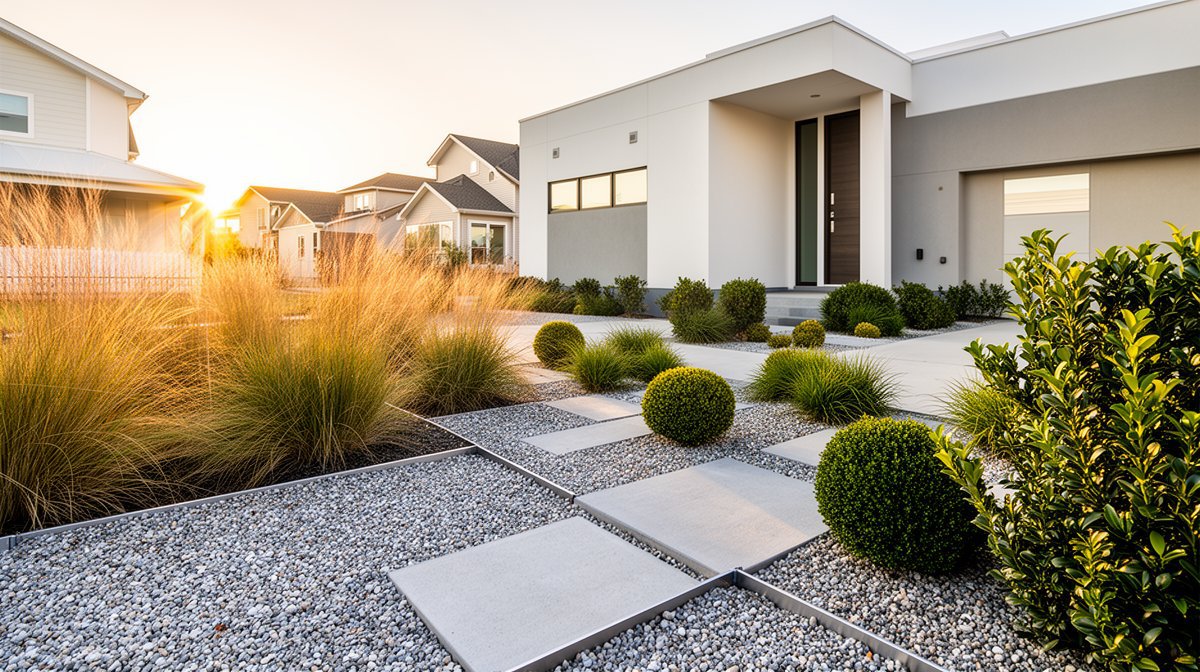
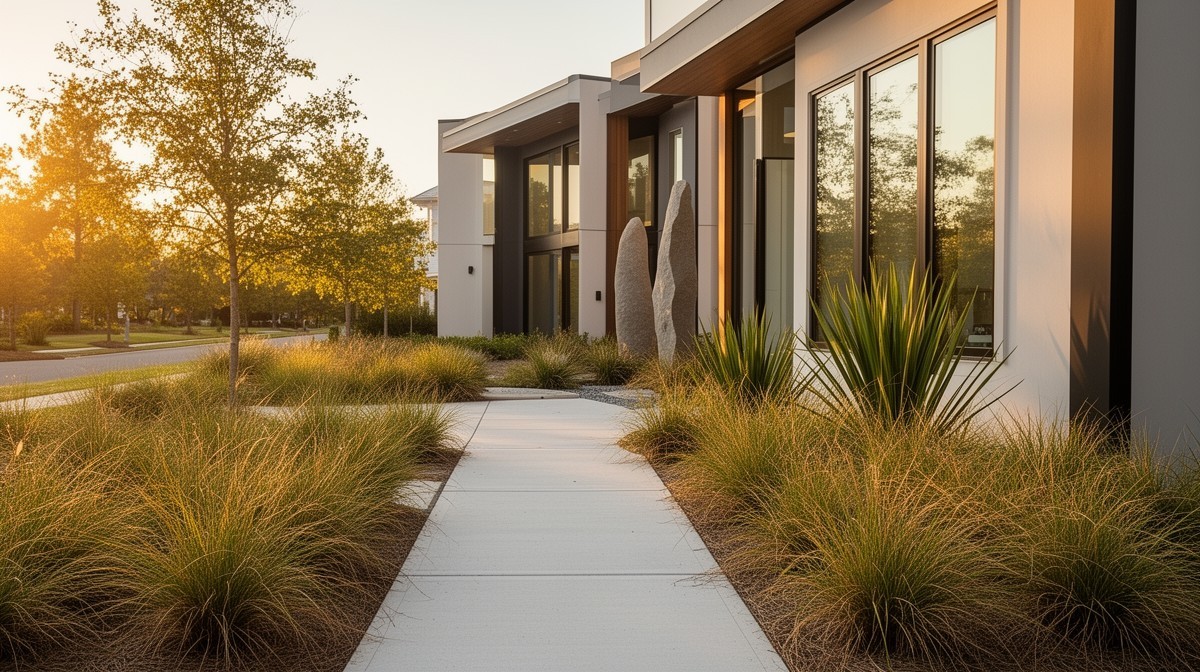
$12–24/sqftA single-story flat-roofed home with deep overhanging eaves, warm-lit floor-to-ceiling glass and a dark-framed double door, approached by a wide poured concrete walk that runs dead straight from the sidewalk to the entry with clean score lines breaking it into panels. The planting is symmetrical and reduced to three notes: a broad drift of silver-plumed upright grasses catching the low sun on both sides, a solid band of purple lavender in front of it, and a scatter of spiky burgundy rosette accents pulled up tight against the stucco foundation. Crisp panels of lawn edge the concrete, a multi-stem shade tree balances the composition on the left, and a clipped hedge with a slatted wood gate closes the side yard. Nothing is fussy and nothing is repeated more than three times.

The Gravel Courtyard Front Yard
$9–19/sqftThe lawn is gone entirely. A low stucco ranch with a brown hipped roof and black-framed windows now sits behind a field of buff pea gravel, organised by three rectangular steel-edged beds set flush into it and filled with grey crushed stone. Each bed holds a repeated composition of big blue-grey agave rosettes at two scales, with one clump of golden grass breaking the rhythm so the geometry does not go rigid. A slatted wood privacy fence closes the right-hand side and a mature shade tree rises behind the roofline. Everything about it is engineered for Hampton: the raised steel beds and crushed-stone mulch are what let sculptural rosettes survive a 47-inch rain year, and there is no turf left to mow or irrigate.

The Fire Bowl Concrete Terrace
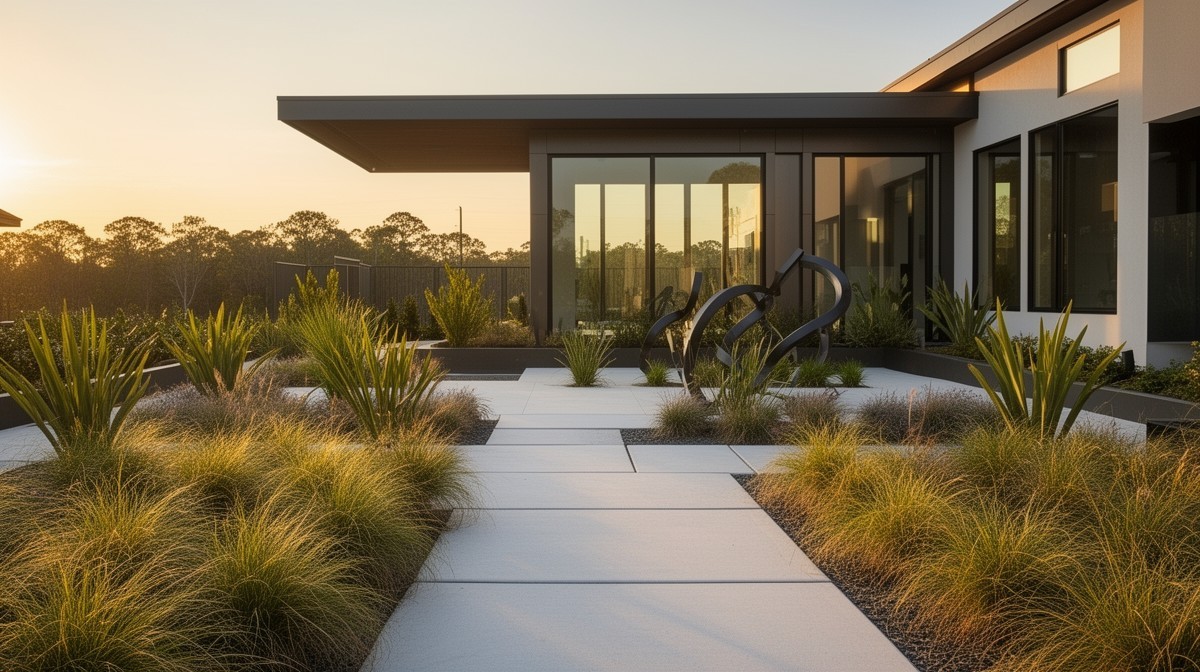
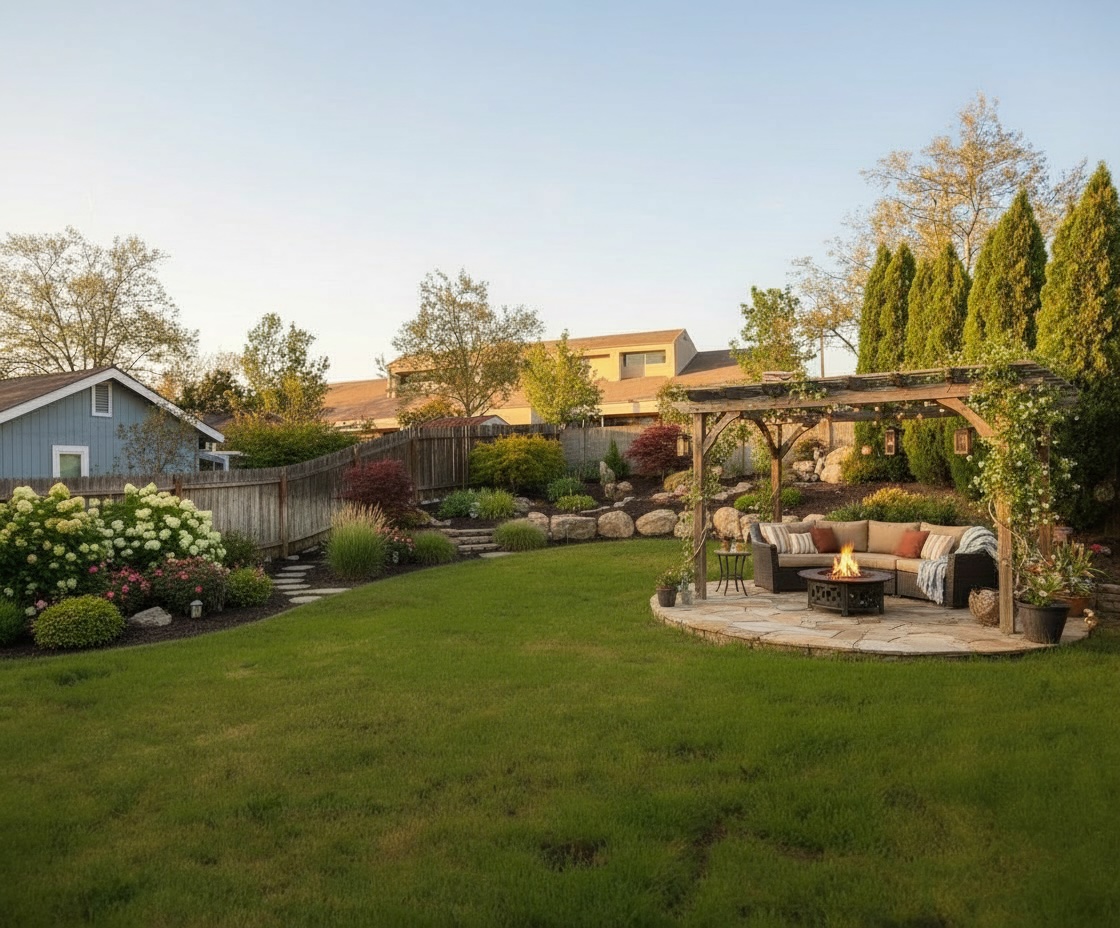
$20–38/sqftA rectangular terrace of large-format concrete slabs, laid with fine joints, sits off a pale stucco house with a wide sliding glass wall. A low round concrete gas fire bowl anchors the centre, ringed by a deep beige sectional and two lounge chairs, and catenary string lights sweep from the roofline out to a big spreading shade tree at the left, throwing the terrace ceiling over open sky. Instead of a hard edge, the paving meets loose drifts of feathery plume grasses and low flowering mounds along one whole side, with a single square lantern set out on the lawn. A clipped hedge runs the back boundary to close the room. It is one material underfoot, one focal object and one planting texture — the discipline is what makes it read as modern.

The Pool Court at Dusk
$45–90/sqft (pool area inclusive)A two-story glass-box home glowing from the inside opens onto a rectangular pool set flush into pale large-format pavers, lit from below so the water reads as a lantern at blue hour. A long low sectional and a fire table sit on a raised deck platform along one side of the pool, and the boundary is handled in three layers: a white rendered wall, a slatted screen panel, and a row of small multi-stem trees uplit along the length of it. In the foreground, big steel-edged beds hold repeated masses of arching grasses with in-ground uplights buried among them, so the whole edge of the paving dissolves into moving silhouettes after dark. White flowering shrubs pick up the last light at the far corners.
See how a modern/minimalist garden looks on YOUR property
Upload a photo of your Hampton yard and visualize your dream garden in seconds.
Try ProScapeAI Free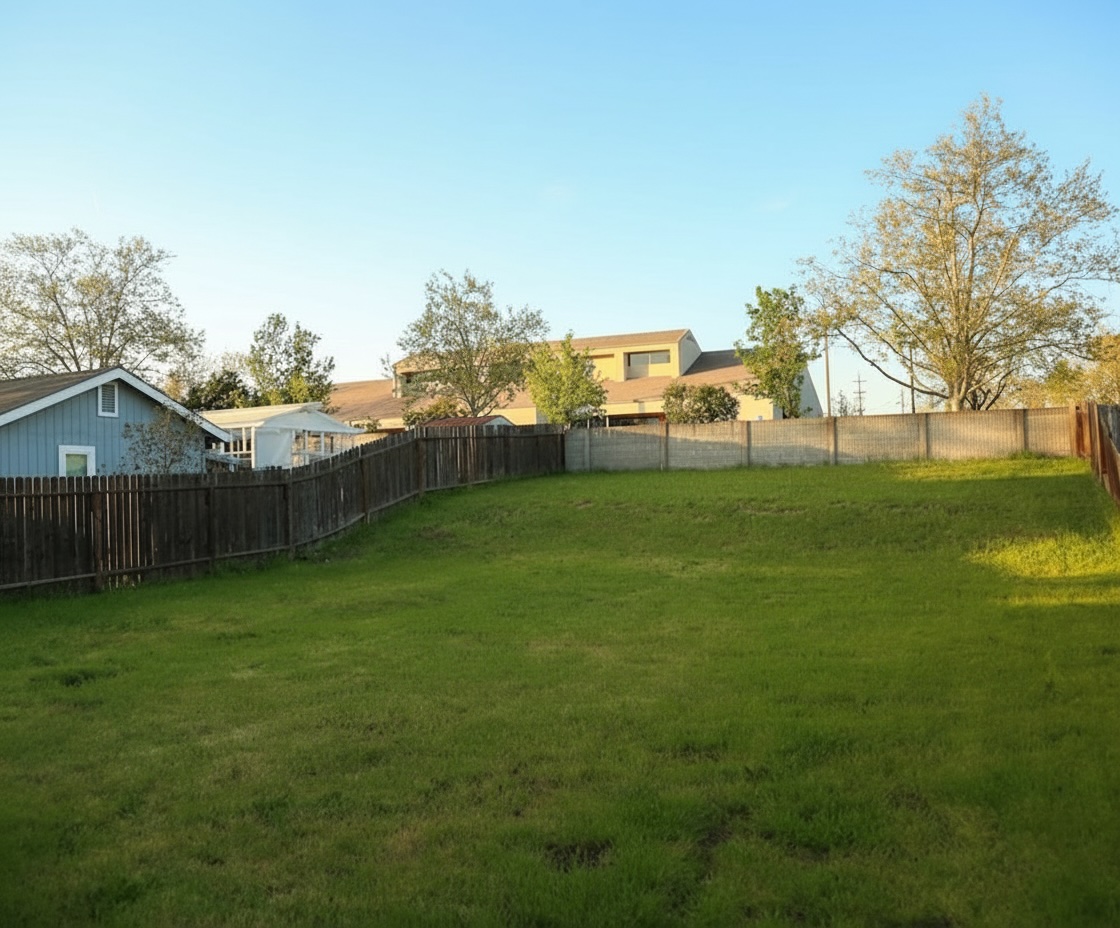
Featured Flowers & Perennials for Modern/Minimalist Gardens
Browse all 150 plants for Hampton
Water Lettuce
Pistia stratiotes
low-growing ground cover, white blooms in summer. Evergreen year-round.

Tussock Sedge
Carex stricta
low-growing ground cover, blooms in spring. Brown fall color.

Umbrella Sedge
Cyperus alternifolius
grows to 4 feet, blooms in summer. Evergreen year-round.
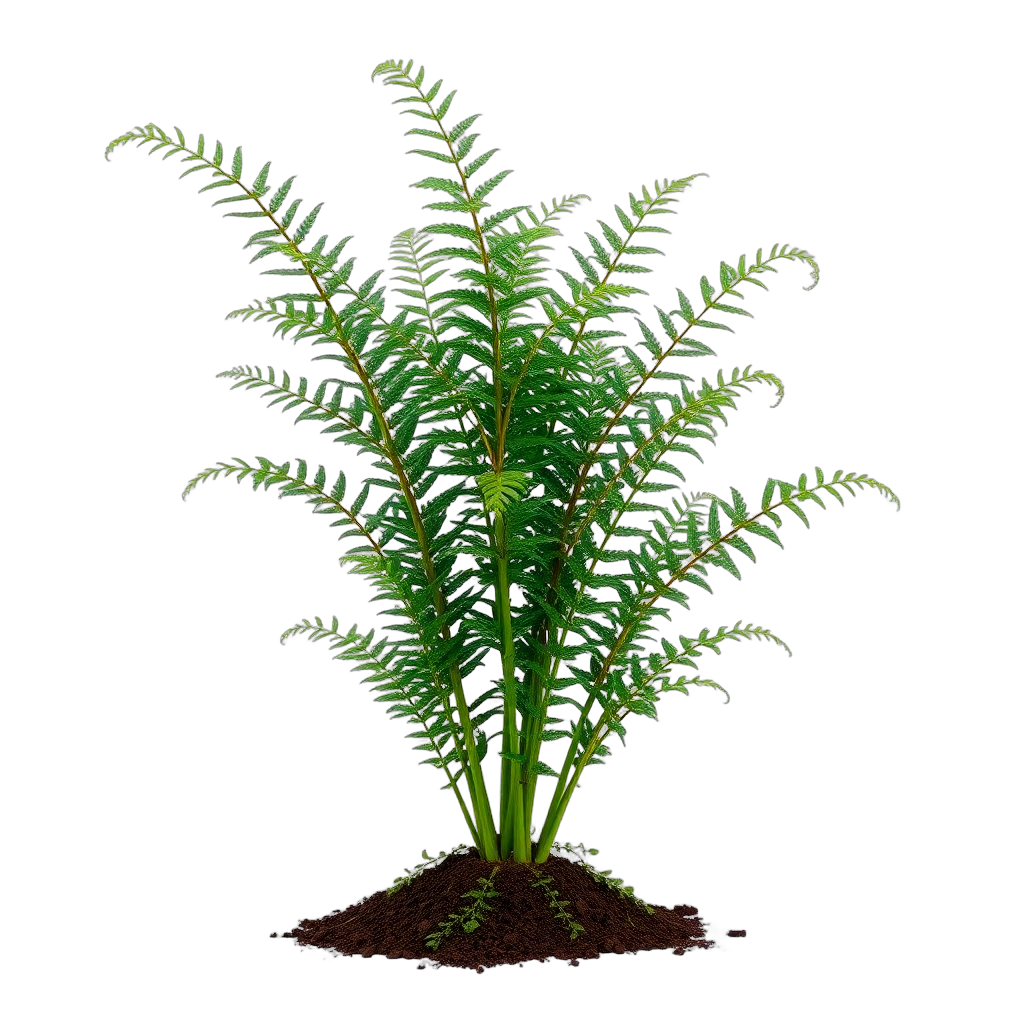
Deer Fern
Blechnum spicant
low-growing ground cover, blooms in none. Evergreen year-round.
Zone and sun checks come from our database — confirm with your local nursery before you buy.
Bloom Calendar for Hampton
spring
Tussock Sedge, Austrian Speedwell, Bigroot Geraniumsummer
Water Lettuce, Umbrella Sedge, Alpine Sea Hollyfall
Autumn Snakerootwinter
Limited bloomsDesign Tips for Hampton (Zone 8a)
- Raise every sculptural bed eight to twelve inches above grade inside a steel frame — with 47 inches of rain, sandy loam over clay and a water table three to five feet down, Agave ovatifolia and Yucca rostrata die of a wet February in Hampton, never of the cold
- Mulch architectural beds with crushed stone, not bark. Bark holds moisture against the crown in Hampton's humidity and undoes the drainage you just built; grey granite chip also gives the hard, quiet groundplane that makes a modern bed read as one object
- Spend the money on the base before the surface — six to eight inches of compacted crushed stone under a patio, eight to ten under a driveway. Wet coastal-plain sand pumps, and a slab poured on bare grade will settle and crack within three or four seasons
- Substitute Juniperus virginiana 'Taylor' wherever a design calls for Italian cypress. It gives the same narrow vertical, is native to the coastal plain, and shrugs off both the humidity and the bay salt that scorch a true cypress along Chesapeake Avenue
- Design for permeability, not just looks — open-jointed large-format pavers, gravel courtyards and planted basins keep you on the right side of Hampton's Chesapeake Bay Preservation Area rules and handle the recurrent flooding that a sealed slab simply relocates
- Repeat five or six species and stop. Modern planting fails when it becomes a collection; a mass of Panicum virgatum 'Northwind' repeated three times reads as design, while fifteen single specimens read as a nursery clearance shelf
- Light the grasses from the ground and leave the lawn dark. Uplights buried in a drift of Miscanthus sinensis 'Morning Light' or Muhlenbergia capillaris give Hampton's long, mild evenings eight or nine usable months of depth for a fraction of a hardscape budget
Where to Source Plants in Hampton
Skip the big-box stores. These independent Hampton nurseries specialize in the plants that make modern/minimalist gardens thrive in Zone 8a.
Ken Matthews Garden Center
Grafton / Yorktown, about 12 miles from Hampton
Long-running independent Peninsula garden center with strong grass, conifer and architectural shrub selection for Zone 8a
Anderson's Garden Center
Denbigh / Jefferson Avenue, Newport News
Family-owned since 1954; large greenhouse and nursery yard with container specimens, grasses and structural shrubs for clean-line designs
McDonald Garden Center
Virginia Beach, founded in Hampton in 1943
Hampton Roads institution with two year-round stores and seasonal garden markets across the region; broad grass, palm and evergreen selection
Coleman Nursery
Ironbound Road, Williamsburg
Independent nursery and garden center with a deep conifer, broadleaf evergreen and tree list — useful for the clipped and columnar structure modern designs need
Modern/Minimalist Landscaping Costs in Hampton
| Project Scope | Estimated Cost |
|---|---|
| Front-yard modern conversion (turf removal, gravel, steel edging, planting) | $6,000 – $14,000 |
| Poured concrete or large-format paver terrace (200–400 sqft) | $9,000 – $21,000 |
| Back garden room with fire bowl, seating and string lighting | $18,000 – $45,000 |
| Pool deck plus full modern backyard landscape | $70,000 – $170,000 |
| Raised steel planter beds, fabricated and filled | $600 – $1,400 each |
| Low-voltage landscape lighting (12–18 fixtures, installed) | $2,500 – $6,500 |
| AI visualization with ProScapeAI | Free to start |
Estimates based on Hampton, VA-area contractor rates as of 2026. Actual costs vary by site conditions, materials, and contractor.
Hampton Climate & Growing Zone
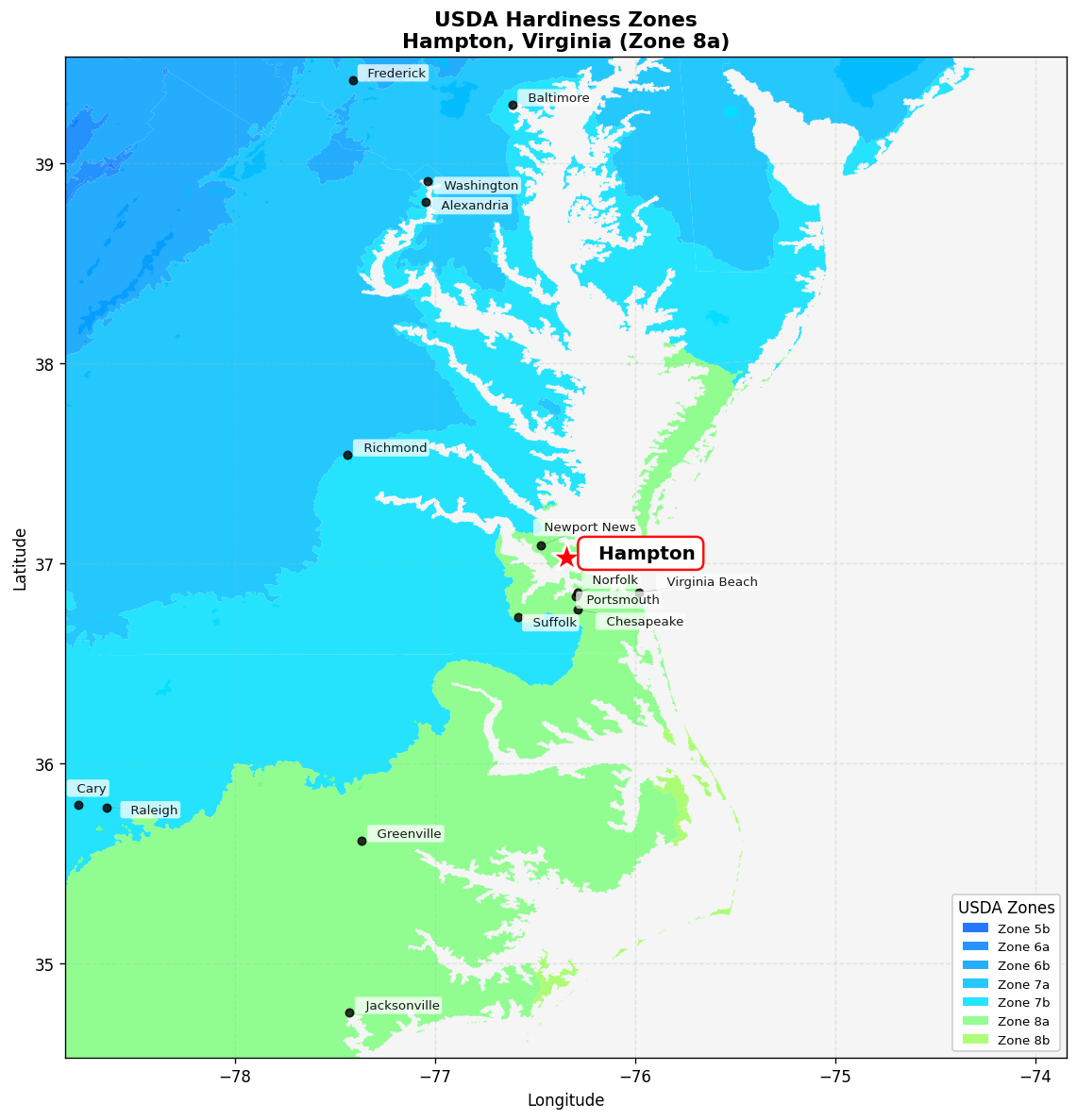
USDA Zone 8a
Hardiness zone for Hampton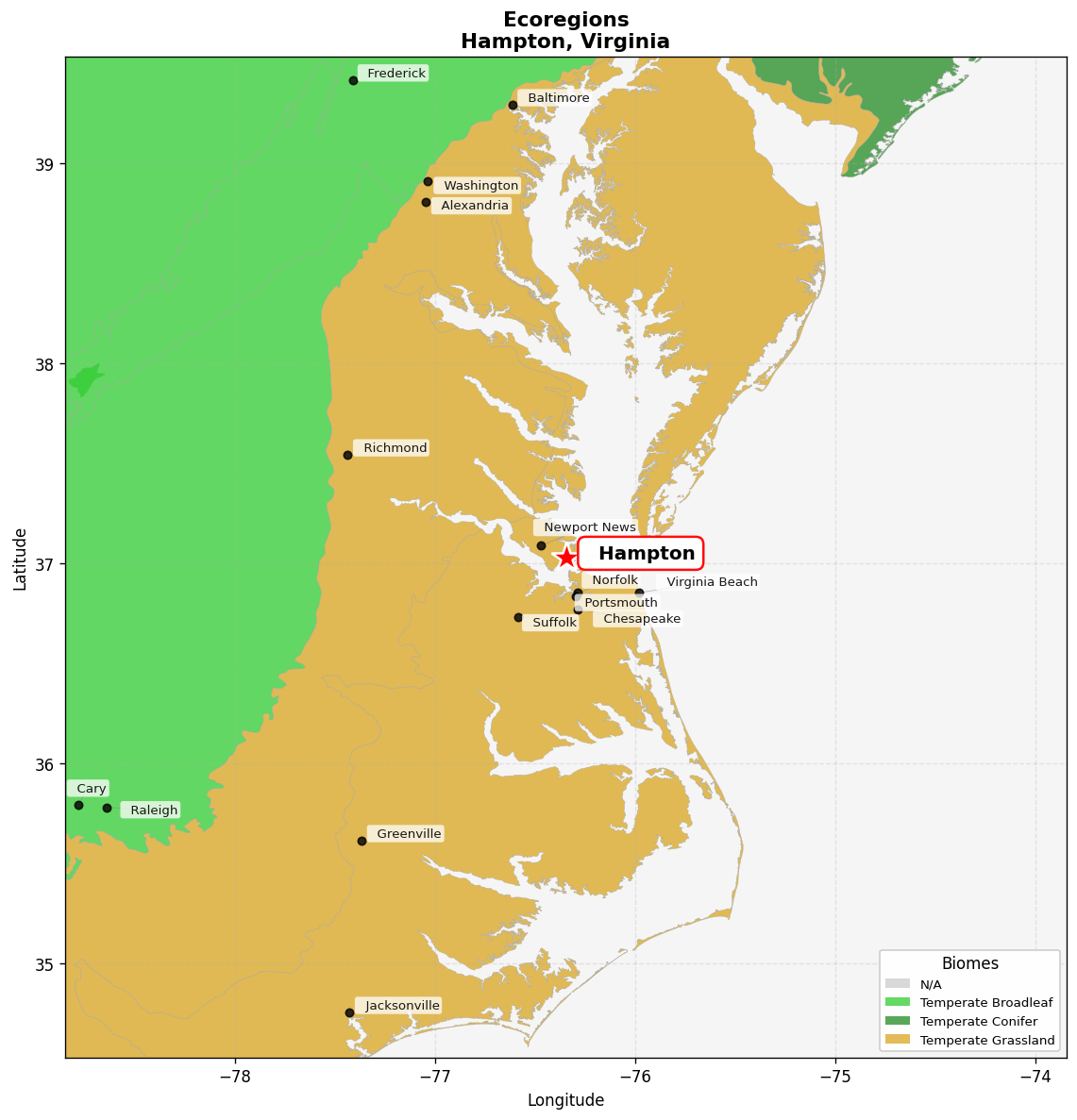
Mid-Atlantic US coastal savannas
Native ecoregionFrequently Asked Questions
How much does modern landscaping cost in Hampton, VA?
Hampton Roads installation pricing runs roughly 10–20% below the national metro average, so clean-line design is more attainable here than the look suggests. A front-yard modern conversion on a typical 500 sqft frontage — turf removal, gravel field, steel edging and architectural planting — runs $6,000–14,000 installed. A 300 sqft poured concrete or large-format paver terrace lands at $9,000–21,000. A full back garden with a fire feature, seating terrace and lighting is $18,000–45,000. Pool-and-landscape backyards on the bigger waterfront-adjacent lots typically fall between $70,000 and $170,000. A DIY gravel-and-plants front conversion can come in under $5/sqft in materials.
Can agaves and yuccas survive Hampton's 47 inches of rain?
Yes, but only above grade. Cold is not the problem in Zone 8a — Agave ovatifolia and Agave parryi var. truncata handle 10–15°F comfortably. Wet crowns in February are what kill them, and Hampton's sandy loam over a slow clay subsoil plus a water table three to five feet down means flat ground stays saturated for days after a nor'easter. Build the bed eight to twelve inches proud of grade inside a steel frame, blend a third expanded slate or coarse granite into the soil, and mulch with crushed stone rather than bark so nothing holds moisture against the rosette. Do the same for Hesperaloe parviflora 'Brakelights' and Yucca rostrata, and skip irrigation entirely once they are established.
What base does concrete or paving need over Hampton's sandy soil?
Treat the base as most of the job. Excavate and compact six to eight inches of crushed stone under a patio and eight to ten inches under a driveway — sand that stays wet will pump and let a slab poured on bare grade settle within a few seasons. Frost depth in Hampton is shallow at about 12 inches, so pours can run through most of the winter, but the shallow water table makes drainage the real design question: slope every flat surface at least a quarter inch per foot away from the house and finish it somewhere deliberate, ideally a planted basin rather than the neighbour's yard. Open-jointed large-format pavers over an aggregate base are the smarter modern choice here because they let water through instead of pushing it around.
Which architectural plants stay evergreen through a Hampton winter?
Zone 8a gives you a genuinely sculptural evergreen palette. Sabal minor, the dwarf palmetto native to southeastern Virginia, is the most reliable and looks like nothing else in a modern bed. Trachycarpus fortunei and Rhapidophyllum hystrix both hold, and Yucca filamentosa 'Color Guard' and Yucca gloriosa give hard spikes year-round. For clipped mass, Ilex vomitoria 'Nana' is native, salt-proof and shears into perfect low geometry, while Podocarpus macrophyllus 'Maki' and Ilex crenata 'Sky Pencil' handle vertical accents. Juniperus virginiana 'Taylor' is the honest local substitute for Italian cypress — it takes the humidity and the salt that would kill a true cypress on a Hampton waterfront lot.
Do Chesapeake Bay Preservation Area rules affect a modern hardscape design?
More than most people expect, because modern design tends toward large paved surfaces. Hampton enforces the Chesapeake Bay Preservation Act through its own ordinance, with a 100-foot Resource Protection Area buffer landward of tidal shores, tidal wetlands and perennial streams — relevant across the Hampton River, Back River, Newmarket Creek and Salters Creek. Planting is encouraged inside the buffer; clearing, grading and adding impervious surface are what trigger review. If your lot is affected, design toward permeability: an open-jointed paver terrace, a gravel courtyard, and a steel-edged planted basin of Panicum virgatum 'Shenandoah' and Ilex glabra 'Shamrock' on the low side. Confirm your line with the city before you set a grade.
Which grasses give the best year-round structure in Hampton?
Panicum virgatum 'Northwind' is the best upright here — it is native to the coastal plain, stands through winter storms without flopping, and takes salt. Calamagrostis acutiflora 'Karl Foerster' delivers the early vertical plume that modern beds want by June. Muhlenbergia capillaris turns the October garden pink and thrives on sand, and Miscanthus sinensis 'Morning Light' is the fine-textured choice for a pool edge. Pennisetum alopecuroides 'Hameln' is dependable at the front of a bed. Cut them all back once in late February, and choose Schizachyrium scoparium 'Standing Ovation' over generic little bluestem if you want the winter colour to hold.
When should the work happen in Hampton?
October through early December is the ideal planting window: soil stays warm while the air cools, so roots establish over the mild winter and the garden hits its first spring already settled. Late March into April is the second window, after the average last frost in the final week of March. Avoid planting from late June through August, when 88°F highs and dew points in the 70s make daily watering unavoidable. Hardscape is different — the shallow 12-inch frost depth means concrete and paving can be installed almost year-round, and winter is often the easier time to get a crew scheduled on the Peninsula.