4 English Cottage Garden Ideas for Hampton, VA | Zone 8a Coastal Design
Native plants from the Mid-Atlantic US coastal savannas (Zone 8a) — Humid subtropical climate
Why Cottage/English Gardens in Hampton?
Hampton has been building the kind of houses a cottage garden was invented to frame since 1610. The Victorian and early-1900s frame cottages of Phoebus, the shingled Capes and Colonial Revivals lining Chesapeake Avenue in Wythe, the beach bungalows behind Buckroe, and the brick officers' quarters under the live oaks at Fort Monroe all share the same ingredients the English cottage style needs: modest front setbacks, real front porches, picket fences and a path that wants to curve rather than march. You do not have to invent romance here the way you would on a new-build cul-de-sac in a Sun Belt subdivision — Hampton's older streets already supply it, and the garden's job is simply to soften the fence line and crowd the walk with flowers. Even the postwar ranches of Willow Oaks, Farmington and Northampton take to the style easily, because a deep border of Nepeta 'Walker's Low' and Salvia nemorosa 'Caradonna' in front of a low brick foundation reads as cottage the moment the picket goes in.
The climate is the part homeowners get wrong. Hampton sits in USDA Zone 8a, with winter lows around 10–15°F, a growing season near 230 days (last frost in the last week of March, first frost around the middle of November), and roughly 47 inches of rain a year — more than London gets, which is why literal English plant lists fail here. July highs average close to 88°F with dew points parked in the 70s, and that combination of heat and wet air is what kills classic cottage plants: blackspot strips hybrid tea roses bare by August, powdery mildew grays out garden phlox, and true English lavender rots at the crown in a wet October. The fix is cultivar selection, not compromise. Rosa 'New Dawn' and Rosa 'Zephirine Drouhin' climb an arbor with far better disease resistance than a hybrid tea, Rosa rugosa shrugs off both blackspot and salt spray, Phlox paniculata 'David' was bred for mildew resistance, and Lavandula × intermedia 'Phenomenal' is the one lavender that reliably survives a Hampton Roads summer. Digitalis purpurea 'Camelot Rose', Echinacea purpurea 'Magnus', Rudbeckia fulgida 'Goldsturm' and Baptisia australis fill the rest of the border without complaint.
Underfoot, Hampton is Atlantic Coastal Plain: sandy loam of the Bojac and Munden series over a slow clay subsoil, a water table often only three to five feet down, and a city that averages barely 10 feet above sea level. That means beds drain fast in the top eight inches and then stall, so double-digging deep is wasted effort — build up instead. A raised border six to ten inches above grade, cut with two to three inches of composted pine fines and topped with shredded hardwood, gives lavender and Salvia the sharp drainage they need while the sand below still holds enough moisture through August. Salt matters too: on Chesapeake Avenue, Grandview and Fox Hill, the wind carries bay spray far enough inland to burn tender foliage, and Morella cerifera, Ilex vomitoria 'Nana', Hibiscus moscheutos and Rosa rugosa are the plants that ignore it.
Finally, know where the water rules bite. Hampton enforces the Chesapeake Bay Preservation Act, which puts a 100-foot Resource Protection Area buffer landward of tidal shorelines, tidal wetlands and perennial streams — relevant to a great many lots on the Hampton River, Back River, Newmarket Creek and Salters Creek. Inside that buffer you are encouraged to plant and discouraged from clearing, which suits cottage design perfectly: a deep, layered, mostly unmown border is exactly what the ordinance wants. The city's Resilient Hampton program has also made rain gardens and shallow bioretention basins mainstream here, and a cottage border planted on the low side of the yard with Hibiscus moscheutos, Itea virginica 'Henry's Garnet', Iris versicolor and Panicum virgatum 'Shenandoah' does real stormwater work while looking like nothing but flowers. Design the garden for the water that already comes, and Hampton rewards it with roses that bloom from May into November.
4 Cottage/English Design Ideas for Hampton

The Rose Arbor Picket Front
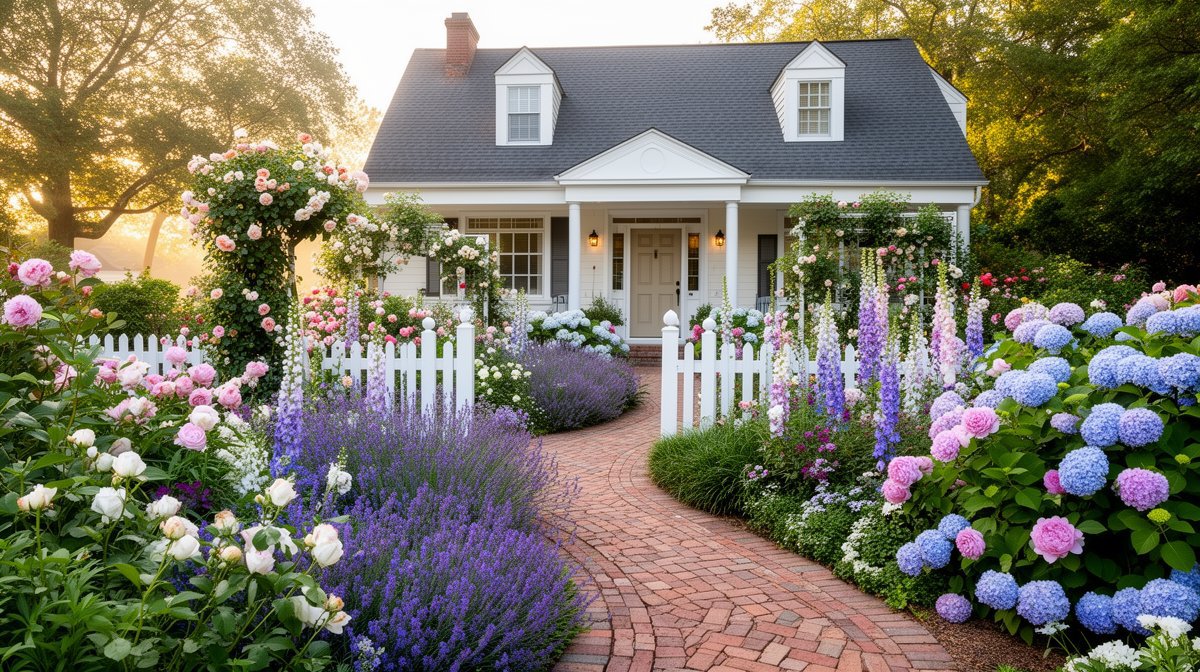
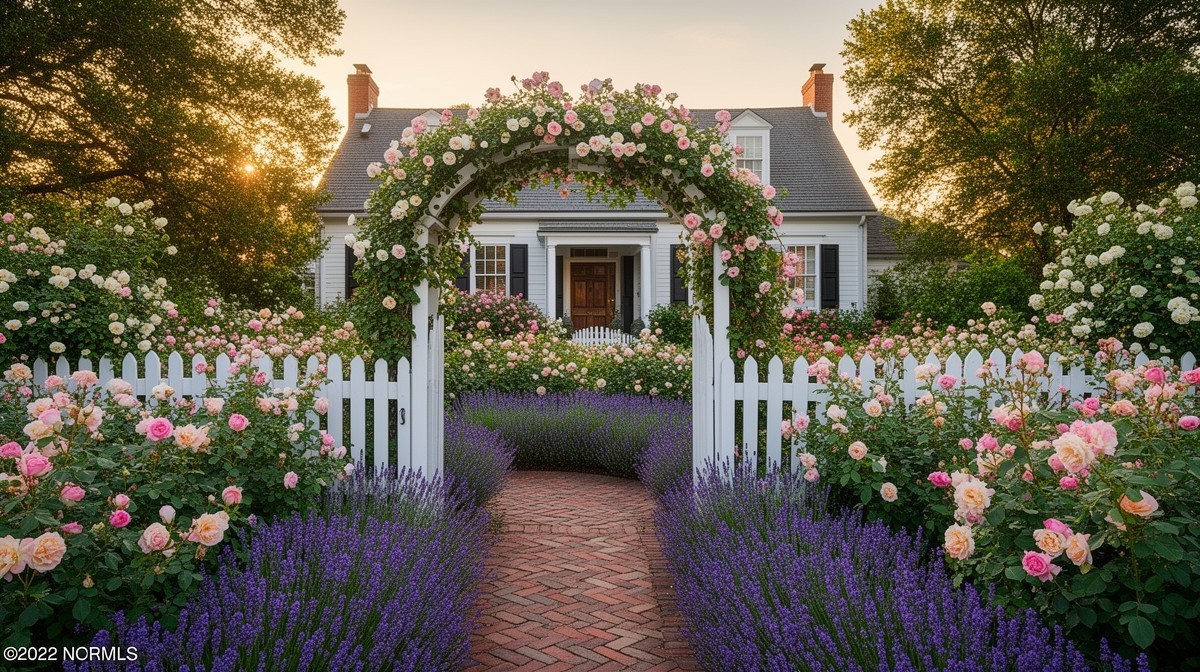
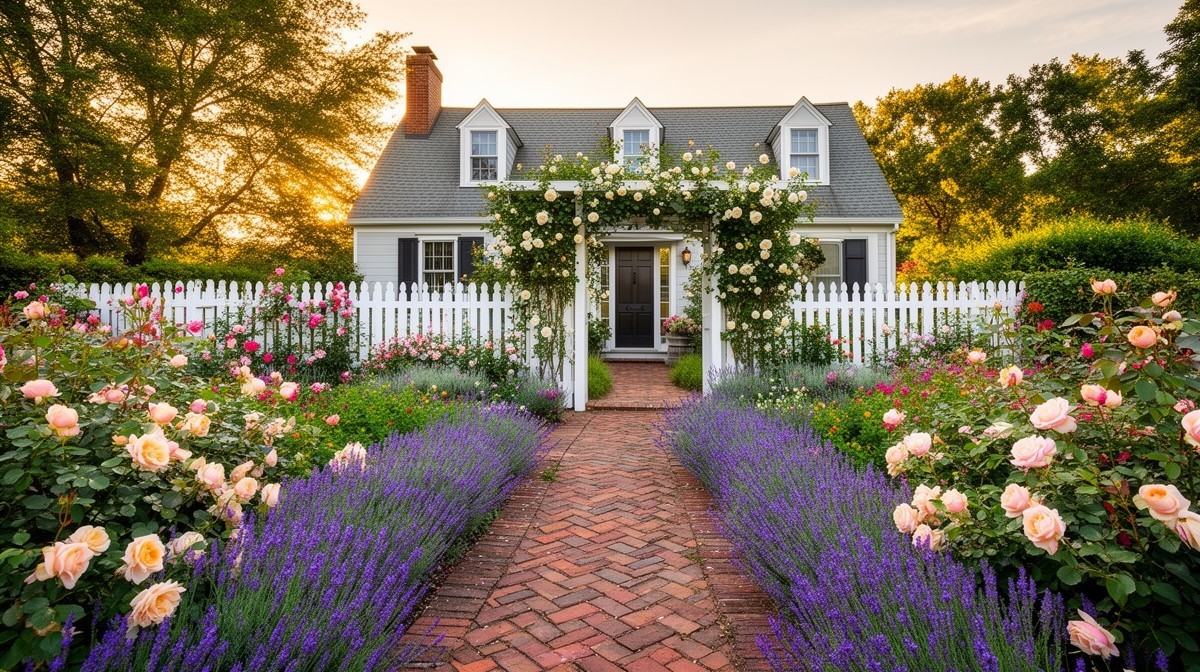
$14–26/sqftA pale-yellow shingled Cape with a taupe front door sits behind a low white picket fence, and the whole design turns on one gesture: a heavy timber arbor set over the gate, buried under blush and cream climbing roses that spill onto the fence rails on both sides. A serpentine brick paver path leaves the gate, swings once, and lands on three brick steps at the door — the curve is what keeps it from feeling suburban. Broad, unclipped mounds of lavender flank the brick on both sides at knee height, so you walk through fragrance before you reach the porch, and taller shrub roses in pink and white fill the corners against the shingles. Lanterns either side of the door and a single potted rose on the step finish it.

The Front Porch Border
$10–20/sqftA two-story cream house with a deep, full-width white porch — rocking chairs, hanging flower baskets, a lantern by the door — fronted by an irregular flagstone path that curves lazily from the public sidewalk to the porch steps. To the left, a slim white-painted arbor and matching picket gate smothered in white climbing roses mark the side yard entrance. The planting is the point: a continuous mixed border wraps the porch and the lawn edge, layered from low white and orange annual color at the front through purple salvia and blue veronica spikes in the middle to yellow coneflowers and taller perennials at the back. A mature shade tree stands in the lawn on the right inside a clean mulch ring, its border of purple and yellow flowers running out beneath the canopy toward the street.

The Bistro Terrace Under Roses
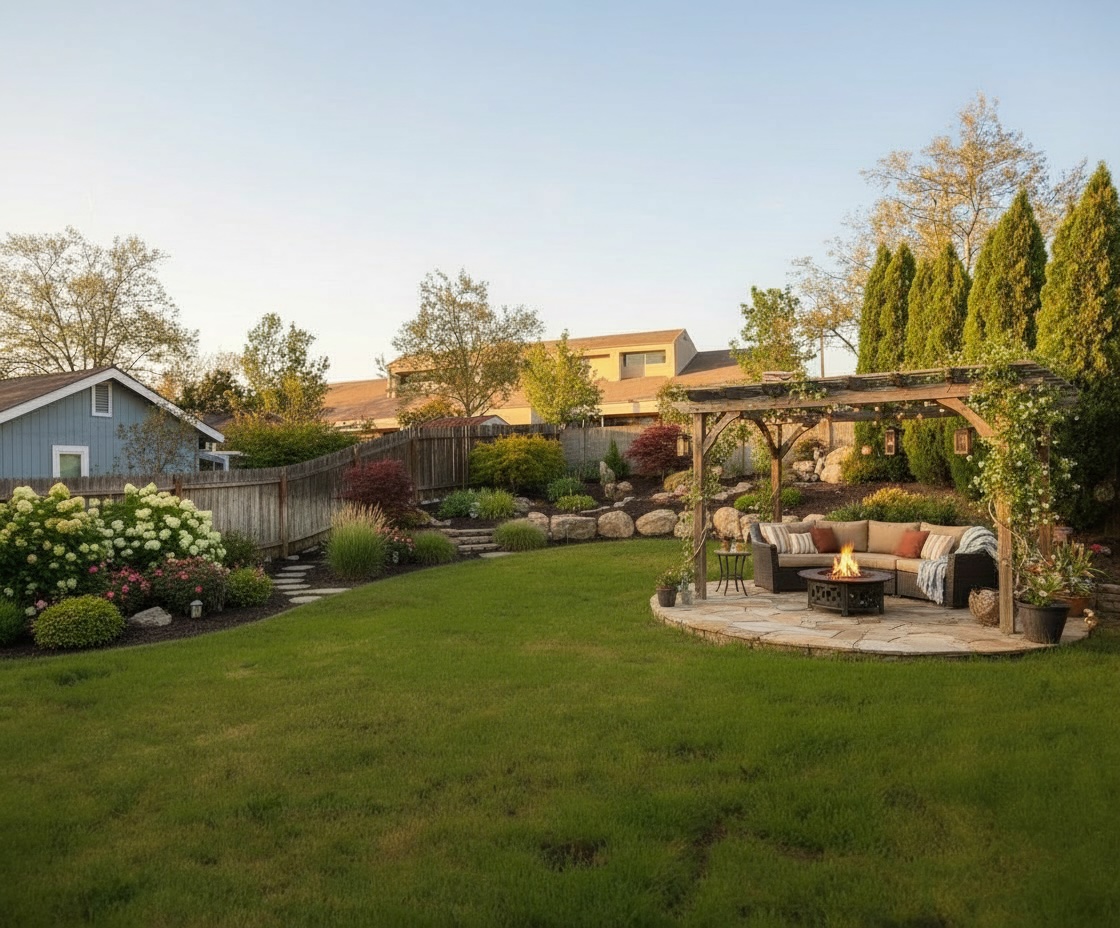
$22–40/sqftThe back of a cream two-story with green shutters, seen across a wide sweep of lawn. A white lattice arbor stands free in the garden, completely covered in cream and blush climbing roses, and just inside it a small square terrace of pale granite pavers sits one riser above the grass — room for a round bistro table, two scrolled metal chairs, and a jug of cut roses. Deep lavender borders wrap three sides of the terrace so the seating feels sunk into planting rather than dropped on the lawn, and behind them go tall pink foxglove spires, shrub roses and low clipped hedging that carries the eye back toward the house. A big deciduous shade tree on the left keeps the whole scene out of the worst of the August sun.

The Pergola and Fountain Garden
$18–34/sqftA compact back garden that does two jobs at once. On the left, a white-painted pergola over a small paved dining terrace holds a teak table and four cushioned chairs, with pink climbing roses running the beams and a tall clipped green screen closing the space behind it against the board fence. On the right, a two-tier cast stone fountain sits as the focal point inside a curved island bed of mixed yellow, orange, white and purple flowers, so the sound reaches the table across the lawn. Blush shrub roses and lavender fill the foreground borders, a climbing rose is trained flat on the house wall, and a simple oval of lawn is left in the middle to hold the two halves apart.
See how a cottage/english garden looks on YOUR property
Upload a photo of your Hampton yard and visualize your dream garden in seconds.
Try ProScapeAI Free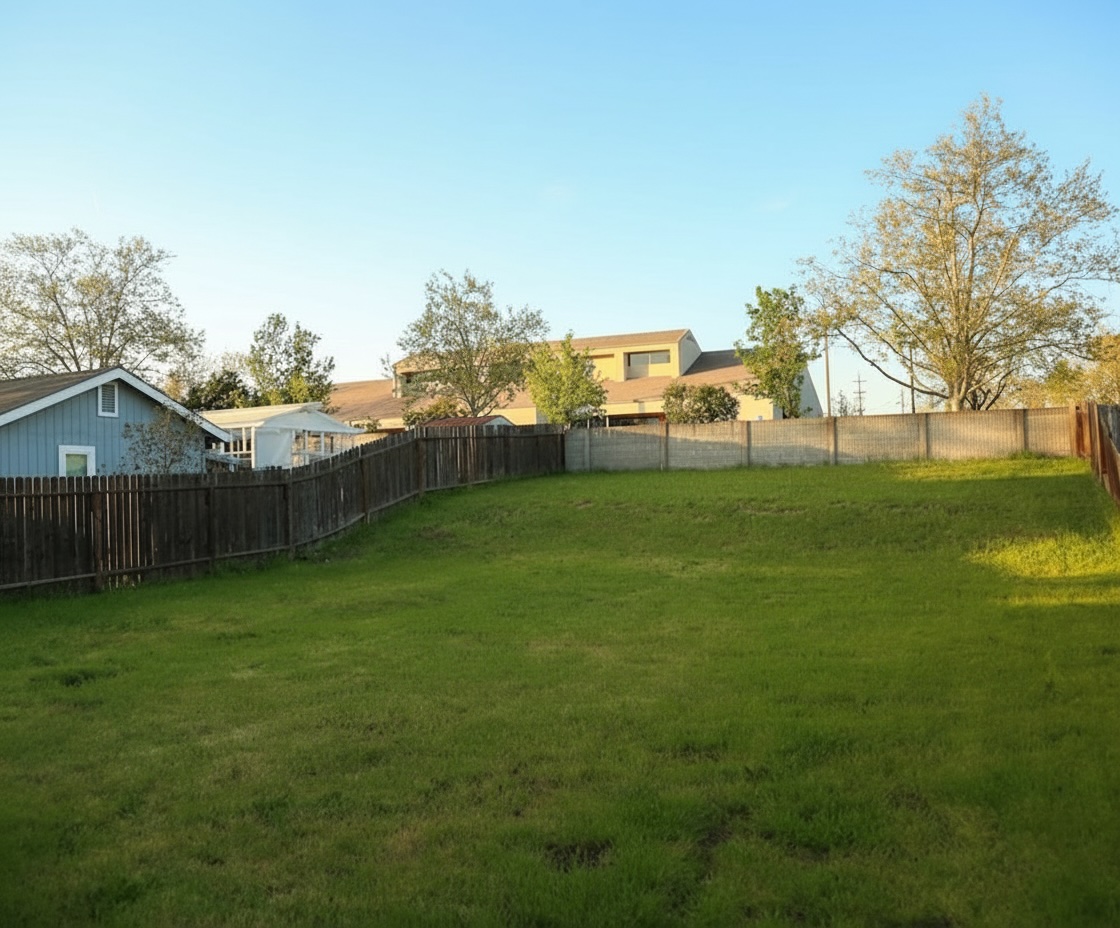
Featured Flowers & Perennials for Cottage/English Gardens
Browse all 150 plants for Hampton
Water Lettuce
Pistia stratiotes
low-growing ground cover, white blooms in summer. Evergreen year-round.

Tussock Sedge
Carex stricta
low-growing ground cover, blooms in spring. Brown fall color.

Umbrella Sedge
Cyperus alternifolius
grows to 4 feet, blooms in summer. Evergreen year-round.
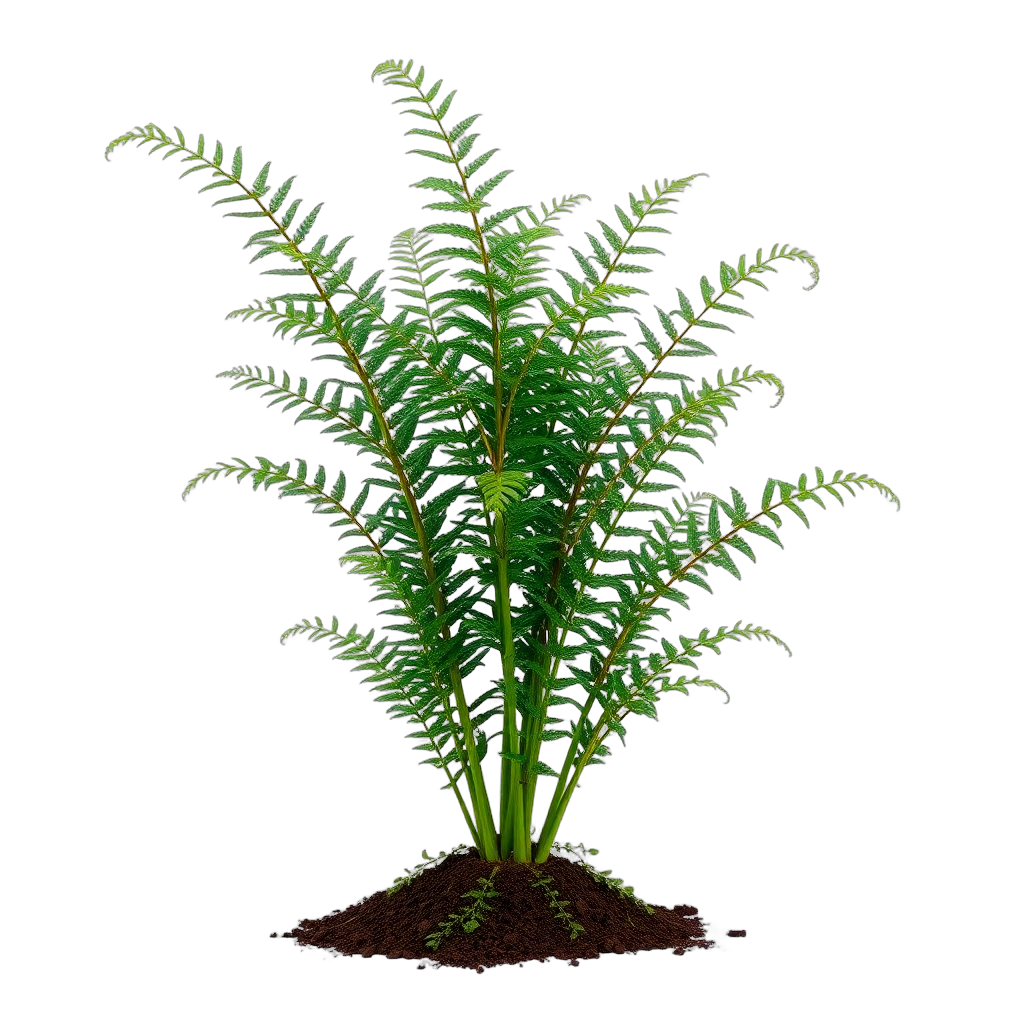
Deer Fern
Blechnum spicant
low-growing ground cover, blooms in none. Evergreen year-round.
Zone and sun checks come from our database — confirm with your local nursery before you buy.
Bloom Calendar for Hampton
spring
Tussock Sedge, Austrian Speedwell, Bigroot Geraniumsummer
Water Lettuce, Umbrella Sedge, Alpine Sea Hollyfall
Autumn Snakerootwinter
Limited bloomsDesign Tips for Hampton (Zone 8a)
- Build every border up, not down — Hampton's sandy loam over clay plus 47 inches of rain drowns crowns at grade; six to ten inches of raised, pine-fines-amended soil is the difference between Lavandula × intermedia 'Phenomenal' thriving and rotting in its second October
- Pick cultivars for humidity before colour: Phlox paniculata 'David' instead of an unnamed garden phlox, Rosa 'New Dawn' instead of a hybrid tea, Monarda 'Jacob Cline' instead of the old mildew-prone bee balms — a July dew point in the 70s will find every weak plant in the border
- Space for airflow, not for coverage. Plant roses three feet clear on all sides and resist the urge to fill the gaps in year one; the tight, shoulder-to-shoulder look of an English border is what turns Hampton's humidity into blackspot by August
- Use salt-proof plants on any lot within a few blocks of the Hampton River, Back River or the Chesapeake Bay — Rosa rugosa, Morella cerifera, Hibiscus moscheutos and Ilex vomitoria 'Nana' handle the spray that burns Hydrangea macrophylla and Buxus foliage brown along the windward side
- Design the low corner of the yard as a planted basin rather than a problem. Hampton floods from rain as much as from tide, and a sunken cottage border of Itea virginica 'Henry's Garnet', Iris versicolor and Panicum virgatum 'Shenandoah' absorbs a downpour while reading as pure flower garden
- Plant in October, not May. A 230-day growing season and mild winters mean roots run all through a Hampton winter, so autumn-planted borders skip the daily watering that a June planting demands through the first summer
- Anchor the romance with something evergreen and clipped — a short run of Buxus 'Green Velvet', a pair of Ilex crenata 'Soft Touch' mounds at the gate — so the garden still has a shape in February when the Digitalis and Nepeta are gone
Where to Source Plants in Hampton
Skip the big-box stores. These independent Hampton nurseries specialize in the plants that make cottage/english gardens thrive in Zone 8a.
Ken Matthews Garden Center
Grafton / Yorktown, about 12 miles from Hampton
Long-running independent Peninsula garden center with deep perennial, shrub and rose stock chosen for Zone 8a coastal conditions
Anderson's Garden Center
Denbigh / Jefferson Avenue, Newport News
Family-owned since 1954; large greenhouse with annuals, perennials, roses and container plants, plus a boutique and on-site kitchen
Forest Lane Botanicals
Northern York County, near Williamsburg
Virginia certified specialty nursery growing cultivated and native perennials and shrubs on five acres, with mature display gardens — the place to find uncommon cottage border plants
Homestead Garden Center
Rochambeau Drive, Williamsburg
Independent flower and garden supply center with strong perennial, tree and shrub availability lists published through the season
Cottage/English Landscaping Costs in Hampton
| Project Scope | Estimated Cost |
|---|---|
| Front-yard cottage border conversion (bed shaping, soil, 60–90 plants) | $7,000 – $16,000 |
| Brick or flagstone entry walk (60–120 sqft, curved) | $2,800 – $7,500 |
| Painted picket fence and gate (100 linear ft, installed) | $3,500 – $8,000 |
| Cedar or timber rose arbor over a gate | $1,200 – $3,500 |
| Back garden terrace with pergola, fountain and wrapping borders | $18,000 – $45,000 |
| Rain garden / bioretention border on the low side of the lot | $3,000 – $9,000 |
| AI visualization with ProScapeAI | Free to start |
Estimates based on Hampton, VA-area contractor rates as of 2026. Actual costs vary by site conditions, materials, and contractor.
Hampton Climate & Growing Zone
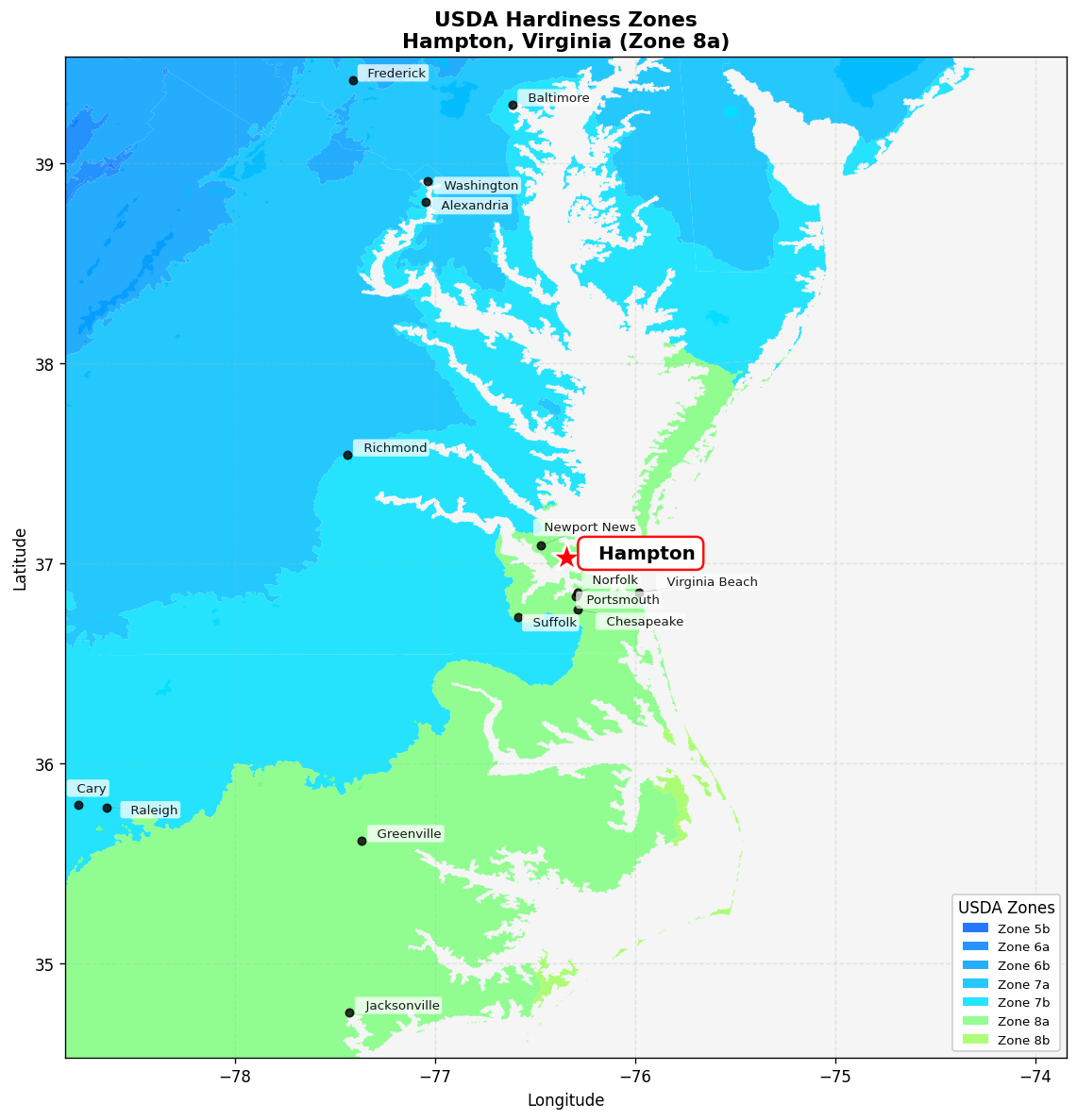
USDA Zone 8a
Hardiness zone for Hampton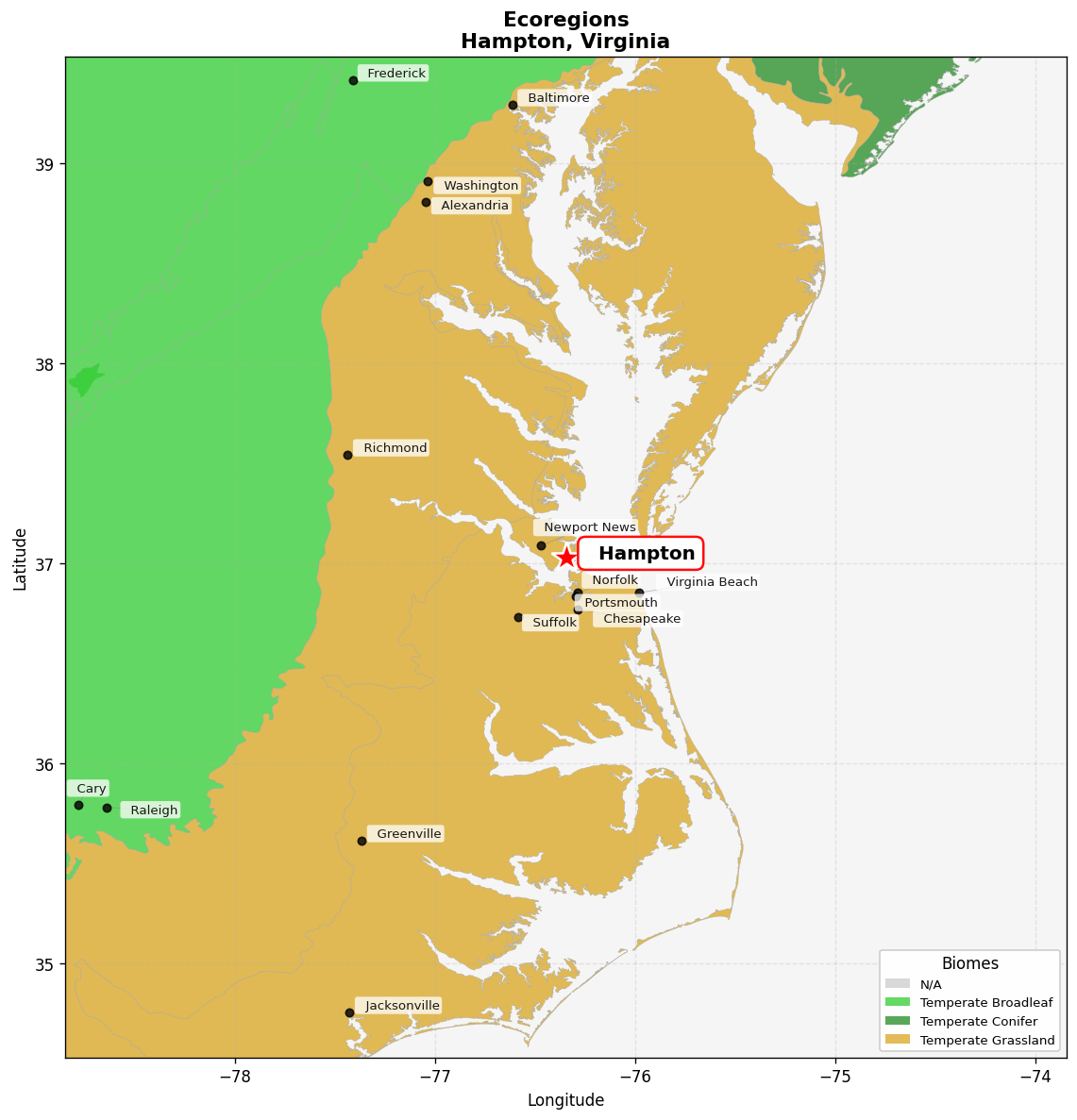
Mid-Atlantic US coastal savannas
Native ecoregionFrequently Asked Questions
How much does a cottage garden cost in Hampton, VA?
Hampton Roads installation pricing runs roughly 10–20% below the national metro average, which makes cottage planting unusually affordable here because the style is plant-heavy and hardscape-light. A full front-yard cottage conversion on a typical 500 sqft frontage — bed shaping, soil amendment, 60 to 90 perennials and shrubs, a picket fence and a brick or flagstone walk — lands at $7,000–16,000 installed. A timber or cedar rose arbor over a gate is $1,200–3,500 depending on span and finish. A small back terrace with a bistro set and wrapping lavender borders runs $6,000–14,000. Planting only, with the homeowner doing the fence and path, can come in under $9/sqft.
Which roses actually survive Hampton's humidity and salt air?
Choose for disease resistance first, colour second — blackspot is the single biggest reason cottage gardens fail on the Peninsula. Rosa 'New Dawn' and Rosa 'Zephirine Drouhin' are the two climbers that hold their leaves through a Hampton August, and Rosa 'Eden' and Rosa 'A Shropshire Lad' are close behind on an arbor with good air movement. For shrubs, Rosa 'Bonica', Rosa 'Iceberg', Rosa 'Olivia Rose Austin' and the Knock Out group all perform. If you are within a few blocks of the water in Grandview, Fox Hill or along Chesapeake Avenue, add Rosa rugosa — it is the one rose that treats salt spray as a non-event. Give every rose at least six hours of sun and three feet of air on all sides; crowding is what turns humidity into disease.
Can I really grow lavender in Hampton with 47 inches of rain?
Yes, if you treat it as a drainage problem rather than a watering one. Lavandula × intermedia 'Phenomenal' was selected specifically for humid Southeastern summers and is the safest choice; Lavandula angustifolia 'Munstead' and 'Hidcote' work in a raised, sunny, breezy spot. Plant on a berm or in a border built six to ten inches above grade, mix a third coarse sand or expanded slate into Hampton's sandy loam, and mulch with pea gravel rather than bark right at the crown — bark holds moisture against the stem and causes the rot most people blame on cold. Never irrigate an established plant, prune by a third right after the first flush in late June, and skip the fall haircut.
Do Chesapeake Bay Preservation Area rules affect my landscaping?
They can, and on Hampton's waterfront lots they usually do. The Chesapeake Bay Preservation Act, which Hampton enforces through its own ordinance, establishes a 100-foot Resource Protection Area buffer landward of tidal shores, tidal wetlands and perennial streams — so lots along the Hampton River, Back River, Newmarket Creek and Salters Creek are commonly affected. Planting inside the buffer is encouraged; clearing, grading and adding impervious surface are what trigger review. Cottage design fits the rules naturally, since a deep layered border of Itea virginica 'Henry's Garnet', Hibiscus moscheutos, Iris versicolor and Panicum virgatum 'Shenandoah' is precisely the vegetated buffer the ordinance is asking for. Confirm your own line with the city before you move soil near the water.
When is the best time to plant a cottage garden in Hampton?
Mid-October through early December is the best window on the Peninsula. Soil stays warm into November while air temperatures drop, so roots establish all winter and the border hits its first May already settled. The second window is late March into April, after the average last frost in the final week of March. Avoid planting perennials from late June through August: with July highs near 88°F and heavy dew points, new plants transpire faster than a young root system can supply, and you will water daily for six weeks. Bulbs and Digitalis purpurea go in October; bare-root roses go in from late February to mid-March.
How should I prepare Hampton's sandy coastal-plain soil?
Hampton's Bojac and Munden sandy loams drain fast in the top eight inches, then hit a slower clay subsoil, and the water table is often only three to five feet down. Do not dig deep planting pits — they fill and hold water. Build beds up six to ten inches instead, working two to three inches of composted pine fines through the top layer to add the organic matter and cation exchange that sand lacks. Get a soil test through the Virginia Cooperative Extension office in Hampton before you lime: coastal-plain sand commonly runs pH 5.2–5.8, which suits Hydrangea macrophylla and Itea virginica but leaves Lavandula and Buxus 'Green Velvet' wanting a sweeter target near 6.5, so lime those beds selectively rather than the whole yard.
What is the most reliable evergreen structure for a Hampton cottage garden?
Boxwood blight has made Buxus a calculated risk in Tidewater, so use it in short, well-spaced runs rather than long unbroken hedges, and choose the more resistant Buxus 'Green Velvet' or Buxus microphylla 'Winter Gem' over old English boxwood. The safer backbone plants here are Ilex vomitoria 'Nana', which is native to the coastal plain and utterly indifferent to salt, Ilex crenata 'Soft Touch', Morella cerifera for a fast informal screen, and Ilex × 'Nellie R. Stevens' where you need a 12-foot evergreen wall against a neighbouring fence. All four hold their form through Zone 8a winters and give the flower borders something to lean on in February.