4 Desert Garden Ideas for Cape Coral, FL | Xeriscape Landscape Design for Zone 10a
Native plants from the Southeast US conifer savannas (Zone 10a) — Tropical savanna climate
Why Desert/Xeriscape Gardens in Cape Coral?
Let's start with the honest part. Cape Coral receives roughly 54 inches of rain a year, and more than 30 of those inches fall between June and September — the wettest four months here are wetter than an entire year in Tucson. On top of that, the seasonal water table on many Cape Coral lots rises to within one to three feet of the surface during the wet season, especially near the city's 400-plus miles of canals. That combination is fatal to the plants most people picture when they hear 'desert garden.' Agave americana, Agave parryi, Dasylirion wheeleri, Echinocactus grusonii, ocotillo and most Echeveria will rot out within one to three summers if you plant them at grade in Cape Coral, and the survivors that limp through get finished off by the agave snout weevil, which is endemic in Southwest Florida. Anyone who tells you otherwise has not watched an August here.
And yet xeriscape genuinely works in Cape Coral — because the water problem is a drainage problem, and drainage is buildable. The single technique that makes the whole style viable is the raised mineral berm: 12 to 18 inches of coarse washed sand or #89 limerock screenings mounded above the existing grade, every rosette set proud of the berm shoulder, and a three-inch collar of 3/8-inch shell or river rock held two inches clear of each stem. No organic mulch against crowns, no drip emitter under a succulent, and never site these beds in the low point where a Cape Coral lot swales toward the street or the seawall — you want sheet flow to run past the berm, not into it. Then choose plants that are drought-adapted and humidity-proof. Florida has its own dry-land flora and it is excellent: Opuntia stricta and Opuntia humifusa grow wild in Lee County scrub, Zamia integrifolia and Serenoa repens 'Cinerea' survive on rainfall alone, and Yucca aloifolia is a genuine Florida native yucca that thrives in the same sand that kills its western cousins.
The payoff is not water cost — Cape Coral's dual-water system already delivers cheap canal-sourced irrigation on a two-day-a-week schedule with a 9 a.m. to 5 p.m. ban. The payoff is everything else: no 40-week mowing season, no southern chinch bug destroying Floratam every August, no scrambling around Lee County's June 1 – September 30 fertilizer blackout, and far less to lose in a 150 mph design-wind event like Hurricane Ian. Low, deep-rooted, mineral-mulched plantings simply do not break.
4 Desert/Xeriscape Design Ideas for Cape Coral
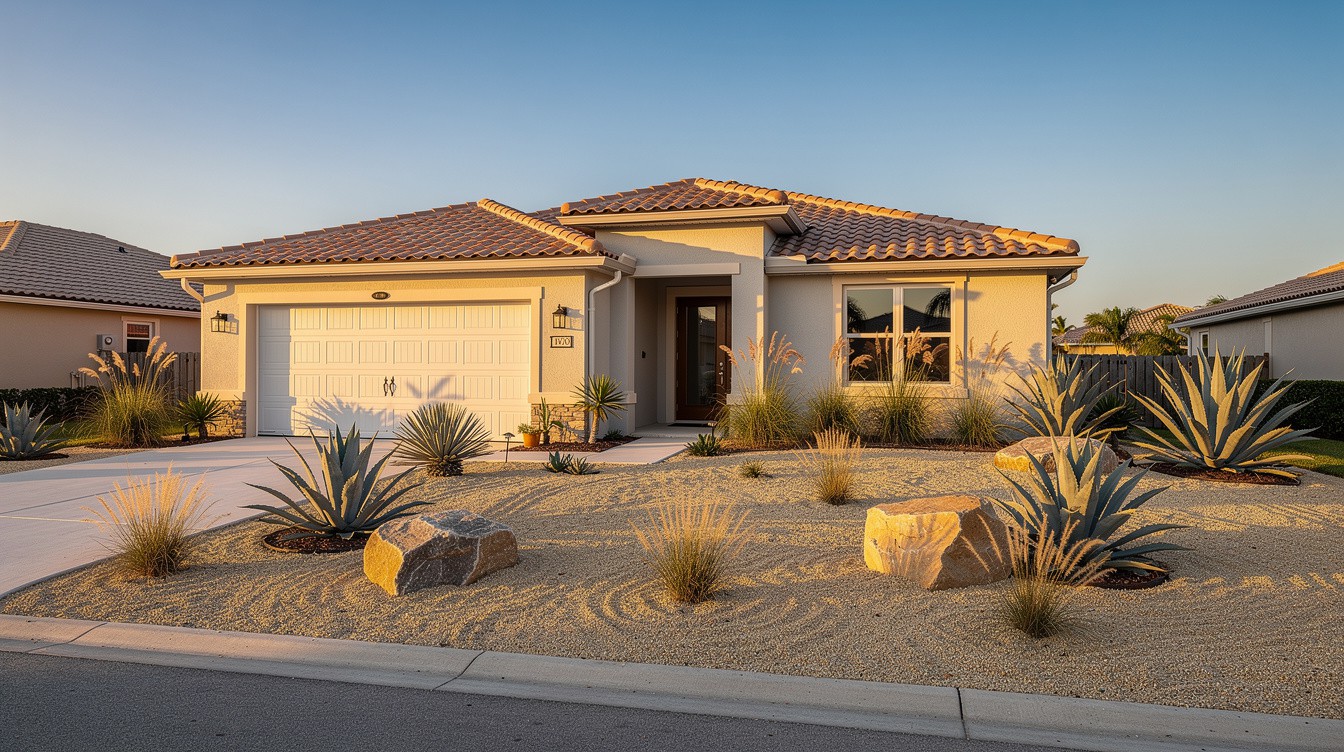
The Raked Shell Court
$7–14/sqftA cream stucco ranch with a barrel-tile roof and a two-car garage, its entire front yard converted to a pale tan shell-and-gravel court raked into shallow concentric arcs that catch the low golden light. The planting is deliberately sparse and asymmetric: six or seven blue-green agave rosettes set individually into dark mineral pockets, three weathered limestone boulders placed as visual anchors, and tall silver-plumed bunch grasses run along the foundation to break the flat wall. Everything sits on a low, barely perceptible berm — the mound is what keeps the rosettes alive through August, and the raked pattern is what makes an inexpensive material look intentional.
The Prickly Pear Rubble Border
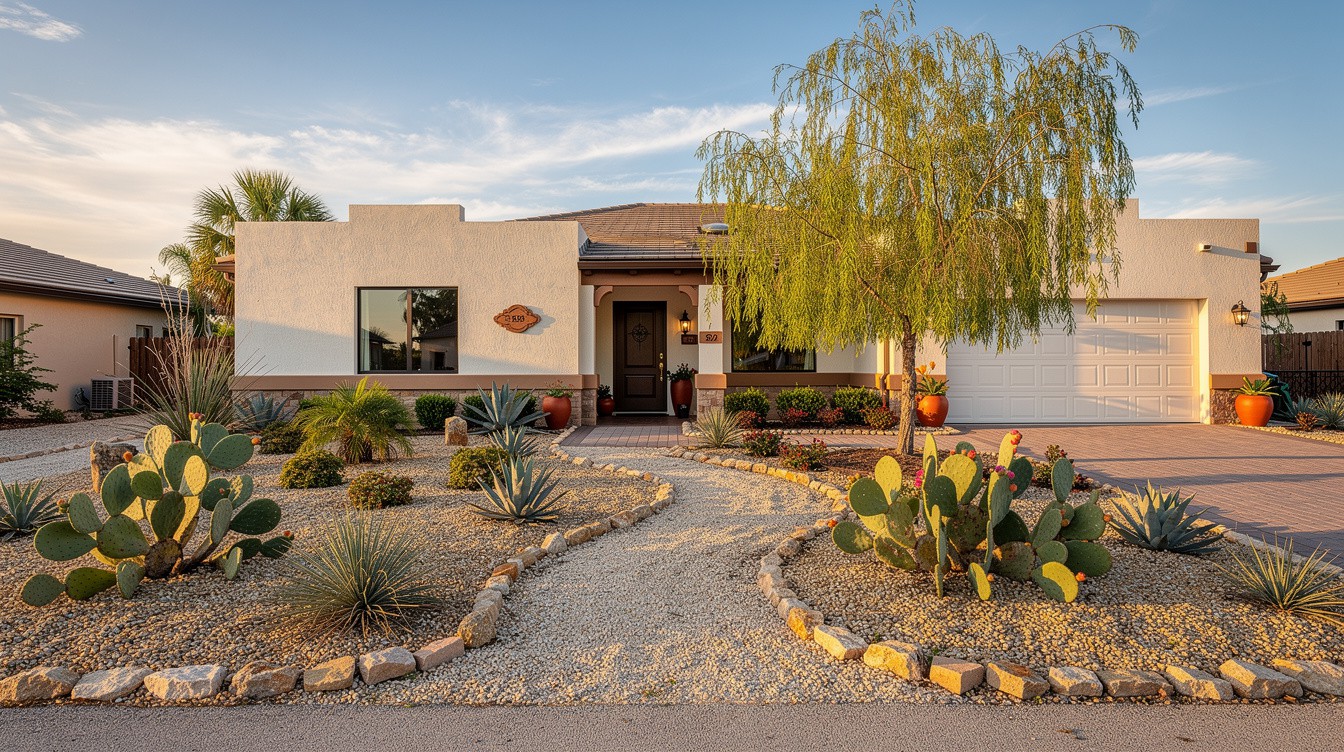
$9–17/sqftA pueblo-profile stucco home with a parapet wall and a paver drive, with the front yard divided into two rock fields of slightly different color and grade, separated by a sinuous border of stacked limestone rubble. The rubble edge is doing real work: it holds each planting area 10 to 14 inches above the surrounding grade so water sheets between the beds instead of standing in them. Broad clumps of native prickly pear with pink fruit sit at the outer corners, agaves and blue-green yuccas fill the middle ground, and a weeping silver trumpet tree with chartreuse foliage arches over the entry — a genuinely drought-deciduous Florida-proven tree doing the job a palo verde would do out west. Terracotta glazed pots at the door supply the only saturated color.
The Agave Fire Court
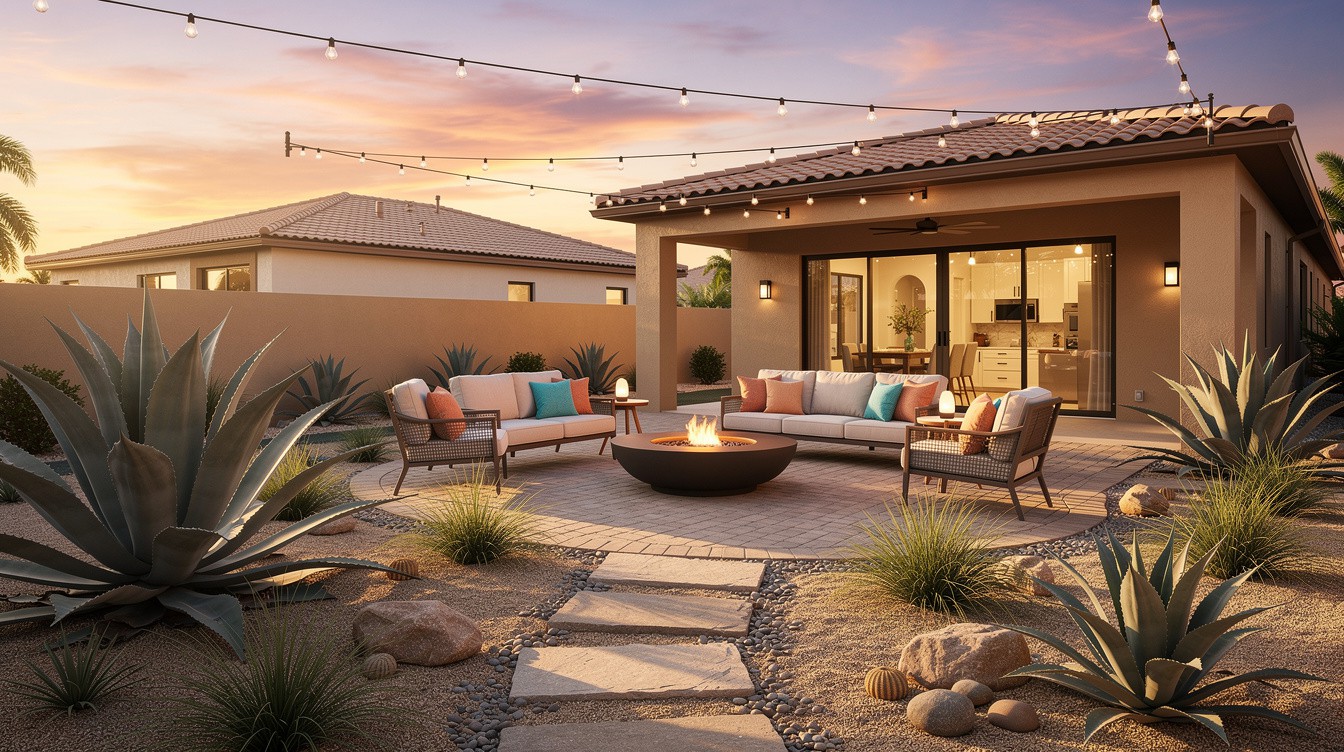
$16–32/sqftA circular paver patio in warm buff tones holding a low round steel fire bowl, ringed by woven-and-aluminum sofas dressed in coral and turquoise cushions, with café string lights arcing overhead from a tan stucco privacy wall to the lanai roof. What makes the space is what happens outside the paving: enormous silver-blue agave rosettes at the corners, planted on built-up gravel mounds so they sit slightly above the patio plane and read at eye level from a seated position. Irregular flagstone stepping pads float through ribbons of river cobble that double as a drainage channel, moving wet-season runoff around the seating area rather than through it, and small bunch grasses fill the gaps between boulders.
The Boulder Cascade Lagoon
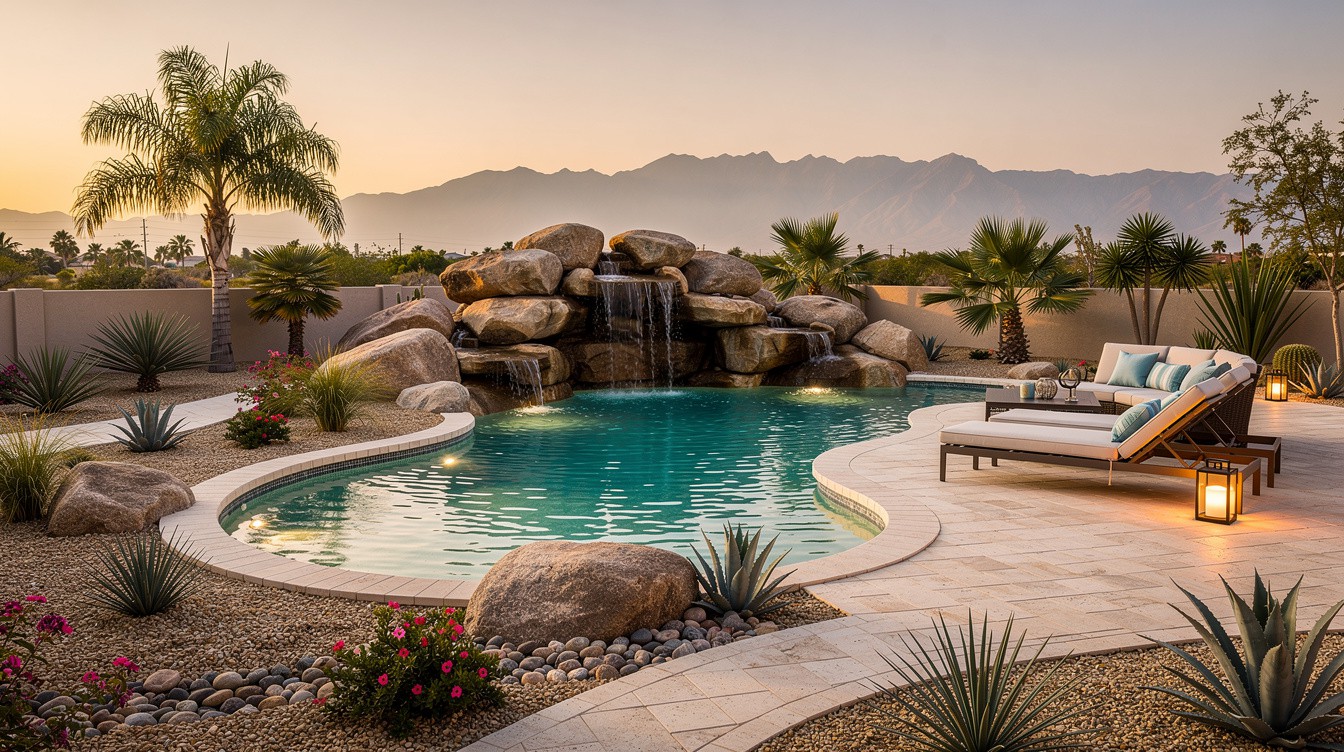
$50–100/sqft (pool and rock feature inclusive)A freeform lagoon-shaped pool with a multi-tier boulder cascade at its head, travertine decking sweeping around one side to a pair of chaise lounges, and gravel-and-cobble beds threaded with agaves, fan palms and low bougainvillea. One honest translation note: Cape Coral is flat and has no mountain horizon, so the version built here puts the same cascade against a seawall and canal view or a stuccoed privacy wall, and the rock mound is trucked and stacked rather than found — budget 20 to 40 tons of Florida limestone or imported fieldstone plus crane or skid-steer placement. Because a waterfall recirculates, the water feature adds almost nothing to consumption; the whole composition still lives on well under a quarter of a turf yard's irrigation.
See how a desert/xeriscape garden looks on YOUR property
Upload a photo of your Cape Coral yard and visualize your dream garden in seconds.
Try ProScapeAI Free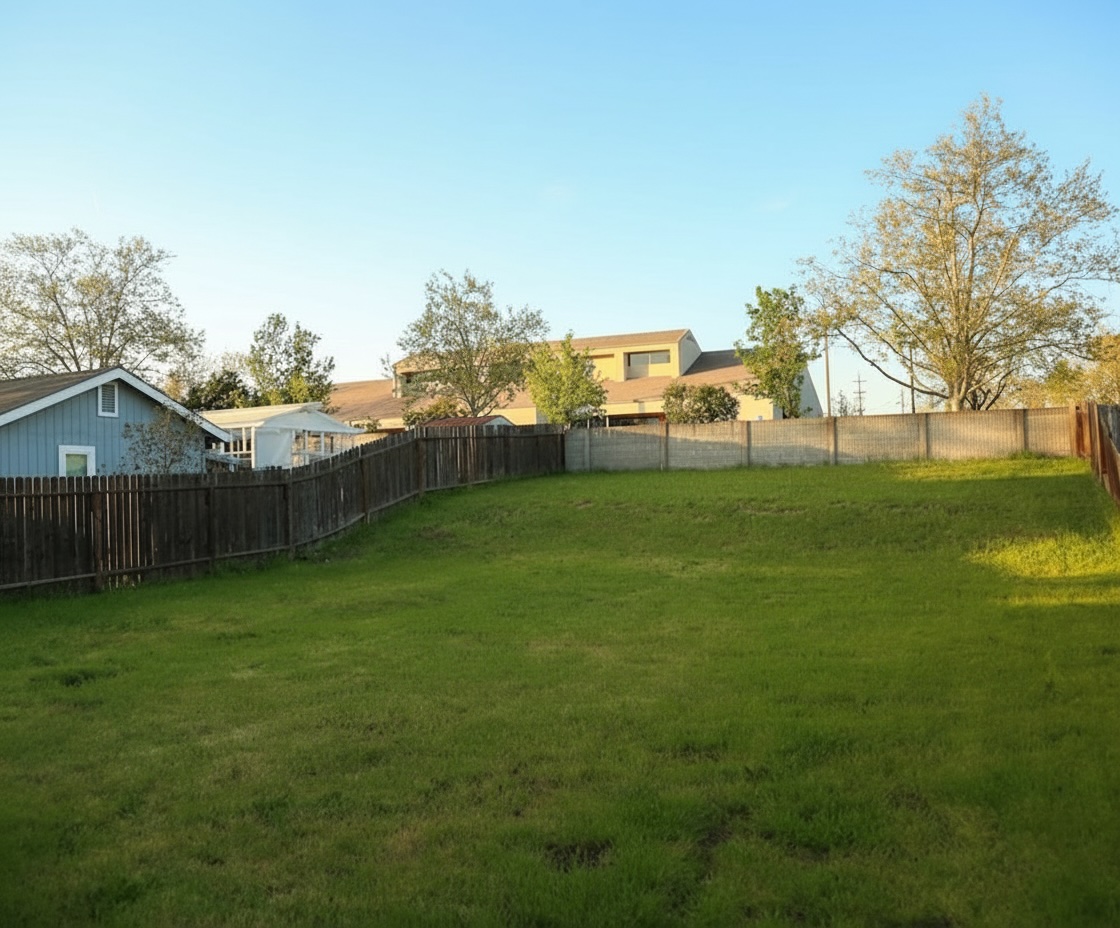
Featured Trees & Shrubs for Desert/Xeriscape Gardens
Browse all 65 plants for Cape Coral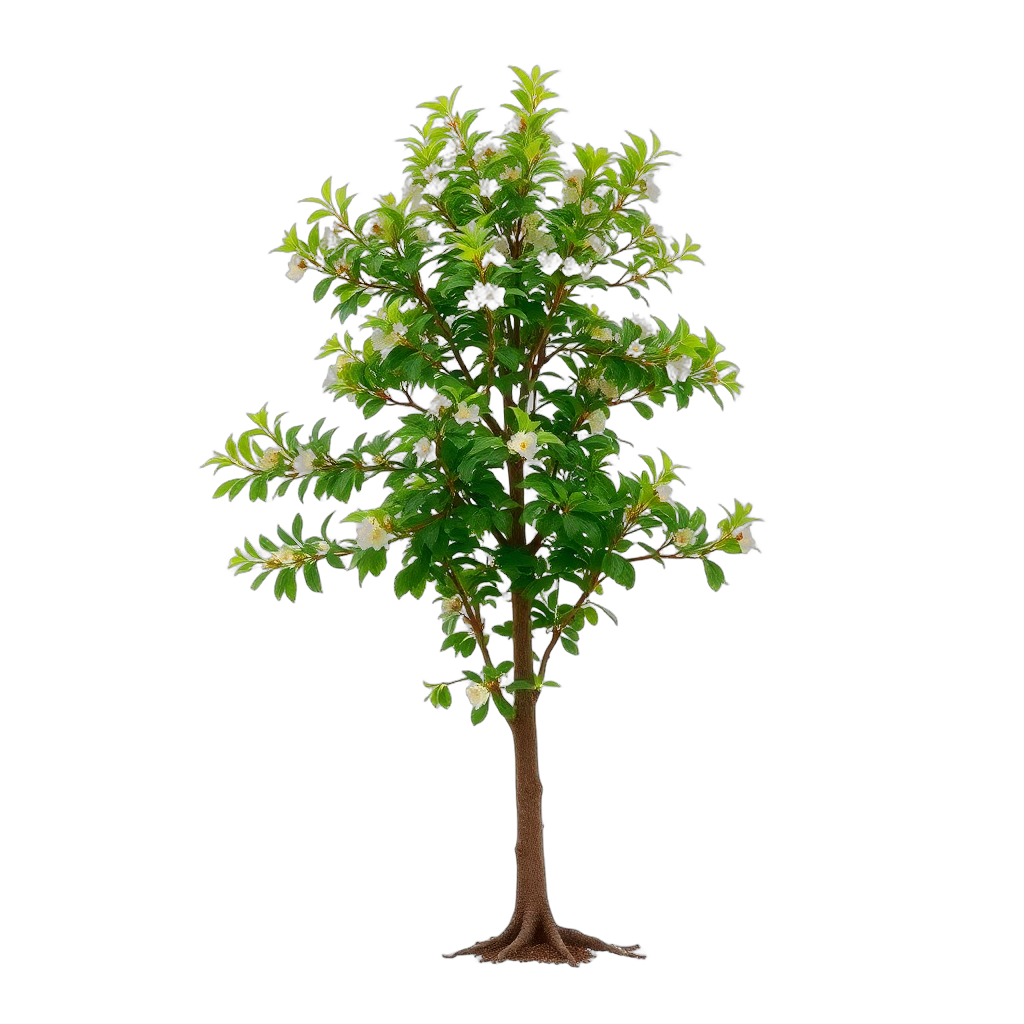
Buckwheat Tree
Cliftonia monophylla
medium-sized at 15 feet, white blooms in spring. Attracts butterflies.
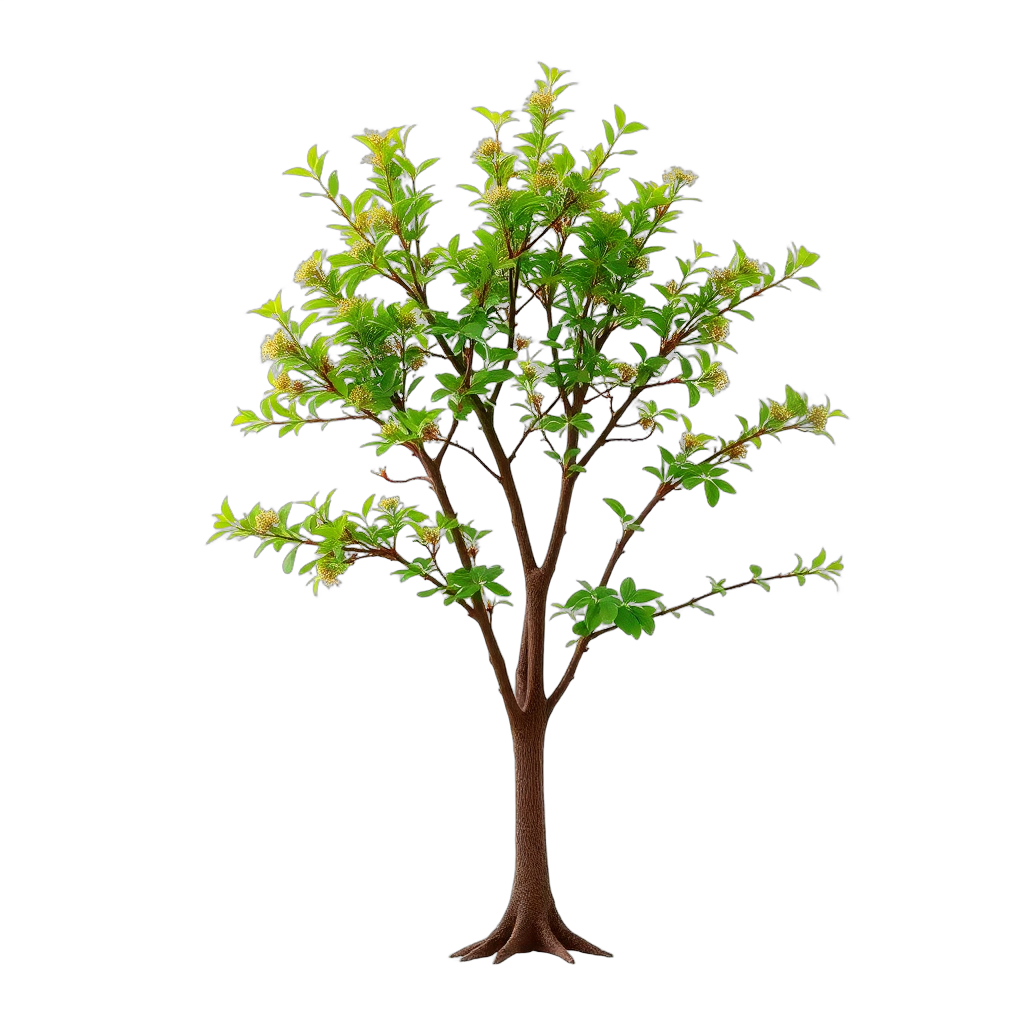
Fetterbush
Lyonia lucida
grows to 6 feet, white blooms in spring. Evergreen year-round.
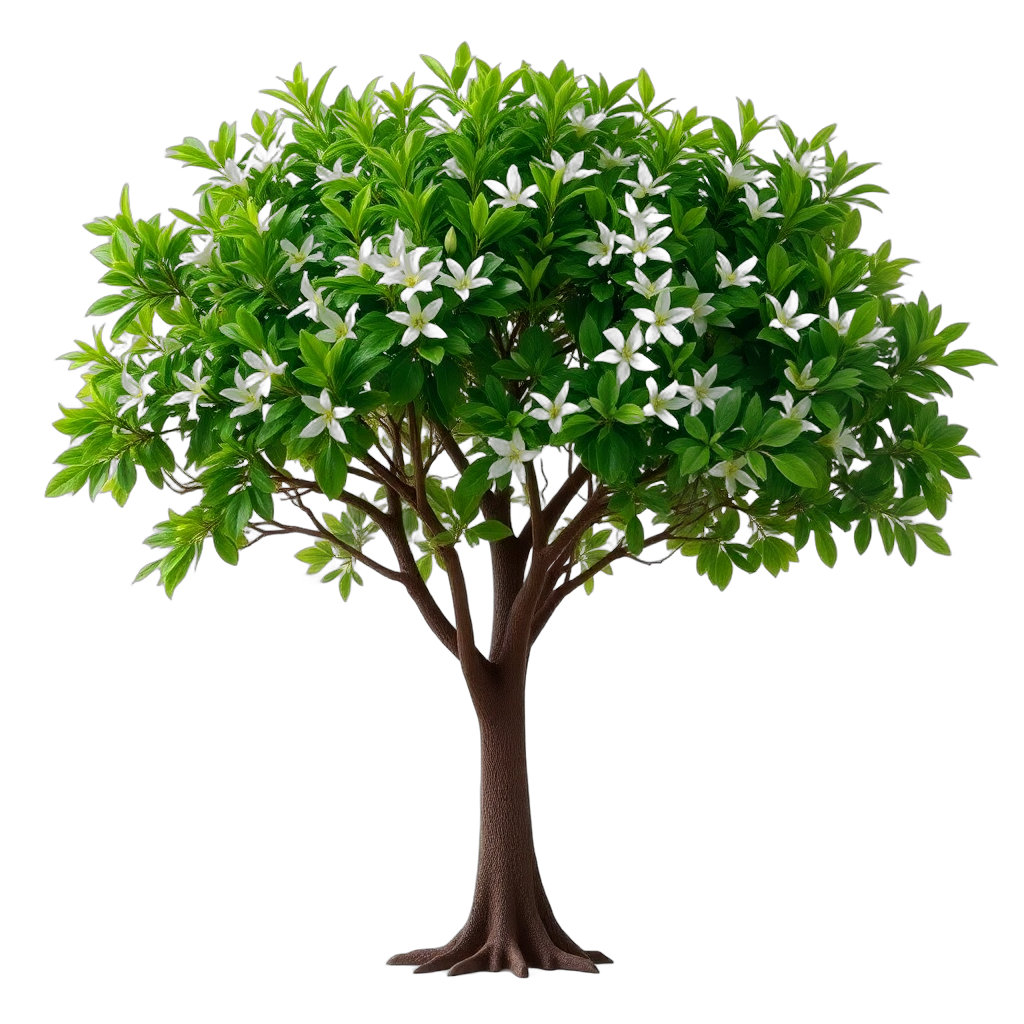
Florida Anise
Illicium floridanum
medium-sized at 8 feet, red blooms in spring. Evergreen year-round.

Inkberry
Ilex glabra
medium-sized at 8 feet, white blooms in spring. Pollinator-friendly.
Featured Grasses & Groundcovers for Desert/Xeriscape Gardens

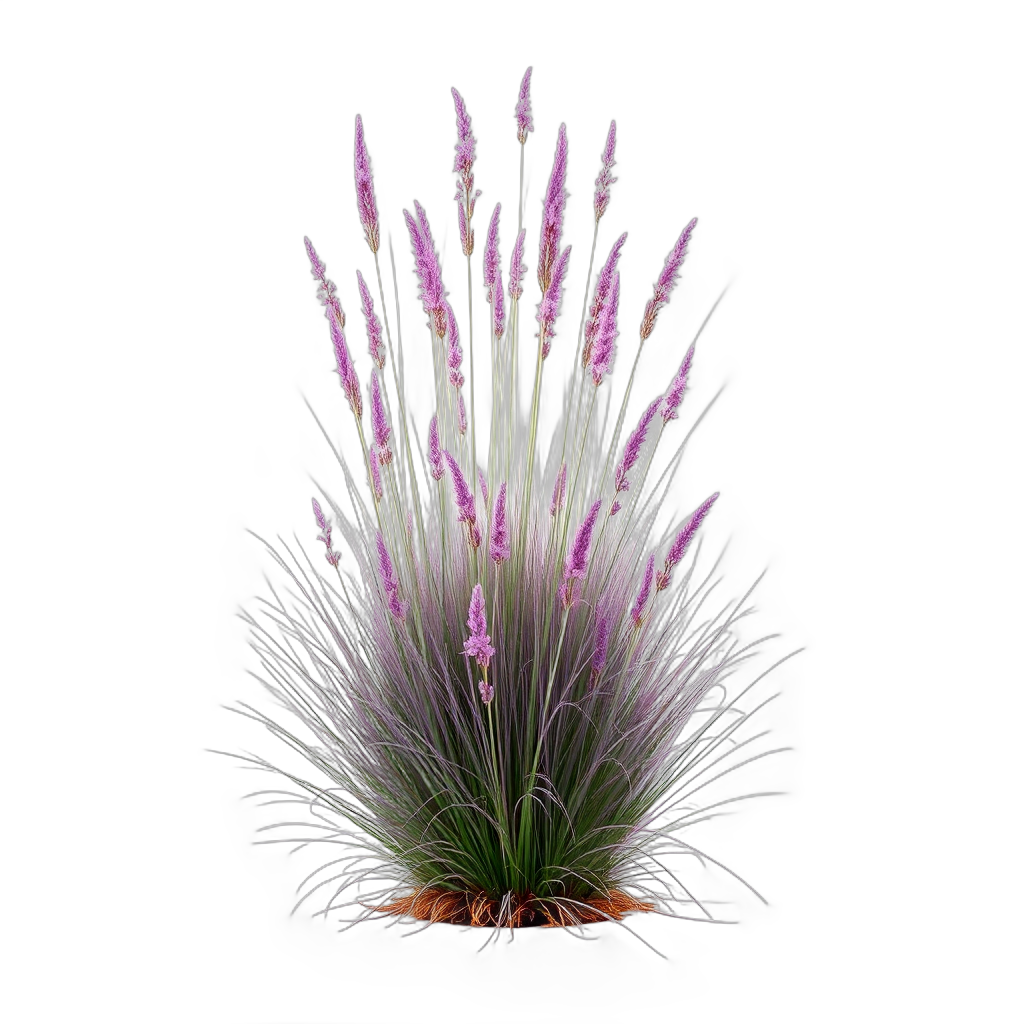
Pink Muhly Grass
Muhlenbergia capillaris
grows to 3 feet, pink blooms in fall.
Purple Love Grass
Eragrostis spectabilis
low-growing ground cover, purple blooms in fall. Orange fall color.

Bermuda Grass
Cynodon dactylon
low-growing ground cover, blooms in summer. Brown fall color.
Featured Flowers & Perennials for Desert/Xeriscape Gardens
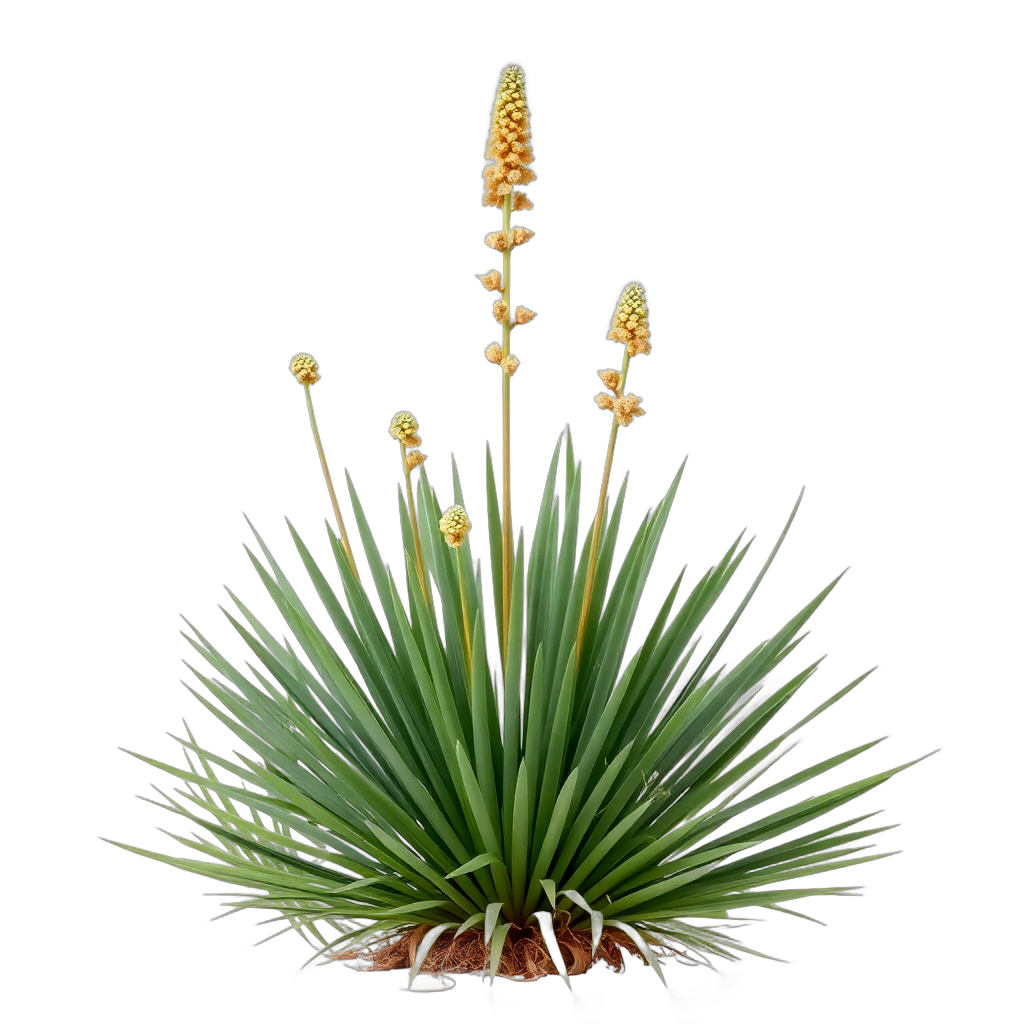
Adam's Needle
Yucca filamentosa
low-growing ground cover, white blooms in summer. Attracts hummingbirds.

Broadleaf Arrowhead
Sagittaria latifolia
low-growing ground cover, white blooms in summer. Attracts butterflies.

Canadian Waterweed
Elodea canadensis
grows to 3 feet, white blooms in spring. Evergreen year-round.

Common Cattail
Typha latifolia
grows to 5 feet, blooms in summer. Pollinator-friendly.
Bloom Calendar for Cape Coral
spring
Buckwheat Tree, Fetterbush, Florida Anisesummer
Adam's Needle, Swamp Cyrilla, Loblolly Bayfall
Pink Muhly Grass, Purple Love Grasswinter
Limited bloomsDesign Tips for Cape Coral (Zone 10a)
- Build up, never down — a planting hole dug into Cape Coral's marl fill and backfilled with sandy mix is a bathtub, and the seasonal water table climbs to within one to three feet of the surface each summer; 12 to 18 inches of raised coarse sand or #89 limerock screenings is the difference between an agave that lives ten years and one that liquefies in its second August
- Substitute Caribbean and Florida-native species for Sonoran ones — Agave desmettiana and Agave angustifolia 'Marginata' instead of Agave americana, Yucca aloifolia instead of Dasylirion, Opuntia stricta and Opuntia humifusa instead of barrel cactus, and Zamia integrifolia instead of desert spoon; the silhouette is the same and the survival rate is not close
- Never let organic mulch touch a succulent crown: pine bark and eucalyptus hold moisture exactly where rot starts, and in Cape Coral they also attract subterranean termites — use a three-inch collar of 3/8-inch shell or river rock and keep it two inches clear of every stem
- Put xeric beds on their own irrigation valve and be willing to turn it off: once every 10 to 14 days from November through May is generous, and from June through September the wet season's six-to-eight inches a month means the correct setting is off
- Use Muhlenbergia capillaris, Tripsacum floridanum, Spartina bakeri and Eragrostis elliottii wherever a western designer would specify blue fescue or Mexican feather grass — these four Florida natives deliver the same fine texture and movement while tolerating both a three-inch downpour and a five-week dry spell
- Check for burrowing owl burrows before you touch the yard — Cape Coral has Florida's largest population of this state-threatened species, nesting season runs February 15 through July 10, and a low open gravel landscape is actually ideal owl habitat once you know where the burrow is and design a buffer around it
Where to Source Plants in Cape Coral
Skip the big-box stores. These independent Cape Coral nurseries specialize in the plants that make desert/xeriscape gardens thrive in Zone 10a.
Danny Yates Landscape Nursery
Southwest Cape Coral
Retail and wholesale nursery specializing in palms, hibiscus, bougainvillea, citrus, and Florida natives since 1986.
Roots and Blooms Nursery
Southeast Cape Coral
Boutique nursery featuring rare succulents, tropical plants, and unique specimens.
Depot Nursery
Northwest Cape Coral
Garden center offering a diverse plant selection with design consultation and delivery.
Desert/Xeriscape Landscaping Costs in Cape Coral
| Project Scope | Estimated Cost |
|---|---|
| Front yard xeriscape conversion (sod removal, berms, gravel, plants) | $7,000 – $16,000 |
| Washed shell or river gravel, delivered and spread per ton | $60 – $110 per ton |
| Raised mineral berm construction (sand/limerock screenings, per cubic yard) | $40 – $70 per yd3 |
| Florida limestone accent boulders, placed | $150 – $500 each |
| Rear courtyard with paver fire court and desert planting | $16,000 – $40,000 |
| AI visualization with ProScapeAI | Free to start |
Estimates based on Cape Coral, FL-area contractor rates as of 2026. Actual costs vary by site conditions, materials, and contractor.
Cape Coral Climate & Growing Zone
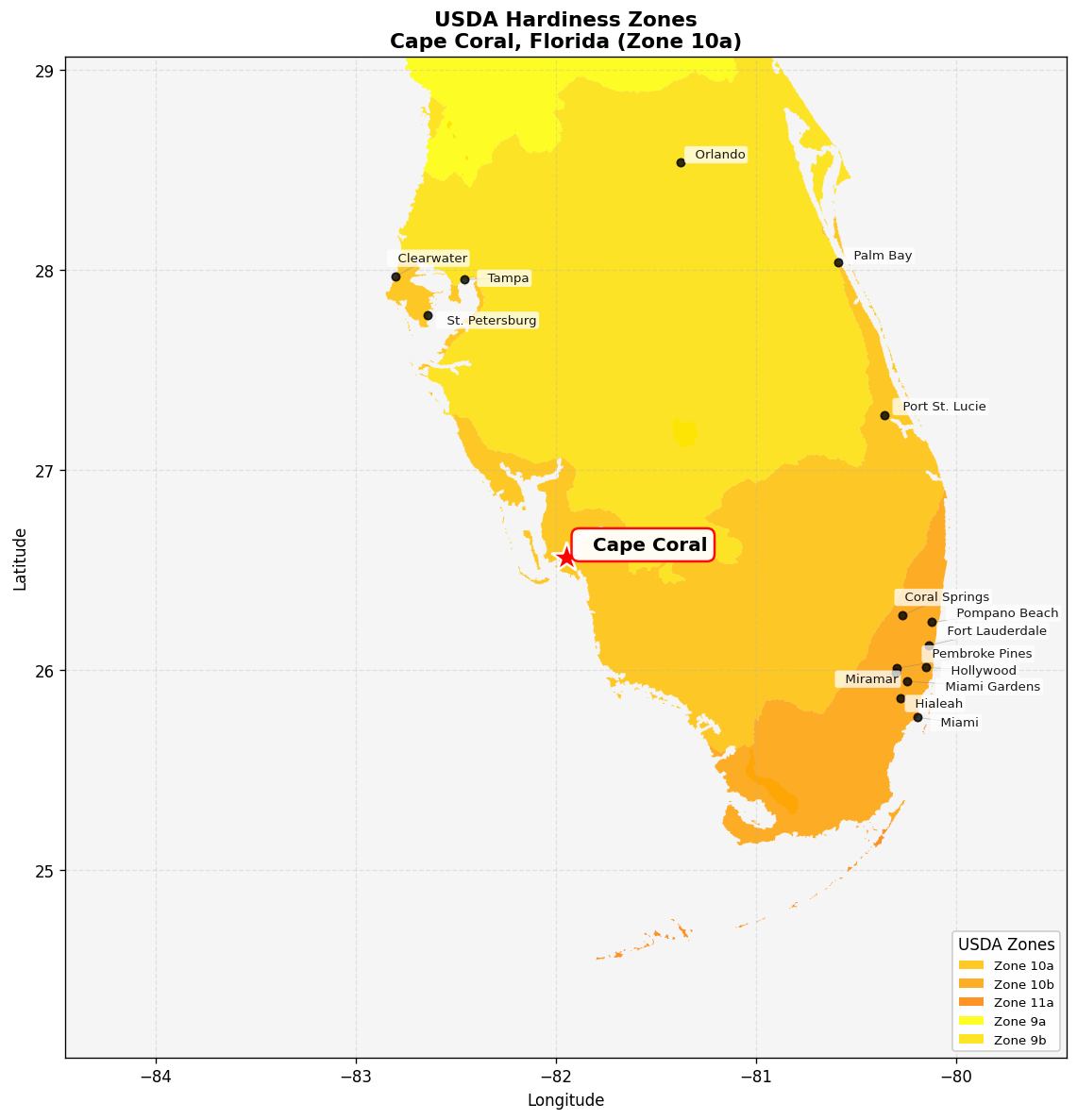
USDA Zone 10a
Hardiness zone for Cape Coral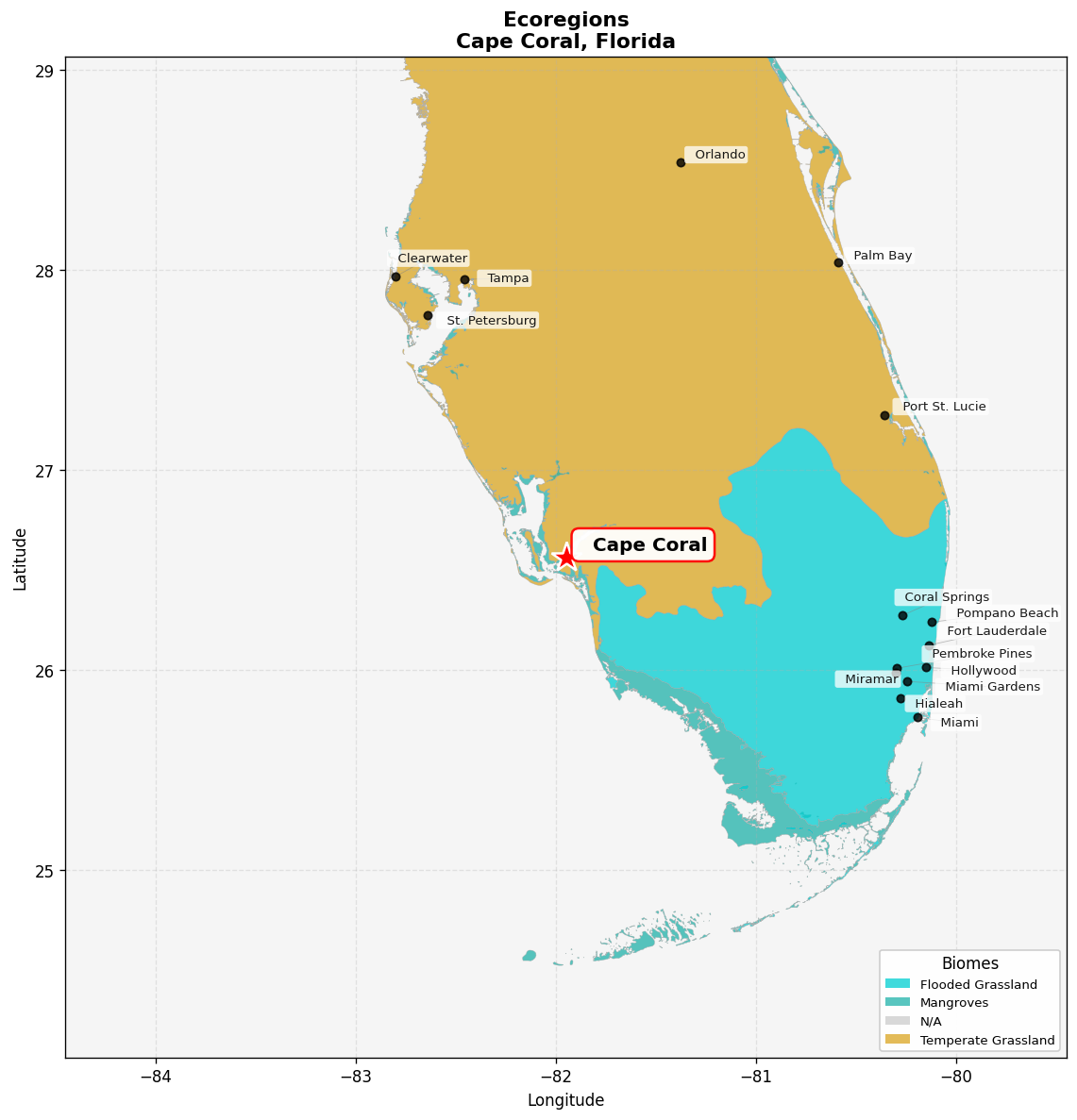
Southeast US conifer savannas
Native ecoregionFrequently Asked Questions
Will desert plants actually survive Cape Coral's 54 inches of rain?
Southwest desert species mostly will not, and you should plan around that rather than fight it. Cape Coral takes about 54 inches a year with 30-plus inches concentrated in June through September, and the seasonal water table climbs to within one to three feet of the surface on many lots. Agave americana, Agave parryi, Dasylirion wheeleri, golden barrel cactus, ocotillo and most Echeveria rot at the crown in that regime, usually in their second or third summer, and the agave snout weevil (Scyphophorus acupunctatus) finishes off whatever the water starts. What does work is a substitution list: Agave desmettiana 'Variegata', Agave angustifolia 'Marginata' and Agave 'Blue Glow' from the Caribbean and coastal Mexico handle humidity far better; Yucca aloifolia is a Florida native; Opuntia stricta and Opuntia humifusa grow wild in Lee County scrub; and Beaucarnea recurvata, Euphorbia tirucalli 'Sticks on Fire', Portulacaria afra, Aloe 'Blue Elf' and Bulbine frutescens all perform well here. Plant every one of them on a raised mineral berm, not at grade.
How do I build the drainage so a xeriscape bed actually survives?
This is the whole ballgame, so do it properly. Strip the sod and any organic topsoil, then build UP rather than digging down — a hole backfilled with sandy mix inside Cape Coral's marl fill becomes a bathtub. Mound 12 to 18 inches of coarse washed sand or #89 limerock screenings blended roughly 70/30 with the native material, with zero peat and no compost. Set each rosette so its crown sits proud of the berm shoulder and the root flare is visible, then apply a three-inch collar of 3/8-inch shell or river rock kept two inches clear of the stem. Never use organic mulch against succulents; it holds moisture at the crown and invites termites. Site berms on the high side of the lot, keep the platted street-side drainage swale open, and if you must plant near a low spot, run a shallow cobble channel around the bed to carry sheet flow past it. On irrigation, put xeric zones on their own valve, run them once every 10 to 14 days in the dry season, and shut them off completely from June through September.
How much does a xeriscape or rock yard cost in Cape Coral?
A full front-yard conversion on a standard 80x125 lot runs $7,000–16,000 installed, or roughly $7–17 per square foot depending on how much berm-building and boulder work is involved. The line items that move the number: turf removal and haul-off at $1.00–2.00/sqft; commercial woven geotextile at $0.30–0.60/sqft; washed shell or river gravel at $60–110 per ton delivered, and a typical front yard eats 25 to 40 tons; Florida limestone accent boulders at $150–500 each placed; and berm material at $40–70 per cubic yard. Specimen plants are cheap by comparison — 7-gallon agaves run $60–120, Zamia integrifolia $35–90. A rear courtyard with a paver fire court lands at $16,000–40,000. Add $2,500–6,000 for a low-voltage LED lighting package, which does more for a rock garden at night than any other single upgrade.
Can I legally replace my entire lawn with rock in Cape Coral?
Mostly yes, with real caveats worth checking before you order gravel. Cape Coral's Land Use and Development Regulations set minimum landscape requirements for residential lots including canopy tree provisions, and removing an existing tree requires a vegetation removal permit from the city — do not clear first and ask later. Your platted drainage swale must stay intact and functional; gravel over a filled swale pushes runoff onto your neighbor and is the fastest way to a code complaint. Gated communities like Sandoval, Entrada and Coral Lakes carry their own architectural review committees with turf-percentage rules that are usually stricter than the city's. One more Cape Coral specific: the city hosts the largest population of Florida burrowing owls in the state, a state-threatened species that actually favors open, low-vegetation yards. Nesting season runs February 15 through July 10, and if a burrow appears on your lot you must maintain a protective buffer and contact FWC before disturbing it — a low xeric yard is owl-friendly, a bulldozer in April is not.
What are the best drought-tolerant plants that also handle a Florida wet season?
Look for Florida natives and Caribbean species rather than Sonoran ones — they evolved with exactly this feast-or-famine rainfall. Structure and sculpture: Zamia integrifolia (coontie), Serenoa repens 'Cinerea' (silver saw palmetto), Yucca aloifolia, Beaucarnea recurvata, Coccothrinax argentata, Bismarckia nobilis and Hyophorbe lagenicaulis (bottle palm). Grasses: Muhlenbergia capillaris, Tripsacum floridanum, Spartina bakeri and Eragrostis elliottii — all four take a three-inch downpour and a five-week drought with equal indifference. Trees: Conocarpus erectus var. sericeus (silver buttonwood), Bursera simaruba (gumbo limbo), Guaiacum sanctum (lignum vitae), Cordia sebestena (geiger tree) and Tabebuia caraiba. Color and groundcover: Bulbine frutescens, Gaillardia pulchella, Helianthus debilis (beach sunflower), Lantana involucrata, Evolvulus glomeratus 'Blue Daze' and Ernodea littoralis. Avoid Lantana camara and Sansevieria — both are listed invasives in Florida.
Does xeriscaping really save money in Cape Coral?
Not primarily on water, which surprises people. Cape Coral's dual-water system supplies canal-sourced irrigation at a low rate, and city ordinance already caps you at two days a week with no watering between 9 a.m. and 5 p.m., so the irrigation savings on a typical lot are modest — call it $200–500 a year. The real return is in labor and replacement: a lawn service running most of the year at $130–250 a month, southern chinch bug treatments on Floratam St. Augustine, resodding the same scorched patches every summer, and palm and turf fertilization scheduled around Lee County's June 1 – September 30 blackout. Bundle those and most Cape Coral homeowners reach payback on a $10,000–14,000 front-yard conversion in roughly four to seven years, with the storm-resilience benefit thrown in free — low, deep-rooted, mineral-mulched plantings came through Ian's 150 mph design-wind event with essentially nothing to clean up.