4 Tropical Garden Ideas for Cape Coral, FL | Canal-City Landscape Design in Zone 10a
Native plants from the Southeast US conifer savannas (Zone 10a) — Tropical savanna climate
Why Tropical/Lush Gardens in Cape Coral?
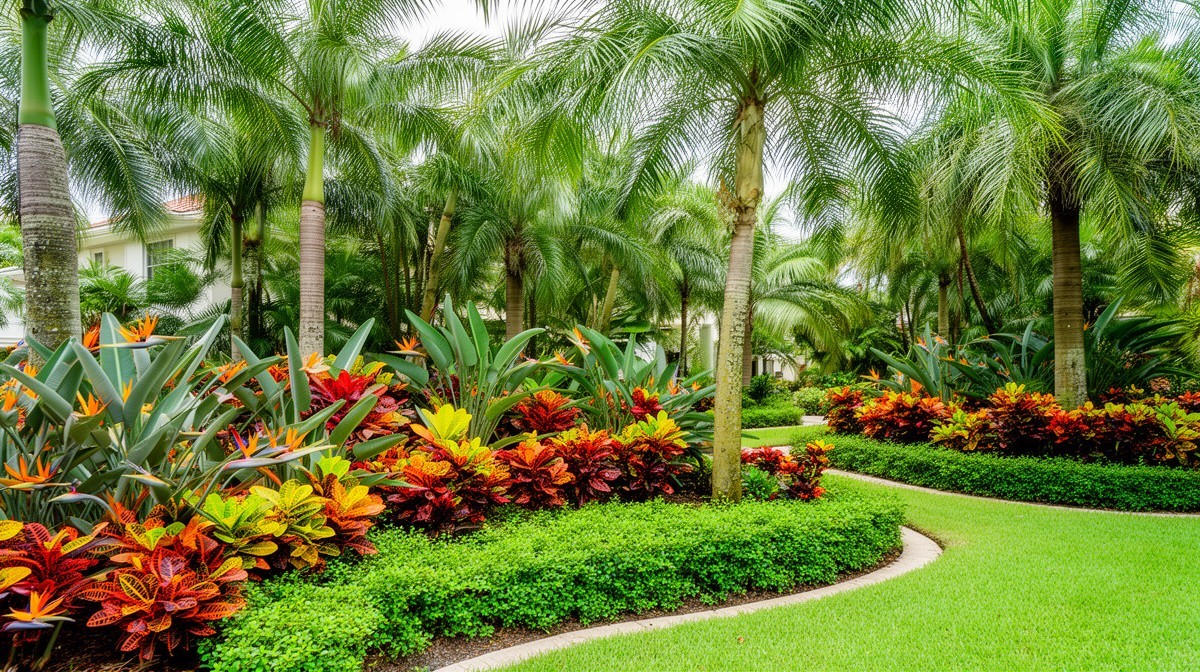
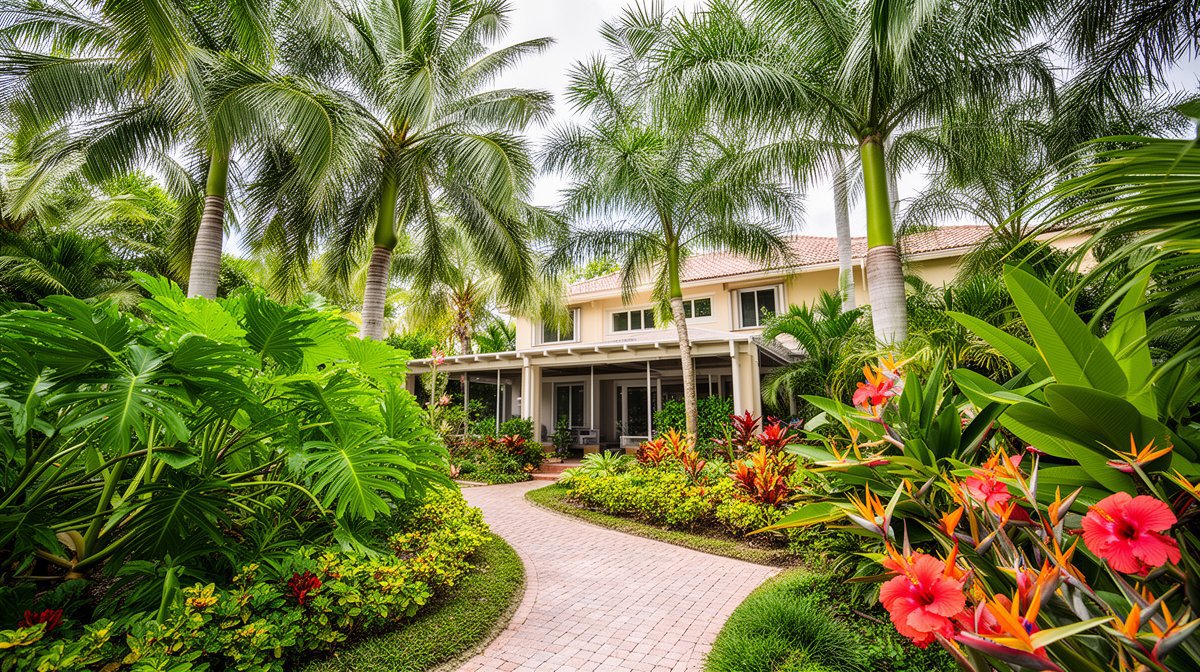
Cape Coral is one of the very few American cities where a true tropical garden is simply the correct answer. The whole city is an engineered landscape — roughly 120 square miles platted by Gulf American in the late 1950s, threaded with more than 400 miles of canals (more than any city on earth) and cut into 80-by-125-foot lots. Sitting at USDA Zone 10a with a Köppen Aw tropical savanna climate, Cape Coral joins Naples and Miami as one of the only mainland markets where Cocos nucifera 'Maypan', Roystonea regia, Delonix regia and Bismarckia nobilis are ordinary landscape plants rather than gambles. Winter lows sit in the 30–35°F band and hard frost is a once-a-decade event, so ti plants, heliconia and crotons hold their color through January instead of collapsing.
The real constraints here are soil chemistry and rainfall timing, not cold. Nearly every Cape Coral yard is built on crushed limestone marl dredged out of the canals, which drains fast and runs alkaline at roughly pH 7.6–8.4. That pH locks up iron and manganese, which is exactly why half the Syagrus romanzoffiana in this city carry frizzled, deformed new spears and half the Ixora 'Nora Grant' hedges look chlorotic and pale. The cure is a controlled-release 8-2-12 palm fertilizer with 4% magnesium and micronutrients, applied three times a year — and remembering that Lee County's fertilizer ordinance bans nitrogen and phosphorus applications from June 1 through September 30. Rain totals about 54 inches a year but arrives lopsided: more than 30 inches falls June through September, then November through April routinely goes four or five weeks bone dry. Cape Coral's dual-water system supplies canal-sourced irrigation cheaply, but city ordinance caps landscape watering at two days a week and prohibits it entirely between 9 a.m. and 5 p.m.
Then there is wind. Hurricane Ian put its eyewall directly over Cape Coral in September 2022, and Lee County builds to roughly a 150 mph ultimate design wind speed. The plants that re-leafed within a season were the ones that evolved here: Sabal palmetto, Bursera simaruba, Conocarpus erectus var. sericeus, Coccoloba uvifera and Chrysobalanus icaco. The casualties were brittle exotics — Ficus benjamina, queen palms, and anything top-heavy planted too close to the roofline. A well-built Cape Coral tropical garden layers those tough natives as the permanent bones, then spends the color budget on crotons, cordylines and heliconia that can be replaced cheaply if a storm takes them.
4 Tropical/Lush Design Ideas for Cape Coral
The Foxtail & Croton Entry Curve
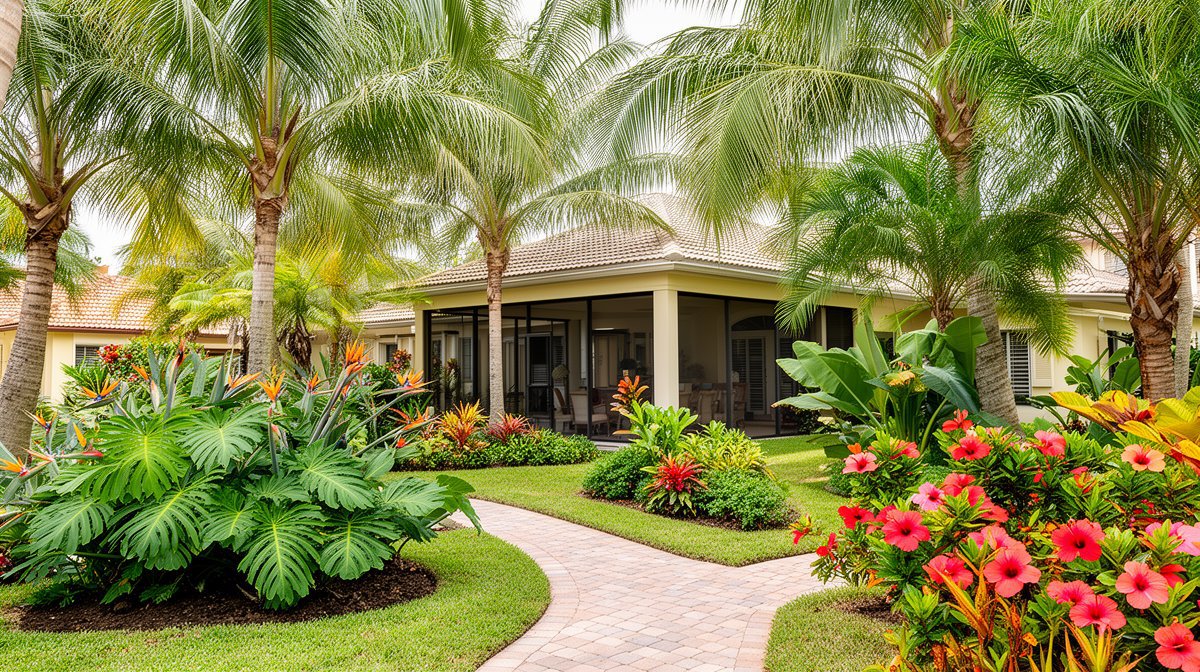
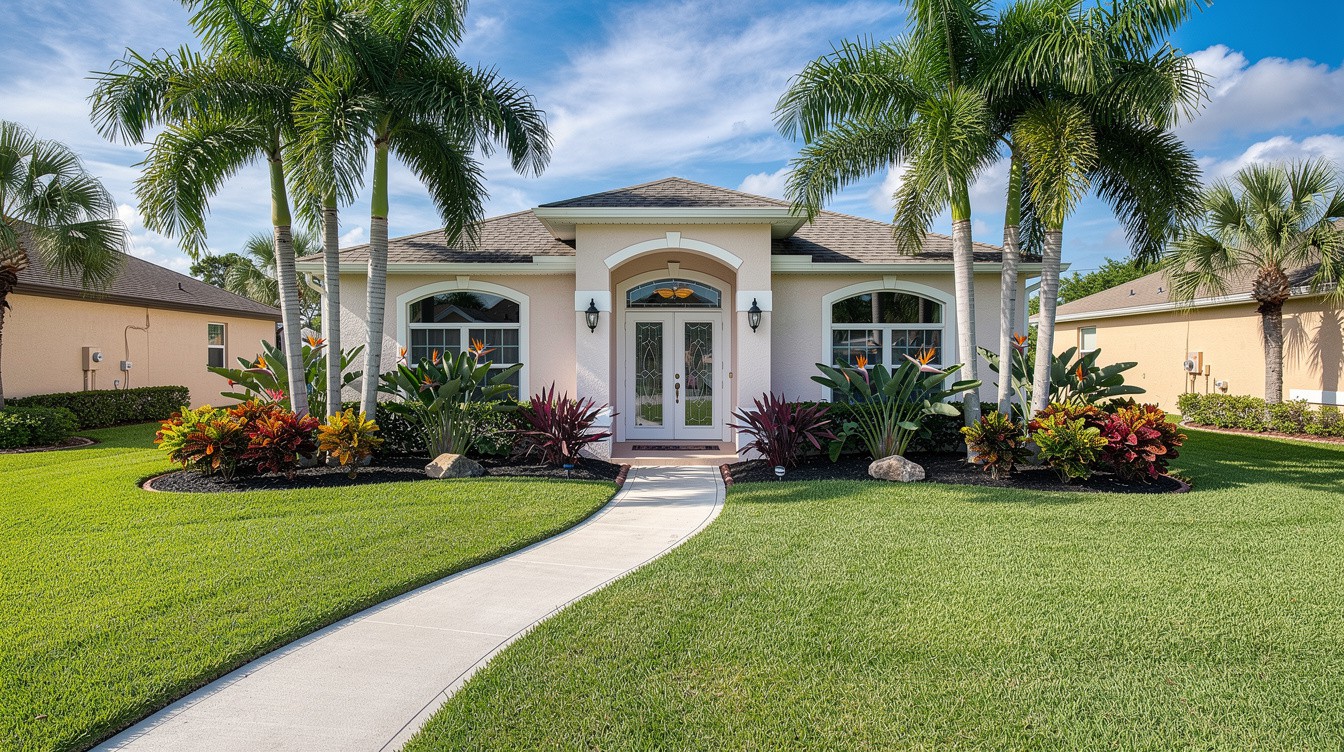
$9–18/sqftA classic blush-stucco Cape ranch with arched picture windows and a leaded-glass double door, approached by a broad concrete walk that sweeps in a long S-curve across the St. Augustine lawn instead of running straight to the street. Slender-trunked foxtail palms are planted in odd-numbered clusters to either side of the entry so their crowns frame the arch rather than block it, and the foundation bed underneath is pure Southwest Florida color theory: mounds of orange-and-burgundy croton, upright burgundy ti plants, and clumps of bird of paradise whose orange bracts sit at exactly eye level from the front door. Coquina boulders anchor each bed corner and a crisp black-mulch edge keeps the whole composition reading as one continuous ribbon.
The Sherbet Cottage Walk
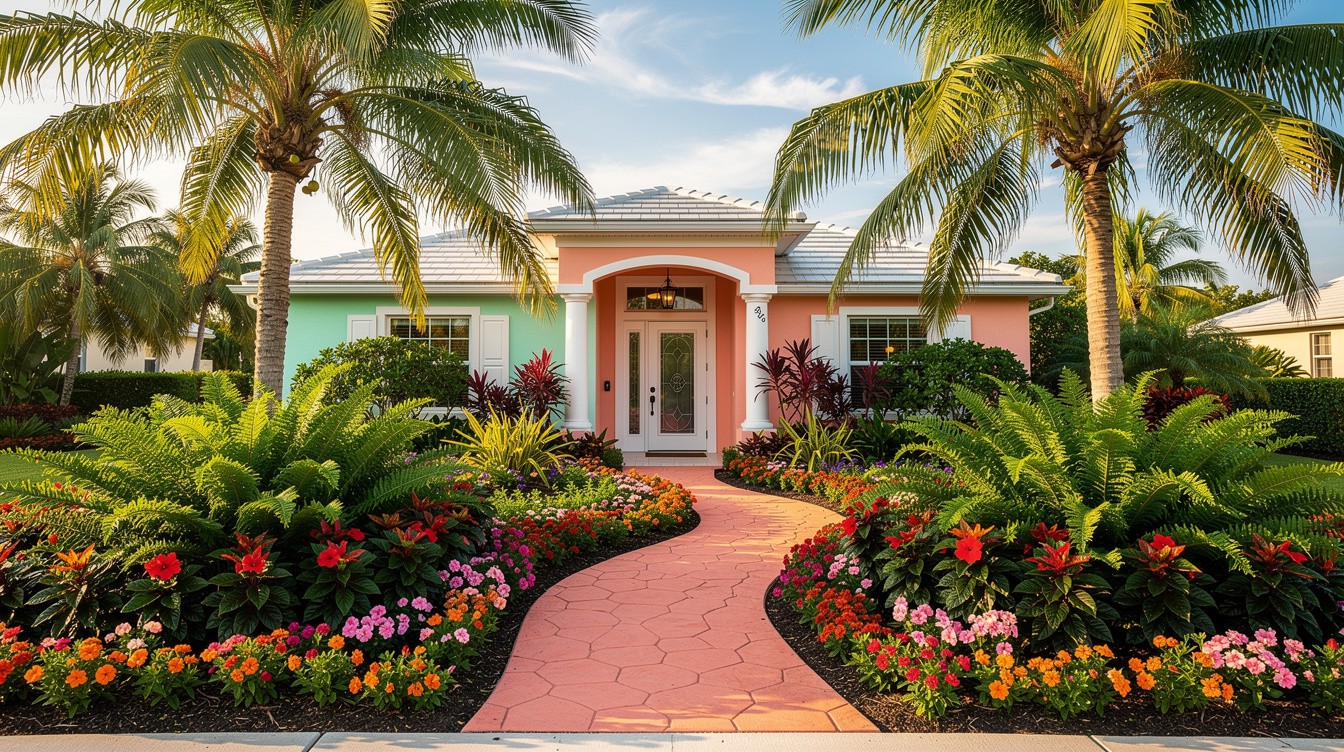
$12–22/sqftOld Florida pastel taken seriously: a coral-and-mint stucco cottage with white trim and a white metal roof, fronted by a salmon-tinted stamped-concrete path that meanders rather than marches. The planting is built in three deliberate bands — a low front ribbon of continuous annual color in pink, coral and orange, a middle layer of enormous macho ferns whose arching fronds soften every hard edge, and a back layer of burgundy ti and glossy broadleaf shrubs against the stucco. Leaning coconut palms with clean, curved trunks arch over the whole thing from both sides, giving the small house a canopy it could never grow on its own footprint.
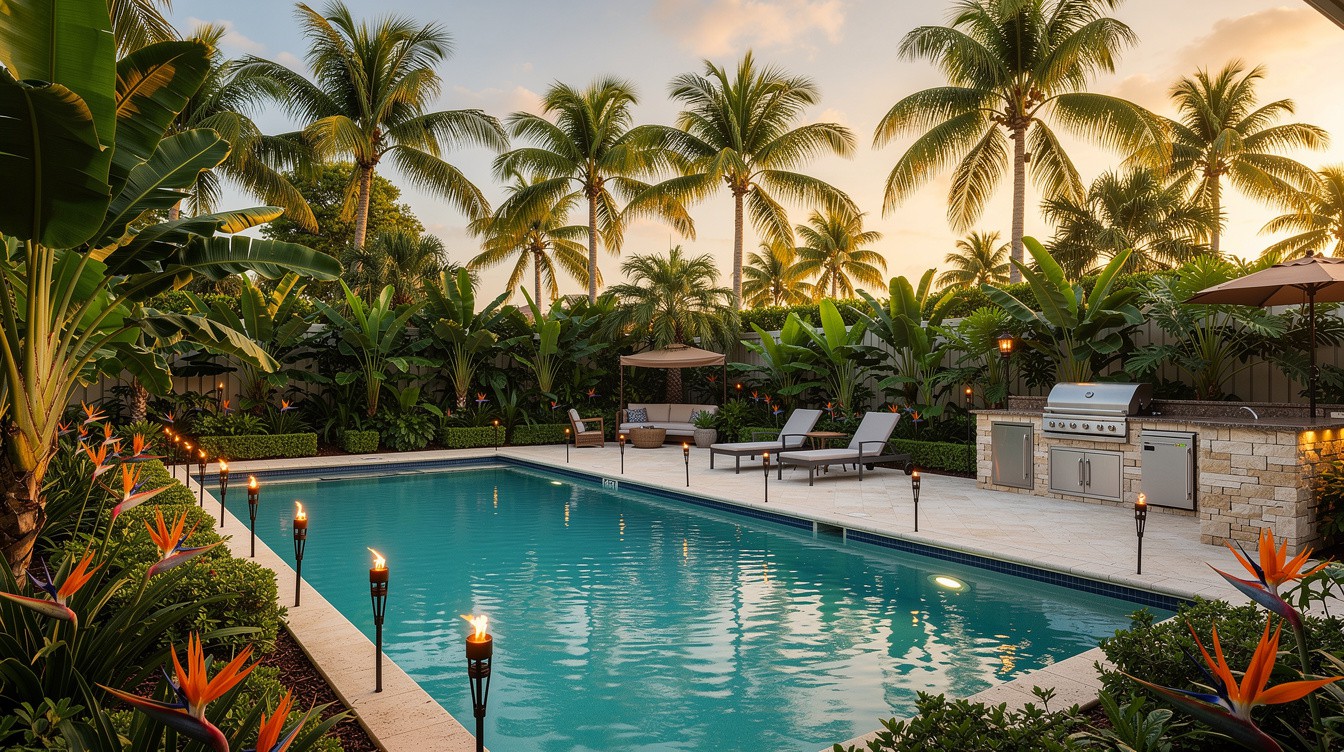
The Torchlit Coconut Grove
$45–90/sqft (pool and kitchen inclusive)A long rectangular pool set in warm travertine, lit at dusk by a double row of black steel tiki torches marching down both long edges and reflecting off the water. On one side, a stone-clad outdoor kitchen island with a built-in stainless grill, drawer refrigerator and a full-length bar counter faces back toward the water; on the other, a low clipped hedge separates the deck from a planted berm. The privacy comes entirely from vegetation — a back wall of coconut palms and traveler's-palm-scale foliage rising above the fence line, with the huge paddle leaves of white bird of paradise filling the gaps at head height. Orange Strelitzia bracts in the foreground beds do the color work so the hardscape can stay neutral.
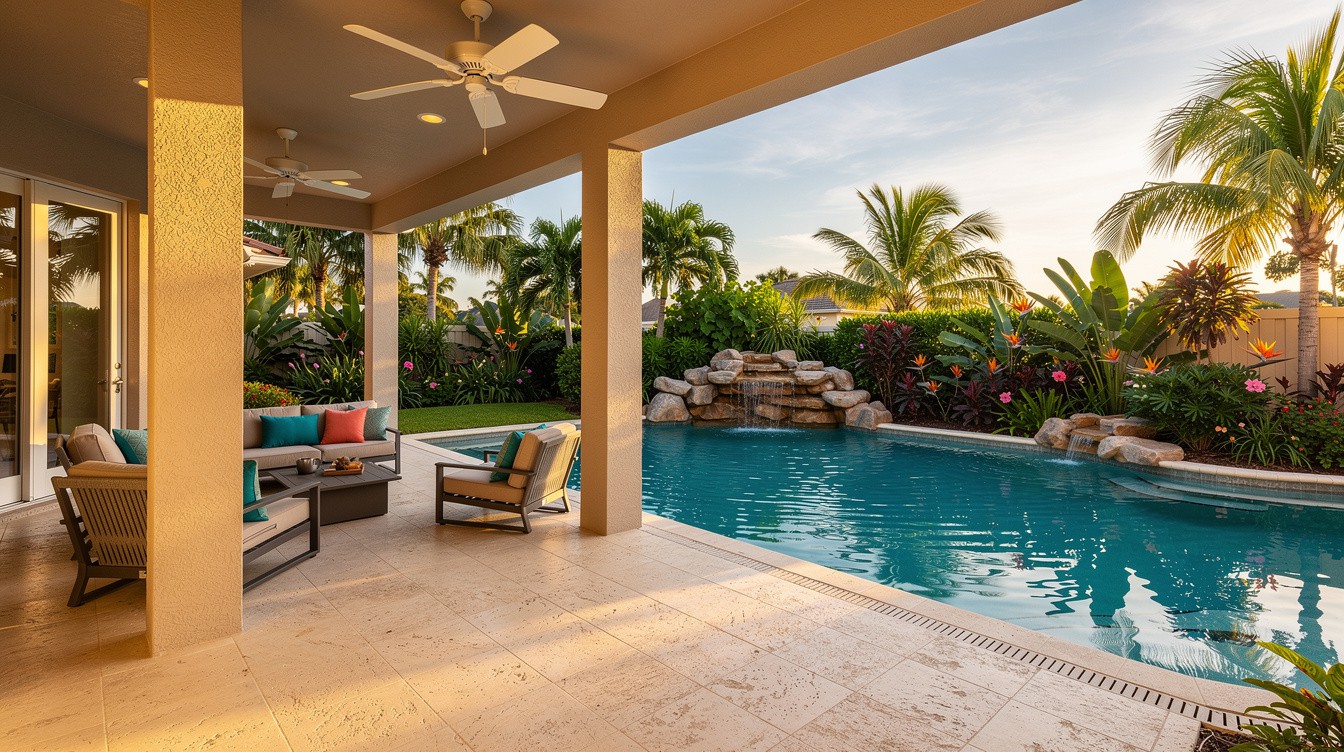
The Shaded Lanai Waterfall
$35–70/sqftThe Cape Coral summer answer: a deep covered lanai with twin ceiling fans and travertine flooring that runs continuously from under the roof out to the pool coping, so the indoor and outdoor rooms read as one. Deep seating in teak and charcoal aluminum sits in the shade with turquoise and coral cushions, and the pool's far edge is built up into a stacked-limestone cascade that masks road noise and gives the water movement. Behind the rock feature, a dense mixed border layers burgundy ti, hibiscus and shell ginger against a back rank of palms and white bird of paradise, so the fence disappears completely by year three.
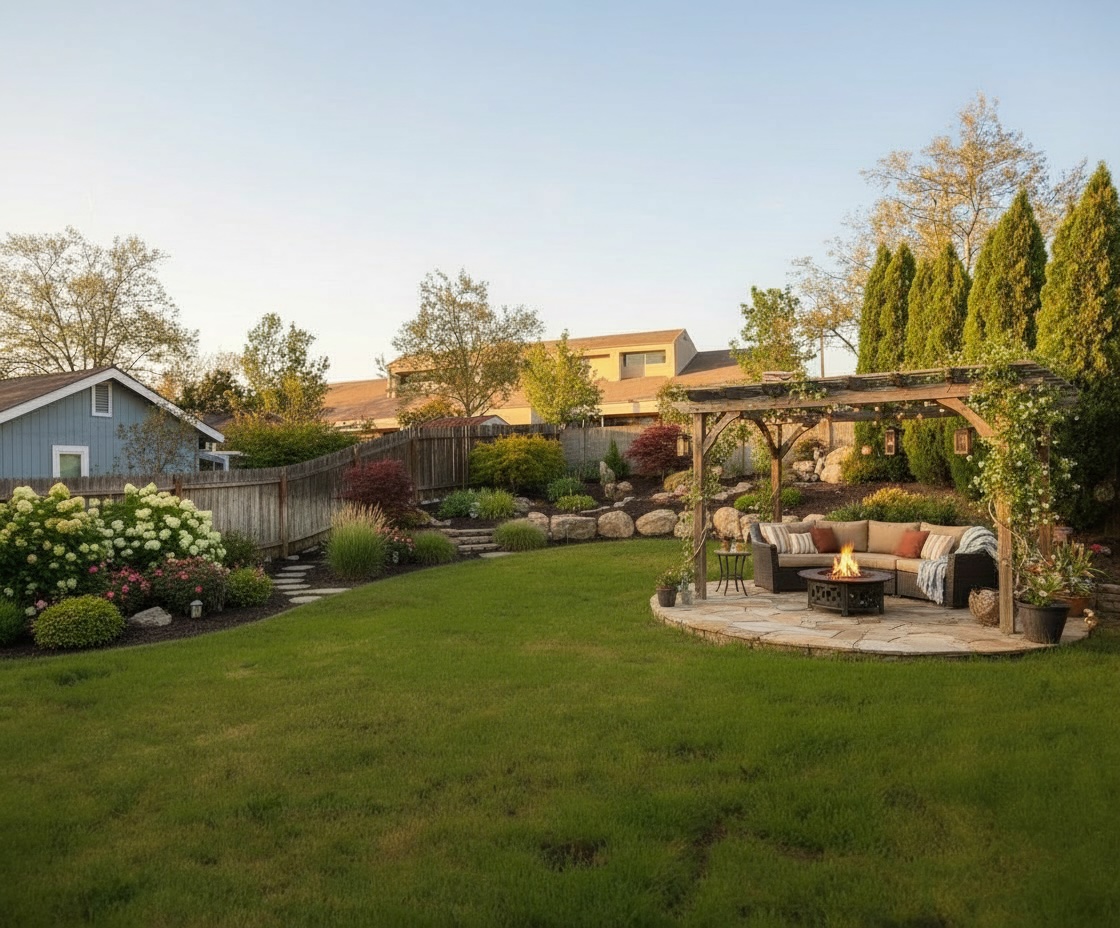
See how a tropical/lush garden looks on YOUR property
Upload a photo of your Cape Coral yard and visualize your dream garden in seconds.
Try ProScapeAI Free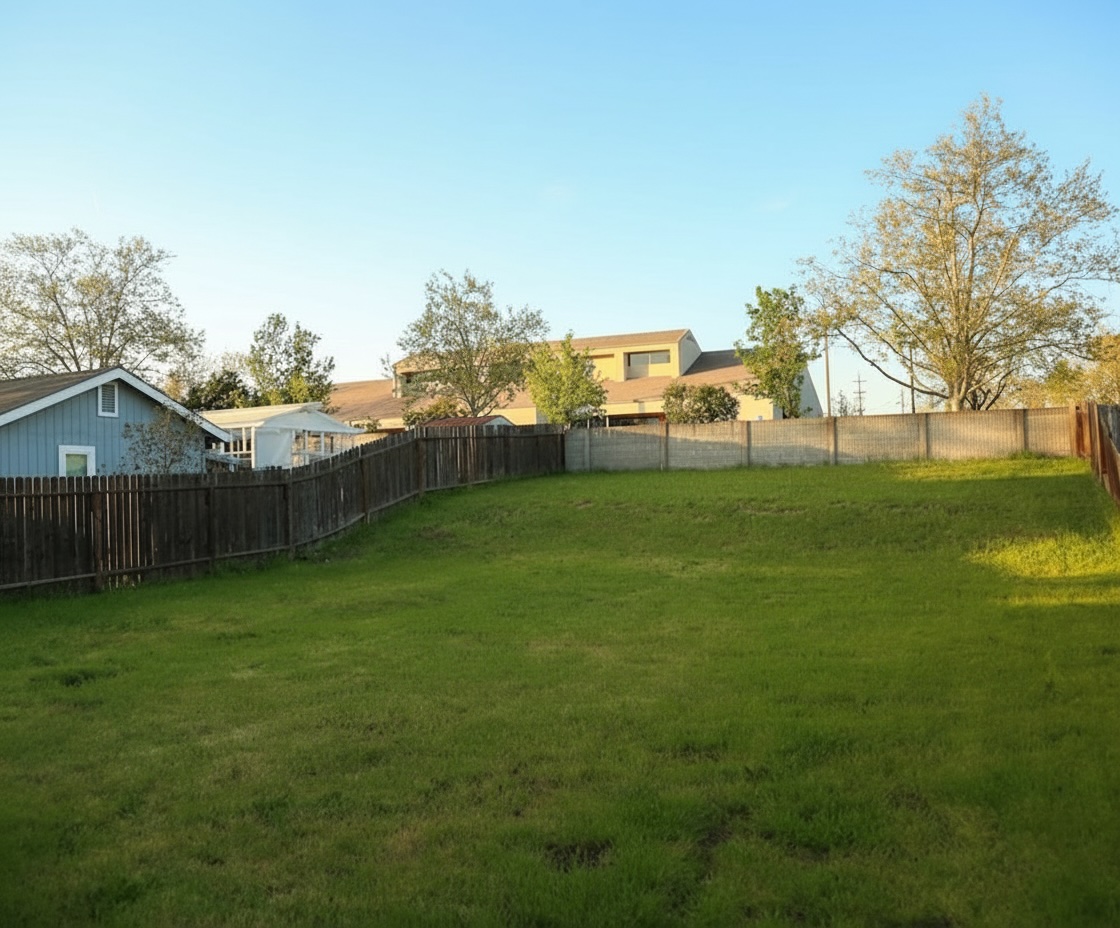
Featured Trees & Shrubs for Tropical/Lush Gardens
Browse all 65 plants for Cape Coral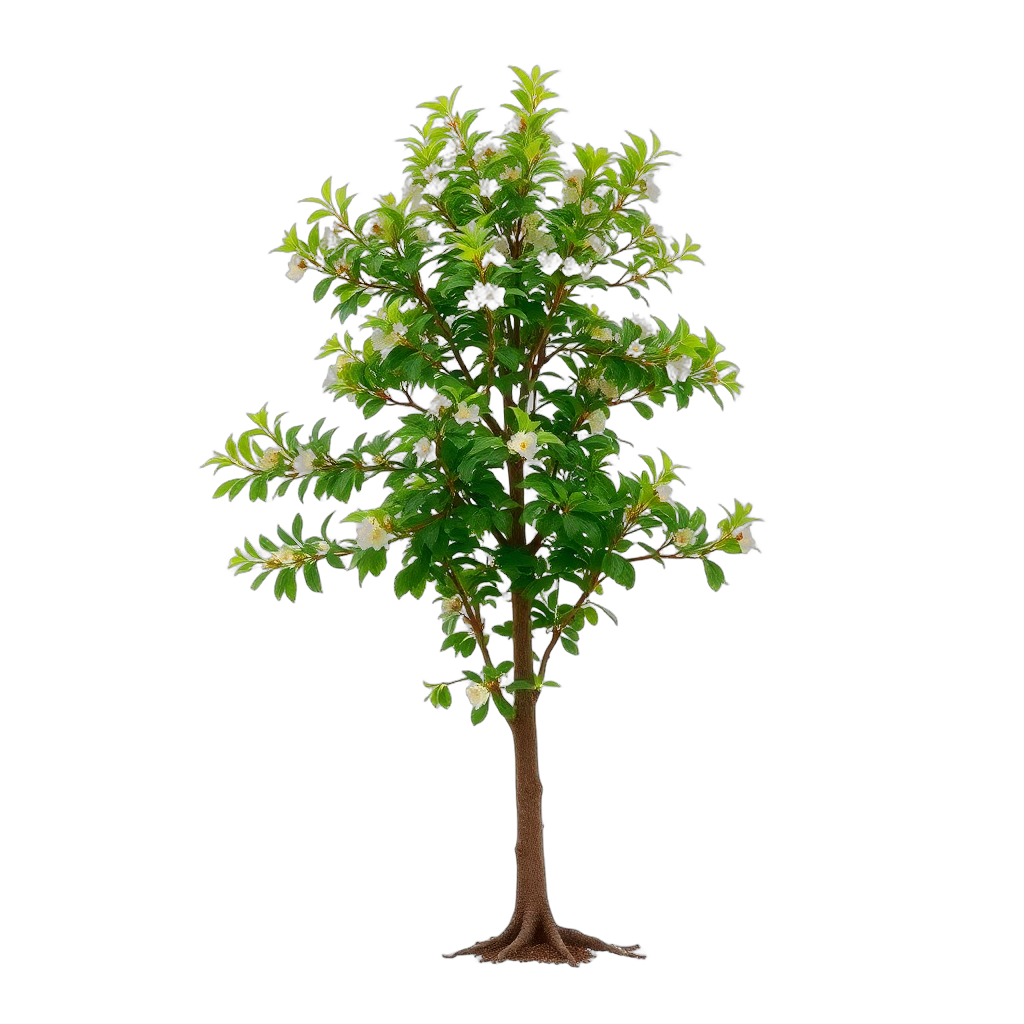
Buckwheat Tree
Cliftonia monophylla
medium-sized at 15 feet, white blooms in spring. Attracts butterflies.
Fetterbush
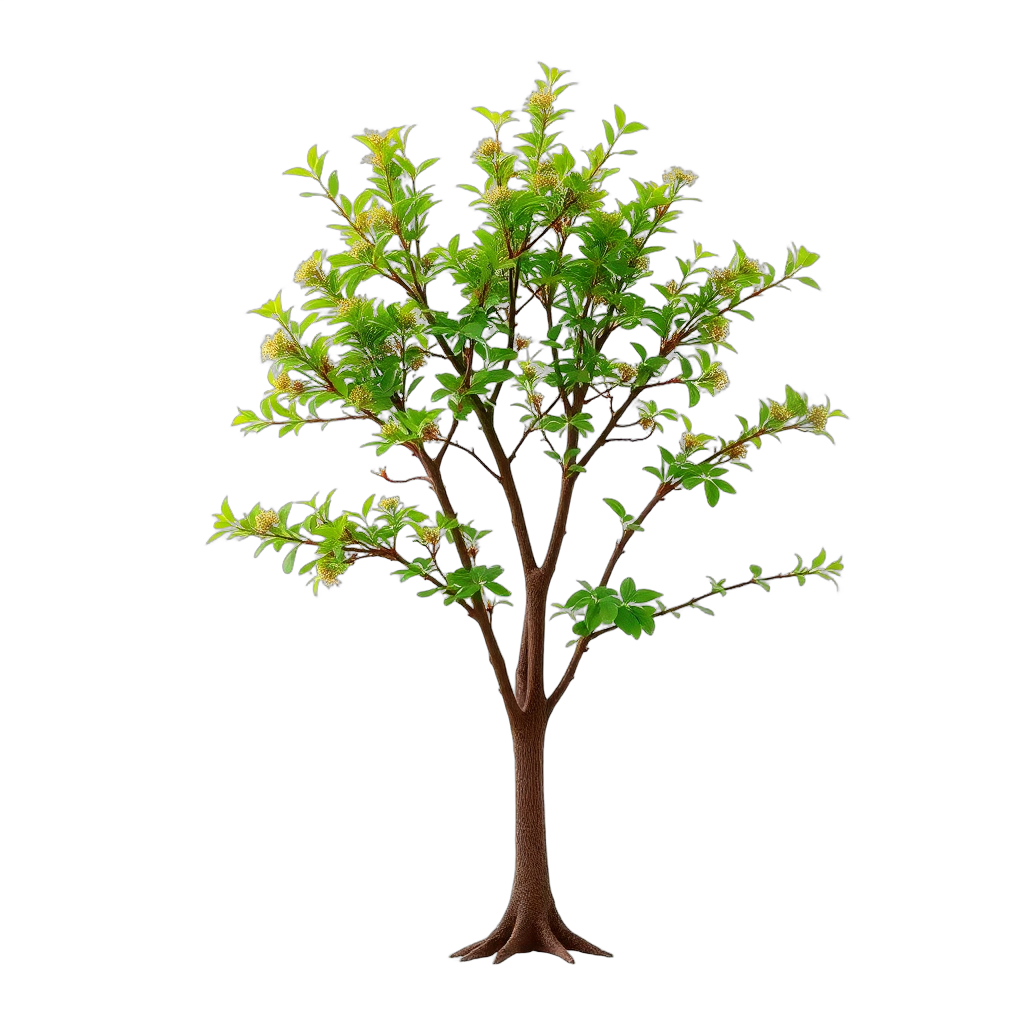
Lyonia lucida
grows to 6 feet, white blooms in spring. Evergreen year-round.
Florida Anise
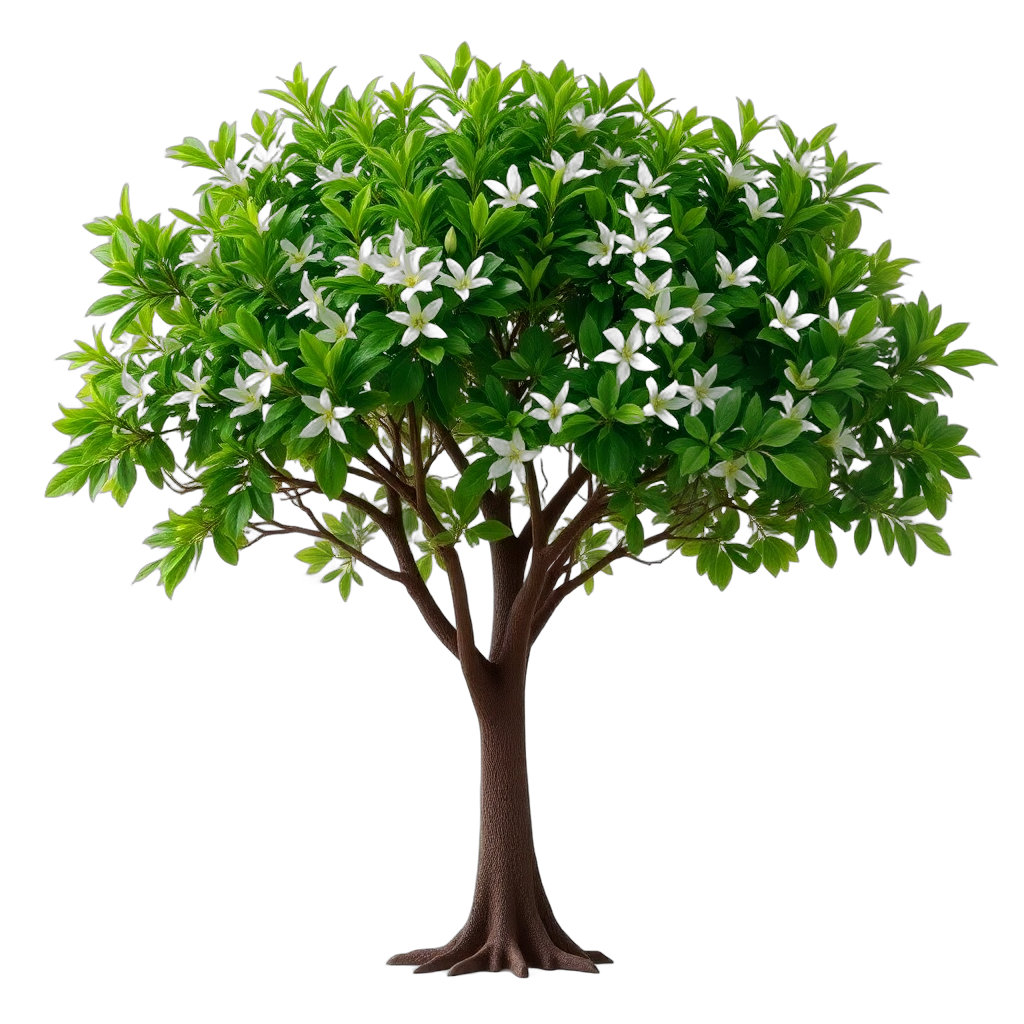
Illicium floridanum
medium-sized at 8 feet, red blooms in spring. Evergreen year-round.

Inkberry
Ilex glabra
medium-sized at 8 feet, white blooms in spring. Pollinator-friendly.
Featured Grasses & Groundcovers for Tropical/Lush Gardens

Pink Muhly Grass
Muhlenbergia capillaris
grows to 3 feet, pink blooms in fall.
Purple Love Grass
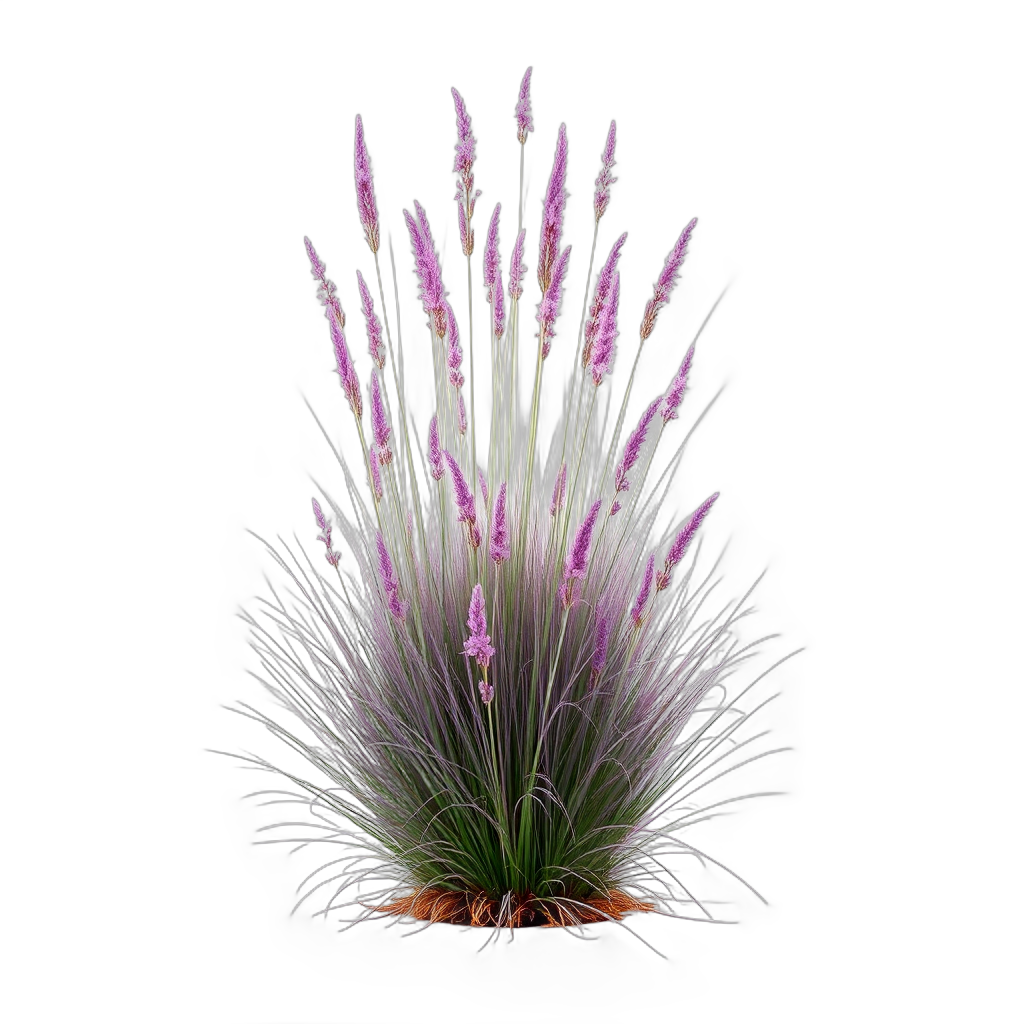
Eragrostis spectabilis
low-growing ground cover, purple blooms in fall. Orange fall color.

Bermuda Grass
Cynodon dactylon
low-growing ground cover, blooms in summer. Brown fall color.
Featured Flowers & Perennials for Tropical/Lush Gardens
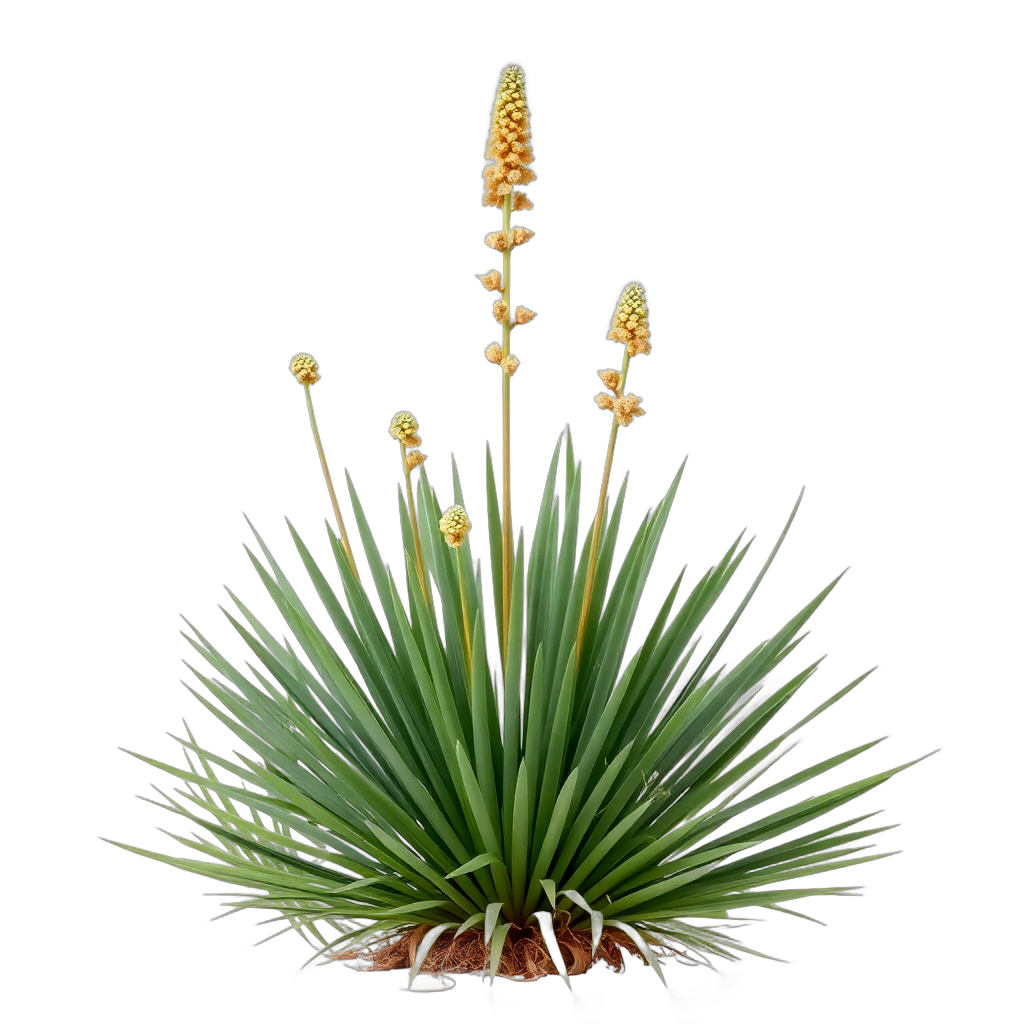
Adam's Needle
Yucca filamentosa
low-growing ground cover, white blooms in summer. Attracts hummingbirds.

Broadleaf Arrowhead
Sagittaria latifolia
low-growing ground cover, white blooms in summer. Attracts butterflies.

Canadian Waterweed
Elodea canadensis
grows to 3 feet, white blooms in spring. Evergreen year-round.

Common Cattail
Typha latifolia
grows to 5 feet, blooms in summer. Pollinator-friendly.
Bloom Calendar for Cape Coral
spring
Buckwheat Tree, Fetterbush, Florida Anisesummer
Adam's Needle, Swamp Cyrilla, Loblolly Bayfall
Pink Muhly Grass, Purple Love Grasswinter
Limited bloomsDesign Tips for Cape Coral (Zone 10a)
- Buy the palm fertilizer before you buy the palms — a controlled-release 8-2-12 with 4% magnesium and micronutrients, three times a year, is the single difference between the lush Cape Coral yard and the yellow one, because dredged marl at pH 8 will not release iron or manganese on its own
- Skip Syagrus romanzoffiana entirely; the queen palm is the most-planted and worst-performing palm in Lee County, chronically manganese-deficient in marl and prone to snapping at the crownshaft — spend the same money on Bismarckia nobilis, Wodyetia bifurcata, or a clustered trio of Sabal palmetto
- Watch for lethal bronzing, the phytoplasma disease spreading through Southwest Florida's Sabal palmetto, Phoenix sylvestris and Adonidia merrillii — early sign is premature fruit drop followed by a collapsing spear leaf; preventive oxytetracycline trunk injections every four months are worth it only on high-value specimens
- Flush your bromeliads weekly with a hose: Aechmea and Neoregelia cups are prime Aedes breeding habitat, and Lee County Mosquito Control's aerial program will not fix what is growing ten feet from your lanai door
- Layer for privacy in three heights, not one hedge — Clusia guttifera or Podocarpus 'Maki' at the fence line, Strelitzia nicolai and Musa at eight feet, then crotons and cordylines at eye level; on an 80-foot Cape lot with neighbors 15 feet away, planting is far cheaper than adding wall height
- Uplight the palm trunks, not the canopy — a single 6-watt LED spot at the base of each Wodyetia or Cocos washes the whole trunk and turns three palms into an evening focal point for under $600, and it keeps light out of the neighbor's bedroom on a narrow lot
Where to Source Plants in Cape Coral
Skip the big-box stores. These independent Cape Coral nurseries specialize in the plants that make tropical/lush gardens thrive in Zone 10a.
Danny Yates Landscape Nursery
Southwest Cape Coral
Retail and wholesale nursery specializing in palms, hibiscus, bougainvillea, citrus, and Florida natives since 1986.
Roots and Blooms Nursery
Southeast Cape Coral
Boutique nursery featuring rare succulents, tropical plants, and unique specimens.
Depot Nursery
Northwest Cape Coral
Garden center offering a diverse plant selection with design consultation and delivery.
Tropical/Lush Landscaping Costs in Cape Coral
| Project Scope | Estimated Cost |
|---|---|
| Front yard tropical refresh (beds, palms, crotons, mulch, edging) | $6,000 – $15,000 |
| Specimen palm installed (foxtail, Bismarckia, or coconut) | $600 – $4,000 each |
| Travertine pool deck, 600–900 sqft | $14,000 – $32,000 |
| Outdoor kitchen island with grill and refrigeration | $9,000 – $28,000 |
| Aluminum pool cage rescreen or new 150 mph-rated enclosure | $3,000 – $32,000 |
| AI visualization with ProScapeAI | Free to start |
Estimates based on Cape Coral, FL-area contractor rates as of 2026. Actual costs vary by site conditions, materials, and contractor.
Cape Coral Climate & Growing Zone
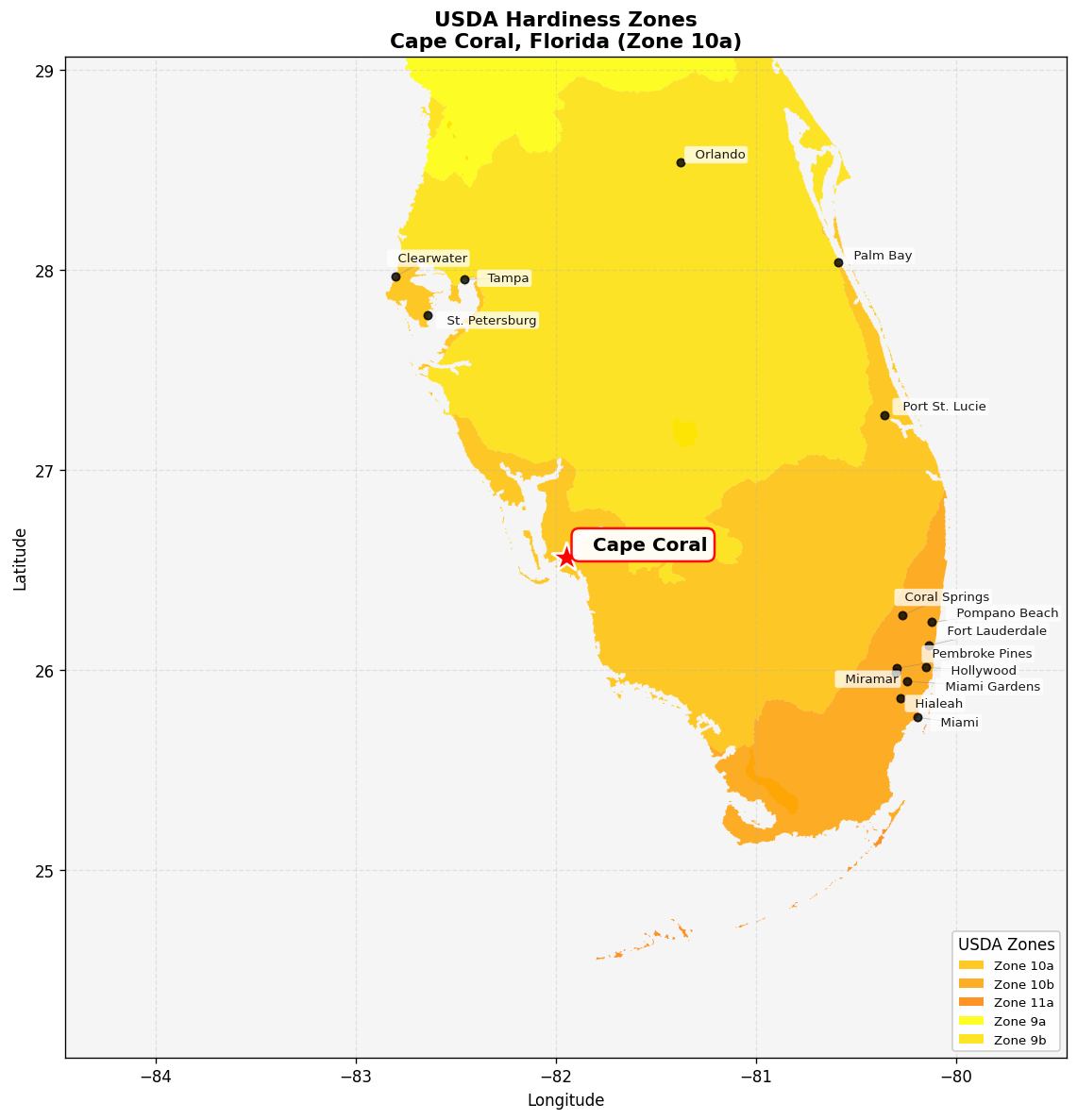
USDA Zone 10a
Hardiness zone for Cape Coral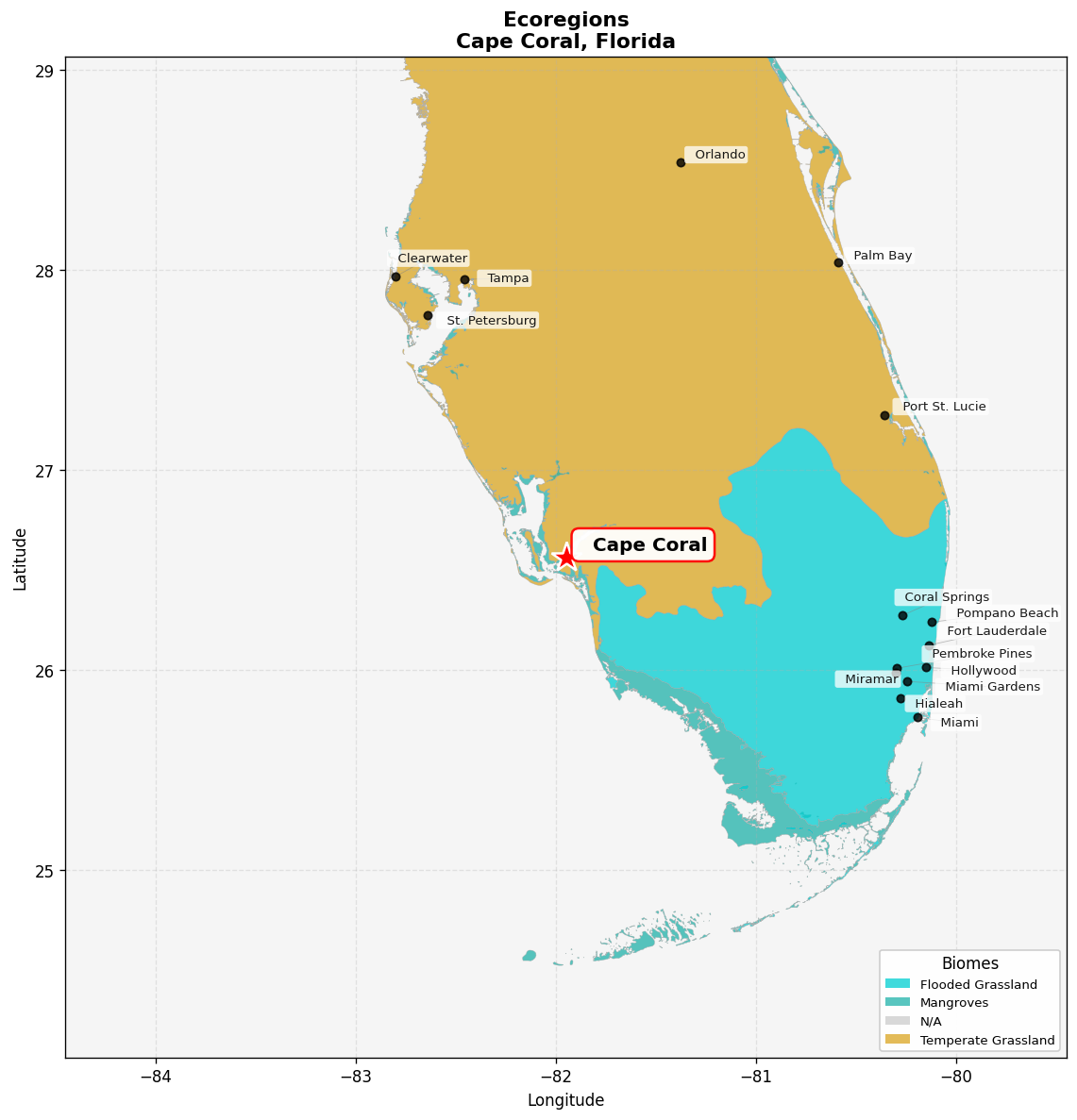
Southeast US conifer savannas
Native ecoregionFrequently Asked Questions
How much does tropical landscaping cost in Cape Coral?
A full front-yard tropical refresh on a standard 80x125 Cape Coral lot — bed excavation, three to five specimen palms, croton and cordyline massing, mulch, and irrigation modifications — runs $6,000–15,000 installed. Specimen palms drive the number more than anything else: a field-dug Sabal palmetto lands around $250–600 installed, a 12-foot clear-trunk Wodyetia bifurcata $600–1,200, and a mature Bismarckia nobilis with a 6-foot silver crown $1,500–4,000. Backyard pool-and-kitchen projects like the torchlit grove typically run $45,000–110,000. Lee County labor rates climbed sharply after Hurricane Ian and have not fully come back down, so get three bids and confirm whether palm staking, warranty, and the first year of fertilization are included.
Which palms actually survive Cape Coral hurricanes?
Lee County builds to roughly a 150 mph ultimate design wind speed, and Ian's 2022 eyewall passage gave the city a brutal live test. The survivors were the natives: Sabal palmetto, Serenoa repens, Coccothrinax argentata, Leucothrinax morrisii and Pseudophoenix sargentii all defoliated and re-leafed within a season. Bismarckia nobilis and Wodyetia bifurcata also came through well once established. The consistent failures were Syagrus romanzoffiana (queen palm), which snaps at the crownshaft, and Ficus benjamina, which uproots wholesale. Plant any palm at least 20 feet from the roofline, group them in odd-numbered clusters so they shelter each other, and never let a landscaper prune above the horizontal — hurricane-cutting a palm into a rooster tail removes the very fronds that protect the bud.
Why do my palms and ixora turn yellow in Cape Coral?
Almost certainly soil pH, not disease. Cape Coral lots are built on crushed limestone marl dredged from the canals, which sits around pH 7.6–8.4 and chemically locks up iron and manganese. Manganese deficiency produces the classic 'frizzle top' of withered, scorched new spears on queen palms and Phoenix roebelenii; potassium deficiency shows as translucent orange-yellow spotting on the oldest fronds; magnesium deficiency makes broad yellow bands along frond margins. The fix is a controlled-release 8-2-12 palm fertilizer with 4% Mg and a full micronutrient package, broadcast three times a year, plus chelated manganese sulfate drenches for acute cases. Acid-lovers like Ixora and Dypsis lutescens will fight you forever in this soil — swap them for Chrysobalanus icaco, Myrcianthes fragrans or Clusia guttifera, all of which shrug off alkalinity. Remember Lee County's June 1 – September 30 nitrogen and phosphorus blackout when scheduling applications.
What can I plant along a Gulf-access saltwater canal?
This matters more in Cape Coral than most people realize, because the city has two separate canal systems: the south and southwest Cape canals are brackish and Gulf-access, while the north Cape freshwater canals feed the city's irrigation supply. Within about 30 feet of a seawall on a saltwater canal, plant only proven salt performers — Coccoloba uvifera (sea grape), Conocarpus erectus var. sericeus (silver buttonwood), Chrysobalanus icaco, Pseudophoenix sargentii, Sabal palmetto, Sesuvium portulacastrum and Ernodea littoralis. Save the crotons, heliconia and coconut palms for the house side of the lot. If Ian-era surge pushed salt water across your yard, apply agricultural gypsum at roughly 40–50 lbs per 1,000 sqft and irrigate heavily to flush sodium out of the root zone before replanting.
What are Cape Coral's watering rules for a new landscape?
Cape Coral limits irrigation to two days a week year-round on an odd/even address schedule and prohibits watering between 9 a.m. and 5 p.m. New installations qualify for a temporary establishment variance — ask your installer to pull it, because tropical material needs daily water for the first two to three weeks. Two quirks of the city's dual-water system are worth budgeting for: canal-sourced irrigation water carries dissolved iron that will stain white stucco, travertine and driveways rust-orange within a season, so aim heads away from walls and consider an inline iron sequestering injector; and the same water carries enough salts that pot-grown ferns and calatheas near the heads will show tip burn. Rain sensors are required on new systems.
When is the best time to plant a tropical landscape in Cape Coral?
Late April through early June is the sweet spot — you plant into warm soil just ahead of the wet season, and the June–September rains do six inches a month of free establishment watering for you. October and November are the second window, with mild temperatures and low storm risk. Avoid installing cold-sensitive material like coconut palms, Adonidia merrillii and heliconia in December or January; Zone 10a lows in the low 30s are rare but they do happen, and a freshly planted palm has no reserves. Hardscape can go in any month, though summer afternoon thunderstorms routinely blow out concrete pours and paver screeding between 2 and 6 p.m., so schedule pours for morning.