4 Cottage Garden Ideas for Waco, TX | Zone 8b Landscape Design
Native plants from the Texas blackland prairies (Zone 8b) — Humid subtropical climate
Why Cottage/English Gardens in Waco?
Waco is one of the few Texas cities where an English cottage garden reads as native to the street rather than imported from a magazine. The 1920s Craftsman bungalows and Tudor-revival cottages of Castle Heights, Sanger Heights, Dean Highland and Mountainview were built with deep front porches, low rooflines and shallow setbacks — exactly the architecture a picket fence, a rose arbour and a billowing front border were invented to frame. The renovation wave that followed the Silos District downtown has pushed that look further: painted clapboard, cottage windows and hand-laid brick walks are now the default vocabulary from Austin Avenue out to the newer porch-fronted builds in Woodway, Hewitt and Badger Ranch. The design problem in Waco is never whether a cottage garden fits the house. It is whether the plant list survives August.
Waco sits in USDA Zone 8b, with winter lows of 15–20°F, roughly 36 inches of rain a year, and July and August afternoons that average 96–97°F and routinely stack up runs of 100°F-plus days. The rain is not spread evenly either — it arrives in a May peak and an October peak, with a genuinely arid hole punched through midsummer. That combination rewrites the classic Sissinghurst plant list line by line. Digitalis purpurea behaves as a fall-planted cool-season annual here, not a biennial — set out 'Camelot Rose' or 'Dalmatian Peach' transplants in October and they will spike beautifully in April and be gone by June. English lavender sulks in the humidity, so the workhorse is Lavandula × intermedia 'Phenomenal' or 'Provence', with Salvia farinacea 'Henry Duelberg' carrying the same blue-violet vertical line straight through the heat. Hybrid tea roses are a maintenance trap; the Earth-Kind selections trialled by Texas A&M AgriLife — Rosa 'Belinda's Dream', 'Caldwell Pink', 'Ducher', 'Marie Pavié' and the climbers 'Peggy Martin' and 'Climbing Pinkie' — give you the same romance on a fraction of the spray schedule. And the shade beds that would hold hosta in Kent hold Aspidistra elatior, Rohdea japonica and Heuchera villosa 'Autumn Bride' in McLennan County.
Underneath all of it is Houston Black clay, the deep, dark, calcareous soil of the Texas Blackland Prairies that Waco is built on. It is fertile and it holds moisture beautifully, but it runs alkaline at roughly pH 7.8–8.2 and it shrinks and swells dramatically between a wet May and a cracked-open August. Two consequences follow. First, acid-loving classics — azalea, gardenia, blue hydrangea, blueberry, pin oak — go chlorotic and yellow within a season, so they are simply off the list. Second, every path, patio and wall wants a compacted crushed-limestone base and a joint that can move; brick and flagstone set on a flexible sand-swept base outlast rigid mortar on Waco clay. West of the Brazos the story flips: Woodway, China Spring and Speegleville sit on thin caliche over Austin Chalk limestone, where the real job is importing depth. In both soils the fix is the same — build beds up 8–12 inches with compost and expanded shale rather than digging planting holes that fill with water like clay bathtubs.
Water is the last design constraint, and in Waco it is a real one. The city draws from Lake Waco, and Waco Water Utility Services runs a stage-based drought contingency plan that tightens watering days and shuts down midday sprinkler use as lake levels fall — check the current stage before you size an irrigation design, and note that new sprinkler systems in a city this size need a licensed irrigator and city sign-off. The practical answer is to keep the thirsty cottage effect in a tight, drip-irrigated core near the porch and the seating, and let the outer borders run on Blackland Prairie stock that never asks — Echinacea purpurea 'Magnus', Salvia greggii 'Furman's Red', Callirhoe involucrata, Liatris mucronata and Muhlenbergia lindheimeri will carry colour and movement through a Waco September on rainfall alone.
4 Cottage/English Design Ideas for Waco

The Picket Fence and Rose Gate
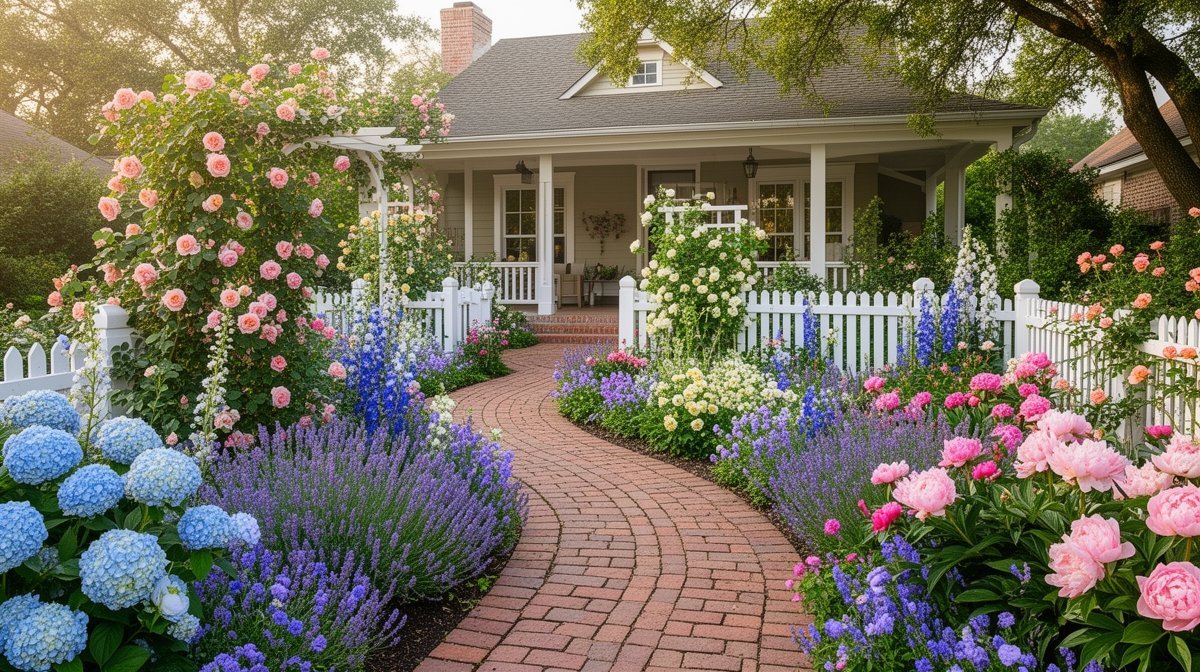
$14–26/sqftA cream clapboard cottage with a gabled porch and a brick chimney sits behind a low white picket fence, and the whole composition turns on one moment: a timber arbour smothered in blush and ivory climbing roses arching over the open gate. A reclaimed red brick path curves from that gate to the front door, edged tight on both sides by deep borders of shrub roses underplanted with a continuous ribbon of lavender in bloom, with low white and pink annuals spilling onto the brick. Two mature canopy trees frame the roofline and throw the late-afternoon shade that keeps a west-facing Waco porch usable in July. The design is deliberately symmetrical at the gate and deliberately loose everywhere else, which is what stops a Zone 8b cottage garden from reading as fussy.

The Flagstone Walk and Porch Border
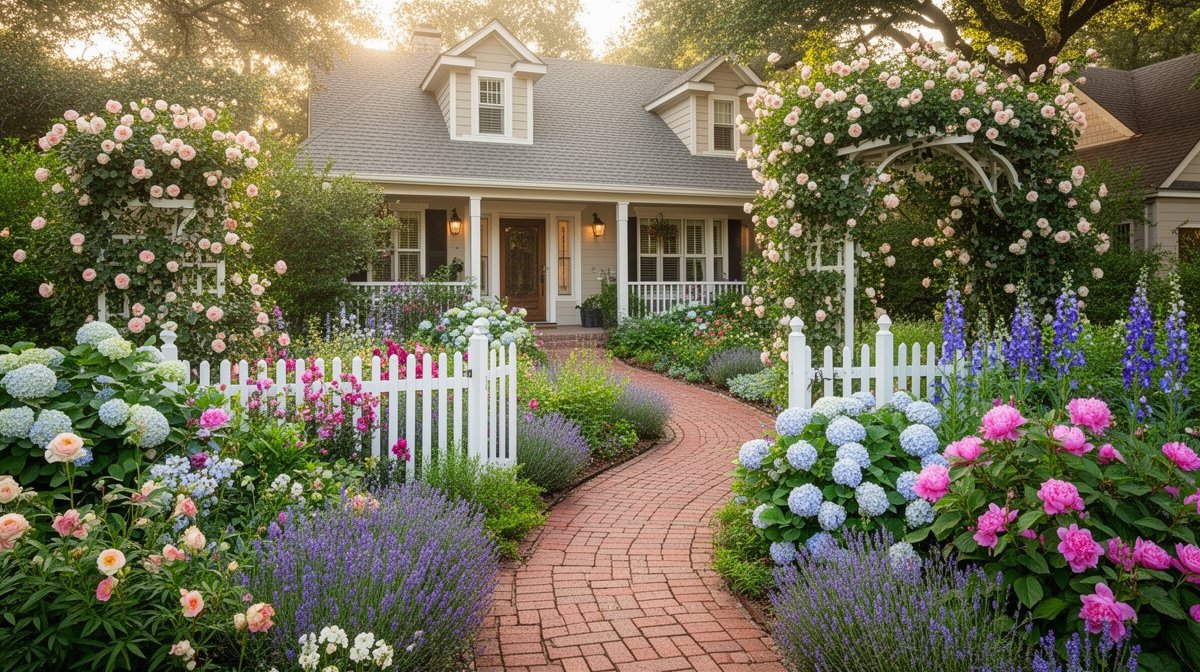
$16–30/sqftA pale-yellow cottage with a shingled roof and a deep columned porch — hanging baskets, a cushioned swing, a wreath on the door — is approached along an irregular Lueders limestone flagstone walk that curves rather than runs straight. A white-painted arbour carrying cream climbing roses marks the halfway point, and the beds on either side are packed shoulder-high with spires of foxglove, cones of purple echinacea, hot yellow rudbeckia, zinnias, red shrub roses and drifts of lavender and white daisies. A mature tree at the right holds a clean mulch ring, and narrow lawn panels between the beds keep the exuberance legible. This is the design that gets the most out of Waco's long spring: the foxgloves and larkspur peak in April, then the echinacea, rudbeckia and zinnias take over and hold until frost in late November.

The Bistro Circle Under the Arbour
$18–34/sqftIn the back garden of a white cottage with French doors, a slate roof and lattice porch skirting, a tall cedar arbour dripping with pink and cream climbing roses stands free in the middle of the lawn and frames a circular flagstone terrace just big enough for a white cast-iron bistro table and two ornate chairs. The circle is ringed by massed lavender in full bloom, with foxglove spires in pink, white and violet standing behind it, Shasta daisies threaded through, and broad-leaved evergreen clumps anchoring the front of the beds where an English garden would use hosta. Two mature trees close the canopy overhead, which is the reason this design works in Waco — a seating circle in full afternoon sun is unusable from June to September, and a seating circle under a high oak canopy is the best room in the house.

The Rose Pergola and Birdbath Lawn
$22–42/sqftA cream stucco boundary wall wraps a generous back garden, and a white-painted pergola attached to the house carries a heavy curtain of pink and ivory climbing roses over a teak dining table and six cane chairs on a pale stone terrace. The lawn is kept as one clean curved shape — that restraint is what makes the borders read as abundance instead of chaos — with a single circular island bed at its centre holding a cast-stone pedestal birdbath surrounded by low roses and annuals. The perimeter borders run deep with shrub roses in pink, peach and white, hazes of catmint and lavender, and a small fruit tree carrying red fruit at the far side. It is the most social of the four designs and the one that most rewards Waco's 250-day growing season and long, warm evenings.
See how a cottage/english garden looks on YOUR property
Upload a photo of your Waco yard and visualize your dream garden in seconds.
Try ProScapeAI Free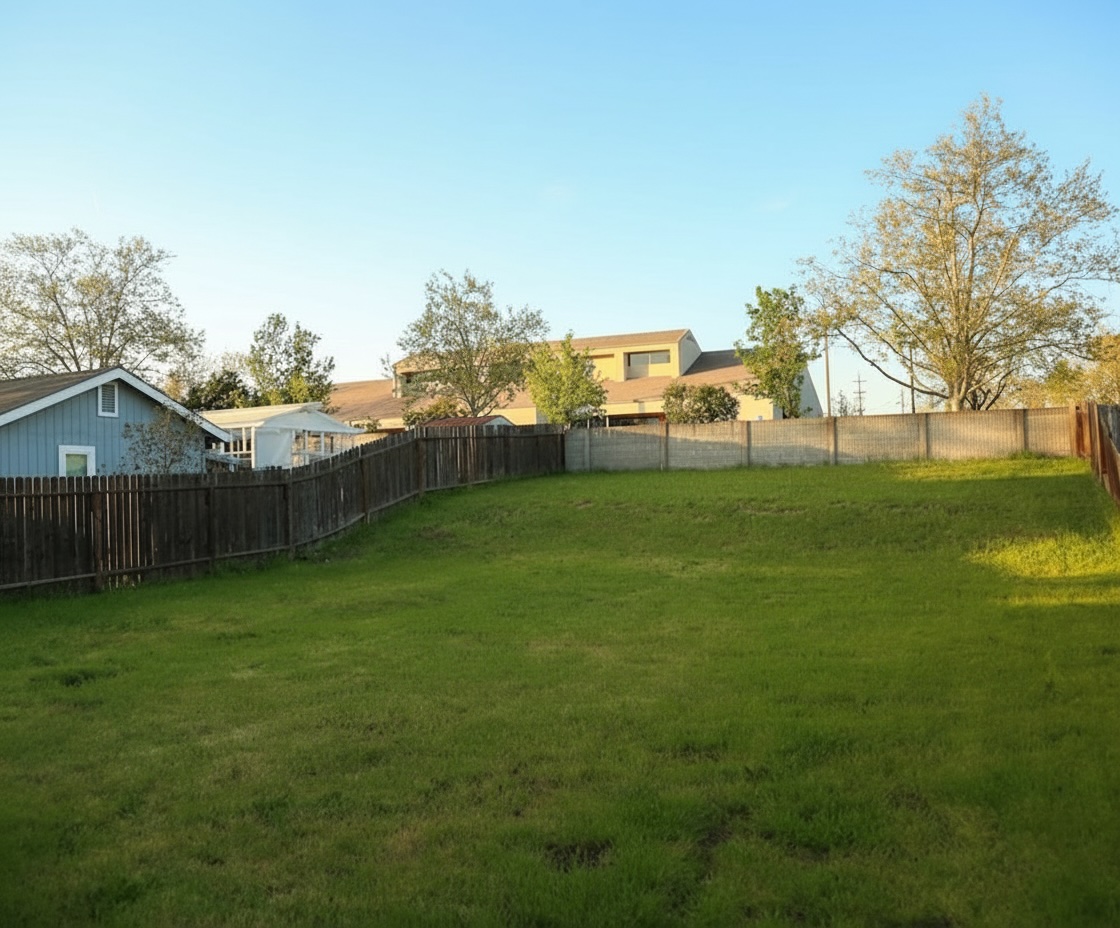
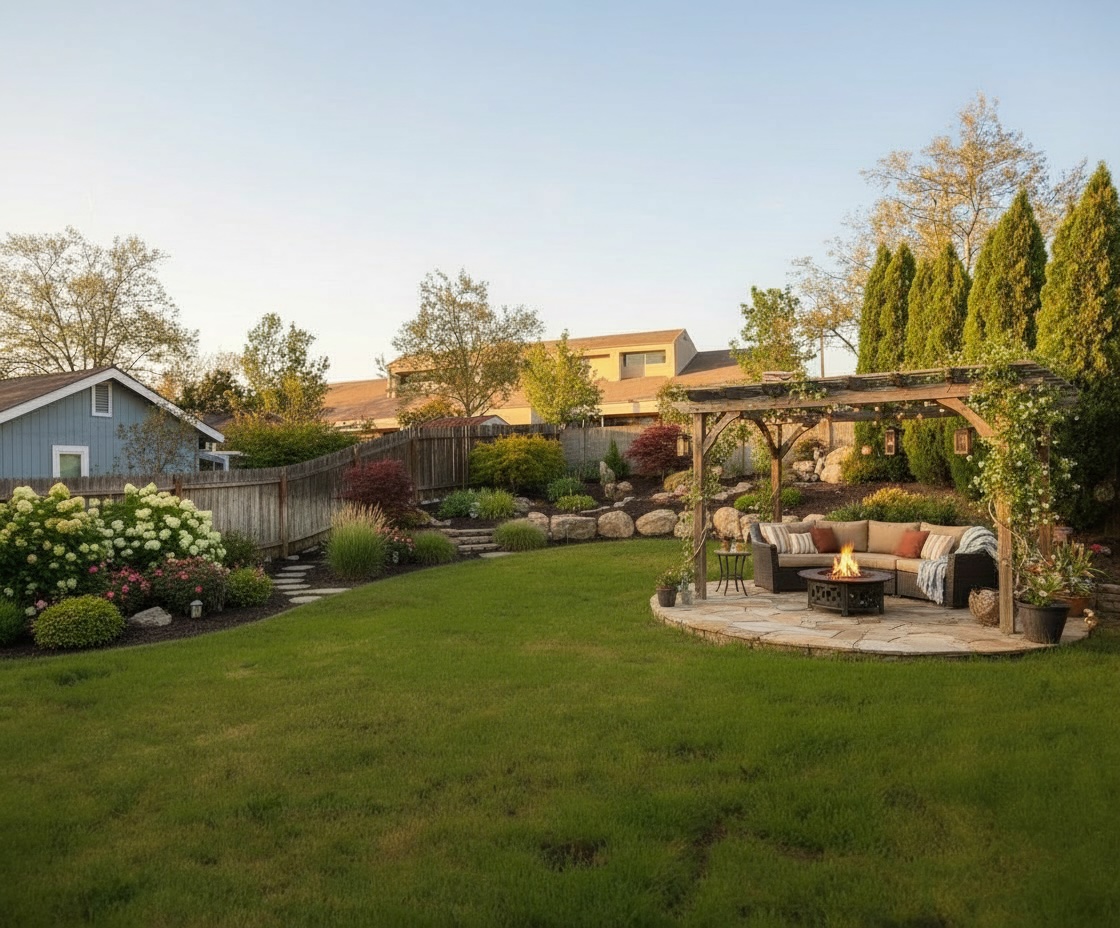
Featured Trees & Shrubs for Cottage/English Gardens
Browse all 156 plants for Waco
Texas Mountain Laurel
Sophora secundiflora
medium-sized at 12 feet, purple blooms in spring. Evergreen year-round.
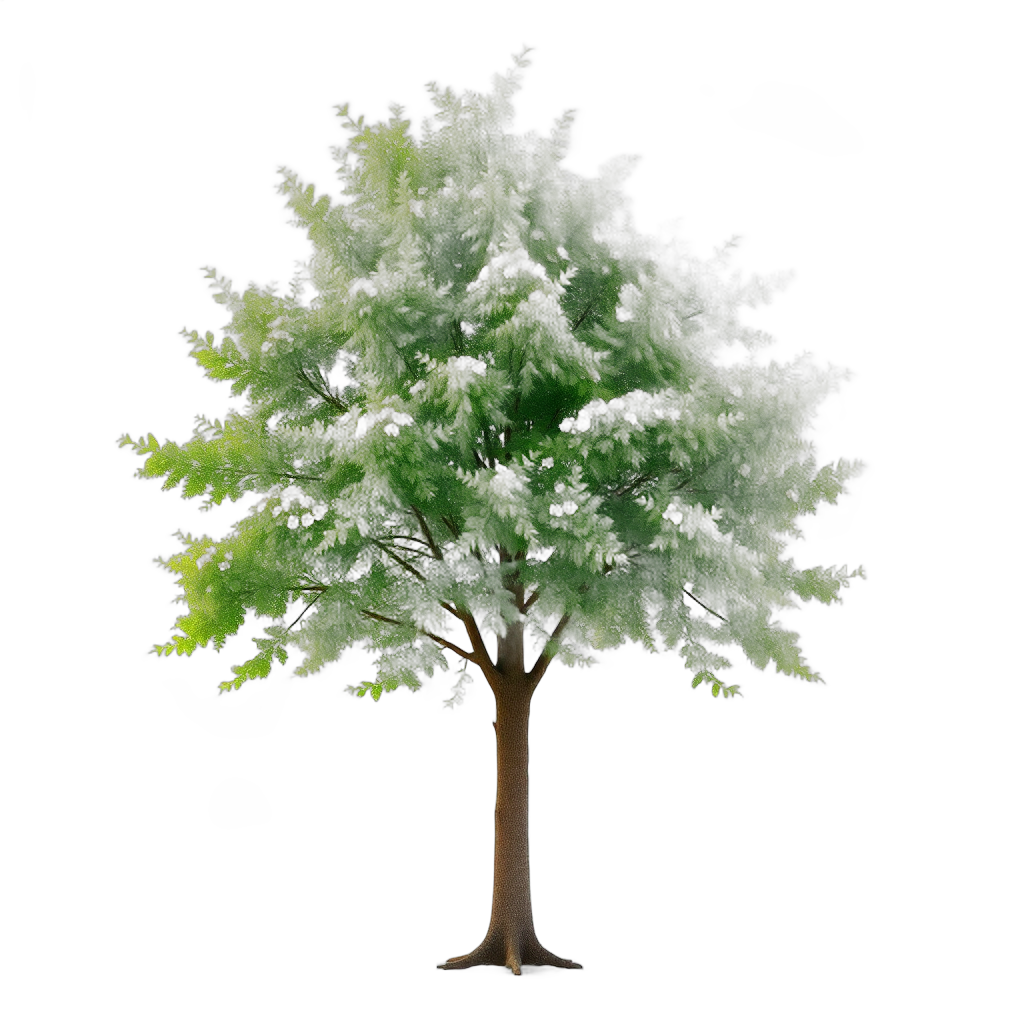
Cedar Elm
Ulmus crassifolia
large shade tree reaching 60+ feet, blooms in fall. Yellow fall color.

Oklahoma Redbud
Cercis reniformis
reaches 20 feet tall, purple blooms in spring. Attracts hummingbirds.

Osage Orange
Maclura pomifera
large shade tree reaching 50+ feet, blooms in spring. Yellow fall color.
Featured Grasses & Groundcovers for Cottage/English Gardens
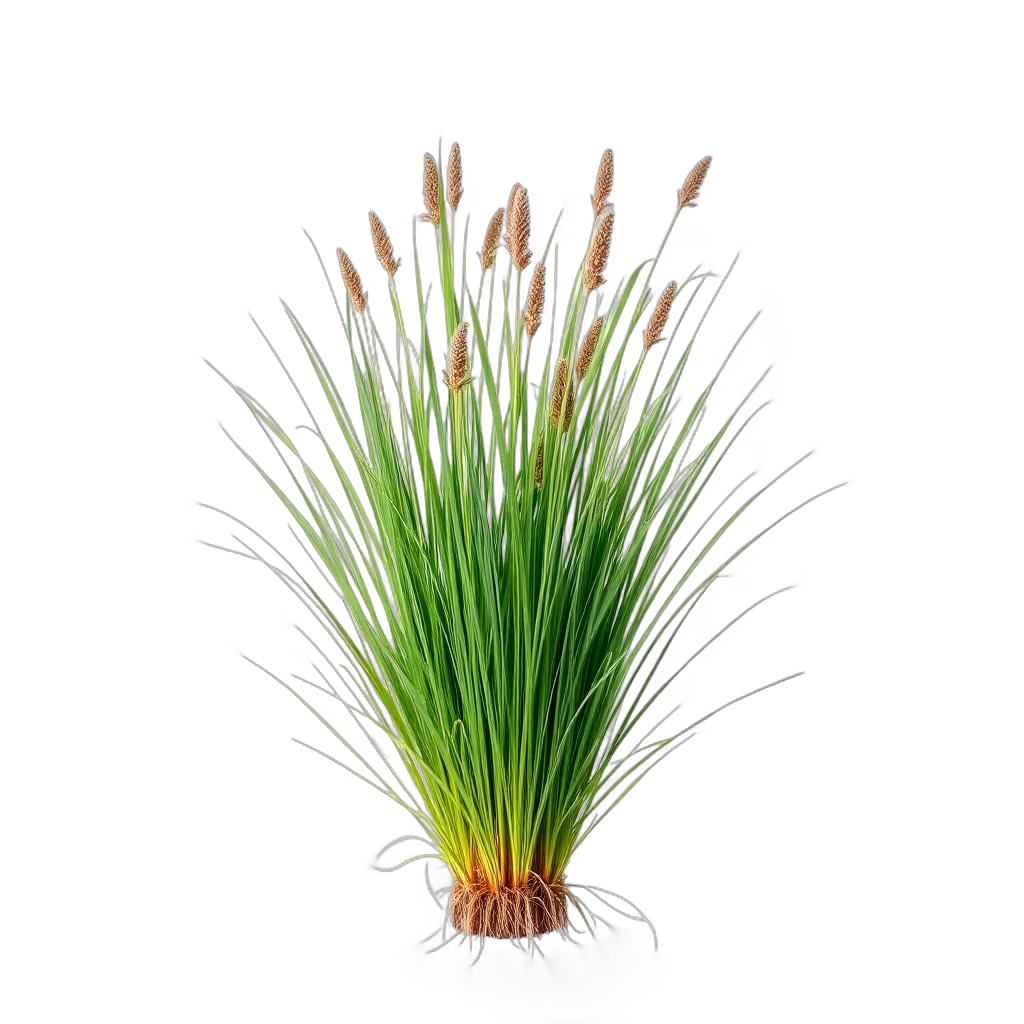
Lindheimer's Muhly
Muhlenbergia lindheimeri
grows to 4 feet, white blooms in fall.
Featured Flowers & Perennials for Cottage/English Gardens
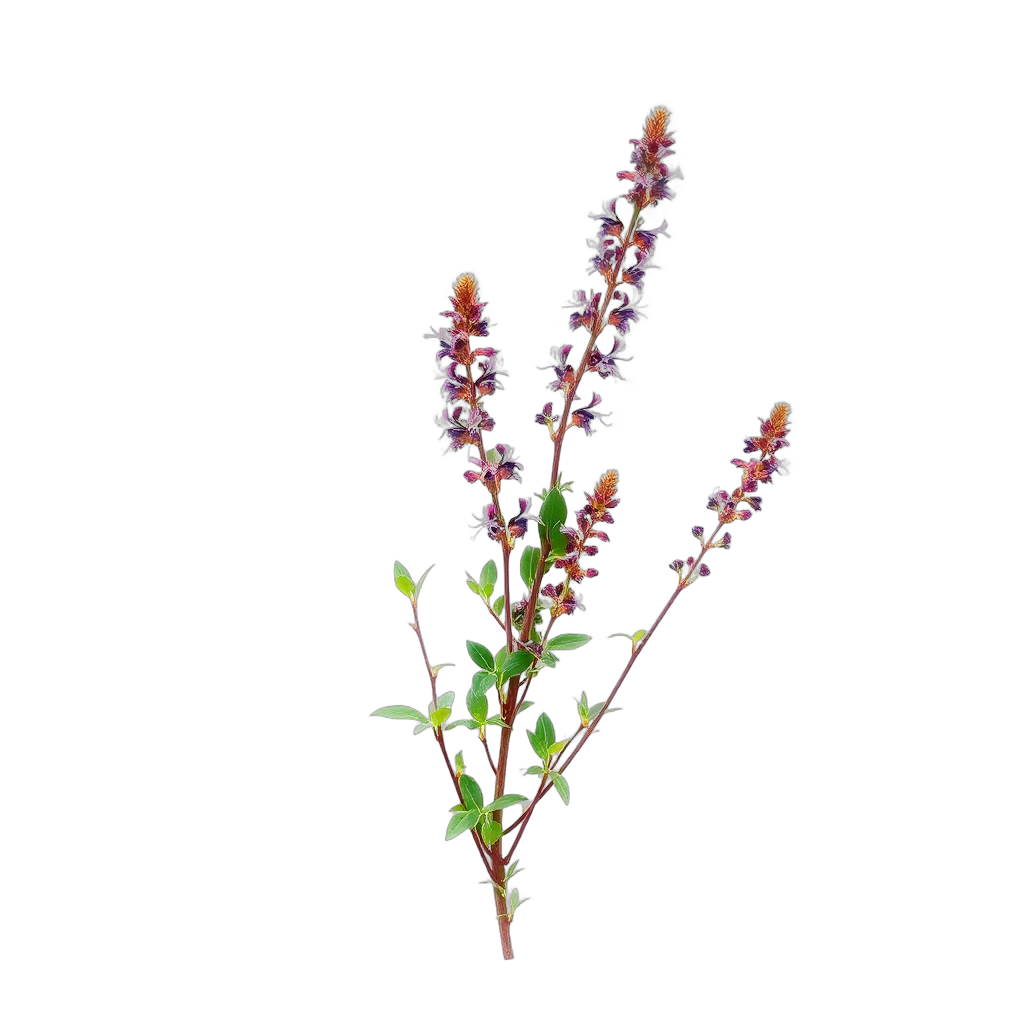
Mealy Cup Sage
Salvia farinacea
low-growing ground cover, blue blooms in summer. Attracts butterflies.
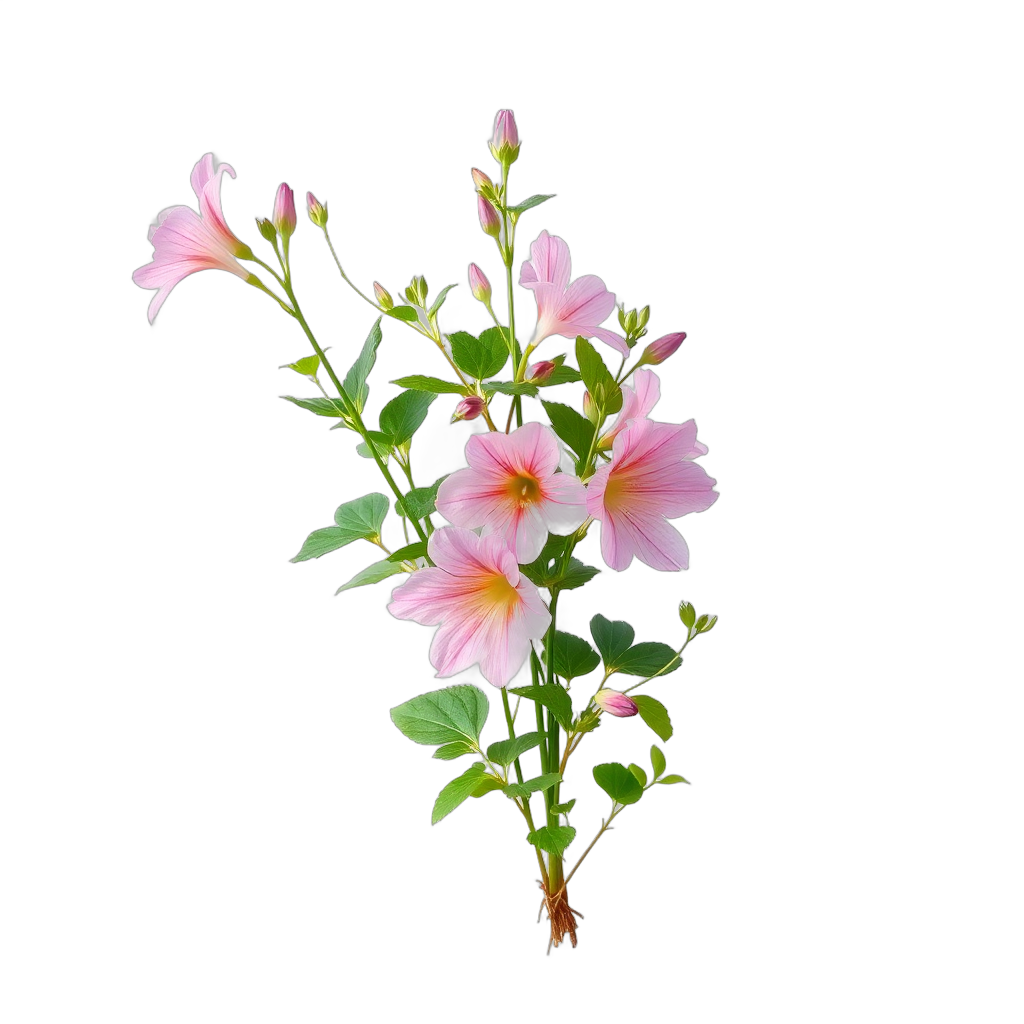
Pink Evening Primrose
Oenothera speciosa
low-growing ground cover, pink blooms in summer. Attracts butterflies.

Water Lettuce
Pistia stratiotes
low-growing ground cover, white blooms in summer. Evergreen year-round.

Tussock Sedge
Carex stricta
low-growing ground cover, blooms in spring. Brown fall color.
Zone and sun checks come from our database — confirm with your local nursery before you buy.
Bloom Calendar for Waco
spring
Texas Mountain Laurel, Oklahoma Redbud, Osage Orangesummer
Mealy Cup Sage, Pink Evening Primrose, Water Lettucefall
Mealy Cup Sage, Lindheimer's Muhly, Cedar Elmwinter
Limited bloomsDesign Tips for Waco (Zone 8b)
- Plant the whole cool-season layer in October — Digitalis purpurea 'Camelot Rose', larkspur, Iceland poppy and sweet pea only perform in Waco if they root through the mild winter; set out in March and they will bolt and fry before they flower
- Build every border up 8–12 inches with compost and expanded shale rather than digging into Houston Black clay; a hole dug in Blackland clay and backfilled soft becomes a bathtub the first wet May and rots the crowns you paid the most for
- Use Earth-Kind roses as the backbone — 'Belinda's Dream', 'Caldwell Pink', 'Ducher' and 'Marie Pavié' were trialled by Texas A&M AgriLife on exactly this alkaline clay and hold their leaves through a Waco August without a spray schedule
- Substitute Lavandula × intermedia 'Phenomenal' for English lavender and plant it on a gravel-mulched mound, not in mulch; the humidity, not the cold, is what kills lavender in a Cfa climate
- Keep one high canopy over the seating area — a pecan, cedar elm or live oak limbed up to 12 feet turns a bistro terrace from a June-to-September dead zone into the most-used room on the property, and it cuts the water demand of everything underneath it
- Repeat one flower colour at least five times down the length of a border; Waco's flat, hard summer light flattens a mixed cottage planting into visual noise unless a single recurring note — the blue of Salvia farinacea 'Henry Duelberg', say — carries the eye through it
- Mulch 3 inches deep and top it up in June, not just March; bare Blackland clay in an August heatwave hits soil temperatures that stall root growth entirely, and mulch is the cheapest irrigation you will ever buy
Where to Source Plants in Waco
Skip the big-box stores. These independent Waco nurseries specialize in the plants that make cottage/english gardens thrive in Zone 8b.
Westview Nursery & Landscaping
Lake Air / N Valley Mills Drive (second yard in Woodway)
Family-owned since 1954; the deepest local bench of alkaline-clay-proof trees, shrubs, roses and Texas-adapted grasses, plus irrigation and delivery
Greenlife Nursery & Landscaping
N New Road / Lake Air
Independent Waco grower of 30+ years; larger, better-watered 3-gallon shrubs than the box stores, plus annual and perennial hybrids trialled at the Dallas Arboretum
Garden City Central Texas
Belton (40 minutes south of Waco)
Family-owned retail garden centre carrying specimen trees from 5-gallon up to 200-gallon, roses, bedding stock and a delivery-and-planting crew
Earthscapes Garden & Home
Temple (Loop 205, 35 minutes south of Waco)
Landscape-architecture firm since 1987 with an attached garden centre: Texas natives, ornamental trees, roses, herbs and soils blended for Blackland clay
Cottage/English Landscaping Costs in Waco
| Project Scope | Estimated Cost |
|---|---|
| Front-yard cottage conversion (picket fence, arbour, brick walk, two borders) | $9,000 – $20,000 |
| Lueders limestone flagstone walk or bistro circle (120–250 sqft) | $3,500 – $9,500 |
| Cedar rose arbour or pergola, built and finished | $1,800 – $9,000 |
| Full back-garden cottage design with terrace and deep borders | $18,000 – $45,000 |
| Raised bed soil build-up (compost + expanded shale, per 100 sqft) | $350 – $700 |
| Drip irrigation retrofit for planting beds | $2,500 – $6,000 |
| AI visualization with ProScapeAI | Free to start |
Estimates based on Waco, TX-area contractor rates as of 2026. Actual costs vary by site conditions, materials, and contractor.
Waco Climate & Growing Zone
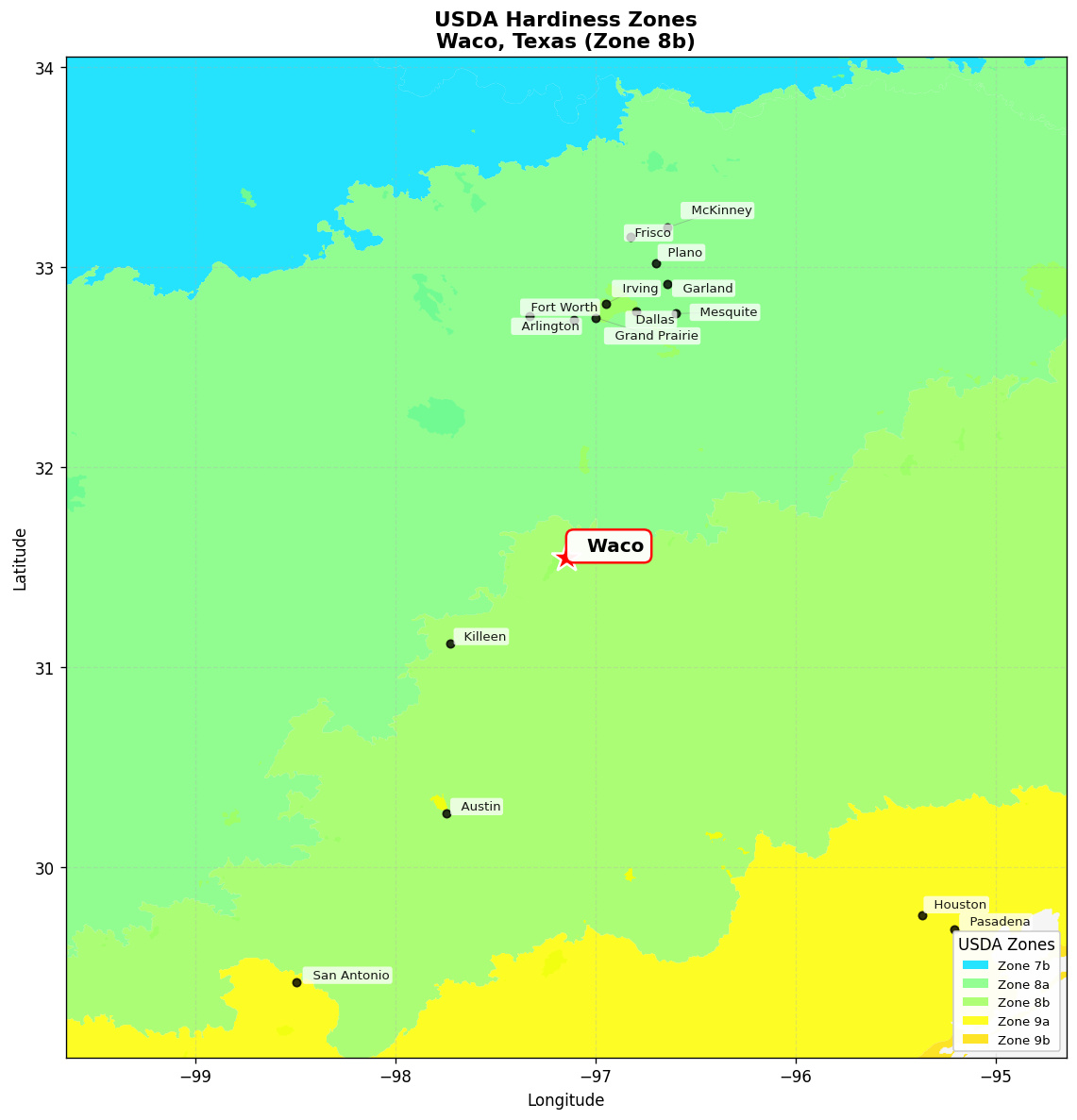
USDA Zone 8b
Hardiness zone for Waco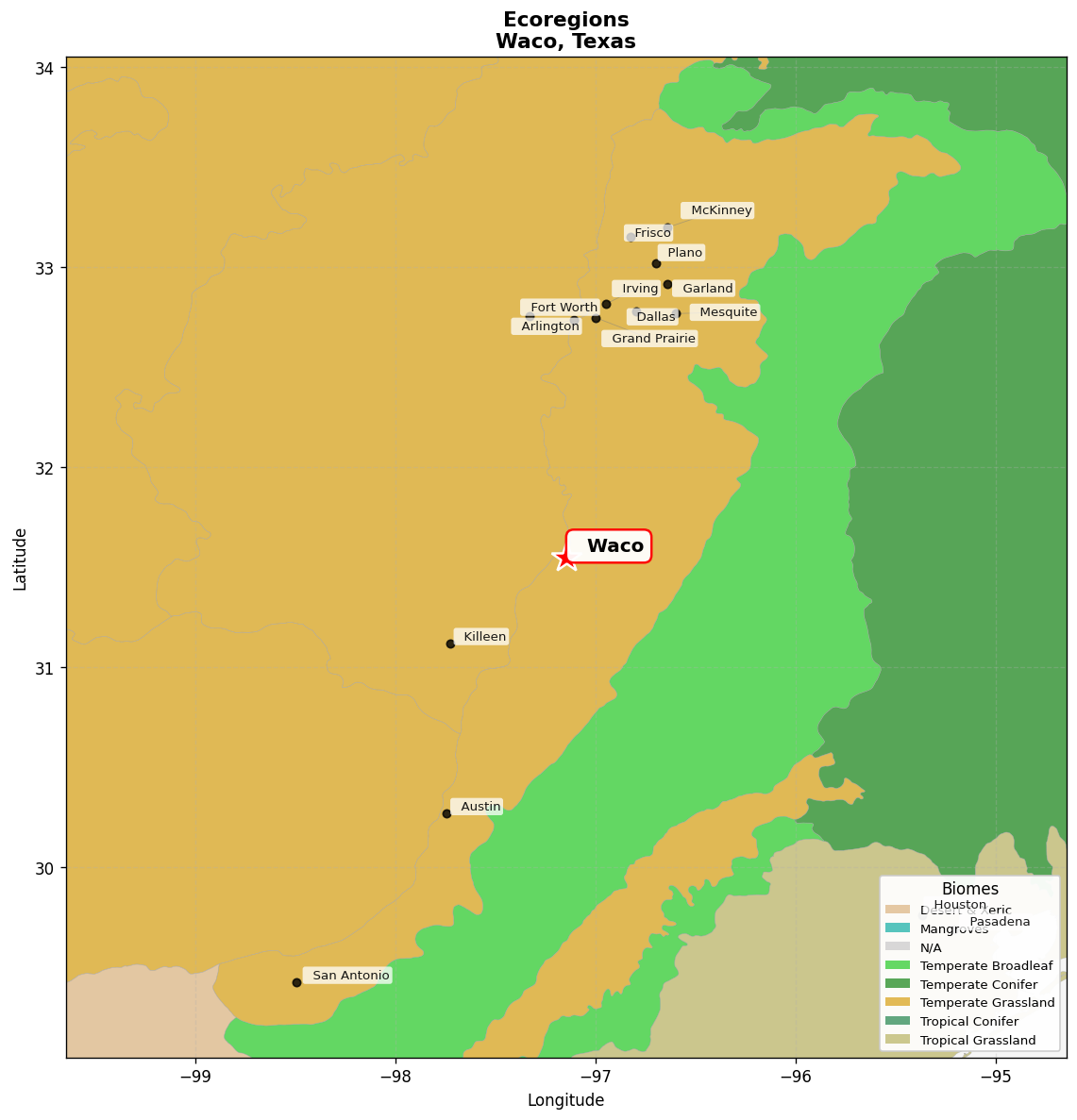
Texas blackland prairies
Native ecoregionFrequently Asked Questions
Can you really grow an English cottage garden in Waco's heat?
Yes, but you swap roughly a third of the plant list. The structure — picket fence, arbour, brick or flagstone walk, deep layered borders — is unchanged. The substitutions are specific: Lavandula × intermedia 'Phenomenal' or 'Provence' instead of Lavandula angustifolia 'Munstead', which rots in Cfa humidity; Salvia farinacea 'Henry Duelberg' or Salvia greggii 'Furman's Red' where an English border would use delphinium; Rosa 'Belinda's Dream' and 'Caldwell Pink' instead of hybrid teas; Aspidistra elatior and Heuchera villosa 'Autumn Bride' instead of hosta; and Digitalis purpurea grown as a fall-planted annual rather than a biennial. Do that and the garden looks English in April and still looks intentional in the second week of August.
What does a cottage garden cost in Waco?
Central Texas install rates run roughly 10–20% under the national metro average, which makes this an unusually affordable style here. A full front-yard cottage conversion on a typical 600 sqft Waco front yard — picket fence, rose arbour, brick walk and two deep borders — lands between $9,000 and $20,000 installed. A flagstone bistro circle with surrounding beds runs $6,000–$14,000. A rose pergola over a dining terrace runs $12,000–$30,000 depending on the terrace material. Doing the planting yourself and paying only for the hardscape typically cuts 30–40% off those numbers, because plants are the cheap part in a city with nurseries like Westview and Greenlife.
How do I plant roses in Waco's black clay?
Never dig a hole and backfill it with soft potting soil — on Houston Black clay that creates a bathtub that drowns the rose in a wet May. Build up instead: mound or berm the bed 8–12 inches above grade with a blend of native soil, compost and expanded shale, and set the graft or crown proud of the surrounding grade. Because Waco clay runs pH 7.8–8.2, choose roses that shrug off alkalinity: 'Belinda's Dream', 'Caldwell Pink', 'Ducher', 'Marie Pavié', 'Mutabilis', and for climbers 'Peggy Martin', 'New Dawn' and 'Climbing Pinkie'. Feed with an iron-inclusive fertiliser in March and again in early September, and mulch 3 inches deep to buffer the summer soil temperature.
When should I plant a cottage garden in Waco?
October and November are the best planting window by a wide margin. Waco's average last freeze falls around 12–15 March and the first freeze around 22–28 November, so a fall-planted border spends five mild months putting down roots before it ever meets a 100°F day. Foxglove, larkspur, snapdragon, poppies and sweet pea must be sown or set out in October to bloom the following April. February to early March is the second window for roses and woody shrubs. Avoid planting anything from mid-June through mid-September; even with drip irrigation, new roots in Blackland clay rarely establish while the soil is baking.
What are the watering rules in Waco, and how thirsty is this style?
Waco's supply comes from Lake Waco, and Waco Water Utility Services operates a stage-based drought contingency plan that restricts watering days and bans midday sprinkler use as lake levels fall, so confirm the current stage with the city before you finalise an irrigation design. Drip and hand-watering are usually treated more leniently than spray, which is exactly why a well-designed Waco cottage garden puts inline drip under the borders and keeps spray heads only on the lawn. Concentrate the thirsty roses, foxglove and lavender within about 15 feet of the house and hose bib, and let the outer borders run on Blackland Prairie stock — Echinacea purpurea 'Magnus', Callirhoe involucrata, Liatris mucronata, Muhlenbergia lindheimeri — that lives on 36 inches of rain.
Which plants should I avoid in a Waco cottage garden?
Anything that needs acid soil will yellow and stall in Houston Black clay: azalea, gardenia, blue-flowered hydrangea, camellia in exposed sites, blueberry and pin oak all show iron chlorosis within a season. Skip Lavandula angustifolia, delphinium and true peony — they need a cold winter and a dry summer Waco does not have. Bearded iris, by contrast, is superb here. Also think twice about English boxwood: Buxus sempervirens 'Suffruticosa' struggles with heat and blight in Central Texas, while Buxus microphylla var. japonica 'Green Beauty' or Ilex vomitoria 'Nana' give you the same clipped cottage edge without the losses.
Do brick and flagstone paths hold up on Waco's clay?
They hold up better than concrete does, provided they are built to flex. Houston Black clay has a high shrink-swell potential, and it will crack a rigid mortared slab within a few seasons of Waco's wet-spring, cracked-earth-August cycle. Reclaimed street brick or Lueders limestone flagstone set on 4–6 inches of compacted crushed limestone with sand-swept or polymeric joints simply moves with the ground and can be relevelled in an afternoon. Add a steel or brick soldier-course edge to keep the field from creeping, and slope everything a quarter-inch per foot away from the house — standing water against a slab is a bigger problem in Waco than any planting decision.