4 Cottage Garden Ideas for Aurora, IL | English-Style Landscape Design in Zone 5b
Native plants from the Central US forest-grasslands transition (Zone 5b) — Humid continental (hot summer) climate
Why Cottage/English Gardens in Aurora?
Aurora may be the one Chicago-area suburb that was practically built for cottage gardens. The Victorian and American Foursquare homes of the Tanner and Near Eastside historic districts, the west-side bungalows above the Fox River, and the front-porch neighborhoods around downtown and Stolp Island give the English cottage style exactly the architectural backdrop it wants — and even the newer subdivisions out east in Fox Valley Villages, Stonebridge, and Oakhurst have the generous lawns and traditional facades that a picket fence and a rose arbor instantly transform. In the City of Lights, a garden that blooms from May to October is the best kind of curb appeal.
The secret advantage here is under your feet. Aurora sits in the old tallgrass prairie belt, and its deep, black silt-loam topsoil is some of the most fertile garden ground in America — the same soil that grew eight-foot big bluestem now grows delphiniums, peonies, and foxgloves with almost embarrassing ease. Zone 5b winters (lows of -15 to -10°F) and roughly 38 inches of annual rain actually favor the English classics: peonies and delphiniums need the cold that makes them sulk in the South, and summer rain keeps borders going with little irrigation. The honest substitutions: skip tender hybrid tea and most climbing roses in favor of own-root hardy shrub roses and Canadian Explorer climbers like 'William Baffin' and 'John Cabot', which shrug off -30°F without winter protection, and treat English lavender ('Hidcote', 'Munstead') as a plant that demands a raised, gravelly spot — or swap in catmint and Russian sage for the same silvery-purple effect with zero risk.
The practical realities are manageable if you plan for them. That famous prairie topsoil often sits over dense clay subsoil, so borders benefit from a few inches of compost worked in and roses appreciate slightly mounded beds. Northern Illinois frost reaches 42 inches down, which means arbor posts, pergola footings, and fence posts need to be set below frost depth or they will heave. Hold off planting tender material until after Aurora's average last frost in early-to-mid May, and give everything a shredded-leaf or bark mulch before the first hard freeze in mid-October. Do that, and a cottage border here largely runs itself — the rain does most of the watering, the soil does most of the feeding, and natives like purple coneflower and prairie phlox blend into the borders as if the style were invented for the Fox Valley.
4 Cottage/English Design Ideas for Aurora
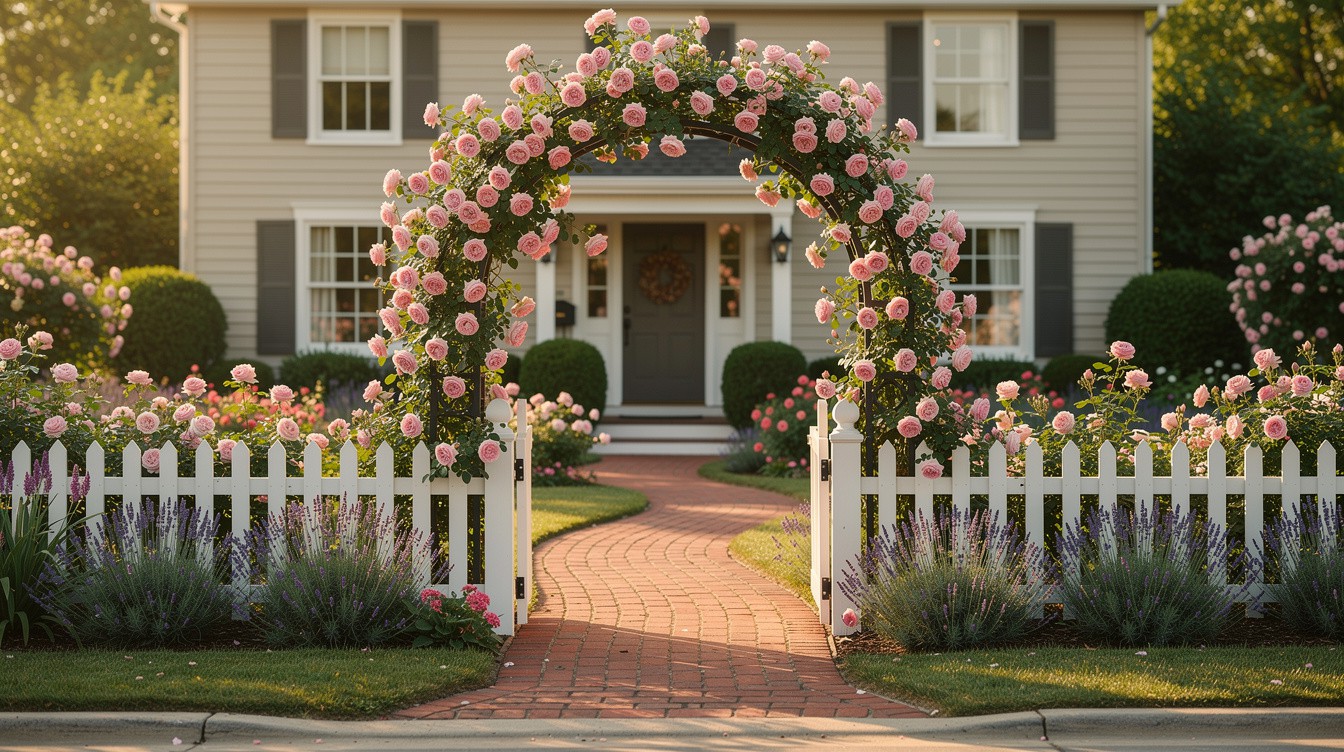
The Picket Fence Rose Walk
$12–22/sqftA classic two-story colonial framed the way a storybook demands: a low white picket fence runs the full frontage, a curved red-brick path leads to the door, and a black iron arch over the gate drips with pink climbing roses. Rows of lavender-toned bloom spill against the fence from both sides while pink shrub roses mass behind the pickets and clipped green mounds anchor the foundation. In Aurora, build this with Canadian Explorer climber 'William Baffin' on the arch — it delivers this exact pink flush and laughs at Zone 5b winters — and use catmint or 'Hidcote' lavender in a raised, gritty strip along the fence line.
The Porch-and-Arbor Cottage
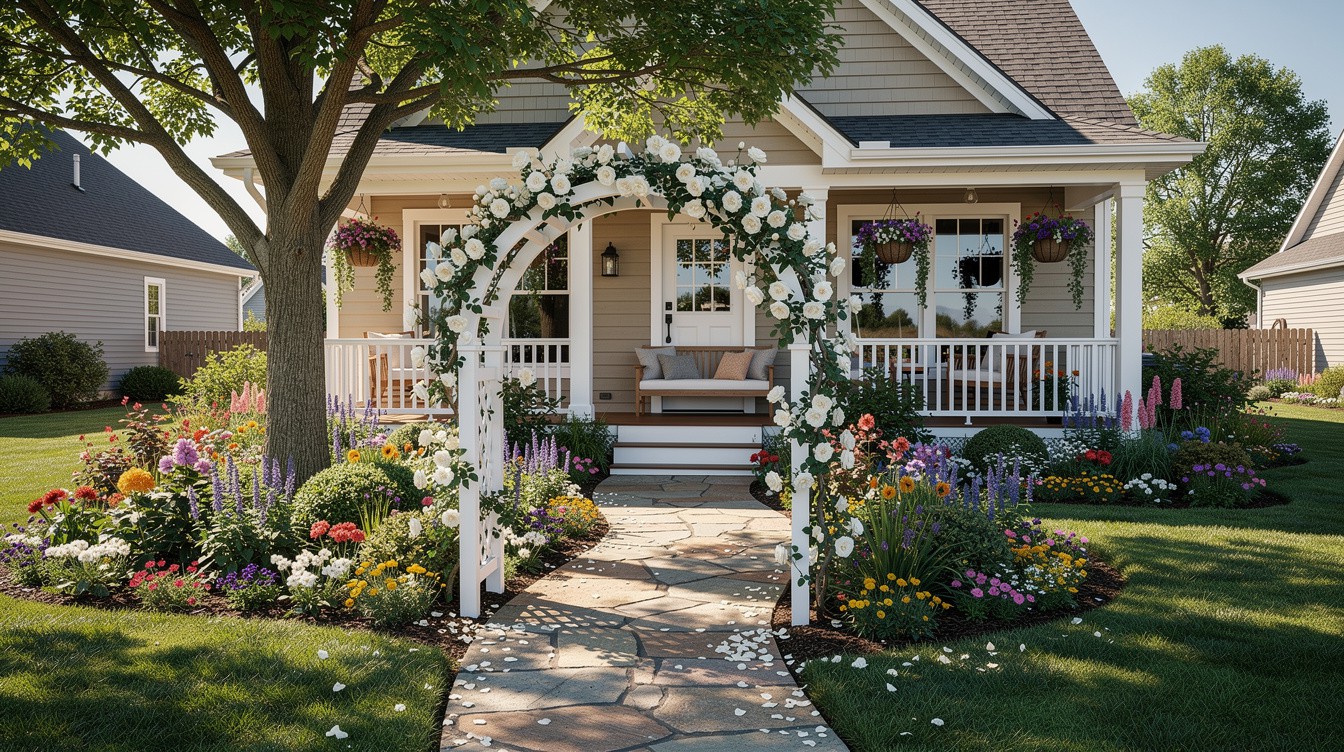
$10–20/sqftA shingled craftsman cottage with a deep front porch — swing bench, hanging baskets, white railings — reached through a white lattice arbor smothered in white climbing roses. The flagstone path is edged by exuberant mixed borders where lupines, salvia, daisies, zinnias, and dahlias jostle in full cottage chaos under a mature shade tree. This is the highest-color idea of the four, and Aurora's prairie loam is exactly the soil that can feed it; plant the borders in drifts of three and five, let self-seeders fill the gaps, and swap the white climber for ultra-hardy 'John Cabot' or a white clematis on the arbor.
The Garden-Room Tea Patio
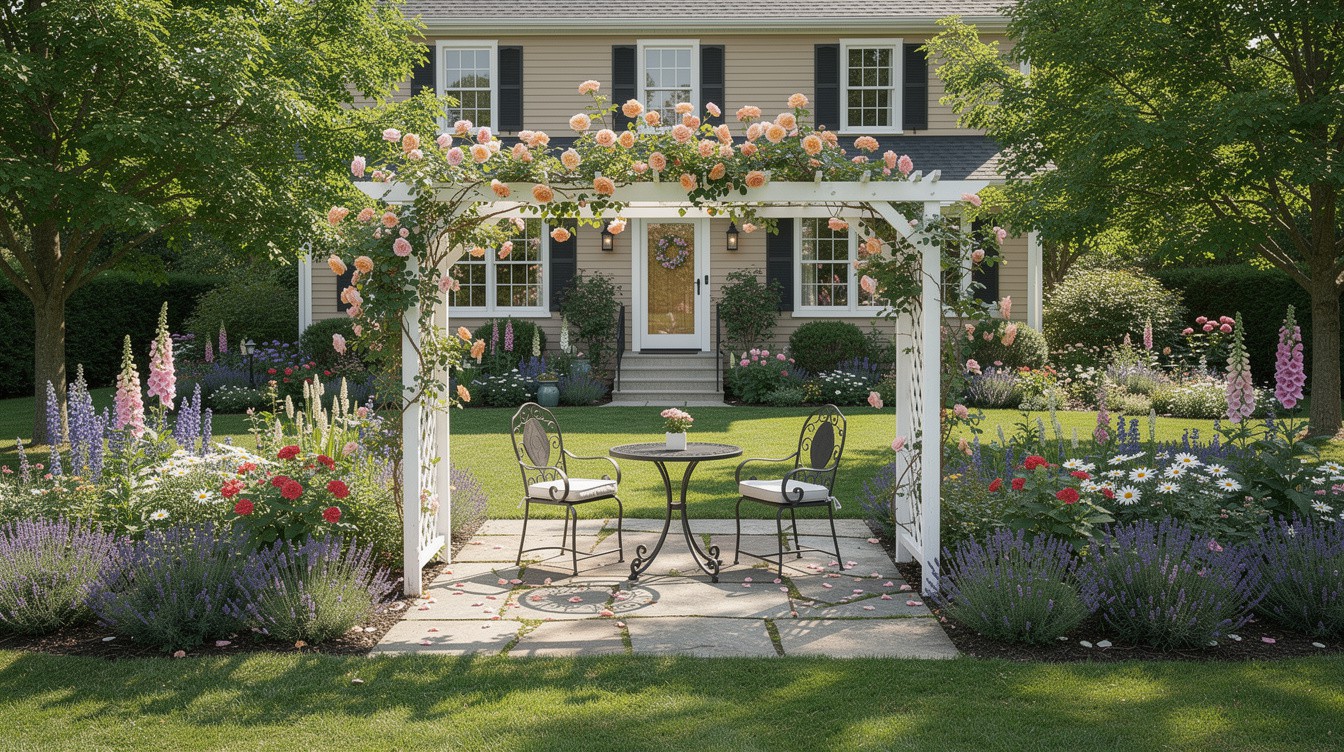
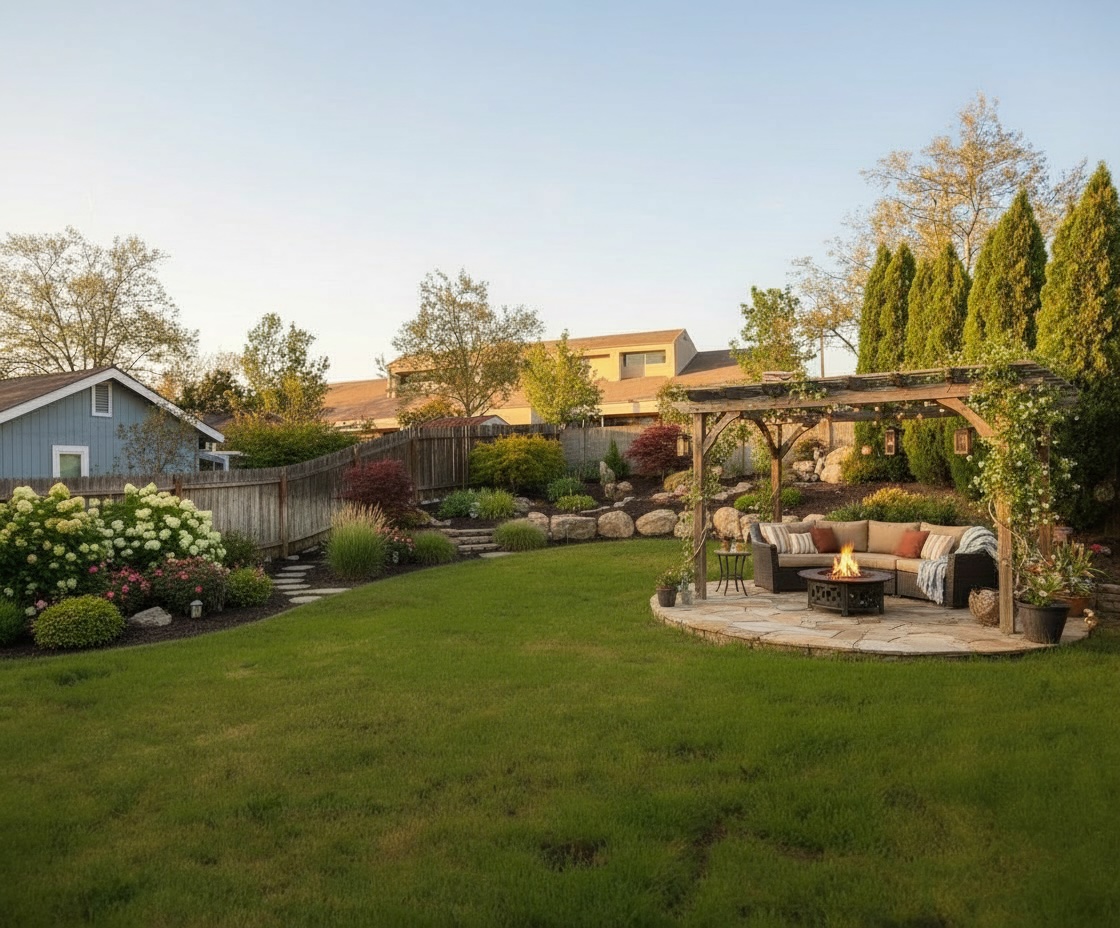
$18–30/sqftInstead of hiding the sitting area out back, this design plants it in the garden itself: a white open pergola frames a small cut-bluestone patio with a wrought-iron bistro table and two chairs, positioned in the lawn like an outdoor room. Peach and apricot climbing roses wind over the pergola beams, and the surrounding borders read like a June perennial catalog — pink foxglove spires, lavender-blue catmint, red roses, white daisies. The pergola posts must be set below Aurora's 42-inch frost line, and the peachy climbers are the one honest substitution: use 'Above and Beyond' (apricot, Zone 3) or an apricot honeysuckle to get this color reliably in 5b.
The Songbird Fountain Garden
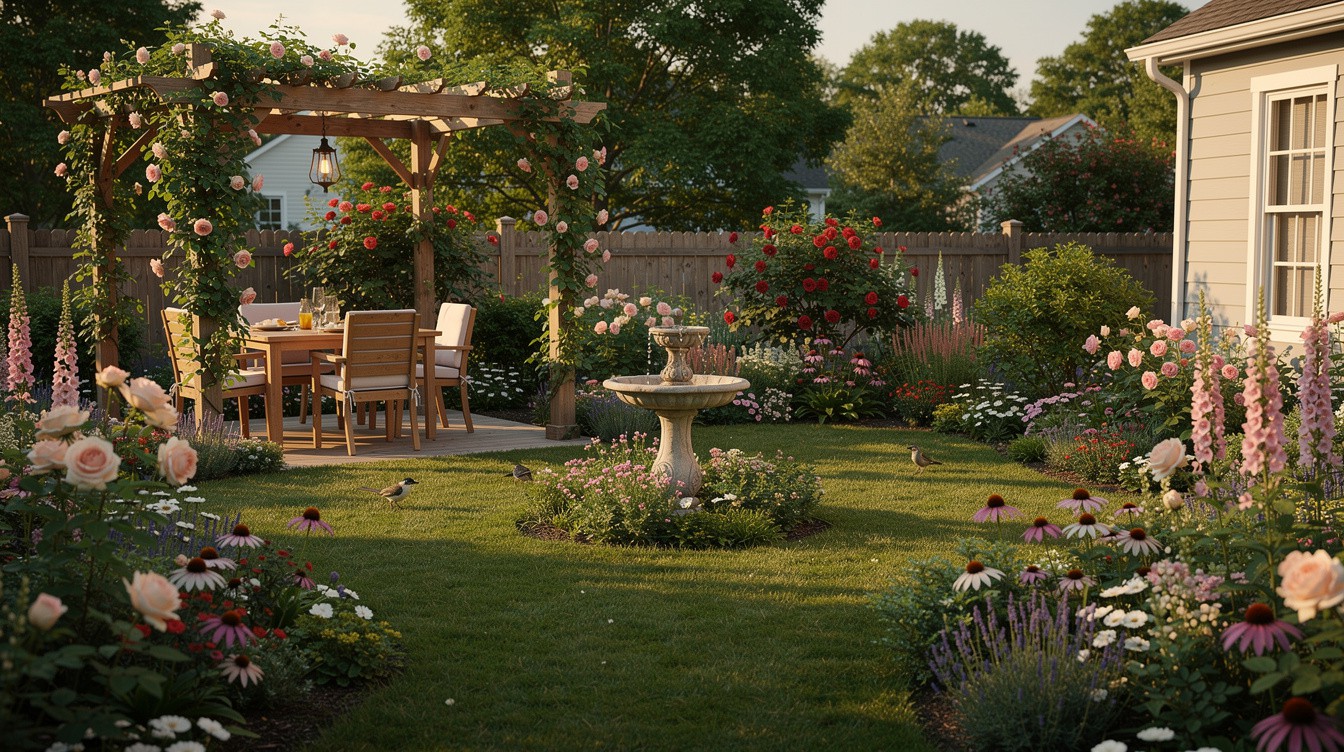
$15–28/sqftA backyard built around two focal points: a cedar pergola dining area wrapped in pink and red climbing roses in one corner, and a tiered stone fountain set in a circular island bed at the center of the lawn, ringed with pink blooms and visited by the sparrows and finches the water reliably attracts. The borders along the wood privacy fence are pure Fox Valley — purple coneflowers, foxgloves, lavender-blue catmint, shrub roses, daisies — mixing English romance with Illinois natives. Drain the fountain before Thanksgiving; everything else in this garden overwinters in place, and the coneflower seedheads feed goldfinches into January.
See how a cottage/english garden looks on YOUR property
Upload a photo of your Aurora yard and visualize your dream garden in seconds.
Try ProScapeAI Free
Featured Trees & Shrubs for Cottage/English Gardens
Browse all 169 plants for Aurora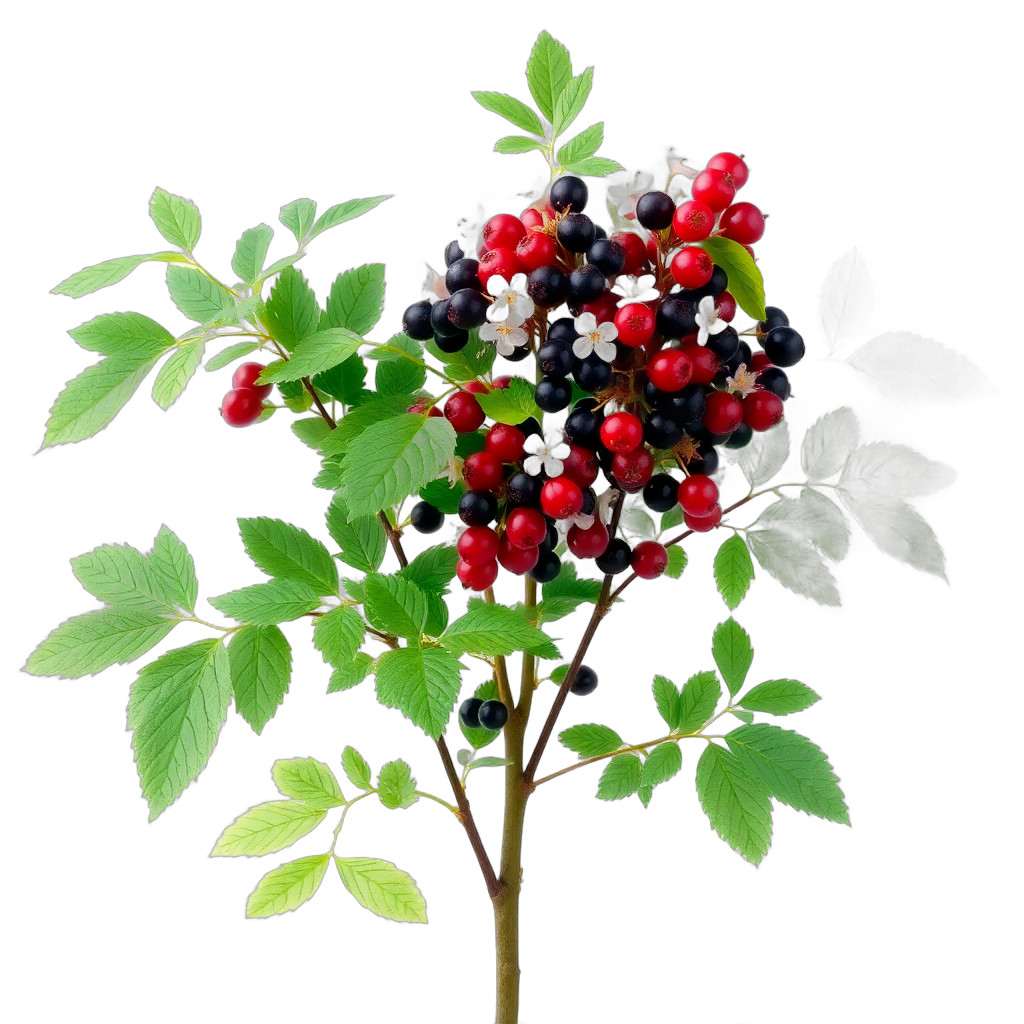
American Black Currant
Ribes americanum
grows to 5 feet, white,yellow blooms in spring. Attracts hummingbirds.
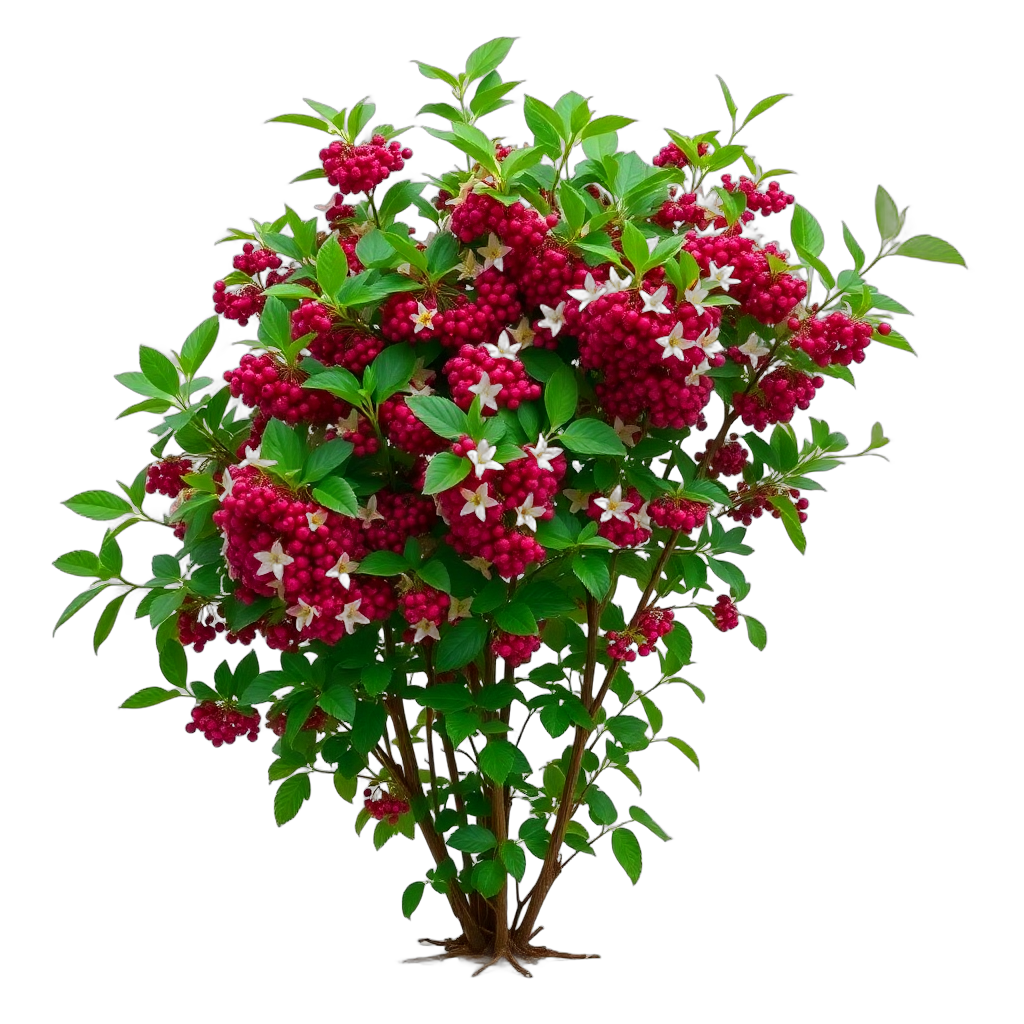
Clove Currant
Ribes odoratum
grows to 6 feet, yellow blooms in spring. Attracts hummingbirds.

Fragrant Sumac
Rhus aromatica
grows to 4 feet, yellow blooms in spring. Attracts butterflies.

Golden Currant
Ribes aureum
grows to 6 feet, yellow blooms in spring. Attracts hummingbirds.
Featured Grasses & Groundcovers for Cottage/English Gardens
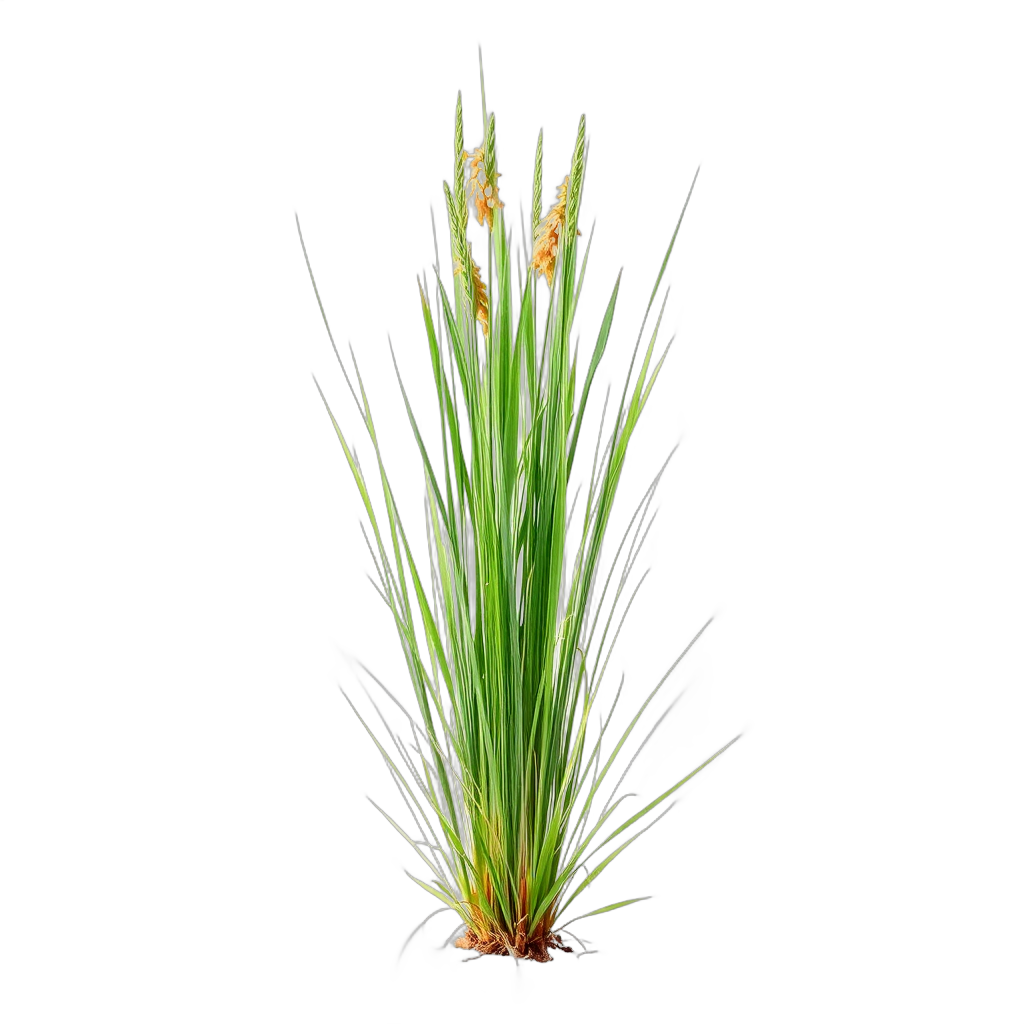
Eastern Gamagrass
Tripsacum dactyloides
grows to 6 feet, blooms in summer. Yellow fall color.
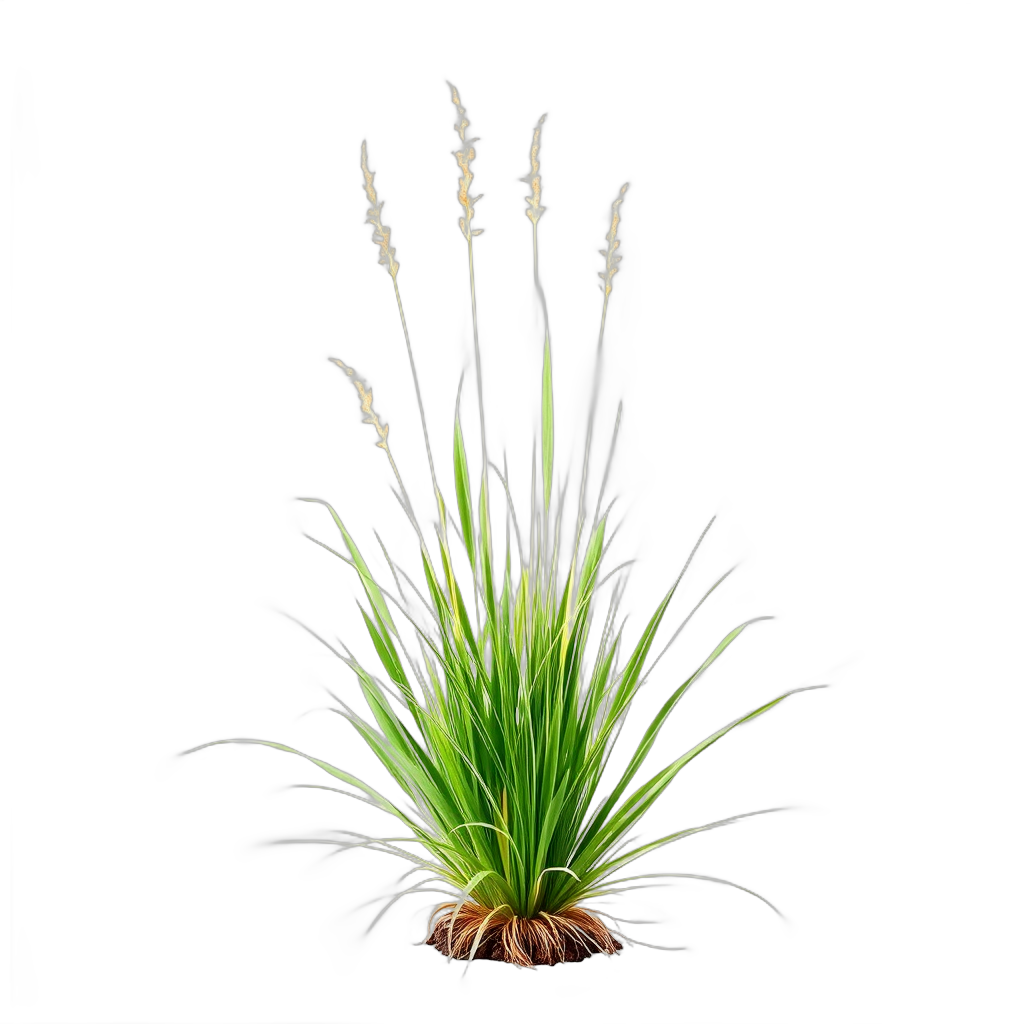
Northern Sea Oats
Chasmanthium latifolium
grows to 4 feet, blooms in fall. Bronze fall color.
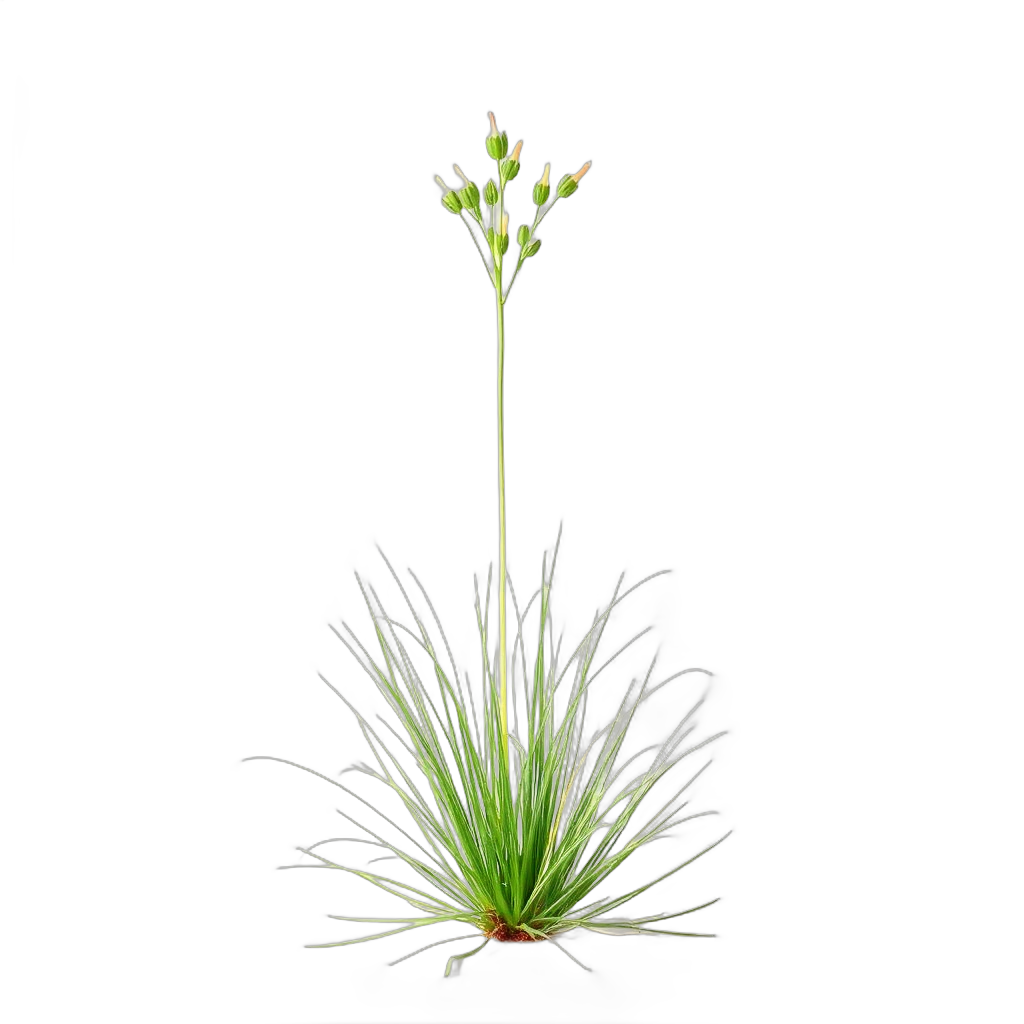
Alkali Sacaton
Sporobolus airoides
grows to 3 feet, blooms in summer. Yellow fall color.

Arrow Bamboo
Pleioblastus chino
medium-sized at 10 feet, blooms in none. Evergreen year-round.
Featured Flowers & Perennials for Cottage/English Gardens
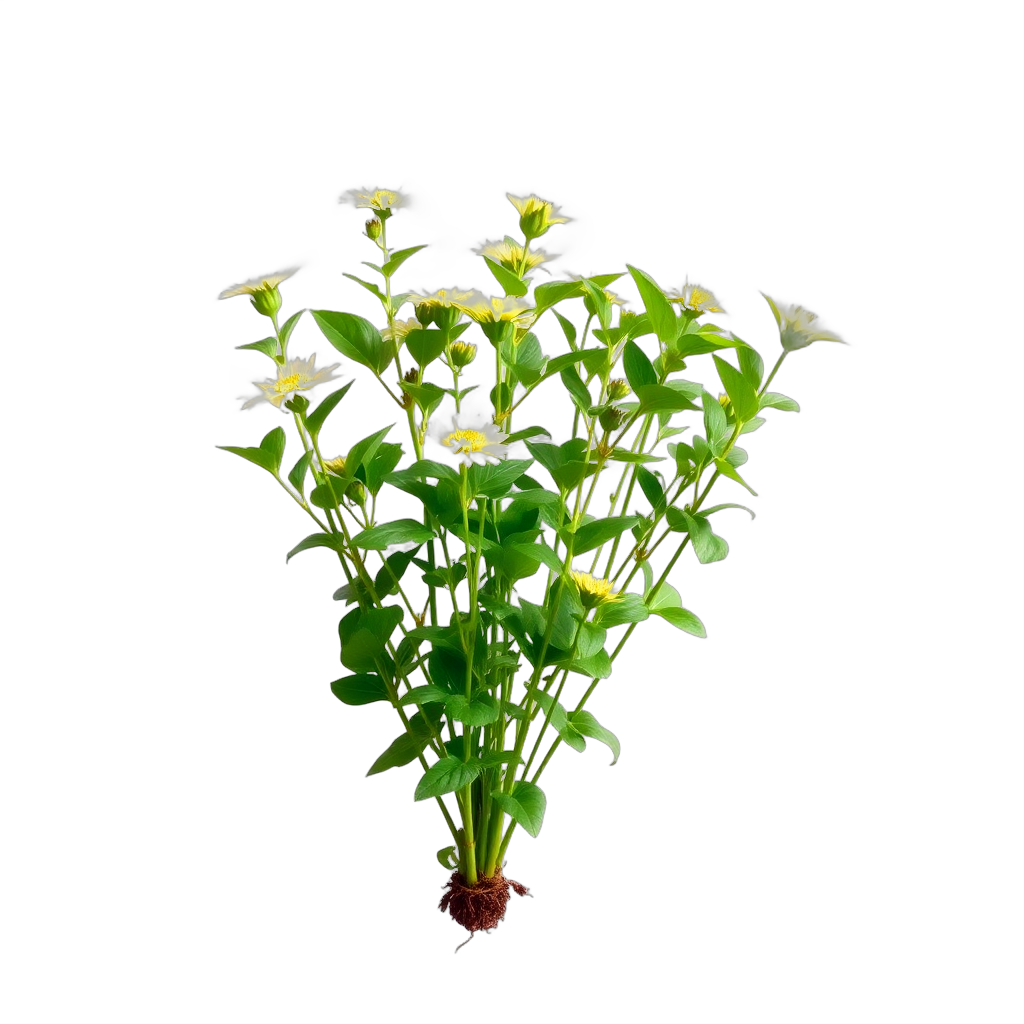
Cup Plant
Silphium perfoliatum
medium-sized at 7 feet, yellow blooms in summer. Attracts butterflies.
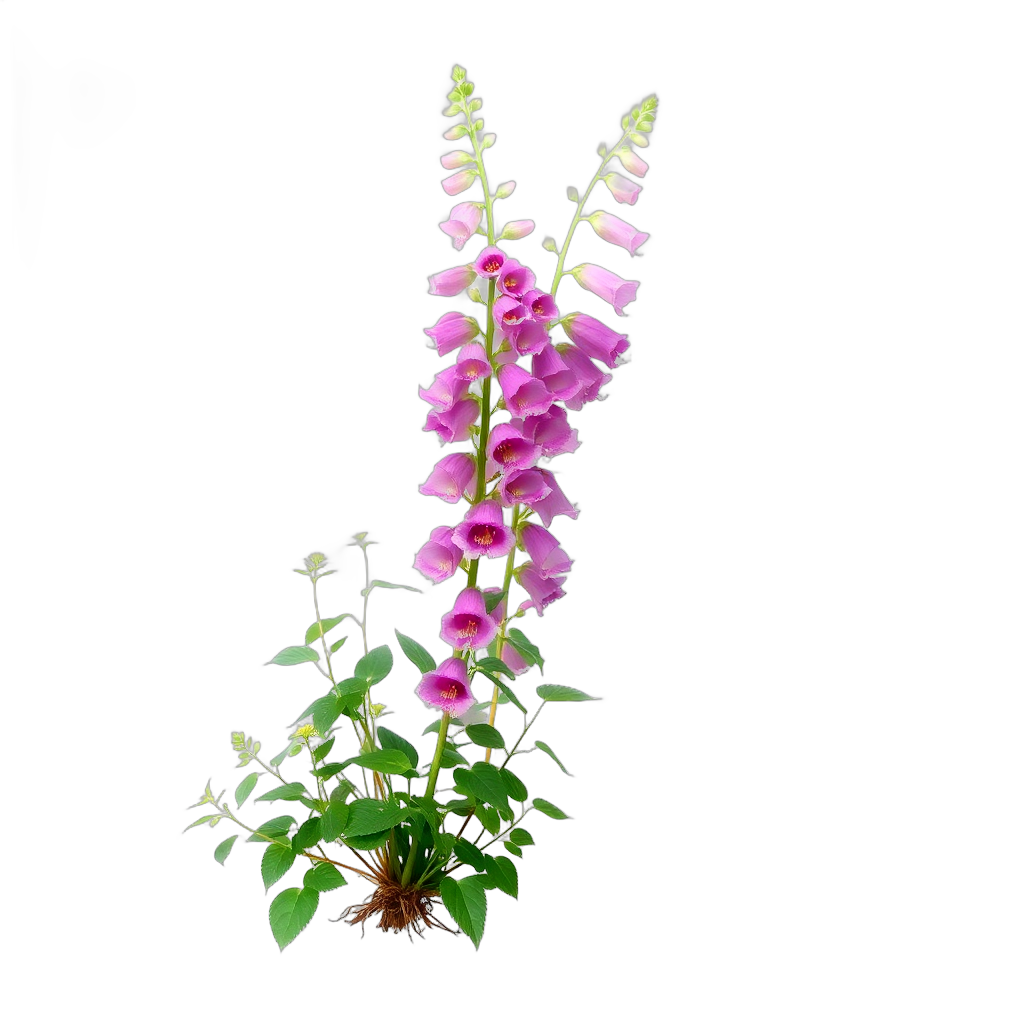
Foxglove Beardtongue
Penstemon digitalis
grows to 3 feet, white blooms in spring. Attracts hummingbirds.
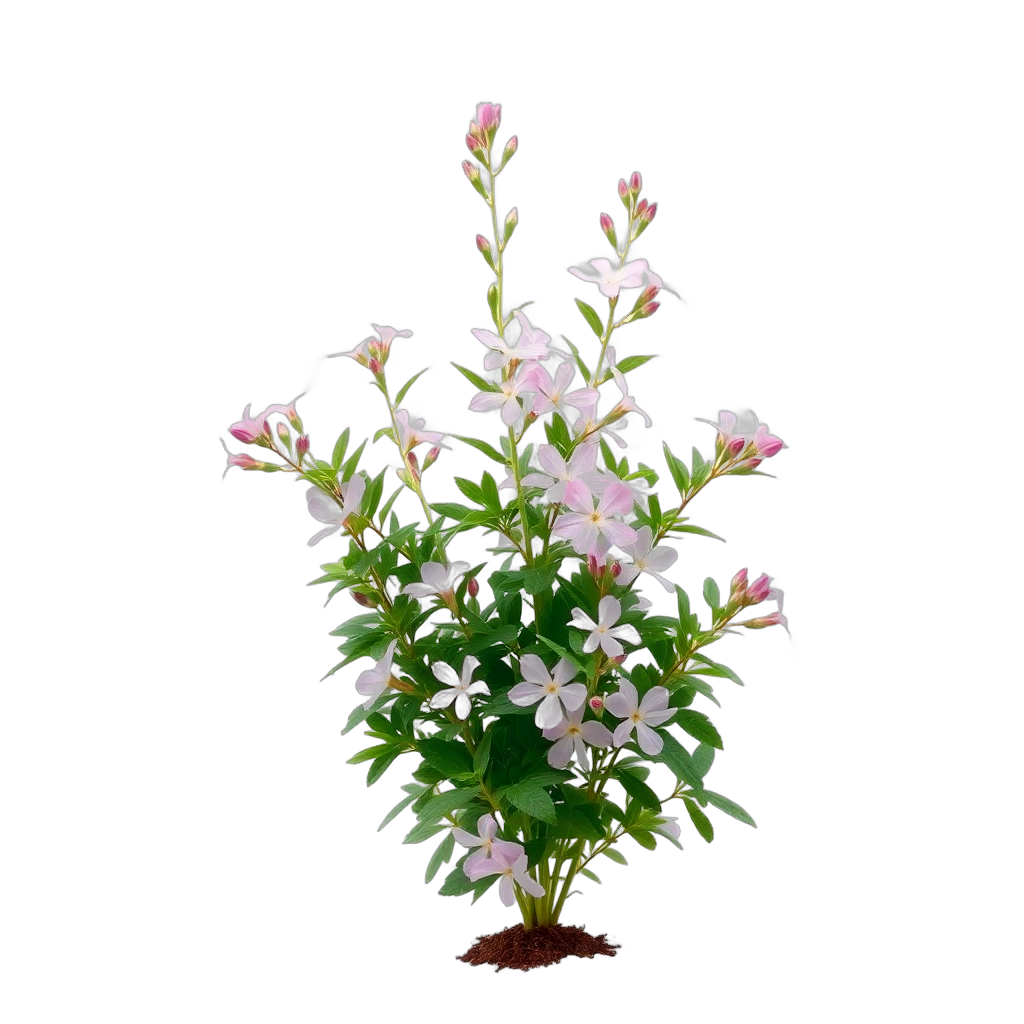
Garden Phlox
Phlox paniculata
grows to 3 feet, multi blooms in summer. Attracts hummingbirds.

Gloriosa Daisy
Rudbeckia hirta
low-growing ground cover, yellow blooms in summer. Attracts butterflies.
Bloom Calendar for Aurora
spring
Foxglove Beardtongue, American Black Currant, Clove Currantsummer
Cup Plant, Garden Phlox, Gloriosa Daisyfall
Northern Sea Oatswinter
Limited bloomsDesign Tips for Aurora (Zone 5b)
- Buy roses by hardiness, not by photo — Canadian Explorer and own-root shrub roses bloom just as romantically as tender English varieties and survive Aurora's -15°F nights without burlap, mounding, or regret
- Set every arbor, pergola, and fence post below the 42-inch northern Illinois frost line; a heaved, leaning rose arch is the most common — and most avoidable — cottage garden failure in the Fox Valley
- Plant lavender high and dry in a gravelly raised strip, and use catmint everywhere else you want that purple haze — in Aurora clay, catmint is the workhorse and lavender is the treat
- Blend prairie natives into the borders — purple coneflower, prairie phlox, wild bergamot — they read as perfectly 'cottage,' thrive in the local soil with zero coddling, and keep the garden alive with goldfinches and monarchs
- In newer east-side subdivisions, budget for 2–3 inches of compost before planting; builders' lots around Fox Valley Villages often kept only a thin skim of Aurora's famous black topsoil
- Leave seedheads standing and lean on structure — fences, arbors, boxwood — because a Zone 5b cottage garden is judged across six leafless months, and the ones designed with winter bones look intentional in January instead of abandoned
Where to Source Plants in Aurora
Skip the big-box stores. These independent Aurora nurseries specialize in the plants that make cottage/english gardens thrive in Zone 5b.
The Growing Place Garden Center
Montgomery Road
Organically grown vegetables, herbs, perennials, annuals, natives, and trees; family owned since 1936.
Schaefer Greenhouses
Montgomery (south Aurora)
Largest covered garden center in the Fox Valley with 4 generations of growing experience since 1926.
Wasco Nursery & Garden Center
St. Charles (north Aurora metro)
Family-owned since 1925 with exceptional quality plants, trees, and landscaping supplies.
Cottage/English Landscaping Costs in Aurora
| Project Scope | Estimated Cost |
|---|---|
| Front-yard cottage border conversion (turf removal + compost + perennials and roses) | $4,000 – $10,000 |
| Brick or flagstone walkway with rose arbor (150–250 sqft) | $6,000 – $14,000 |
| White picket fence, installed (approx. 150 linear ft) | $6,000 – $12,000 |
| Cedar pergola garden room with patio (frost-depth footings) | $12,000 – $28,000 |
| Tiered stone fountain or birdbath focal point, installed | $800 – $3,500 |
| AI visualization with ProScapeAI | Free to start |
Estimates based on Aurora, IL-area contractor rates as of 2026. Actual costs vary by site conditions, materials, and contractor.
Aurora Climate & Growing Zone
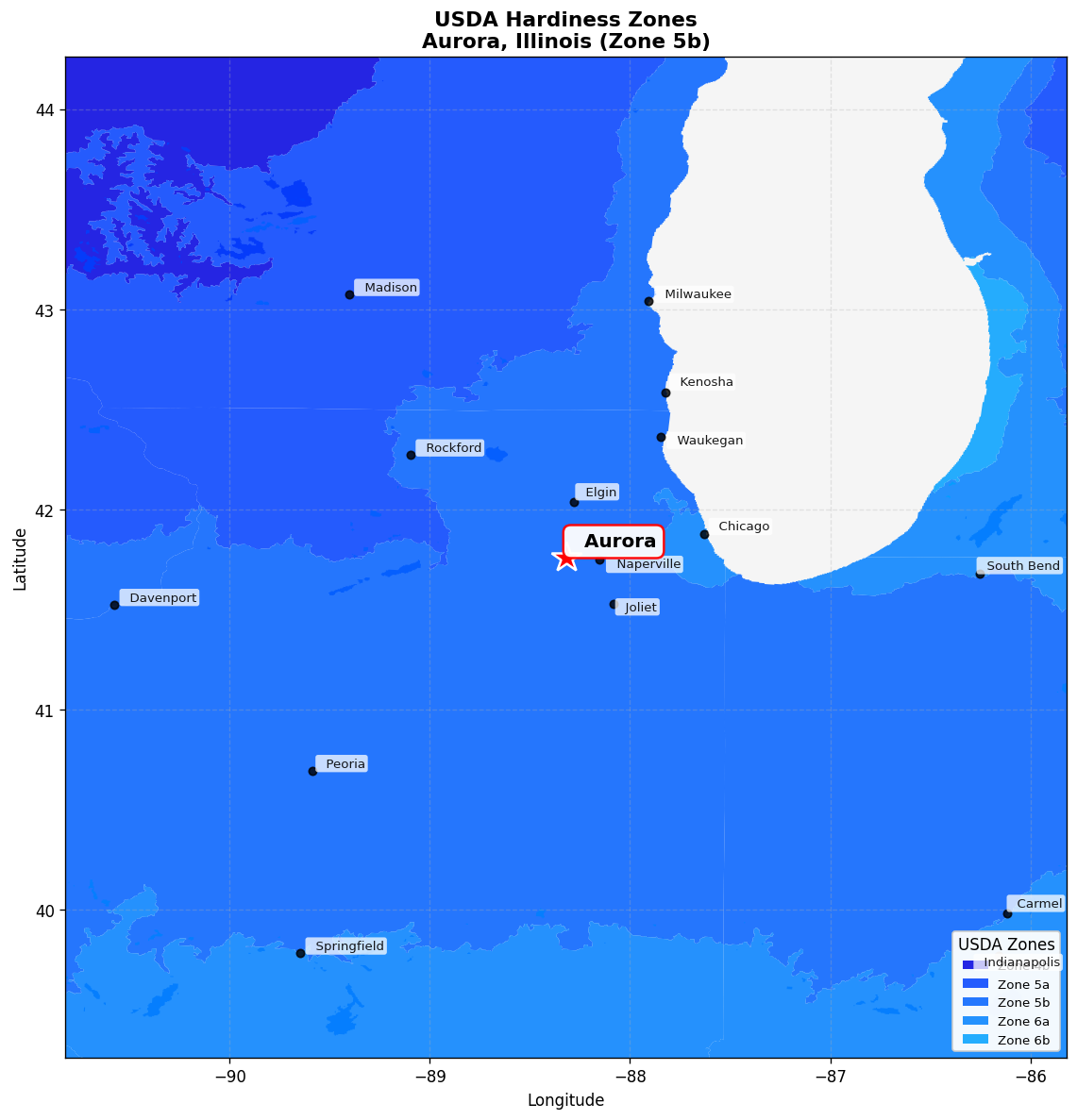
USDA Zone 5b
Hardiness zone for Aurora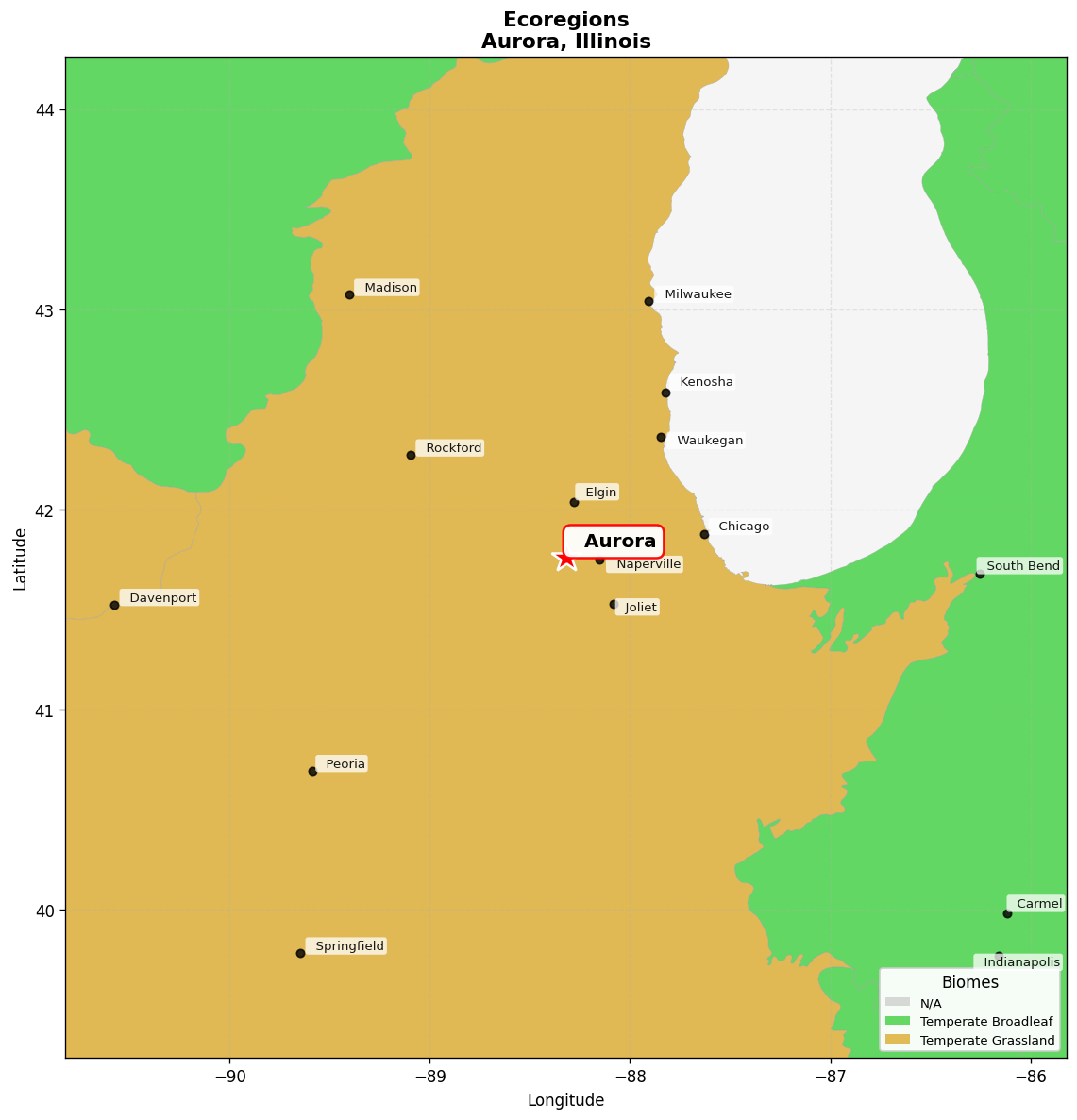
Central US forest-grasslands transition
Native ecoregionFrequently Asked Questions
How much does a cottage garden cost in Aurora?
Chicagoland labor runs a bit above the national average, but cottage style is the most budget-flexible landscape there is because plants — not hardscape — do the heavy lifting. A front-yard border conversion (turf removal, compost, perennials, and roses) for a typical 400–600 sqft frontage runs $4,000–10,000 installed, or under $2,500 DIY from quart and gallon pots. A brick path with an arbor adds $6,000–14,000; a pergola garden room runs $12,000–28,000. The cheapest route of all: plant small in May, because in Aurora's prairie loam a quart-size perennial usually catches up to a gallon plant by August.
Can I grow English lavender and climbing roses in Aurora's Zone 5b?
Lavender: yes, with drainage. 'Hidcote' and 'Munstead' are hardy to Zone 5 but die of wet feet, not cold — plant them in a raised or gravelly spot, never in low clay, and skip fall pruning. If you want zero risk, catmint 'Walker's Low' and Russian sage give the same silver-and-purple look and are bulletproof here. Climbing roses: choose by breeding, not by catalog photo. Canadian Explorer varieties ('William Baffin', 'John Cabot') and 'Above and Beyond' bloom heavily and survive -30°F unprotected, while most hybrid teas and English climbers need winter mounding and still limp through February. Own-root roses always beat grafted ones in 5b.
What do I need to know about Aurora's soil before planting?
You've inherited some of the best garden soil in the country — deep black prairie silt loam — but two caveats apply. First, many newer subdivisions east of Route 59 had topsoil scraped and re-spread thinly during construction, so beds in Fox Valley Villages or Oakhurst often need 2–3 inches of compost forked in to rebuild what the bulldozers took. Second, the subsoil is dense clay that drains slowly; plant roses and lavender slightly high, on gently mounded beds, and never dig holes deeper than the root ball or they become clay bathtubs. A soil test through the Kane County or DuPage County Extension is cheap and worth it — pH here trends neutral to slightly alkaline.
When should I plant a cottage garden in Aurora?
Mid-May through June is the prime window — Aurora's average last frost falls in early May, and containerized perennials planted then get a full season to establish before winter. September is the underrated second window: the soil is warm, the air is cool, and fall-planted peonies, roses, and spring bulbs establish beautifully, though stop planting by mid-October so roots grab hold before the ground freezes. Avoid July–August planting unless you'll water religiously. Bare-root roses go in early April; dahlias and other tender bulbs wait until after Mother's Day.
Do I need a permit for garden structures in Aurora?
Plantings, paths, and beds need nothing. The City of Aurora does require permits for fences (including that picket fence — there are height and placement rules, typically 3–4 feet in front yards), pergolas and gazebos, decks, and any pool. Corner lots face sight-triangle restrictions near intersections. One Aurora-specific wrinkle: the city spans Kane, DuPage, Kendall, and Will counties, but permits go through the City of Aurora regardless — while unincorporated pockets and neighboring Montgomery or North Aurora have their own rules. If you're in the Tanner or Near Eastside historic district, exterior changes visible from the street may also need Historic Preservation review, so call the city first.
What does a cottage garden look like in an Aurora winter?
Better than you'd fear, if you design for it. Leave coneflower and rudbeckia seedheads standing — they feed goldfinches and look striking above snow, which Aurora gets about 30–36 inches of each year. Boxwood mounds, the picket fence, arbors, and pergolas carry the structure from November to April, which is exactly why cottage designs here lean harder on 'bones' than their English originals. Cut roses back only in late March, mound mulch over marginal varieties after Thanksgiving, and drain fountains and birdbaths before hard freezes. The reward for the wait: a Zone 5b winter is precisely the chill that makes peonies, tulips, and delphiniums so spectacular here in May and June.