4 Modern Garden Ideas for Aurora, IL | Minimalist Landscape Design in Zone 5b
Native plants from the Central US forest-grasslands transition (Zone 5b) — Humid continental (hot summer) climate
Why Modern/Minimalist Gardens in Aurora?
Modern landscape design and Aurora's housing stock are a better match than most people expect. The postwar boom left the city with hundreds of low-slung 1950s and '60s ranches — flat rooflines, wide eaves, horizontal massing — around Indian Trail Road, Sans Souci, Hometown, and Riddle Highlands, and those houses were built for exactly this kind of clean, geometric planting. At the other end of town, the new-build corridor east of Route 59 — Stonebridge, Oakhurst, Fox Valley Villages, and The Wheatlands — is full of prairie-transitional facades with black window frames sitting on generous, dead-flat lots. Flat land is a gift to modern design: rectilinear beds, long sight lines, and a poured-concrete walk all read cleanly when there is no grade fighting them.
The climate then does something surprising. The palette modern designers reach for — masses of upright grass, silvery blue-purple flowers, tidy repeated mounds — is essentially the tallgrass prairie flora that grew on this ground before Aurora existed. Little bluestem 'Standing Ovation' and 'Blue Heaven', prairie dropseed (Sporobolus heterolepis), and Panicum virgatum 'Northwind' are Zone 3–4 natives that hold their form under snow, while 'Karl Foerster' feather reed grass throws wheat-colored plumes by early July and stands like a fence post until you cut it in March. Zone 5b lows of -15 to -10°F and roughly 38 inches of annual rain keep Nepeta 'Walker's Low', Salvia nemorosa 'Caradonna', Allium 'Millenium', and Amsonia hubrichtii going with almost no irrigation. The one honest limit is desert modern: the agave, echeveria, and aloe rosettes in every California design photo are Zone 8–9 and turn to mush in a Fox Valley February. Substitute Yucca filamentosa 'Color Guard', Yucca glauca, Sempervivum, and Illinois' own native prickly pear, Opuntia humifusa, for the same architectural rosette at -20°F.
The hardscape is where Aurora bites back, and it is all solvable up front. Northern Illinois frost drives about 42 inches down, so pergola posts, fence posts, string-light poles, and wall footings must reach below that line or they heave and tilt within two winters. Poured concrete — the signature material in all four designs below — wants a 6–8 inch compacted CA-6 base, an air-entrained 4,000-psi mix, tight control joints, and zero de-icing salt its first winter. Beneath the famous black prairie topsoil sits dense, slow-draining clay, so gravel gardens and succulents need excavated, sharply drained rooting mix, not a skim of stone over sod. Budget Chicago-metro labor 15–25% above national averages, and design for six leafless months, because minimalism without evergreen structure looks like an empty parking lot in January.
4 Modern/Minimalist Design Ideas for Aurora
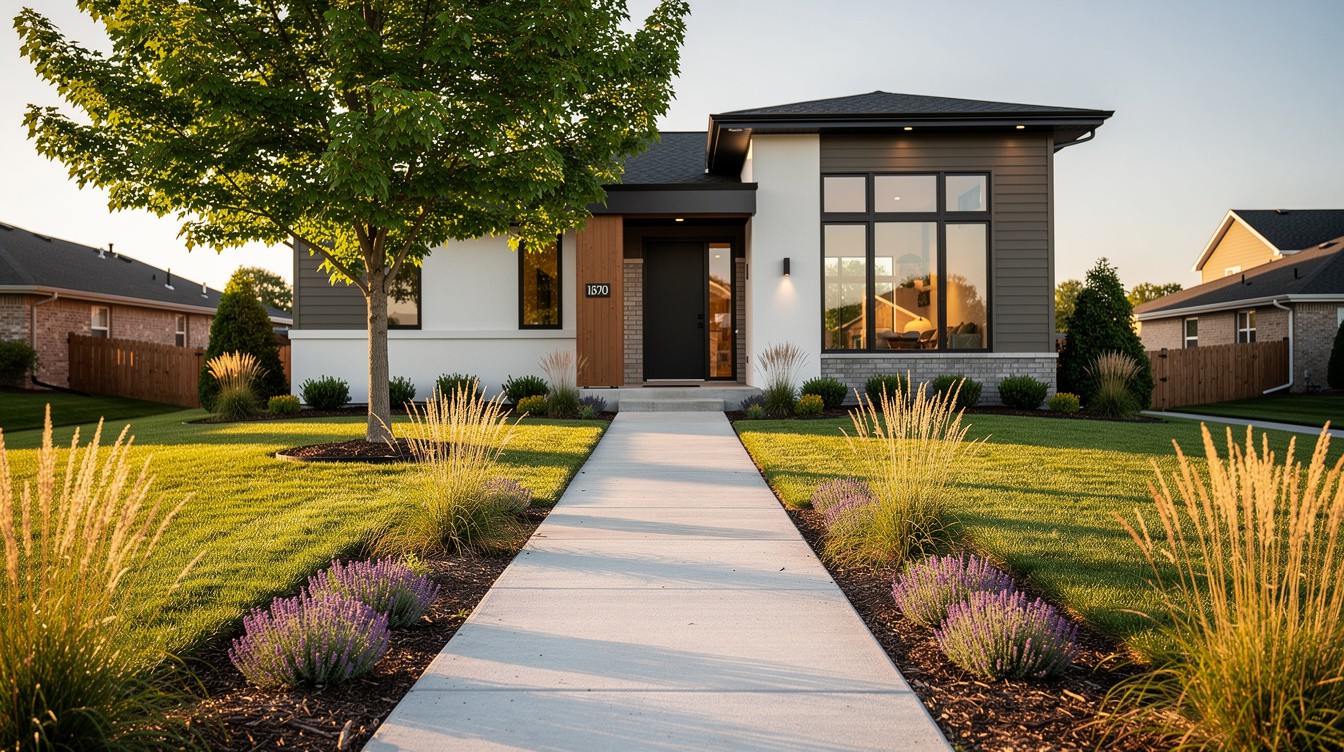
The Prairie Grass Promenade
$14–24/sqftA contemporary two-story with white stucco, charcoal siding, and a wood-clad entry, approached on a wide broom-finish concrete walk that runs dead straight to the door. The beds on both sides are pure Fox Valley modern: tall tan-plumed grasses repeated in rhythm, low lavender-purple mounds spilling to the walk edge, and clipped green globes tight against the foundation, all in crisp steel-edged mulch. Build it with 'Karl Foerster' feather reed grass for the vertical plumes — it is upright by July and still standing in February — with Schizachyrium scoparium 'Standing Ovation' for the softer bronze clumps out in the lawn beds, Nepeta 'Cat's Pajamas' or 'Walker's Low' catmint for the purple haze, and Buxus 'Green Velvet' spheres, a Sheridan hybrid bred in Ontario that holds color through Zone 5b winters where common boxwood bronzes badly. The lawn tree should be Acer rubrum 'Redpointe' or Acer miyabei 'State Street' rather than another 'Autumn Blaze' — both take clay and neither splits in an ice storm.
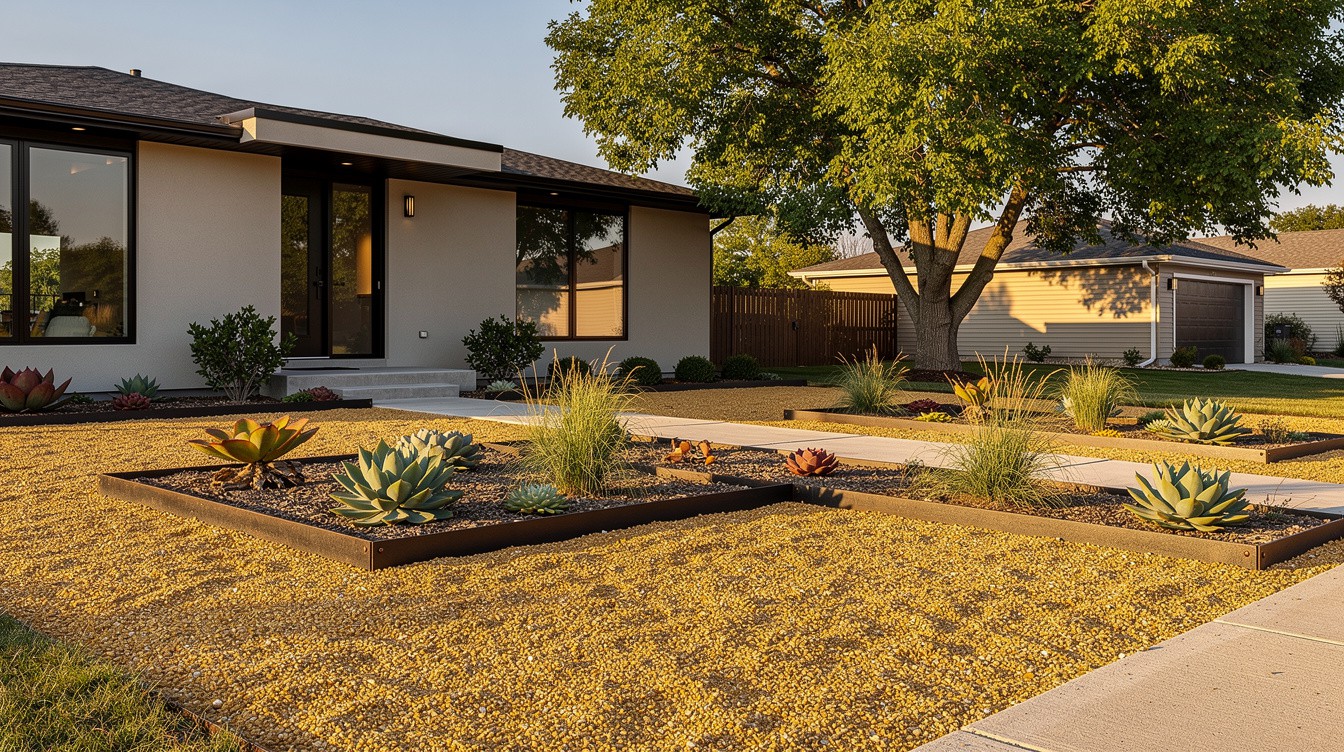
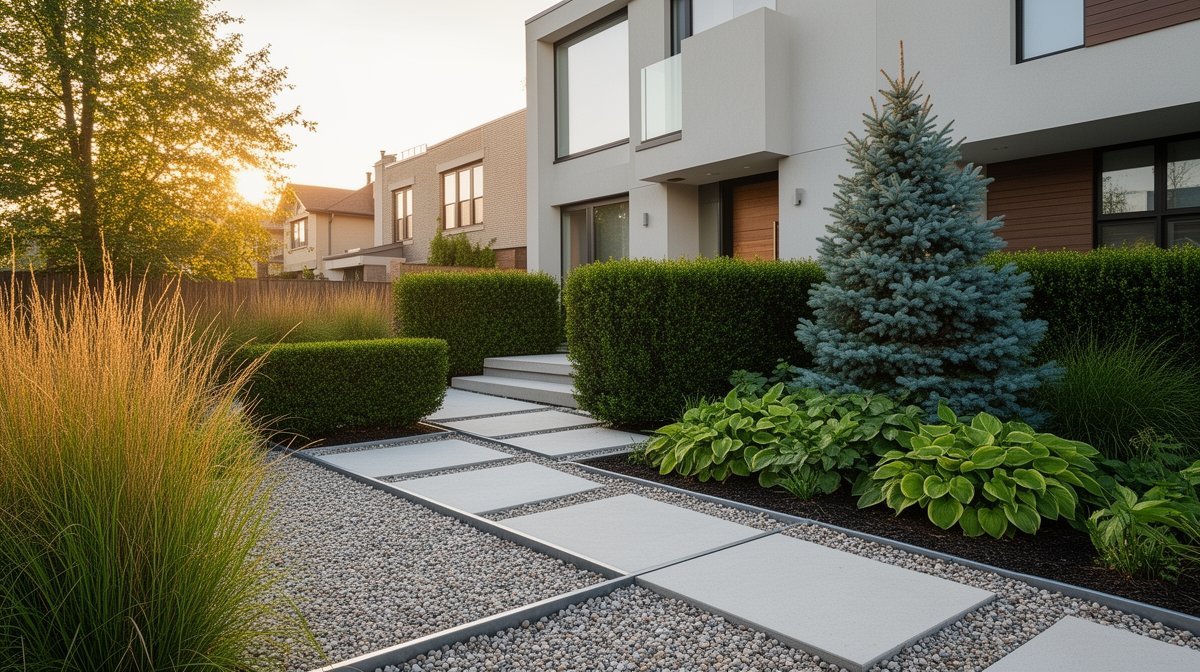
The Corten Gravel Grid
$10–18/sqftA mid-century ranch with a low-pitch roof and black window frames, its entire front lawn replaced by a field of gold gravel divided into rectangular Corten steel planters, with floating concrete pads for a path and blue-green rosettes punctuating the beds. This is the design that needs the most honest translation for Aurora: those agave and echeveria rosettes are Zone 8–9 and will rot out in a Fox Valley thaw. Get the same sculptural geometry from Yucca filamentosa 'Color Guard' (gold-striped, hardy to Zone 4), Yucca glauca soapweed for the narrow blue form, Sempervivum 'Ruby Heart' hens-and-chicks in the tightest gaps, and Opuntia humifusa — the eastern prickly pear that is genuinely native to Illinois sand prairies. Bouteloua gracilis 'Blonde Ambition' supplies the wispy clumps with its horizontal eyelash seedheads, and Sedum rupestre 'Angelina' spills chartreuse over the steel. Excavate 10–12 inches and backfill with a gravel-heavy mix; over undisturbed Aurora clay these plants die of wet feet, never of cold.
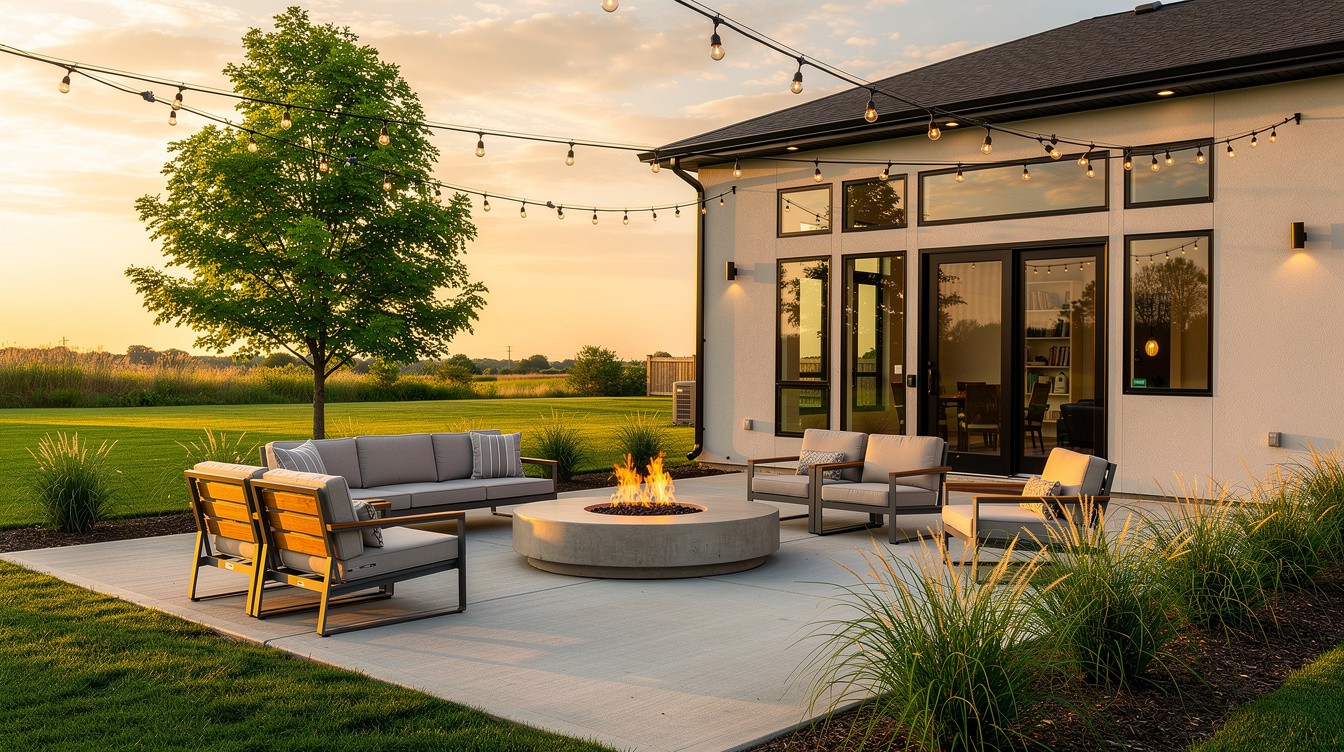
The Prairie-Edge Fire Terrace
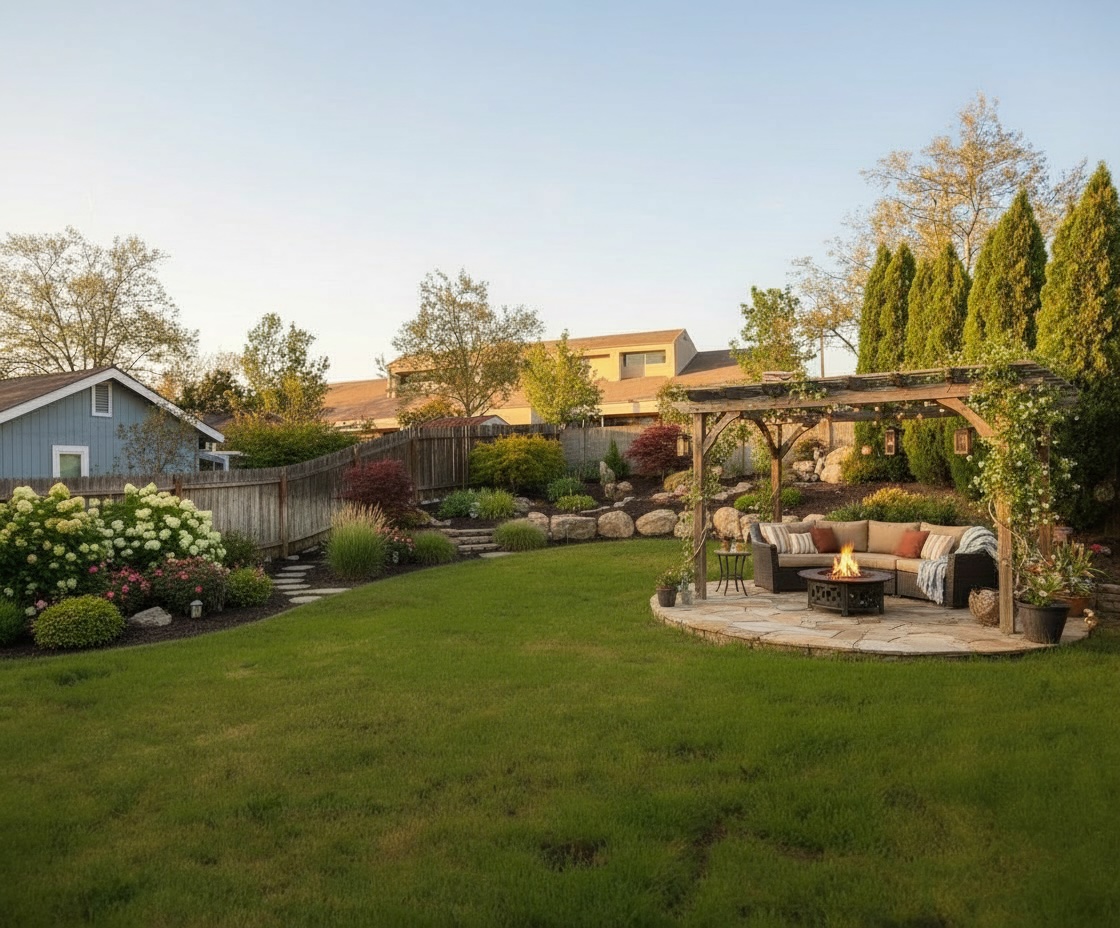
$22–38/sqftA generous poured-concrete terrace off the back of the house with a round precast concrete gas fire bowl at its center, teak-and-aluminum lounge seating, and café string lights swagged overhead on slim poles — all of it looking straight out over open grassland at sunset. Grass masses soften every edge of the slab, which is what makes the terrace feel like it belongs to the prairie instead of sitting on top of it. Use Panicum virgatum 'Northwind' as the tall screen because it is the one switchgrass that will not flop after a wet September storm, prairie dropseed (Sporobolus heterolepis) as the fine-textured mound repeated along the slab edge — it smells faintly of coriander in September — and Amsonia hubrichtii for the gold fall column. Every string-light pole and any pergola upright has to sit in a footing below the 42-inch frost line; poles set in shallow bags of concrete are the single most common failure on Aurora patios. Plumb the fire bowl to natural gas rather than hauling propane tanks.
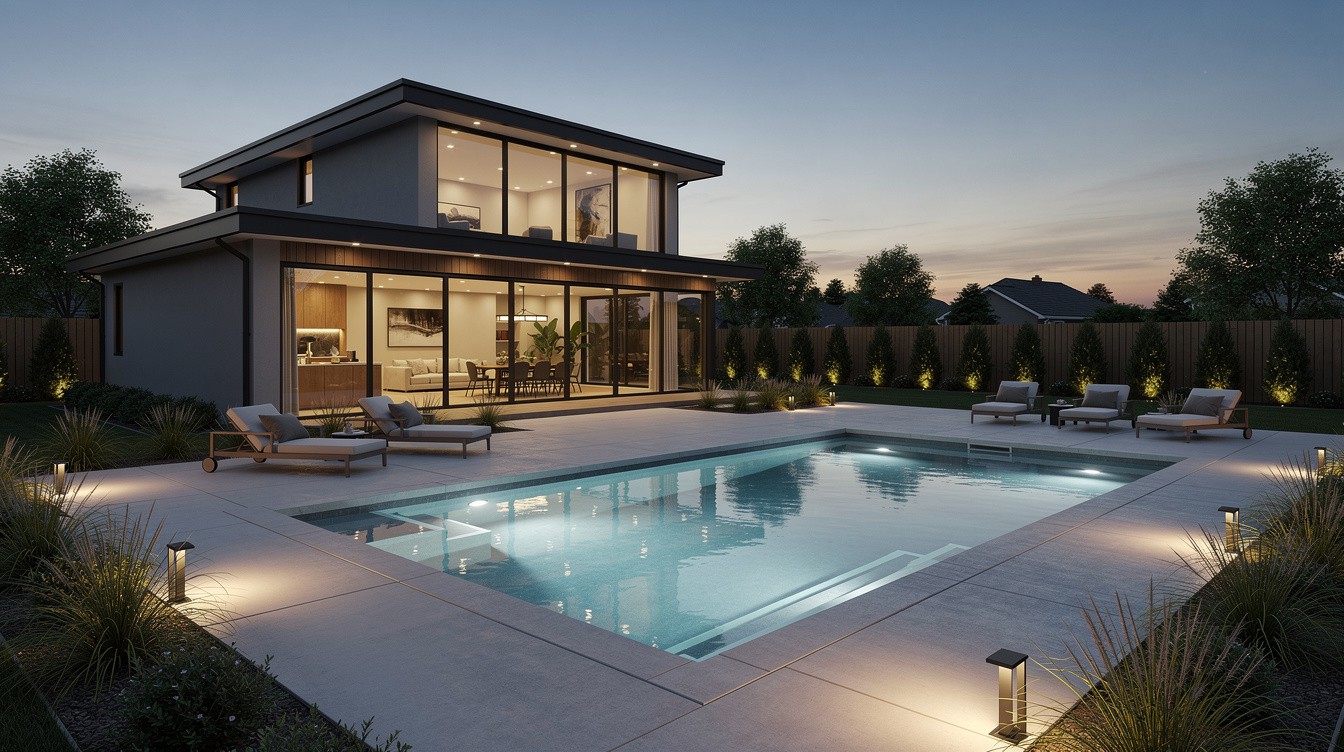
The Twilight Pool Court
$40–75/sqft for deck and planting (pool shell quoted separately)A rectangular pool set in a wide, pale, large-format concrete deck behind a two-story modern house with glass walls glowing at dusk. A rank of columnar evergreens marches along the dark privacy fence, grass clumps anchor the deck corners, and low bollards plus fence-line uplights carry the geometry after dark. The evergreen column is Thuja occidentalis 'Smaragd' (Emerald Green) at 12–15 ft by 3–4 ft, or 'Techny' if the lot is windswept and deer-pressured; skip 'Skyrocket' juniper, which bagworms find first in Kane County. Around a pool, plant clean: Panicum 'Northwind' and prairie dropseed drop almost nothing, Hakonechloa macra 'All Gold' handles the shaded north edge, Ilex glabra 'Gem Box' gives evergreen boxwood form without winter bronzing, and Hylotelephium 'Autumn Joy' holds bronze seedheads above snow. Nothing fruiting, nothing thorny, nothing that sheds into a skimmer. Aurora requires a permit and a 48-inch barrier for the pool, and the deck should be pitched away from the coping so freeze-thaw meltwater has somewhere to go.
See how a modern/minimalist garden looks on YOUR property
Upload a photo of your Aurora yard and visualize your dream garden in seconds.
Try ProScapeAI Free
Featured Trees & Shrubs for Modern/Minimalist Gardens
Browse all 169 plants for Aurora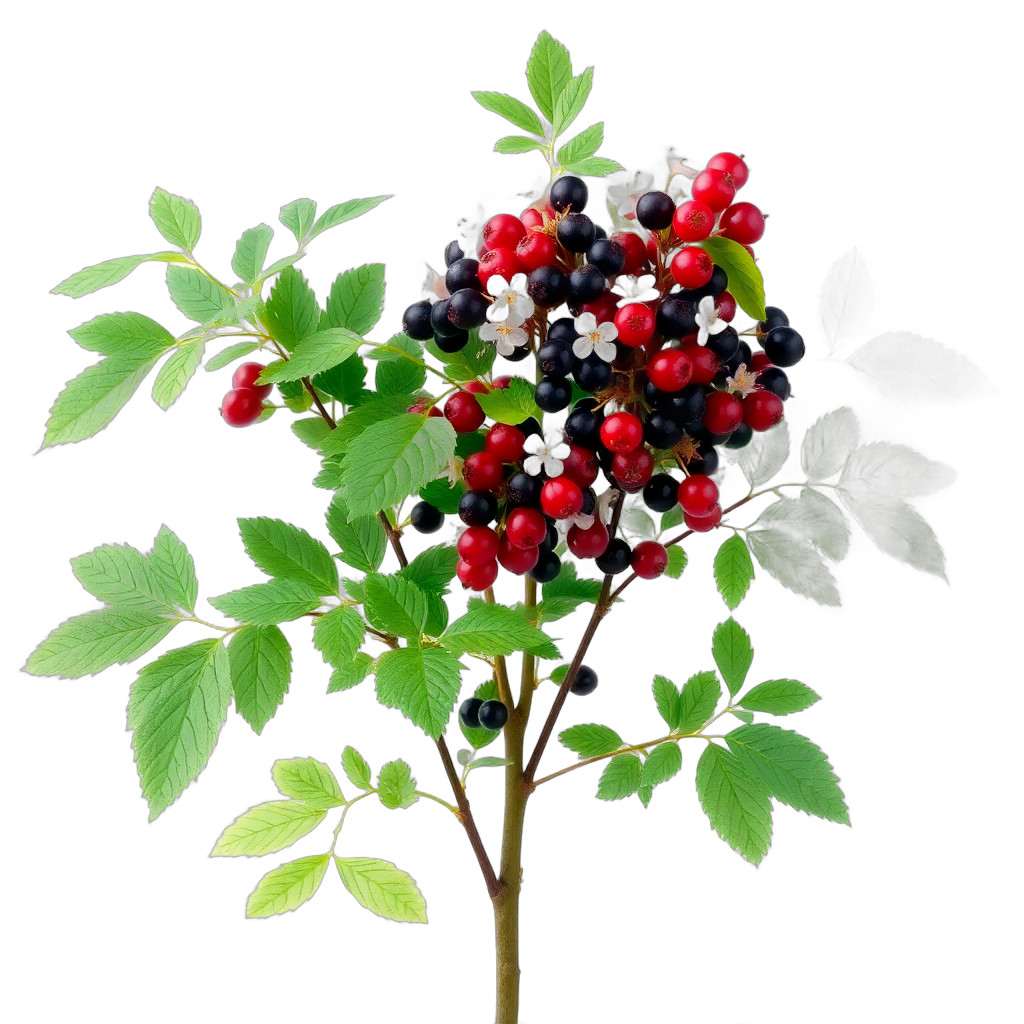
American Black Currant
Ribes americanum
grows to 5 feet, white,yellow blooms in spring. Attracts hummingbirds.
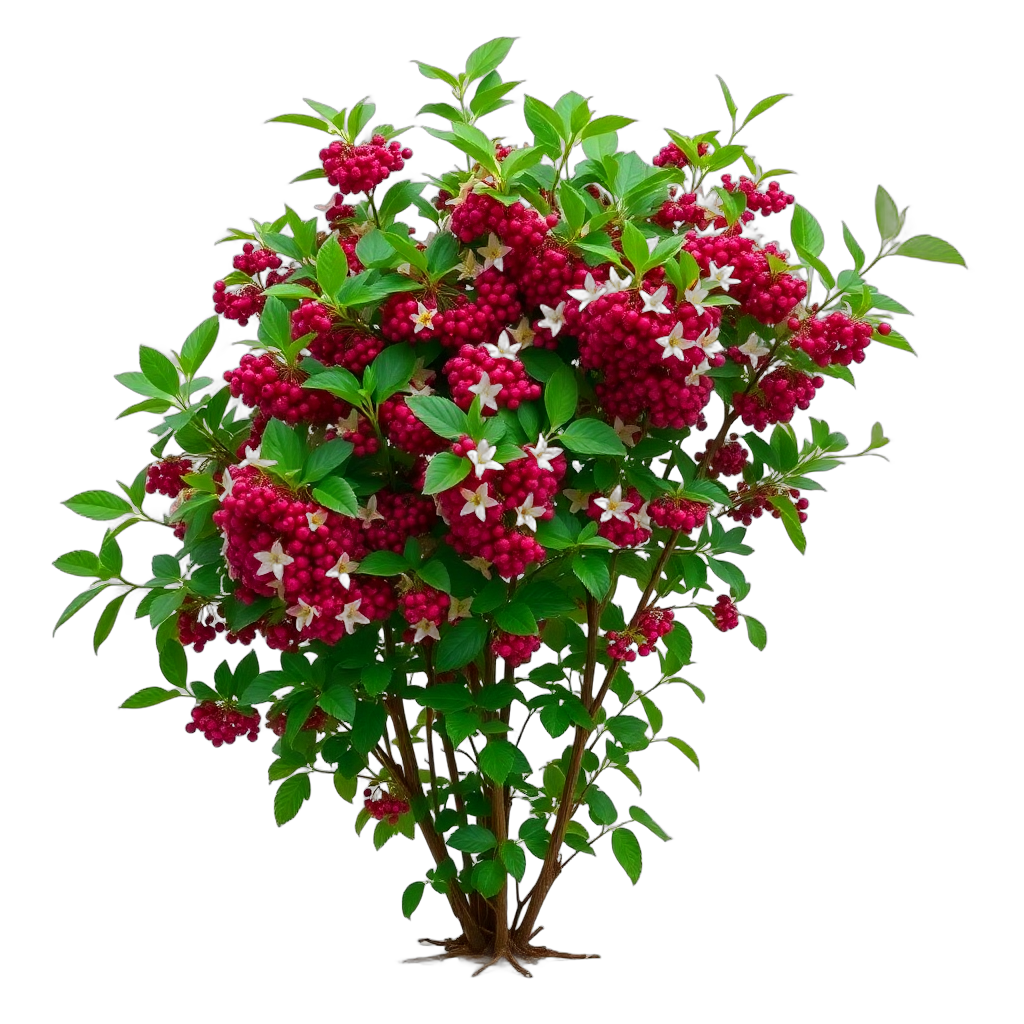
Clove Currant
Ribes odoratum
grows to 6 feet, yellow blooms in spring. Attracts hummingbirds.

Fragrant Sumac
Rhus aromatica
grows to 4 feet, yellow blooms in spring. Attracts butterflies.
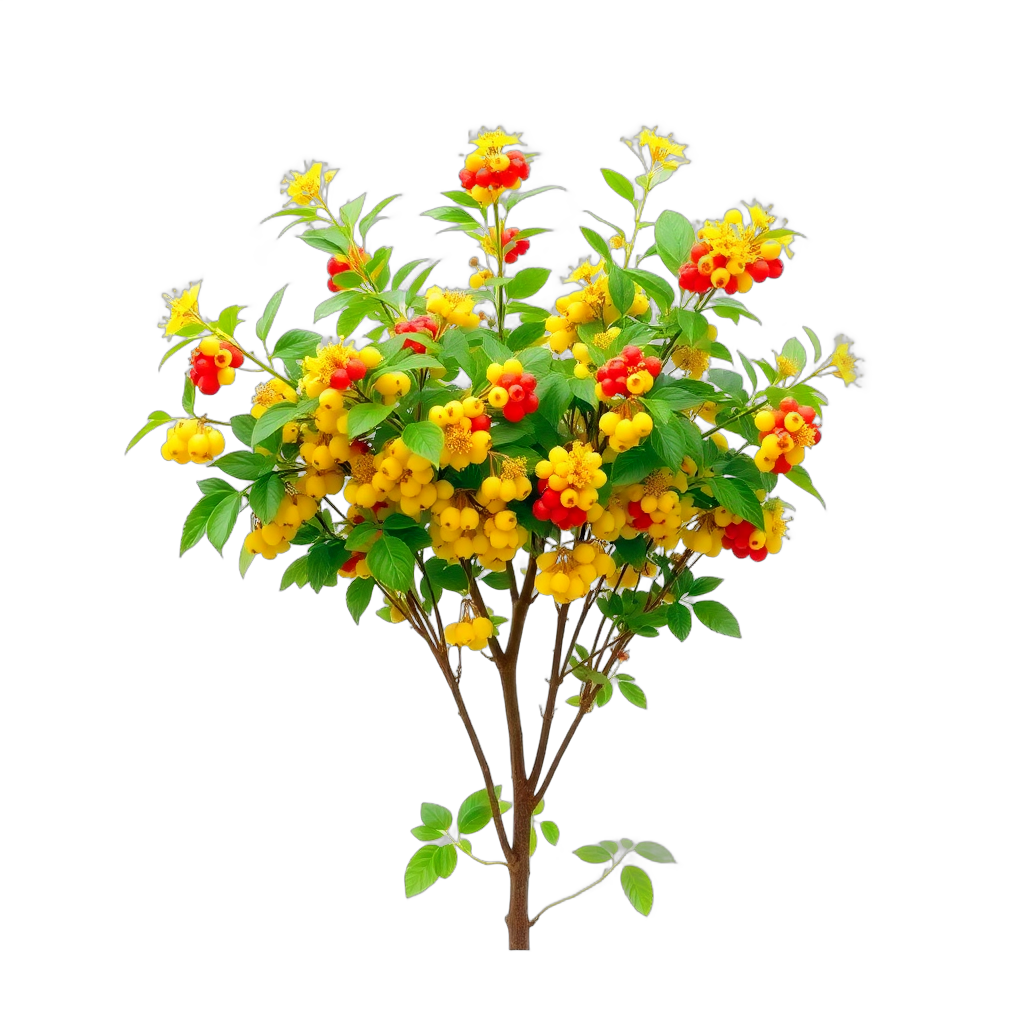
Golden Currant
Ribes aureum
grows to 6 feet, yellow blooms in spring. Attracts hummingbirds.
Featured Grasses & Groundcovers for Modern/Minimalist Gardens
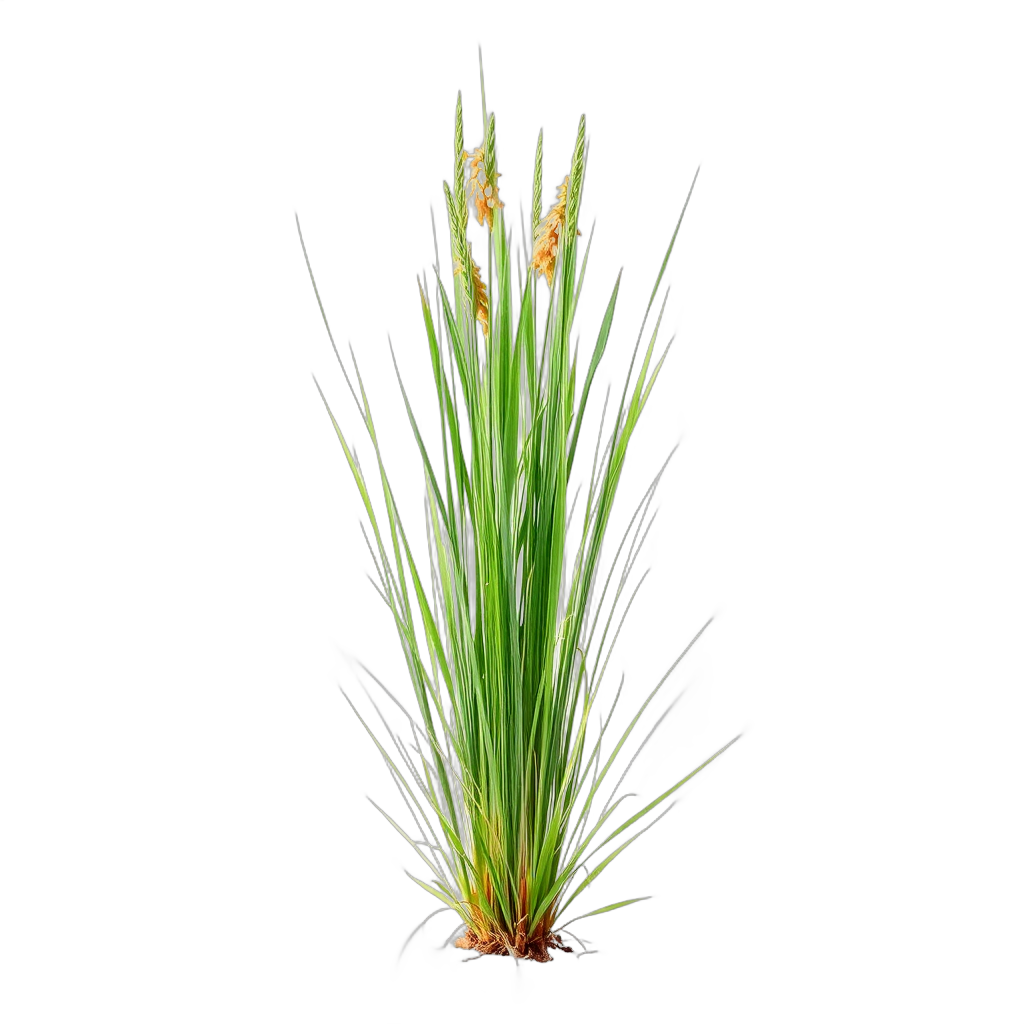
Eastern Gamagrass
Tripsacum dactyloides
grows to 6 feet, blooms in summer. Yellow fall color.
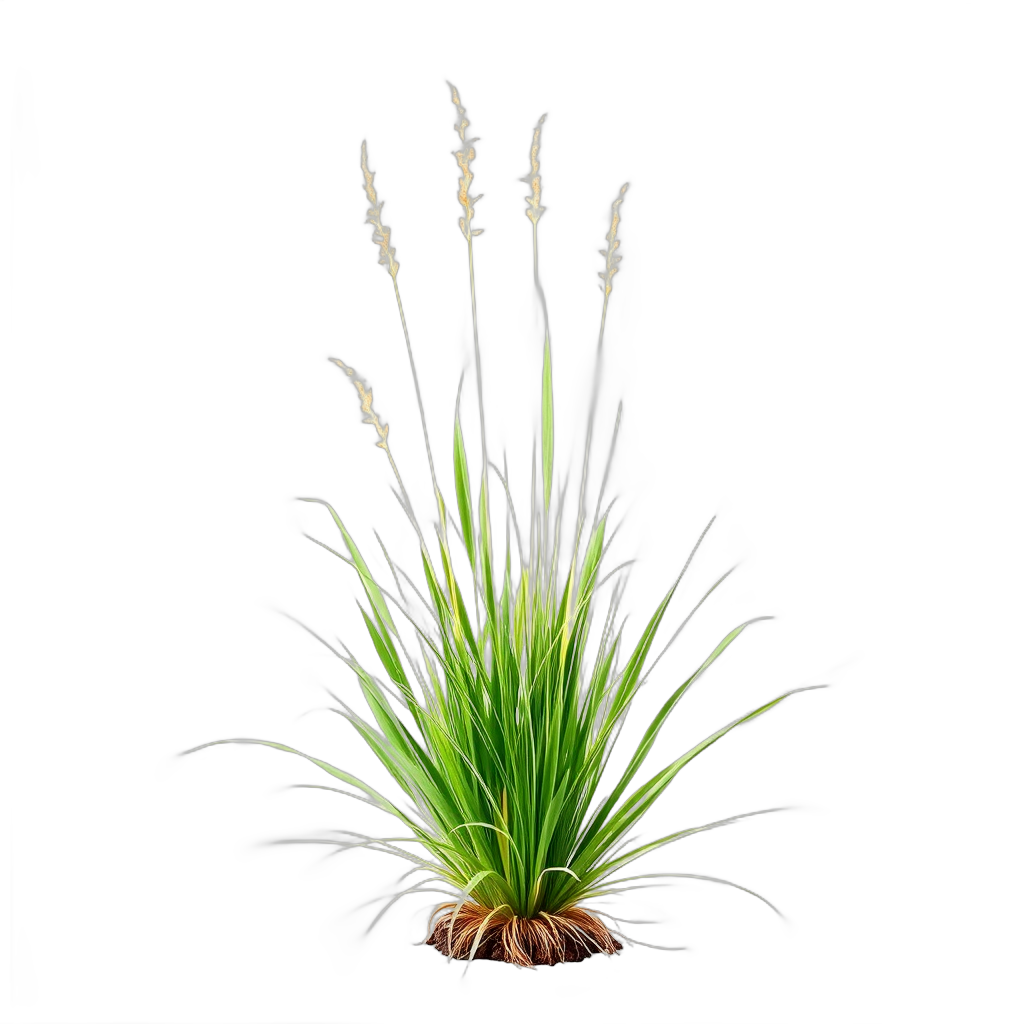
Northern Sea Oats
Chasmanthium latifolium
grows to 4 feet, blooms in fall. Bronze fall color.
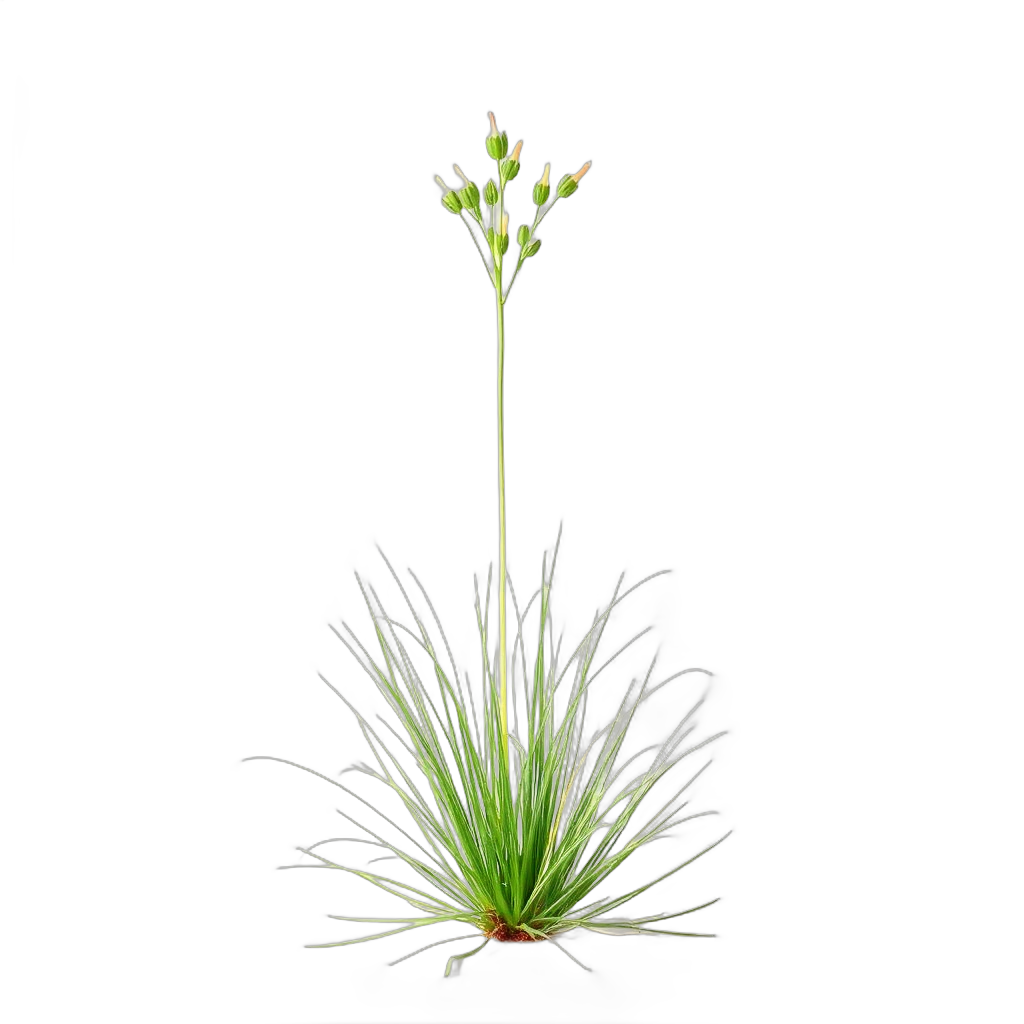
Alkali Sacaton
Sporobolus airoides
grows to 3 feet, blooms in summer. Yellow fall color.

Arrow Bamboo
Pleioblastus chino
medium-sized at 10 feet, blooms in none. Evergreen year-round.
Featured Flowers & Perennials for Modern/Minimalist Gardens
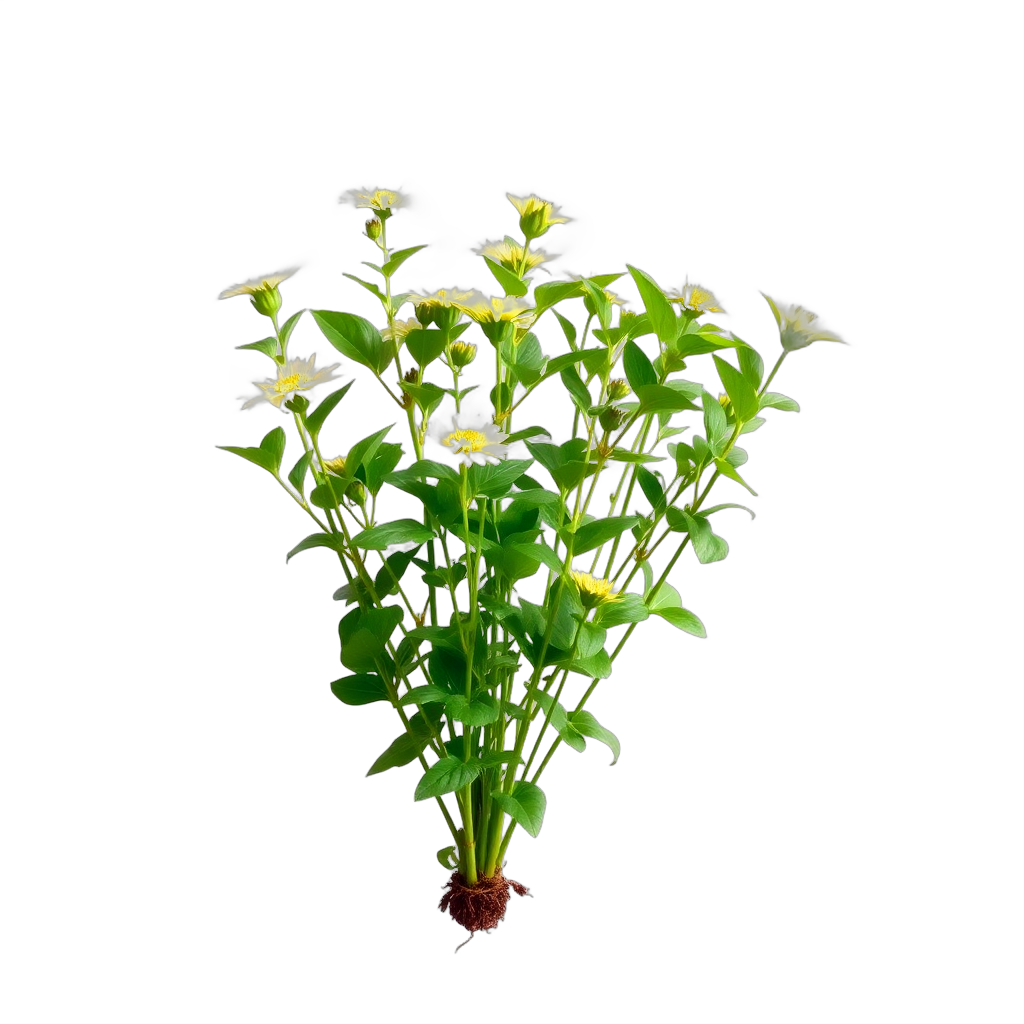
Cup Plant
Silphium perfoliatum
medium-sized at 7 feet, yellow blooms in summer. Attracts butterflies.
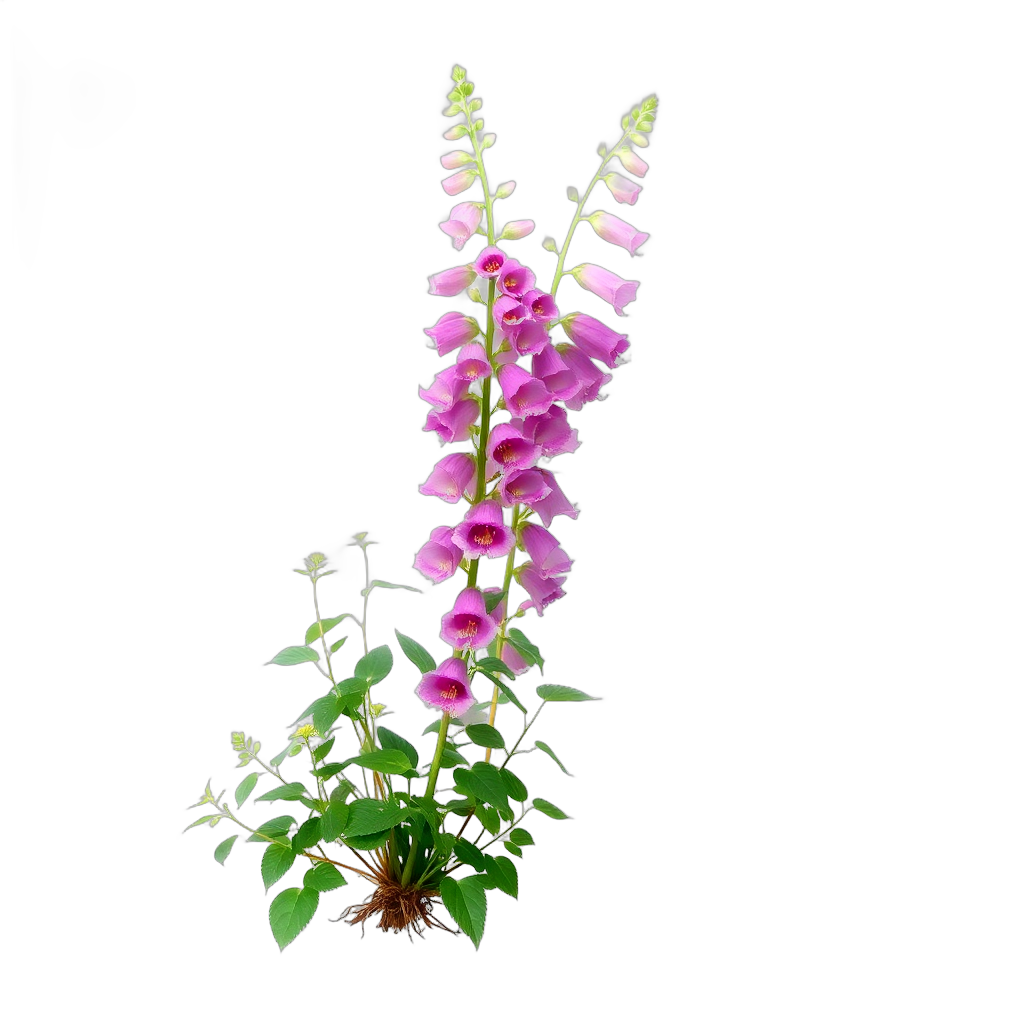
Foxglove Beardtongue
Penstemon digitalis
grows to 3 feet, white blooms in spring. Attracts hummingbirds.
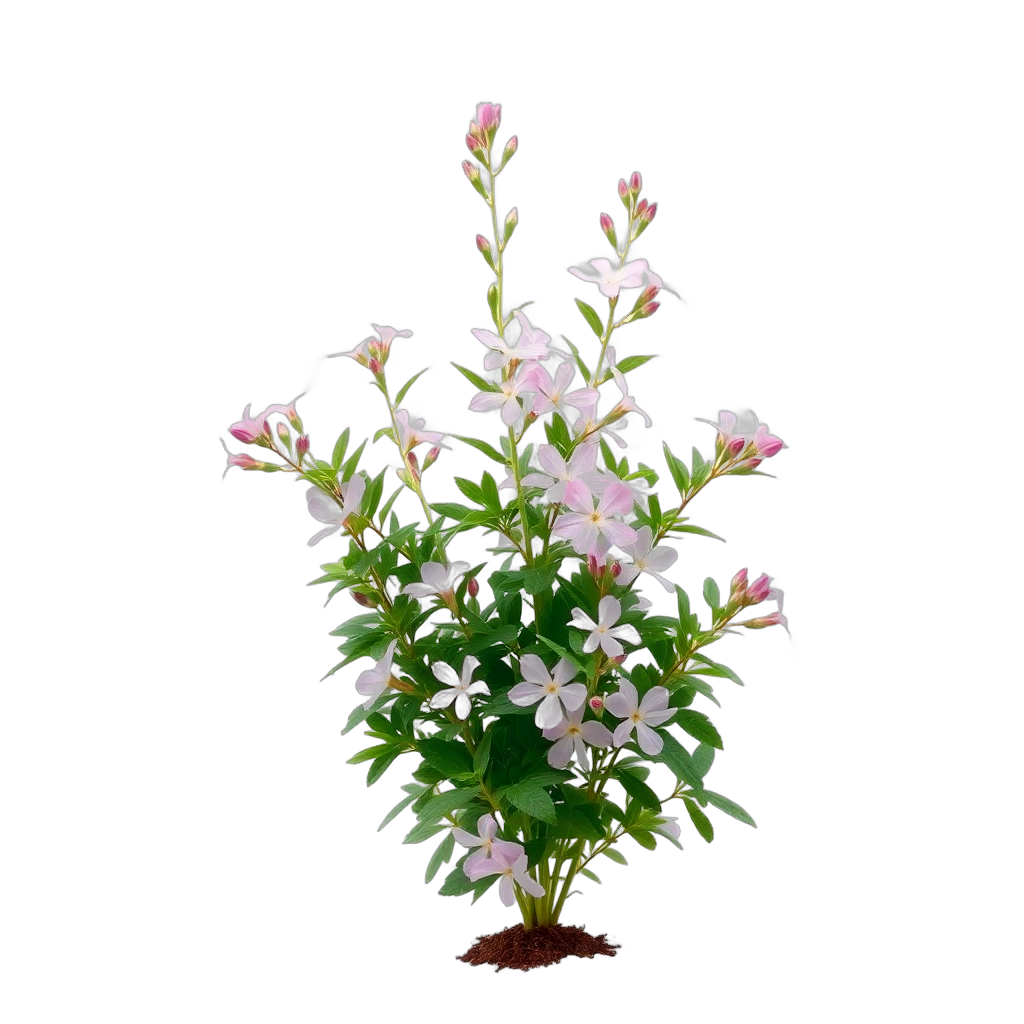
Garden Phlox
Phlox paniculata
grows to 3 feet, multi blooms in summer. Attracts hummingbirds.

Gloriosa Daisy
Rudbeckia hirta
low-growing ground cover, yellow blooms in summer. Attracts butterflies.
Bloom Calendar for Aurora
spring
Foxglove Beardtongue, American Black Currant, Clove Currantsummer
Cup Plant, Garden Phlox, Gloriosa Daisyfall
Northern Sea Oatswinter
Limited bloomsDesign Tips for Aurora (Zone 5b)
- Repeat three plants, not thirty — a mass of 'Karl Foerster', a ribbon of Nepeta 'Walker's Low', and a rhythm of 'Green Velvet' boxwood spheres will out-design a mixed border every time, and in Aurora's soil all three are effectively maintenance-free
- Swap desert rosettes for hardy ones before you draw the plan: Yucca filamentosa 'Color Guard', Yucca glauca, Sempervivum, and native Opuntia humifusa deliver the agave silhouette at -20°F, and none of them care that it is Illinois
- Set every string-light pole, fence post, and pergola upright below the 42-inch frost line — a leaning light pole ruins the one thing modern design cannot fake, which is a straight line
- Specify air-entrained 4,000-psi concrete on 6–8 inches of compacted CA-6, and keep de-icing salt off it entirely the first winter; Aurora's 40-plus annual freeze-thaw cycles scale cheap flatwork within two seasons
- Excavate 10–12 inches for any gravel or succulent bed and backfill with a coarse sand and gravel mix — over undisturbed Fox Valley clay, these plants die of wet crowns in a March thaw, not of January cold
- Cut grasses in mid-to-late March, never in fall: 'Northwind', prairie dropseed, and little bluestem 'Standing Ovation' carry the entire winter composition above the snow and insulate their own crowns while they do it
Where to Source Plants in Aurora
Skip the big-box stores. These independent Aurora nurseries specialize in the plants that make modern/minimalist gardens thrive in Zone 5b.
The Growing Place Garden Center
Montgomery Road
Organically grown vegetables, herbs, perennials, annuals, natives, and trees; family owned since 1936.
Schaefer Greenhouses
Montgomery (south Aurora)
Largest covered garden center in the Fox Valley with 4 generations of growing experience since 1926.
Wasco Nursery & Garden Center
St. Charles (north Aurora metro)
Family-owned since 1925 with exceptional quality plants, trees, and landscaping supplies.
Modern/Minimalist Landscaping Costs in Aurora
| Project Scope | Estimated Cost |
|---|---|
| Front-yard lawn-to-modern conversion (grasses, catmint drifts, clipped boxwood geometry, 600–900 sqft) | $6,500 – $16,000 |
| Broom-finish concrete entry walk and stoop (5 ft wide, 40–60 linear ft) | $4,000 – $9,000 |
| Corten steel planters with excavated gravel field replacing front turf (~800 sqft) | $8,000 – $18,000 |
| Concrete patio with gas fire bowl and string-light poles on frost-depth footings (400–500 sqft) | $14,000 – $32,000 |
| Emerald Green arborvitae privacy hedge plus 12–16 fixture low-voltage LED lighting | $7,000 – $18,000 |
| AI visualization with ProScapeAI | Free to start |
Estimates based on Aurora, IL-area contractor rates as of 2026. Actual costs vary by site conditions, materials, and contractor.
Aurora Climate & Growing Zone
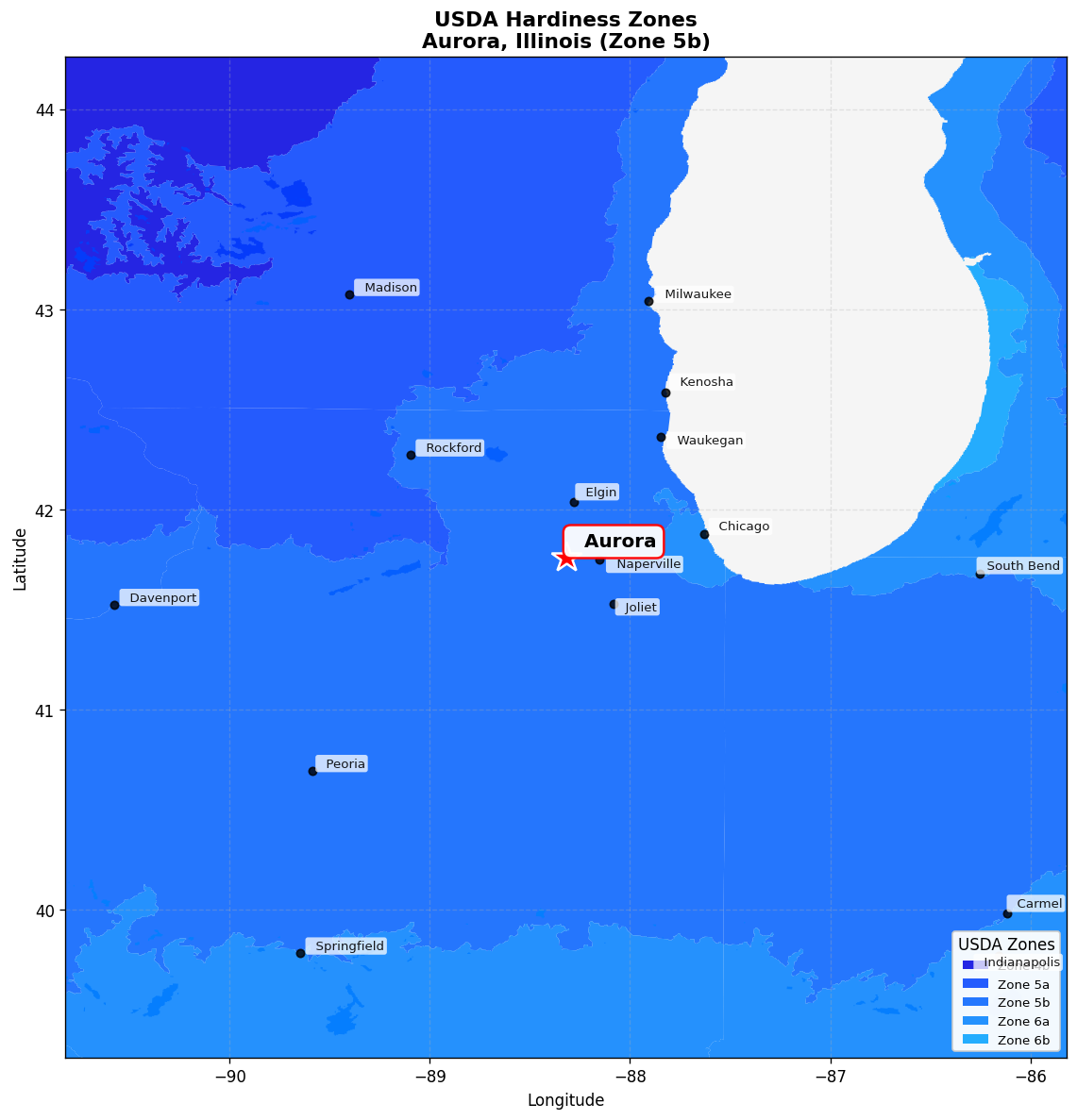
USDA Zone 5b
Hardiness zone for Aurora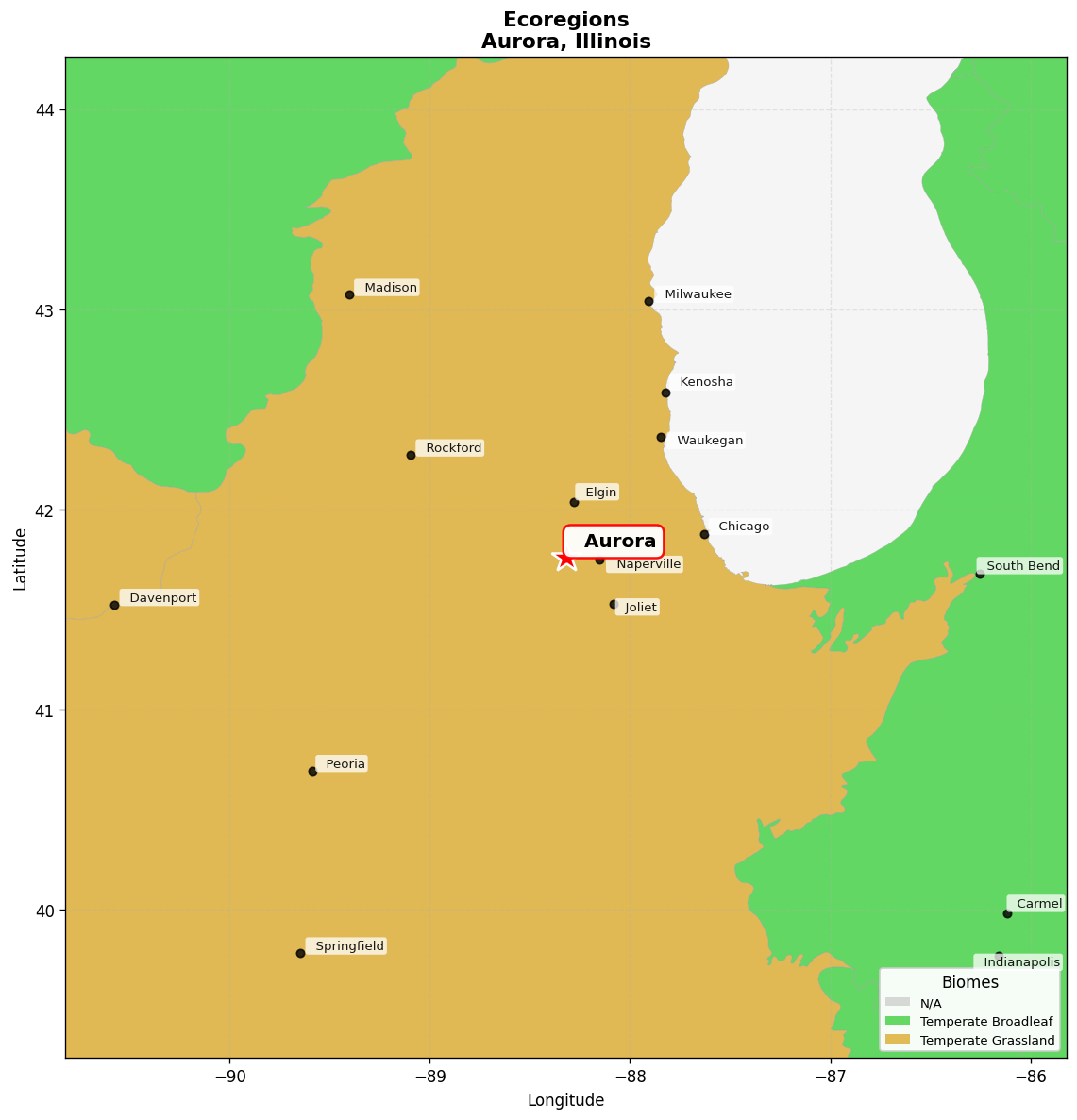
Central US forest-grasslands transition
Native ecoregionFrequently Asked Questions
How much does a modern landscape cost in Aurora?
Modern costs more per square foot than cottage style because the hardscape is the design — you are buying concrete, steel, and lighting, not perennials. Chicago-metro labor runs roughly 15–25% above national averages. A front-yard conversion with 'Karl Foerster' grasses, catmint drifts, and 'Green Velvet' boxwood geometry over 600–900 sqft lands at $6,500–16,000 installed. A broom-finish concrete walk and stoop adds $4,000–9,000. A concrete fire terrace with a gas bowl and string-light poles runs $14,000–32,000. Replacing a front lawn with Corten planters and a gravel field is $10–18/sqft, and the excavation is most of that number. The cheapest real savings: buy grasses as #1 containers in May — 'Northwind' and prairie dropseed catch up to #3 stock by their second August in Aurora's soil.
Can I grow agave, echeveria, and other succulents in Aurora's Zone 5b?
Echeveria and aloe, no — they are Zone 9 and only work here as summer container plants you overwinter indoors. Most agave is Zone 8, though Agave parryi var. neomexicana and Agave havardiana survive to roughly -20°F in a pure gravel bed with a stone mulch and a winter rain shield, which is a serious commitment. The reliable route is hardy substitutes with identical architecture: Yucca filamentosa 'Color Guard' and 'Bright Edge' are Zone 4 and give you the gold-and-green rosette outright, Yucca glauca gives the narrow blue soapweed form, Sempervivum 'Ruby Heart' and 'Black' hens-and-chicks fill the small geometry, Delosperma 'Fire Spinner' provides the neon groundcover, and Opuntia humifusa is a genuine Illinois prairie native. In every case the killer is winter wet, not winter cold — 12 inches of gravelly mix and drainage to daylight matter more than any zone rating.
Which ornamental grasses actually stay upright through an Aurora winter?
This decides whether a modern garden looks composed or collapsed in February. The dependable standers are Calamagrostis × acutiflora 'Karl Foerster' (rigid, tan by July, upright until March), Panicum virgatum 'Northwind' (the stiffest switchgrass, 5 ft, no flop), Sporobolus heterolepis prairie dropseed (a tight 2-ft mound that domes under snow), and Schizachyrium scoparium 'Standing Ovation' or 'Blue Heaven' — bred specifically because older little bluestem seedlings splay open. Avoid straight-species Miscanthus sinensis, which self-seeds and shatters after Aurora's typical 30–36 inches of wet snow, and treat Pennisetum alopecuroides 'Hameln' as Zone 5 marginal in exposed east-side subdivisions. Cut everything back in mid-to-late March, not fall; the standing stems are half the winter design and they insulate the crowns.
Will a gravel garden work over Aurora's prairie clay?
Yes, but only if you excavate. Aurora's black silt loam sits over dense glacial-till clay that drains at a crawl, so a few inches of decorative stone laid over existing grade creates a bathtub that kills yucca and sedum by March. Dig 10–12 inches, backfill with a coarse sand and crushed-gravel mix (roughly 70/30 mineral to compost), run perforated drain tile to daylight or to a dry well, and set planting pockets slightly proud of grade. Use woven geotextile — not plastic sheeting — under the decorative gravel field only, never under the planting islands. Expect to spot-weed the gravel for the first two seasons until the surface stops holding blown-in prairie seed, and top up the stone about every four years where it works into the clay.
Do I need permits in Aurora, and how deep do footings have to go?
The City of Aurora issues permits for patios, driveways, decks, fences, pergolas, and pools even though the city spans Kane, DuPage, Kendall, and Will counties — you file with Aurora regardless of which county you are in, while unincorporated pockets and neighboring Montgomery or North Aurora have their own rules. Pools additionally require a 48-inch barrier. Plantings, mulch beds, and gravel fields generally need nothing, though large impervious additions can trigger stormwater review. On footings: northern Illinois frost depth is about 42 inches, so pergola posts, fence posts, string-light poles, and any freestanding wall need footings below that. For flatwork, insist on 6–8 inches of compacted CA-6, an air-entrained 4,000-psi mix, control joints, and no de-icing salt the first winter — Aurora runs through 40-plus freeze-thaw cycles a year and un-air-entrained concrete scales within two seasons.
How do I keep a minimalist landscape from looking dead in an Aurora January?
Modern is judged hardest in winter, because there is nowhere for a bare bed to hide. Three moves fix it. First, evergreen mass: Thuja 'Smaragd' or 'Techny' columns, Buxus 'Green Velvet' spheres, Taxus × media 'Densiformis' low hedging, and Ilex glabra 'Gem Box', which unlike common boxwood does not bronze at -15°F. Second, standing texture: leave 'Karl Foerster', 'Northwind', and prairie dropseed uncut until March, and add Cornus sericea 'Arctic Fire' for red stems against 30-plus inches of snow. Third, material and light: Corten steel keeps its rust glow all winter, concrete looks better wet and frosted than it does in July, and a 12–16 fixture low-voltage LED system uplighting the arborvitae extends the garden through the 4:30 p.m. sunsets. Done right, an Aurora modern garden is arguably at its best in January.