4 Tropical Garden Ideas for Plantation, FL | Zone 10b Palms and Heliconia
Native plants from the Everglades flooded grasslands (Zone 10b) — Tropical monsoon climate
For a tropical garden in Plantation, FL, a zone 10b city with a tropical monsoon climate, start with Wodyetia bifurcata, Philodendron 'Xanadu' and Ixora 'Maui', the plants this guide's first design is built on.
Why Tropical/Lush Gardens in Plantation?
Plantation is built for tropical planting. The housing stock runs from 1960s and 1970s concrete block ranches in central Plantation to golf-course homes and larger lots in Plantation Acres, and nearly all of it has a flat, sunny lot, a screened pool or a covered patio, and stucco walls that read well behind big leaves. A single Wodyetia bifurcata by the front door and a bed of Philodendron 'Xanadu' beneath it already looks like a finished design.
NOAA's 1991–2020 normals for Fort Lauderdale-Hollywood airport, about 6 miles southeast of the city, put the average January low at 60.9°F and the average July high at 90.0°F, and they count 0.0 days a year at or below 32°F and 0.8 days at or below 40°F. Rain totals about 61 inches a year. June is the wettest month at 9.55 inches, and January and February sit near 2.4–2.9 inches, so the garden needs help mostly from November through April. USDA Zone 10b suits Heliconia psittacorum 'Lady Di', Alpinia zerumbet 'Variegata', Codiaeum variegatum 'Petra' and Strelitzia nicolai without protection in a normal winter.
Soil is the part to plan around. Much of Broward is sand over limestone, and the pH is commonly alkaline, so acid-lovers show it fast as yellow new growth. Palms such as Dypsis lutescens and Ptychosperma elegans can show manganese and potassium deficiency, and a slow-release palm fertilizer with micronutrients does more than extra water. Clusia guttifera, Philodendron 'Xanadu' and Sabal palmetto cope with the alkalinity with little help, which makes them the backbone of the foundation layer.
Hurricane season shapes the layout. Keep canopy palms at least 15 feet from the roofline, thin heavy crowns before June, and avoid Roystonea regia beside a screen enclosure. Palms that shed cleanly, such as Veitchia merrillii and Sabal palmetto, are easier on pool decks. Before removing a mature tree or adding a tall palm near a boundary, check the City of Plantation's tree rules and any HOA covenants.
4 Tropical/Lush Design Ideas for Plantation
AI-generated image
The Palm Court Entry
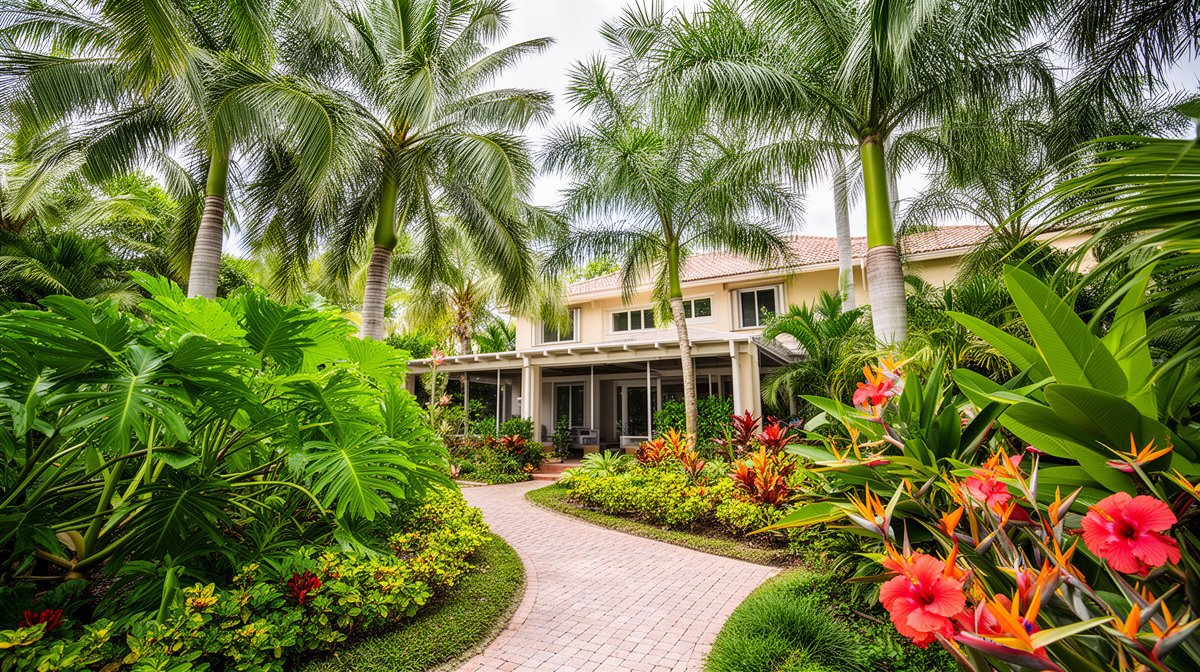
$18–40/sqftA pair of Wodyetia bifurcata flank the entry of a 1970s stucco ranch, with a mass of Philodendron 'Xanadu' at their base and a low Ixora 'Maui' hedge tracing the walkway. White porcelain pavers lead to the door, a band of white Mexican beach pebble separates path from bed, and small uplights wash the palm trunks after dark. The front faces south, so the beds get full afternoon sun and the foxtail crowns catch the light.
Try this on your yard: The Palm Court EntryAI-generated image
The Heliconia Pool Screen
$22–48/sqftBehind a screened pool, a tall back border layers Strelitzia nicolai at the rear, clumps of Alpinia zerumbet 'Variegata' in the middle and Heliconia psittacorum 'Lady Di' along the front edge. A grouping of three Veitchia merrillii rises beside the enclosure corner, far enough from the screen to avoid frond damage. The orange and red bracts show against the dark foliage from the pool deck, and the golf-course side of the lot stays open to the view.
Try this on your yard: The Heliconia Pool ScreenAI-generated image
The Oak Shade Understory
$16–36/sqftUnder an established Quercus virginiana on a larger lot, a loose carpet of Philodendron 'Xanadu', Zamia furfuracea and Neoregelia 'Fireball' sits around a pair of Sabal palmetto. A crushed-shell path winds through, bordered by coontie and a few Licuala grandis near a patio where the shade is deepest. Filtered light keeps the foliage from scorching in July and the bromeliad cups hold a little red against the green.
Try this on your yard: The Oak Shade UnderstoryAI-generated image
The Canal-Side Banana and Bromeliad Edge
$20–44/sqftOn a lot that backs onto a canal or lake, Musa 'Dwarf Cavendish' and Heliconia rostrata form a screen along the fence line while Bismarckia nobilis anchors the corner in full sun. A low bed of Neoregelia 'Fireball' and Aechmea blanchetiana wraps the base, and Thrinax radiata gives a native palm profile against the water. The planting is tall enough to block the view from the neighbor's lanai and loose enough to look natural from the water side.
Try this on your yard: The Canal-Side Banana and Bromeliad EdgeSee how a tropical/lush garden looks on YOUR property
Upload a photo of your Plantation yard and visualize your dream garden in seconds.
Try ProScapeAI Free

AI-generated image
Featured Trees & Shrubs for Tropical/Lush Gardens
Browse all 150 plants for Plantation
Bismarck Palm
Bismarckia nobilis
reaches 30 feet tall, blooms in summer. Pollinator-friendly.

Clustering Fishtail Palm
Caryota mitis
medium-sized at 15 feet, yellow blooms in summer. Pollinator-friendly.

Pygmy Date Palm
Phoenix roebelenii
grows to 6 feet, yellow blooms in spring. Pollinator-friendly.

Royal Palm
Roystonea regia
large shade tree reaching 50+ feet, white blooms in spring. Pollinator-friendly.
Featured Grasses & Groundcovers for Tropical/Lush Gardens
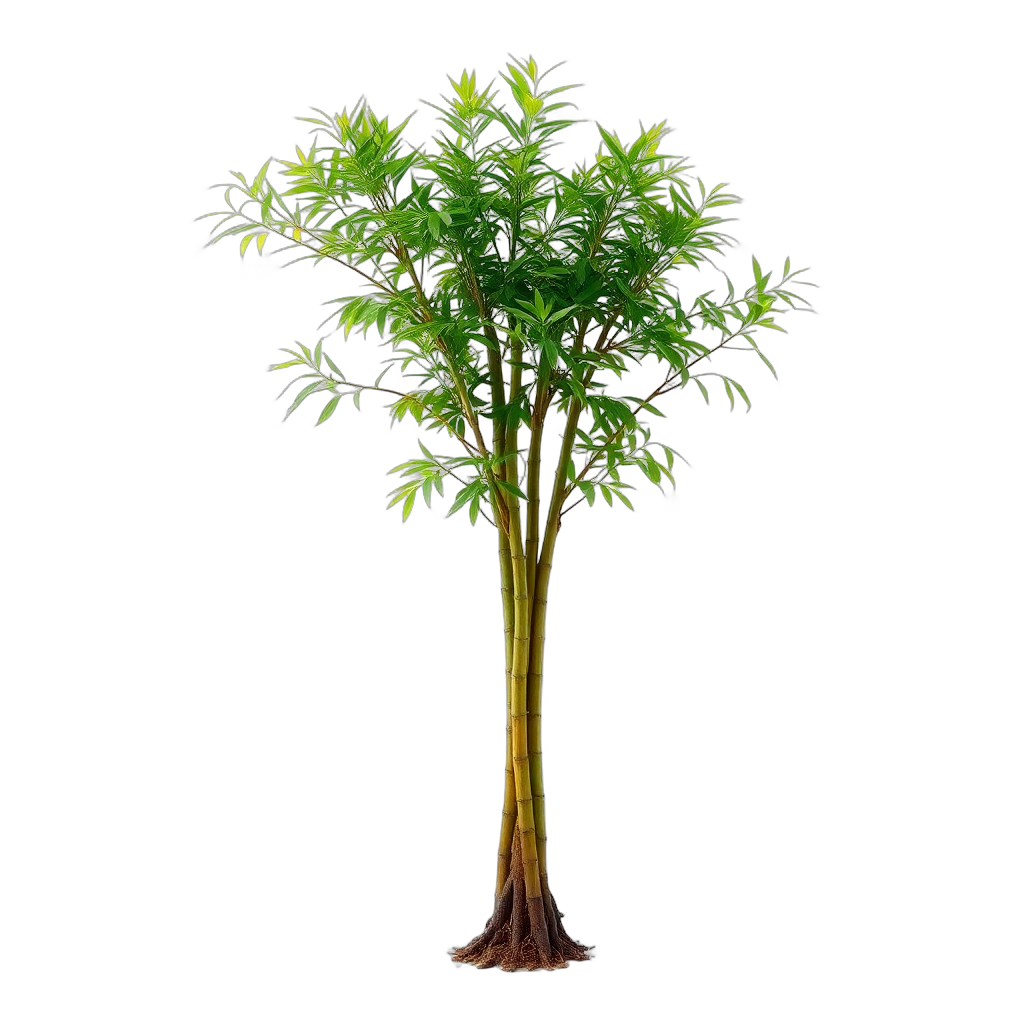
Anceps Bamboo
Yushania anceps
medium-sized at 12 feet, blooms in none. Evergreen year-round.
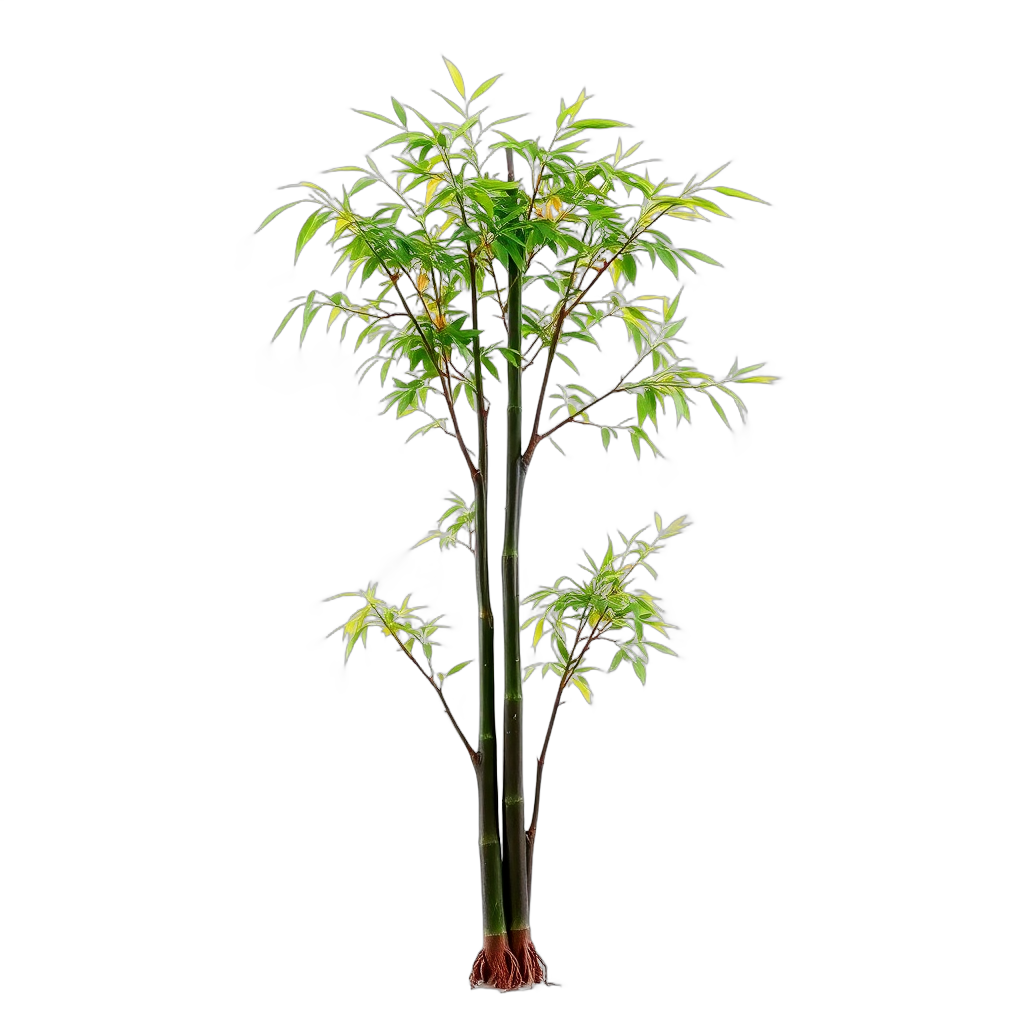
Black Bamboo
Phyllostachys nigra
reaches 25 feet tall, blooms in none. Evergreen year-round.
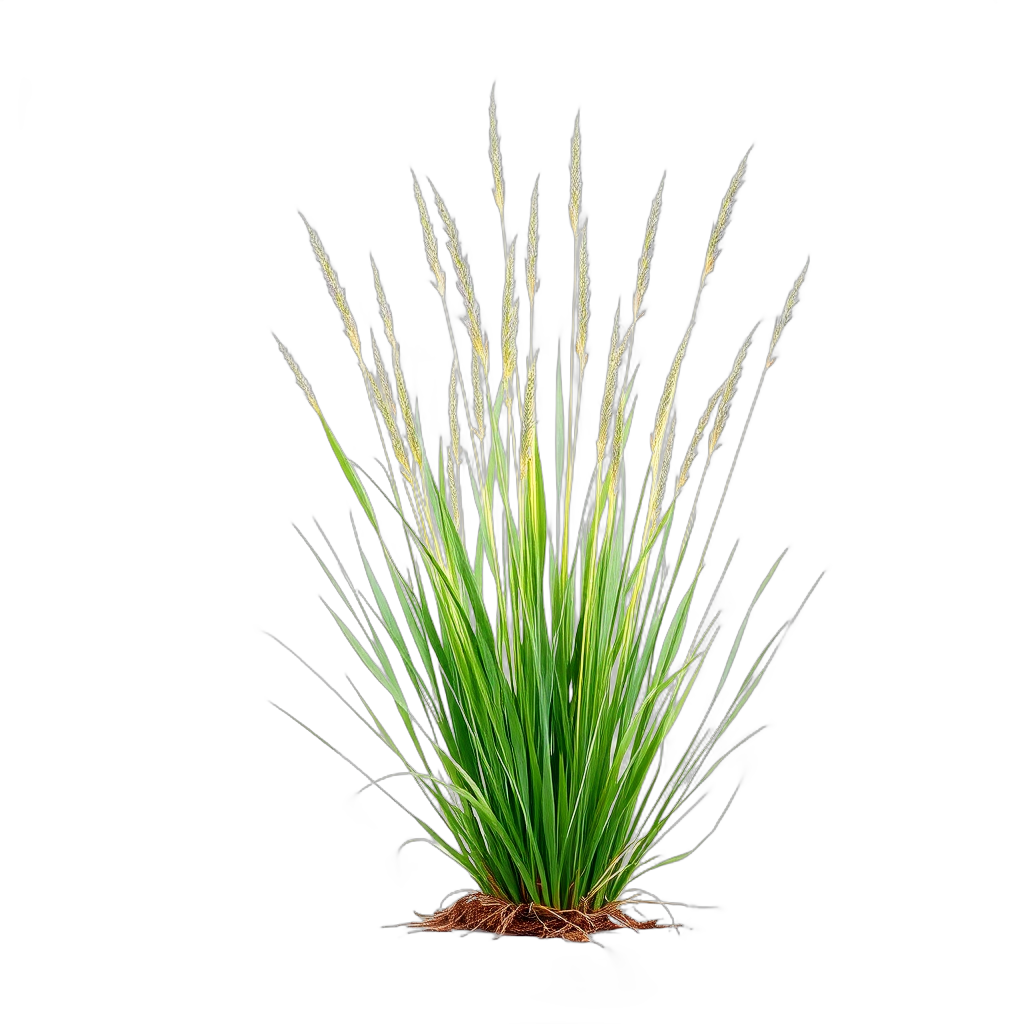
Blue Grama Grass
Bouteloua gracilis
low-growing ground cover, purple blooms in summer. Yellow fall color.
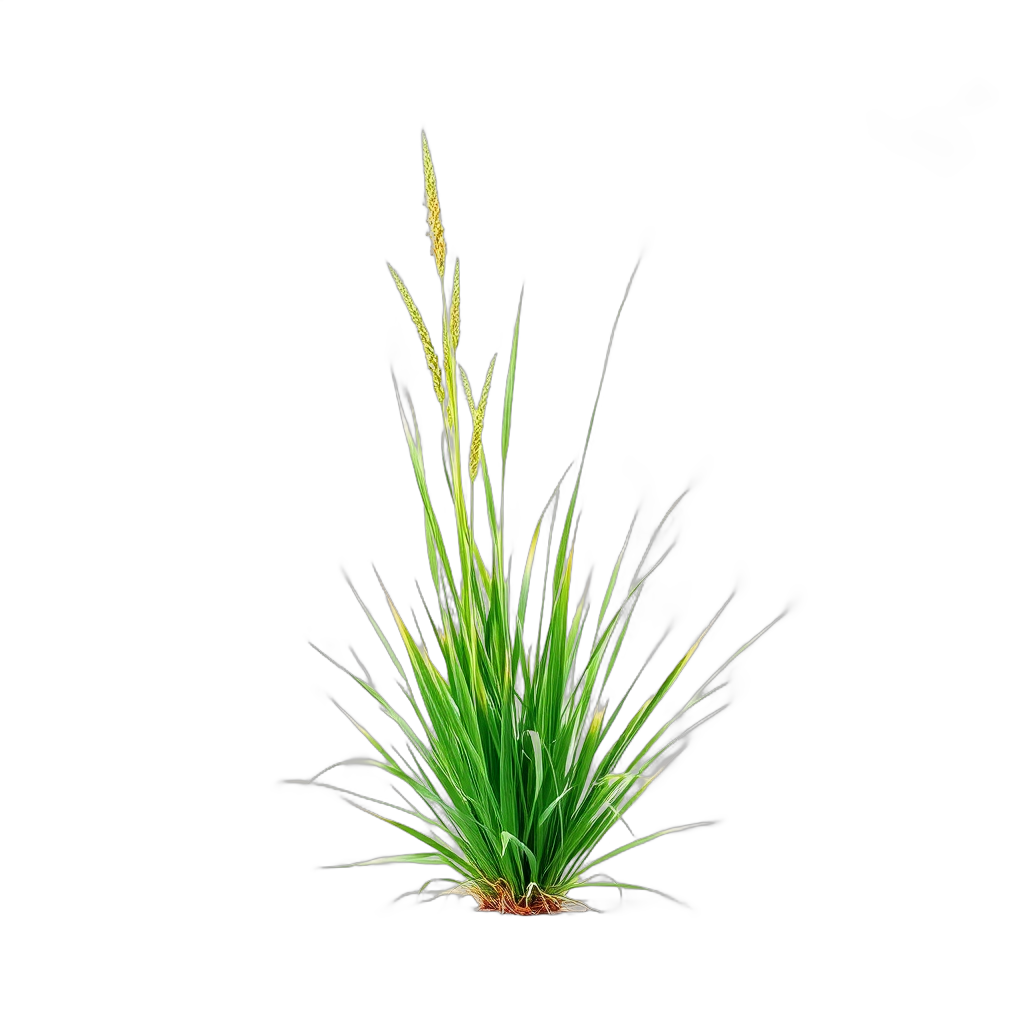
Bull Grass
Muhlenbergia emersleyi
grows to 4 feet, purple blooms in fall. Yellow fall color.
Featured Flowers & Perennials for Tropical/Lush Gardens

Canadian Waterweed
Elodea canadensis
grows to 3 feet, white blooms in spring. Evergreen year-round.

Common Cattail
Typha latifolia
grows to 5 feet, blooms in summer. Pollinator-friendly.

Common Duckweed
Lemna minor
low-growing ground cover, white blooms in summer. Evergreen year-round.

European Frogbit
Hydrocharis morsus-ranae
low-growing ground cover, white blooms in summer. Pollinator-friendly.
Zone and sun checks come from our database — confirm with your local nursery before you buy.
Bloom Calendar for Plantation
spring
Canadian Waterweed, Sweet Flag, African Daisysummer
Canadian Waterweed, Common Cattail, Common Duckweedfall
Canadian Waterweed, Pickerelweed, African Daisywinter
Limited bloomsDesign Tips for Plantation (Zone 10b)
- Plan irrigation around the wet season: Plantation gets about 61 inches of rain a year, with June the wettest month at 9.55 inches, so drip with a rain sensor covers most of the dry months from November through April
- Keep big palms 15 feet or more from the roofline and pool cage: a Wodyetia bifurcata is easier to thin than to remove after a storm
- Feed palms with a micronutrient mix: alkaline Broward limestone soil pushes Ptychosperma elegans and Dypsis lutescens toward manganese and potassium deficiency
- Build three layers: Sabal palmetto or Wodyetia bifurcata overhead, Strelitzia nicolai or Alpinia zerumbet 'Variegata' mid-level, Heliconia psittacorum 'Lady Di' and Codiaeum variegatum 'Petra' low
- Put Cyrtostachys renda and Heliconia rostrata near a south or west wall: a night near 40°F is rare in Plantation but can scorch their leaves
- Use Neoregelia 'Fireball' and Aechmea blanchetiana under the palms for color when the heliconias take a winter break
- Mulch with cypress or bark 3 inches deep and pull it back from palm trunks: wet summers invite fungus where mulch touches the crown
Where to Source Plants in Plantation
Skip the big-box stores. These independent Plantation nurseries specialize in the plants that make tropical/lush gardens thrive in Zone 10b.
Flamingo Road Nursery
Davie (South Flamingo Road)
Ten-acre garden center with a plant nursery, more than 200 fountains, pottery, boulders, mulch and rock, plus delivery, installation and in-home garden consultations
Living Color Garden Center
Fort Lauderdale (Griffin Road)
Five-acre garden center where about 80 percent of the plants are grown at its sister nursery; anthurium, vanda orchids, peace lily and bougainvillea are featured, with pottery and fountains
Nu Turf of Pompano Beach
Pompano Beach (North Dixie Highway)
Retail garden center with palms, exotic fruit and shade trees, Florida native and drought-tolerant plants, roses, succulents, sod, and bagged or bulk mulch, rock and soil
Tropical/Lush Landscaping Cost Ranges
| Project Scope | Estimated Cost |
|---|---|
| Interlocking concrete pavers patio (200 sqft) | $4,300–$5,700 |
| Low-voltage landscape lighting (6 fixtures) | $1,200–$2,000 |
| Tree planting labor, tree not included (2 trees) | $1,200–$1,500 |
| AI visualization (ProScapeAI) | Free to start |
National average installed ranges for 2026 from our landscaping price list (Homewyse and other published sources). Prices in Plantation, FL vary with site, materials and contractor, so get two or three local quotes.
Plantation Climate & Growing Zone
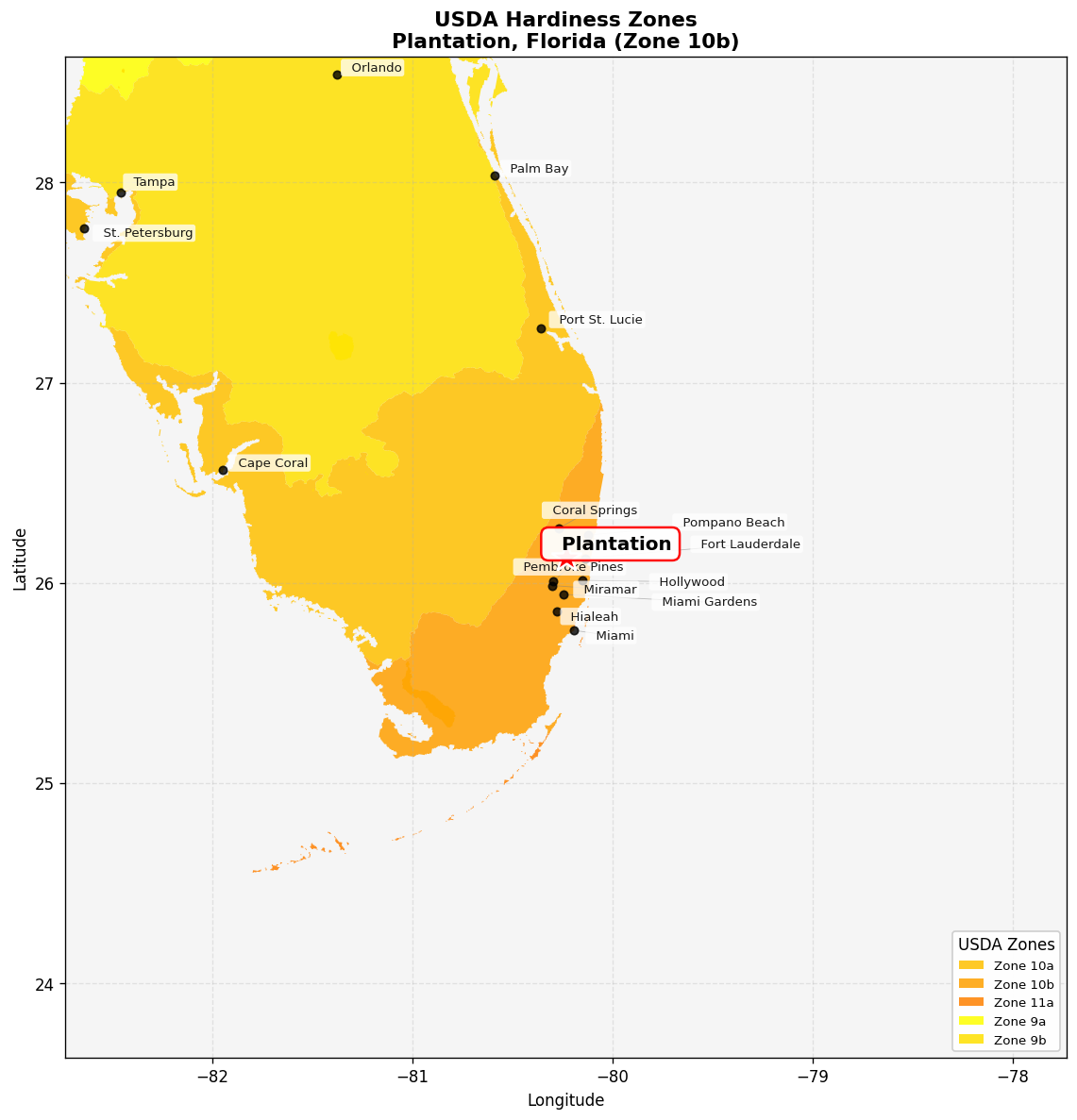
USDA Zone 10b
Hardiness zone for Plantation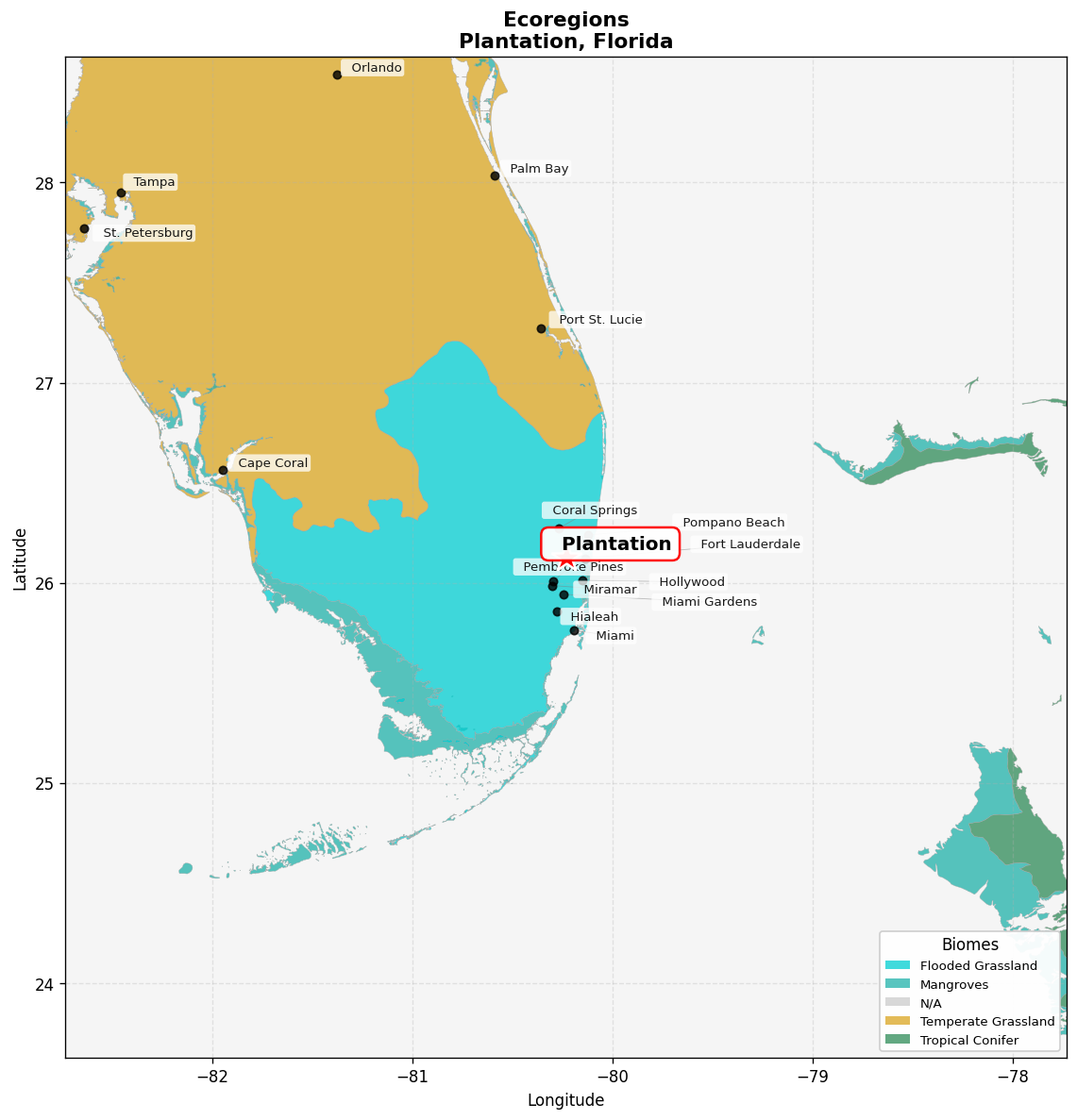
Everglades flooded grasslands
Native ecoregionFrequently Asked Questions
How much does tropical landscaping cost in Plantation, FL?
Palms drive the price: a field-grown Wodyetia bifurcata or Bismarckia nobilis can cost more than the rest of the bed together. Prices vary with site, size and finishes, so get two or three local quotes.
Is a tropical garden low maintenance in Plantation's climate?
Mostly, once it has grown in. With about 61 inches of rain a year and a wet season from May through October, the garden needs supplemental water mainly from November through April. The work is pruning and feeding: palms want a micronutrient palm fertilizer a few times a year, heliconias need old stalks cut out after flowering, and hedges such as Clusia guttifera need shearing before hurricane season. Expect a monthly visit from a crew or a few hours of your own time.
When is the best time to plant in Plantation?
The start of the wet season, from late May through September, is the easiest window because rain does most of the watering and palms root quickly in 77°F nights. October through December also works. Avoid planting large palms during an approaching storm, and stake or guy anything over 12 feet. Cold fronts rarely hurt this garden, as NOAA's normals count only 0.8 days a year at or below 40°F at Fort Lauderdale-Hollywood airport.
Do I need a permit or HOA approval in Plantation?
The City of Plantation's Environmental Landscape Division handles tree and palm removal or relocation permits, so call it before a tree or palm comes down. Florida Statute 163.045 bars a local government from requiring a permit, fee or replanting for removing a tree on a single-family lot when an ISA-certified arborist or a Florida-licensed landscape architect documents that it poses an unacceptable risk to people or property. Many Plantation neighborhoods also have HOA landscape rules, so check with the association and the city before removing a mature tree or planting a tall palm near a lot line, and confirm the current irrigation days with your water utility.
What survives Plantation's heat and the occasional cold night?
July highs average 90.0°F and the January average low is 60.9°F, so Zone 10b plants grow well. Heliconia psittacorum 'Lady Di', Alpinia zerumbet 'Variegata', Strelitzia nicolai, Sabal palmetto, Wodyetia bifurcata and Bismarckia nobilis all handle the heat. A rare 40°F night can mark the tips of Cyrtostachys renda and the large-leaved Heliconia rostrata, so plant them near a warm wall. Most losses here come from wind and flooding.
Which palms are safest around a pool and screen enclosure?
Choose palms that drop clean fronds and fit the space: Veitchia merrillii, Ptychosperma elegans, Thrinax radiata and Sabal palmetto. Keep tall crowns of Wodyetia bifurcata and Roystonea regia at least 15 feet from the screen, and thin heavy crowns before June. Palms with sharp spines, such as Phoenix roebelenii, belong away from walking paths.
What do Plantation's alkaline soils do to a tropical garden?
Much of Broward is sand over limestone with an alkaline pH, which blocks iron, manganese and magnesium. Yellow new leaves on Ixora 'Maui' or Dypsis lutescens usually point to that lockout. Use a chelated iron product and a slow-release palm fertilizer with micronutrients, and favor Clusia guttifera, Philodendron 'Xanadu', Zamia furfuracea and Sabal palmetto, which tolerate it.