4 Tropical Garden Ideas for Fort Lauderdale, FL | Palm, Croton & Bromeliad Design in Zone 10b
Native plants from the Everglades flooded grasslands (Zone 10b) — Tropical rainforest climate
Why Tropical/Lush Gardens in Fort Lauderdale?
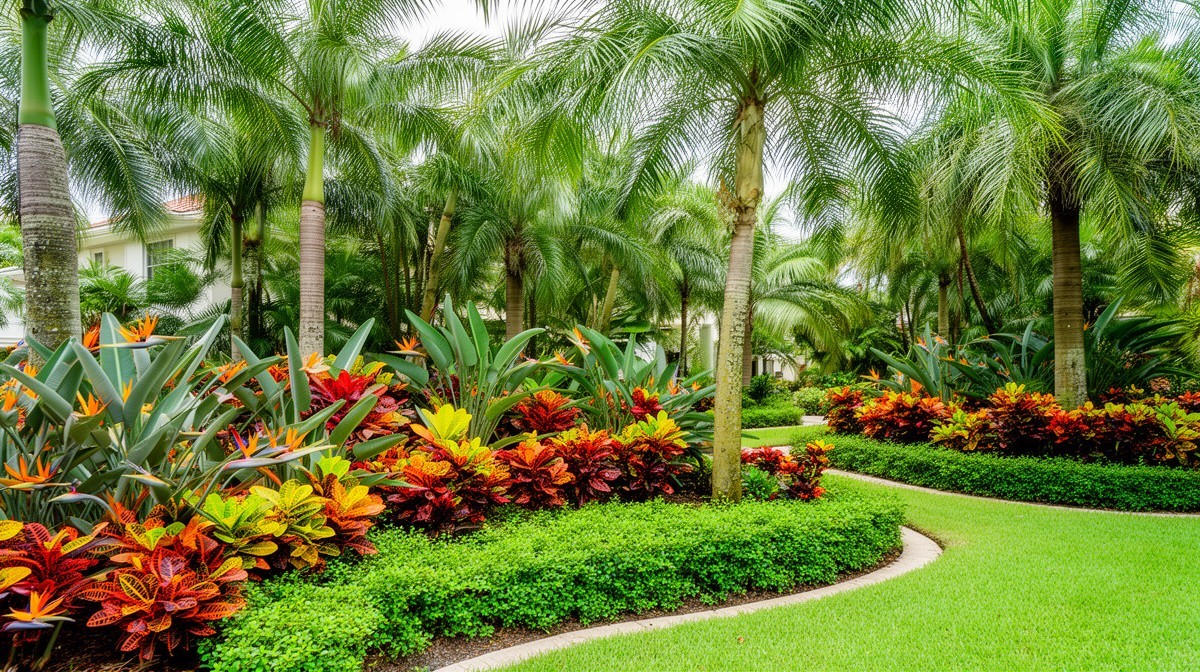
Fort Lauderdale is one of the very few mainland American cities where a genuinely tropical garden is the honest choice rather than a costume. The city sits in USDA Zone 10b with average winter lows of 35-40°F and a Köppen Af tropical classification, so coconut palms, crotons, heliconia and bougainvillea are permanent architecture here, not seasonal props. The look is already written into the neighborhoods: Cuban royal palms (Roystonea regia) marching down the finger isles off Las Olas like street lamps, coconut palms leaning over 1950s ranch rooflines in Coral Ridge, and dense walls of Clusia guttifera turning 50-foot Wilton Manors lots into private courtyards. Even Victoria Park's live oak canopy works in your favor, handing you the filtered shade that philodendron, ginger and bromeliads genuinely prefer over full South Florida sun.
Soil is where most tropical plantings quietly fail. Broward's coastal ridge soil is sandy, fast-draining and derived from oolitic limestone, which pushes pH into the 7.5-8.3 range - alkaline enough to lock up iron and manganese. That is why so many local Ixora 'Nora Grant' and gardenia hedges sit stubbornly yellow between green veins, and why royal and queen palms throw frizzled, deformed new growth. The fixes are specific, not generic: chelated iron and manganese drenches for the shrubs, and a controlled-release 8-2-12 plus 4% magnesium palm fertilizer four times a year for every palm on the property, which UF/IFAS treats as the single highest-value thing you can do for palm health in South Florida. Layer on roughly 62 inches of annual rain, about 70% of it falling May through October, and a seasonal high water table often within two to four feet of grade, and you understand why good local crews mound beds 8-12 inches: Plumeria, Alcantarea and Adenium rot from below, never from above.
Then there is the wind. Broward County sits inside Florida's High-Velocity Hurricane Zone, with ultimate design wind speeds near 170 mph, and that should shape your tree list more than any aesthetic preference. Sabal palmetto, Coccothrinax argentata, Thrinax radiata, gumbo limbo (Bursera simaruba), pigeon plum (Coccoloba diversifolia) and live oak came through Wilma and Irma standing; Ficus benjamina, Australian pine, laurel oak, schefflera and brittle-limbed royal poinciana routinely did not. Ficus hedges carry a second liability - the ficus whitefly that has skeletonized thousands of Broward hedges since 2007 - which is exactly why clusia, podocarpus, cocoplum and silver buttonwood have taken their place. Budget with eyes open: South Florida labor and crane setting run well above national averages, and Broward's year-round two-day-per-week irrigation rule, with no watering between 10 a.m. and 4 p.m., means new installations need drip and a real establishment plan rather than a hose.
4 Tropical/Lush Design Ideas for Fort Lauderdale
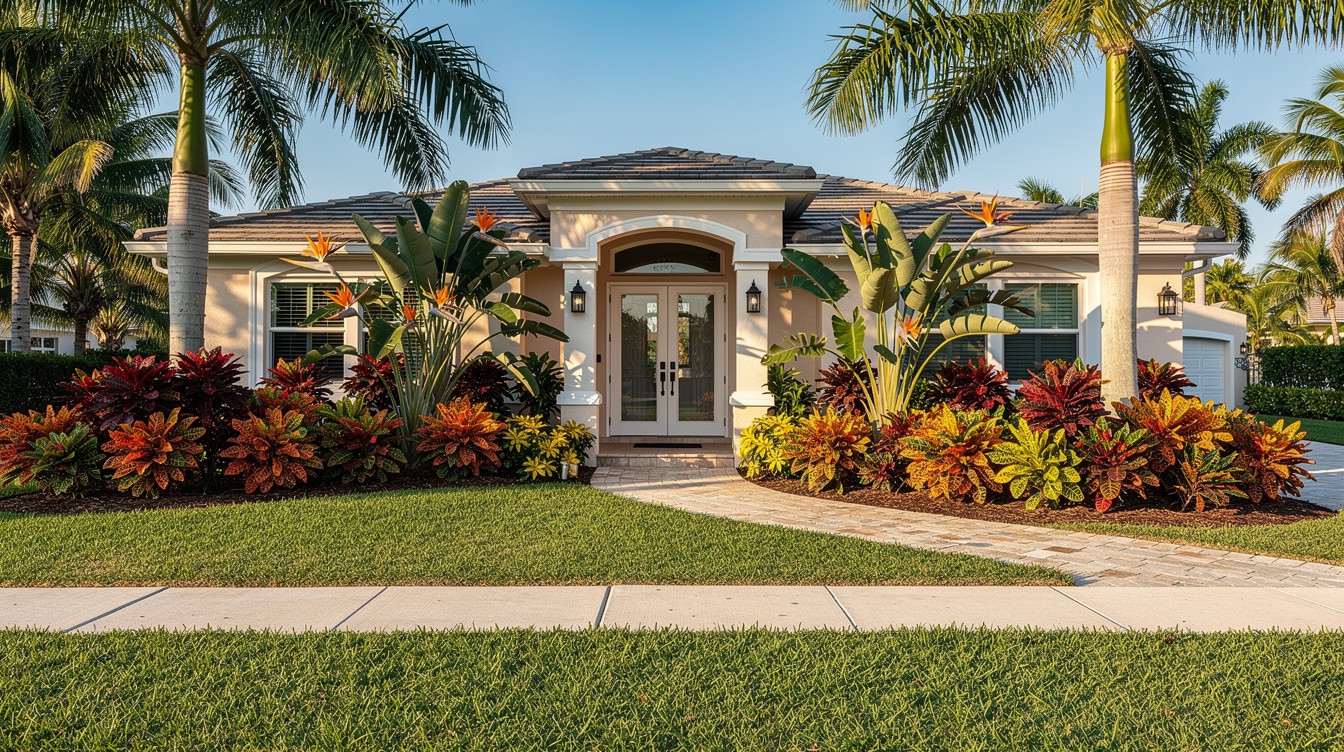
The Royal Palm Portico
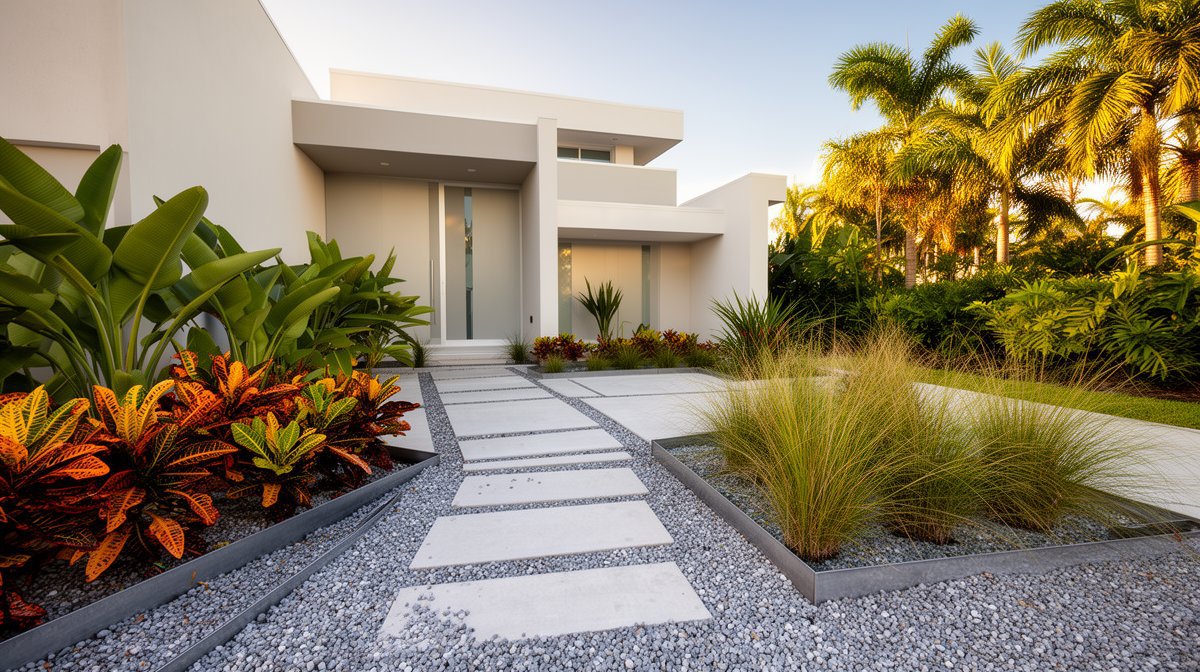
$14-26/sqftA single-story barrel-tile stucco home with an arched, keystone-trimmed entry, framed by a matched pair of Cuban royal palms whose smooth grey trunks and green crownshafts do most of the architectural work. The foundation bed is a solid ribbon of crotons graded by color - burgundy 'Mammy' at the ends, orange-and-gold 'Petra' through the middle - with orange-flowered Strelitzia reginae and big-paddle Strelitzia nicolai punching upward on both sides of the door. Hard-cut bed lines and a clean Floratam lawn keep the whole thing reading as design rather than jungle.
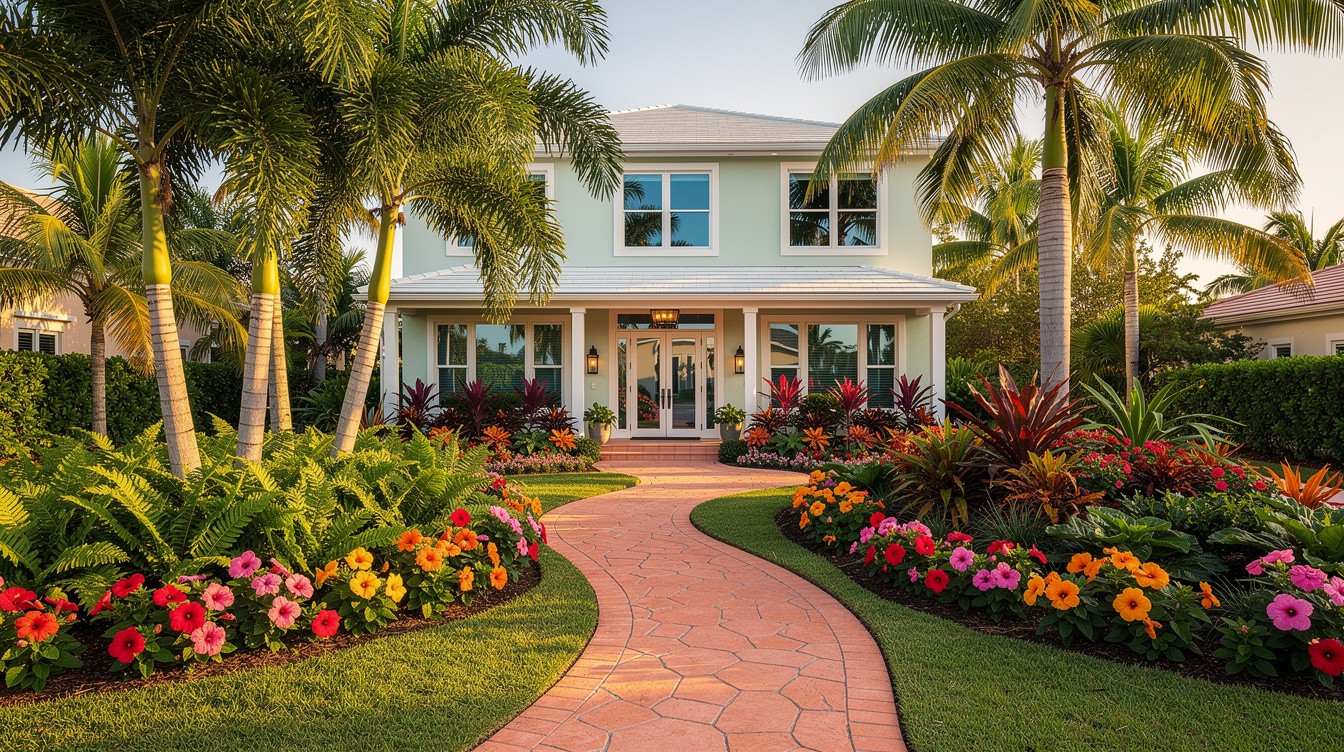
The Coconut Palm Welcome Curve
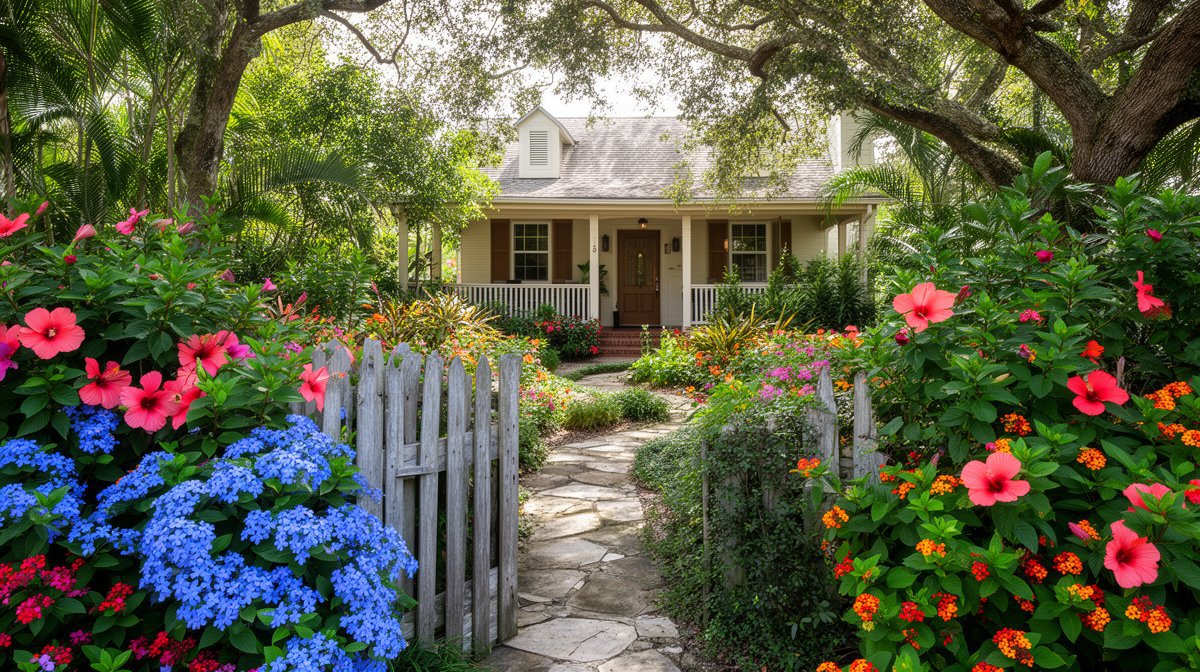
$16-30/sqftA two-story mint-green Key West home where a coral-tinted stamped concrete walk curves through the lawn instead of cutting straight at the door. Coconut palms and royal palms are staggered at three different heights so the canopy layers rather than lines up, macho ferns fill the shaded understory at their bases, and the color comes from a long mass of hibiscus in pink, coral and red backed by burgundy 'Red Sister' ti. A clipped Clusia guttifera hedge runs both property lines, framing the whole composition in flat green.
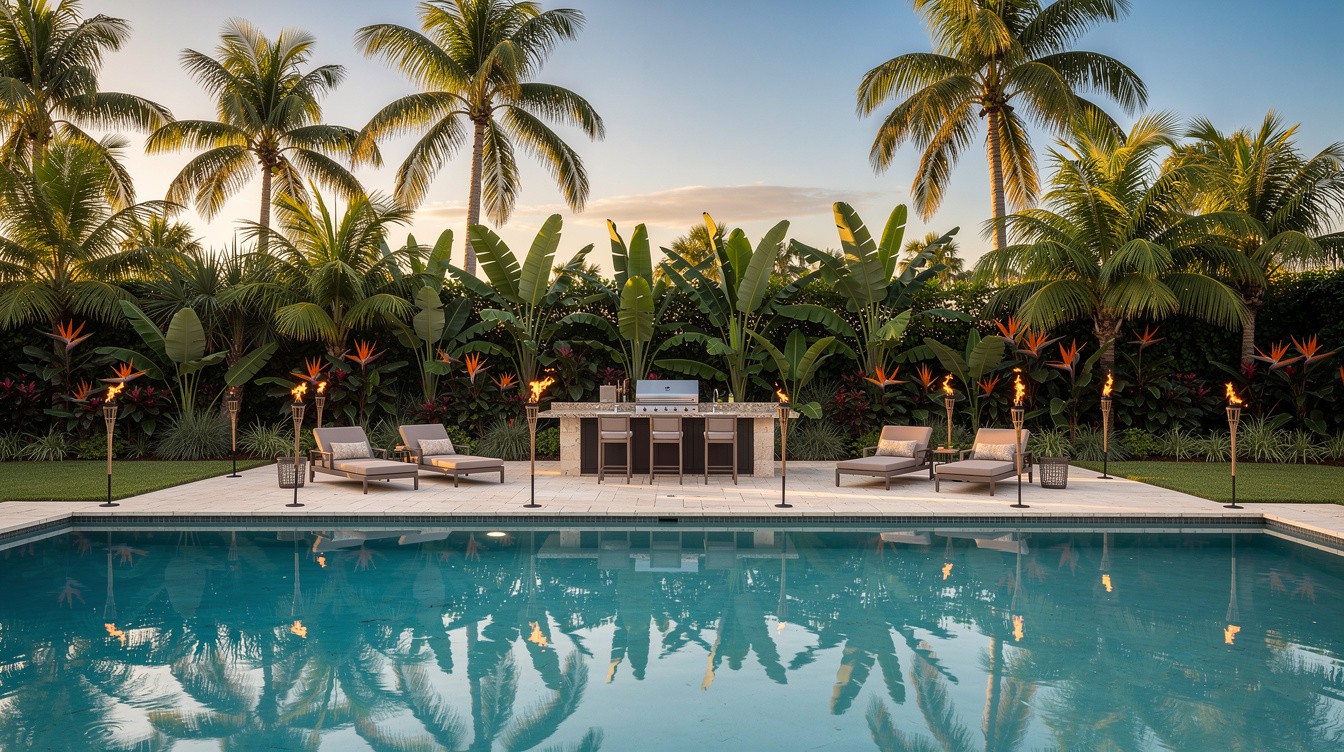
The Tiki Torch Pool Kitchen
$45-90/sqftA wide travertine pool deck with a keystone-faced outdoor kitchen island set dead center against a solid green backdrop, flanked by a rank of standing tiki torches that turn the whole rear yard into a lit stage at dusk. The planting is deliberately simple and big-leafed: giant white bird of paradise and traveler's palm forming the middle wall, coconut palms overhead for canopy, and orange Strelitzia reginae flowers repeated along the base of a Clusia rosea hedge so the color reads from across the water. No fussy detail survives poolside chlorine and salt spray, so this design leans entirely on scale and silhouette.
The Lanai and Waterfall Spa Retreat
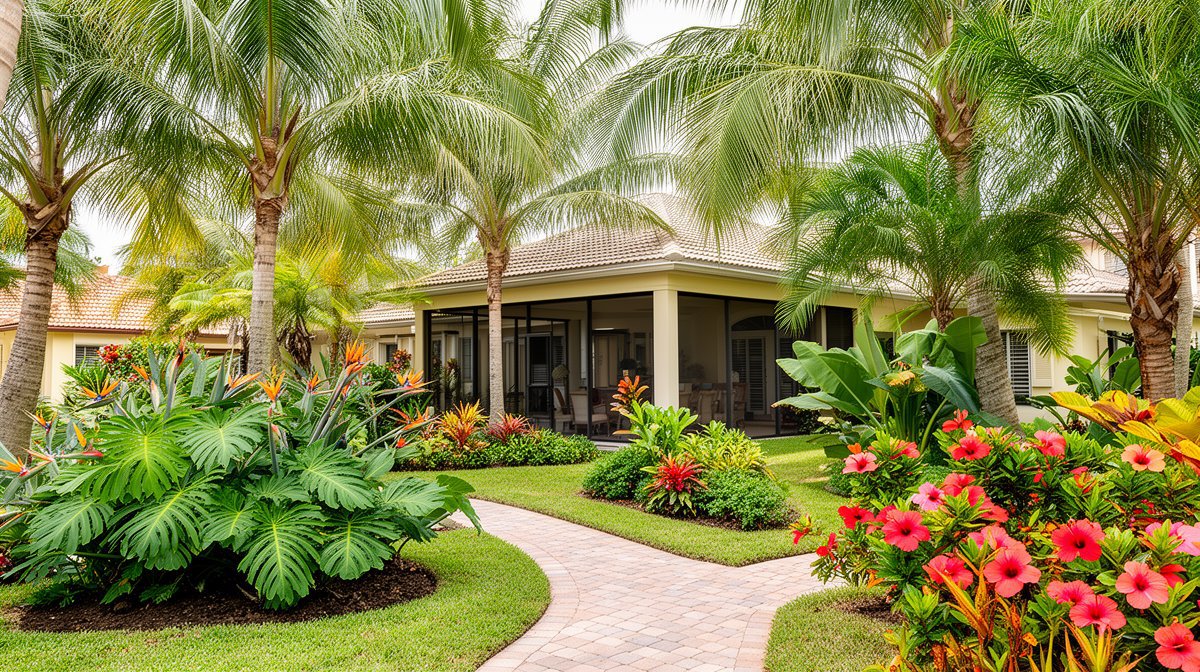
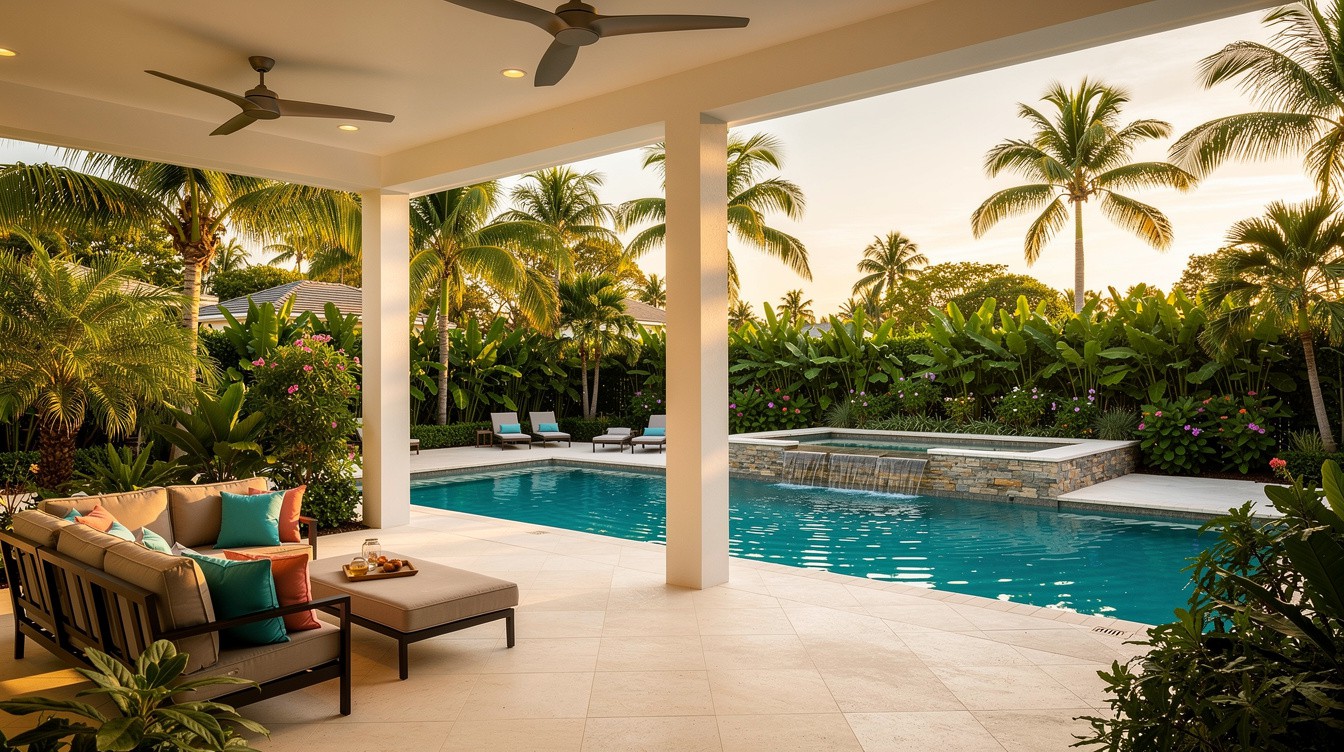
$60-120/sqftA deep covered lanai with a tongue-and-groove ceiling and two oversized fans opens directly onto a turquoise pool with a raised, ledger-stone spa spilling three sheets of water back into the main body. The planting works as a solid green wall on all three sides - clumping palms, big philodendron and banana-leaf texture - punctuated by magenta bougainvillea trained up the far corners so the color sits at eye level from the sofa. The shellstone deck stays cool underfoot in August, which is the entire reason this material dominates Fort Lauderdale backyards.
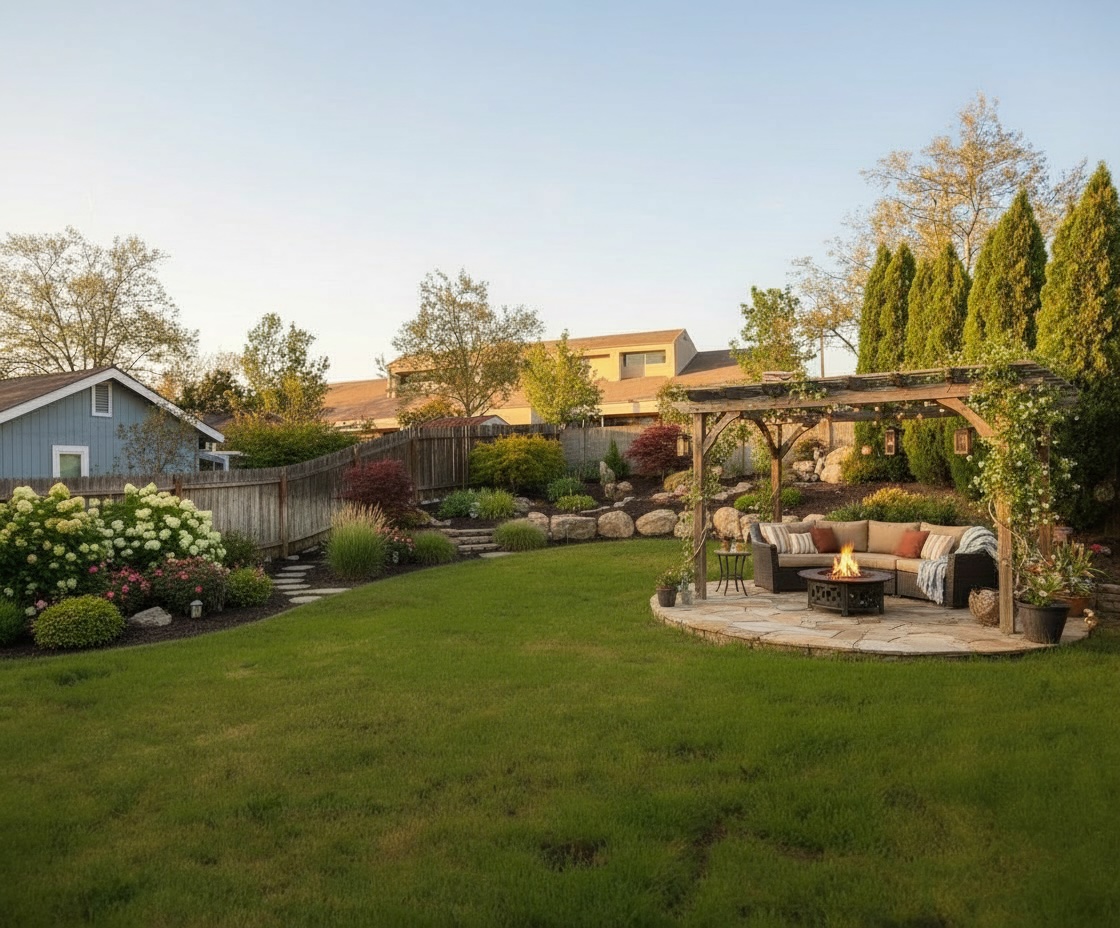
See how a tropical/lush garden looks on YOUR property
Upload a photo of your Fort Lauderdale yard and visualize your dream garden in seconds.
Try ProScapeAI Free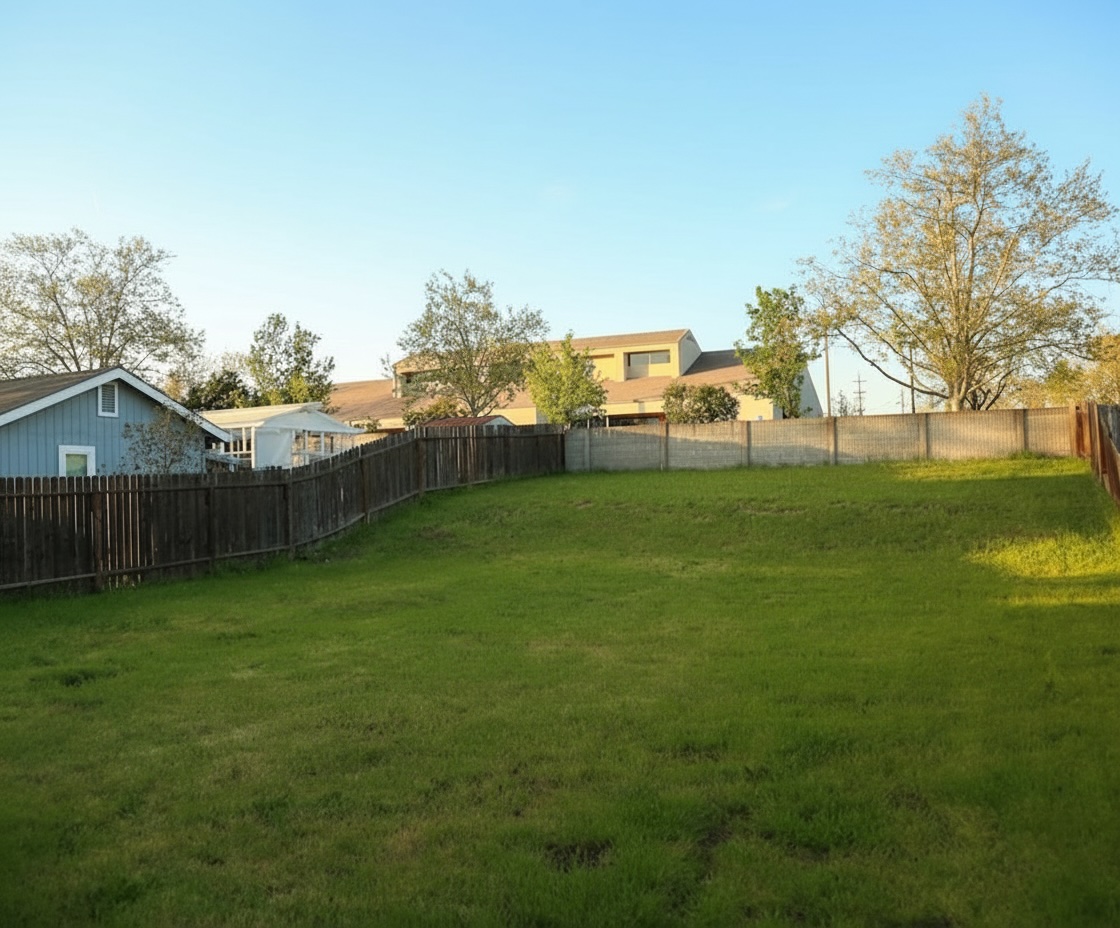
Featured Trees & Shrubs for Tropical/Lush Gardens
Browse all 34 plants for Fort Lauderdale
Pygmy Date Palm
Phoenix roebelenii
grows to 6 feet, yellow blooms in spring. Pollinator-friendly.

Royal Palm
Roystonea regia
large shade tree reaching 50+ feet, white blooms in spring. Pollinator-friendly.

Buddha's Hand Citron
Citrus medica
medium-sized at 10 feet, white,purple blooms in winter. Attracts butterflies.

Common Fig
Ficus carica
medium-sized at 15 feet, blooms in spring. Attracts butterflies.
Featured Grasses & Groundcovers for Tropical/Lush Gardens

Bermuda Grass
Cynodon dactylon
low-growing ground cover, blooms in summer. Brown fall color.
Featured Flowers & Perennials for Tropical/Lush Gardens

Broadleaf Arrowhead
Sagittaria latifolia
low-growing ground cover, white blooms in summer. Attracts butterflies.

Canadian Waterweed
Elodea canadensis
grows to 3 feet, white blooms in spring. Evergreen year-round.

Common Cattail
Typha latifolia
grows to 5 feet, blooms in summer. Pollinator-friendly.

European Frogbit
Hydrocharis morsus-ranae
low-growing ground cover, white blooms in summer. Pollinator-friendly.
Bloom Calendar for Fort Lauderdale
spring
Canadian Waterweed, Arrow Arum, Pygmy Date Palmsummer
Broadleaf Arrowhead, Canadian Waterweed, Common Cattailfall
Broadleaf Arrowhead, Canadian Waterweed, Pickerelweedwinter
Jade Plant, Silver Jade, Buddha's Hand CitronDesign Tips for Fort Lauderdale (Zone 10b)
- Mound every bed 8-12 inches above grade - with 62 inches of annual rain and a water table often two to four feet down, Plumeria, Alcantarea and Adenium drown from below long before anything above ground goes wrong
- Feed every palm on the property a controlled-release 8-2-12 with 4% magnesium four times a year; potassium and manganese deficiency, not cold, is what kills Fort Lauderdale palms slowly
- Stagger palm heights instead of planting matched pairs everywhere - three Cocos nucifera at 8, 14 and 20 feet of clear trunk read as a grove, while three identical ones read as a parking lot
- Use crotons the way a cold-climate designer uses fall color: mass Codiaeum 'Mammy' and 'Petra' in blocks of five or more so they read as a color field, never one-of-each spotted through a bed
- On canal and Intracoastal lots in Las Olas Isles or Seven Isles, build the outer 10 feet from salt-proof species only - Coccoloba uvifera, Coccothrinax argentata, Clusia rosea, cocoplum and silver buttonwood take spray and king-tide flooding that will brown out ixora overnight
- Light upward through palm trunks and across big Strelitzia nicolai leaves rather than flooding the lawn - Fort Lauderdale's outdoor season is twelve months long and evening shadow play is most of what you actually see of the garden
Where to Source Plants in Fort Lauderdale
Skip the big-box stores. These independent Fort Lauderdale nurseries specialize in the plants that make tropical/lush gardens thrive in Zone 10b.
Living Color Garden Center
Griffin Road
Five acres of plants with about 80% of inventory grown at their own sister nursery.
Flamingo Road Nursery
Davie
10-acre garden center with plants, hardscape, a farmers market, and a cafe.
Nu Turf of Pompano Beach
Pompano Beach
Family-owned full-service landscape nursery offering sod, trees, plants, and pottery.
Spykes Grove Nursery
Davie
Tropical fruit trees, citrus, and exotic plants, with a history dating to 1946.
Tropical/Lush Landscaping Costs in Fort Lauderdale
| Project Scope | Estimated Cost |
|---|---|
| Front yard tropical planting refresh (crotons, ti, bromeliads, 500 sqft) | $6,000 - $14,000 |
| Specimen royal or coconut palm, craned and installed | $1,200 - $4,500 each |
| Clusia or podocarpus privacy hedge, 6-8 ft installed | $90 - $250 per linear ft |
| Travertine pool deck + tropical border planting | $25,000 - $65,000 |
| Full backyard resort build (pool, spa, outdoor kitchen, planting) | $120,000 - $350,000 |
| AI visualization with ProScapeAI | Free to start |
Estimates based on Fort Lauderdale, FL-area contractor rates as of 2026. Actual costs vary by site conditions, materials, and contractor.
Fort Lauderdale Climate & Growing Zone
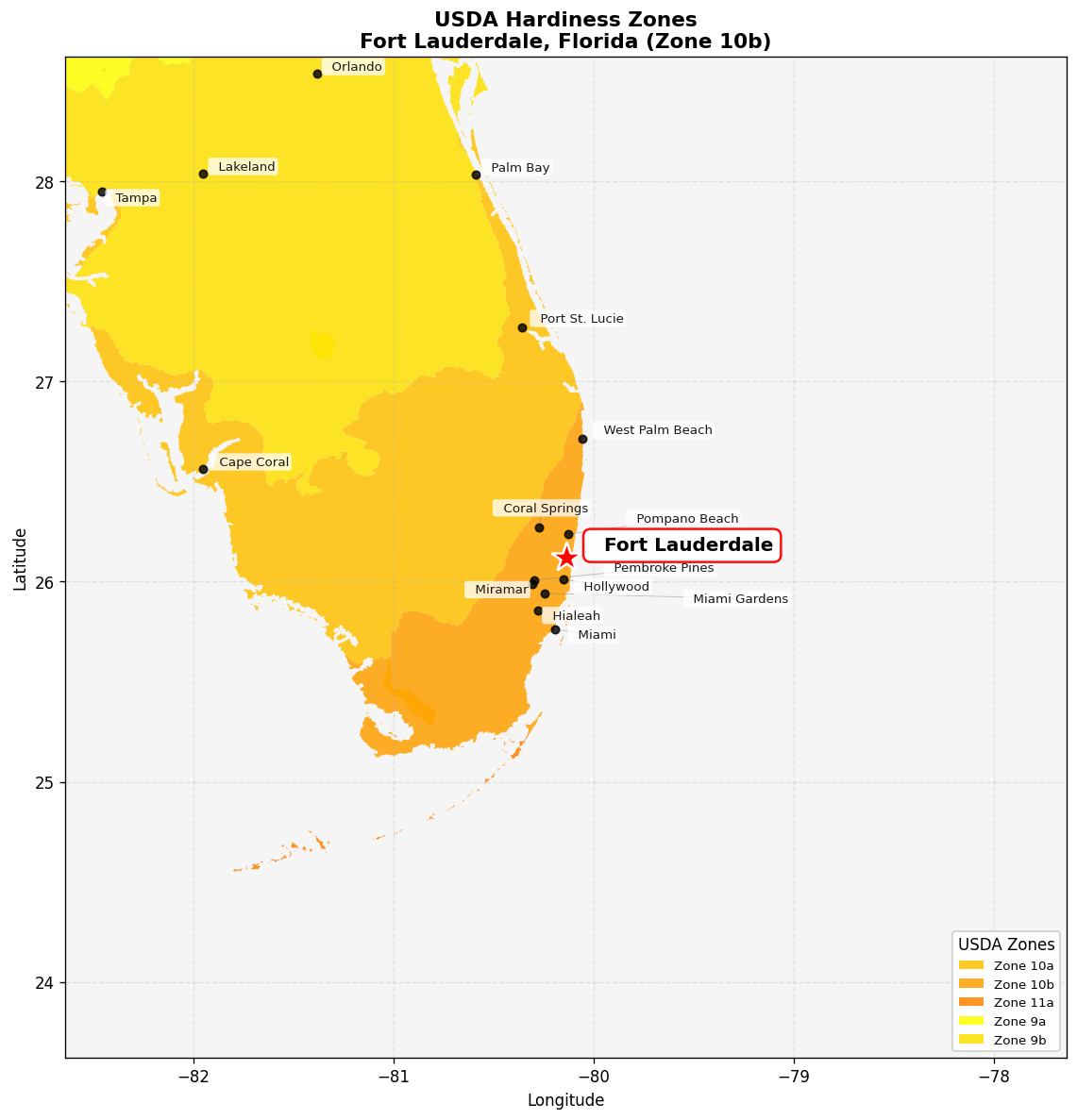
USDA Zone 10b
Hardiness zone for Fort Lauderdale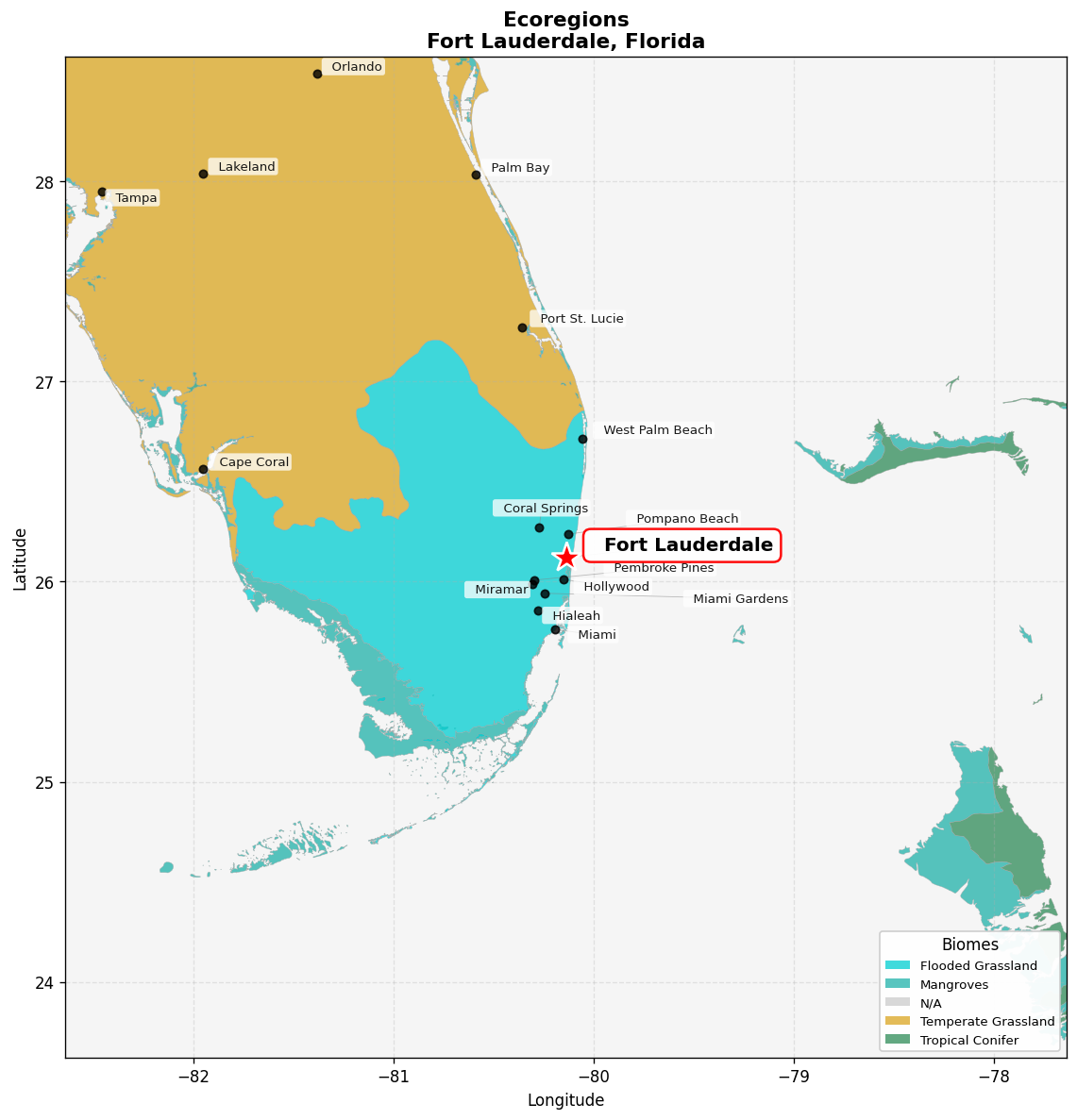
Everglades flooded grasslands
Native ecoregionFrequently Asked Questions
How much does tropical landscaping cost in Fort Lauderdale?
Expect to pay above national averages - South Florida labor, crane setting for palms, and HVHZ-compliant structural work all carry a premium. A front-yard tropical refresh with crotons, ti plants, bromeliads and fresh mulch across 500 sqft typically runs $6,000-14,000. A specimen Cuban royal palm at 16-20 feet of clear trunk, craned in and staked, runs $1,200-4,500 installed depending on size and access. A travertine pool deck with full tropical borders lands between $25,000 and $65,000, and a complete backyard resort build with pool, spa, outdoor kitchen and planting commonly falls between $120,000 and $350,000 on Las Olas Isles and Rio Vista lots.
Which trees and palms actually survive a hurricane in Broward County?
Broward sits in the High-Velocity Hurricane Zone with design wind speeds near 170 mph, and UF/IFAS post-storm surveys are blunt about which species hold. Highest survivors: Sabal palmetto (cabbage palm), Coccothrinax argentata (silver thatch), Thrinax radiata, gumbo limbo (Bursera simaruba, which resprouts even after severe damage), pigeon plum, sea grape, Simpson's stopper and live oak. Worst performers: Ficus benjamina, Australian pine, laurel oak, schefflera, earleaf acacia, and royal poinciana, whose gorgeous limbs are notoriously brittle. Queen palms and Washingtonia usually survive but grow tall and top-heavy fast. Site anything brittle well away from the house and the pool cage.
Why are my ixora, gardenia and palms turning yellow?
Almost always alkaline soil, not disease. Fort Lauderdale's limestone-derived sand runs pH 7.5-8.3, which chemically locks up iron and manganese. Ixora 'Nora Grant' and gardenia show interveinal chlorosis - yellow leaf blade, green veins - and respond to chelated iron drenches plus soil sulfur, though the honest long-term answer is grafting gardenia onto Gardenia thunbergia rootstock or choosing an alkaline-tolerant shrub instead. Palms are a separate problem: yellow-orange spotting on older fronds is potassium deficiency and frizzled new growth is manganese deficiency. Apply a controlled-release 8-2-12 with 4% magnesium palm fertilizer four times a year to every palm on the lot.
How often am I allowed to water in Broward County?
Broward operates a year-round two-day-per-week landscape irrigation rule. Odd-numbered addresses water Wednesday and Saturday, even-numbered addresses water Thursday and Sunday, and no irrigation is permitted between 10 a.m. and 4 p.m. when evaporation losses spike. New plantings get a limited establishment exemption, but you must be able to document the install date. Practically, that means drip or micro-spray in the beds rather than overhead rotors, deep infrequent cycles to push roots down through the sand, and grouping plants by water need. Verify current rules with Broward County or SFWMD before you design the zones - restrictions tighten in dry-season droughts.
What should I plant instead of a ficus hedge?
Ficus benjamina was Fort Lauderdale's default privacy hedge until the ficus whitefly arrived in 2007 and defoliated thousands of them countywide, turning maintenance into a permanent chemical program. The replacements are better plants anyway. Clusia guttifera gives the same dense flat green wall with far less trimming and excellent salt tolerance. Podocarpus macrophyllus takes a crisp vertical shear. Chrysobalanus icaco 'Red Tip' cocoplum is a Florida native that shrugs off salt spray and looks good at 4-6 feet. Silver buttonwood (Conocarpus erectus var. sericeus) brings grey foliage and real coastal toughness for Las Olas Isles and Harbor Beach seawall lots.
When is the best time to install a tropical landscape in Fort Lauderdale?
Late spring through early summer, roughly May into July, is ideal for palms and tropicals - soil is warm, natural rainfall does the establishment watering, and root growth is at its annual peak. October through March is fine for shrubs, hardscape and sod, but avoid setting cold-sensitive material like coconut palms, Adenium and Plumeria right before a January cold snap; Zone 10b lows of 35-40°F will not kill them but will stall them for months. Hardscape can go in year-round. Plan around the June 1 to November 30 hurricane season if you are craning in large specimens, and check whether your municipality restricts nitrogen and phosphorus fertilizer during the summer rainy season.