4 English Cottage Garden Ideas for Wilmington, NC | Coastal Zone 8a Borders
Native plants from the Mid-Atlantic US coastal savannas (Zone 8a) — Humid subtropical climate
Why Cottage/English Gardens in Wilmington?
Wilmington already has the bones of a cottage garden. The Victorian and Italianate houses of the downtown historic district, the 1920s and 1930s cottages of Carolina Heights, Forest Hills and Sunset Park, and the deep porches all over Midtown give a loose, flower-filled border the backdrop it needs: painted clapboard, a picket fence, brick steps and a front setback small enough that the planting reads from the sidewalk. This is the Azalea Festival city, raised on camellias, gardenias and blue mophead hydrangeas. A cottage garden here is the old Southern dooryard garden with an English accent.
Heat and humidity set the plant list. Wilmington sits in USDA Zone 8a, with January nights averaging about 36°F and a typical coldest night of the year near 17°F (the 1991–2020 airport record shows a low of 10°F in that span), so cold is rarely the problem. July highs average close to 90°F with nights around 73°F, and the airport averaged close to 60 inches of rain a year over 1991–2020, with August and September each bringing more than 8 inches in a normal hurricane season. That heat and humidity kill the English classics: Delphinium elatum, lupines and Lavandula angustifolia 'Hidcote' are spring annuals at best here, and most hybrid tea roses lose their leaves to blackspot by July. The plants that hold a Wilmington cottage border are the Southern-proven ones: Rosa 'Mutabilis', Rosa 'Old Blush', Rosa 'Peggy Martin' and Rosa 'Belinda's Dream' for roses, Lavandula × intermedia 'Phenomenal' in place of English lavender, Salvia guaranitica 'Black and Blue' and Verbena bonariensis for height, and Hydrangea macrophylla 'Endless Summer' for the porch.
Sand needs feeding and liming. Most of New Hanover County is Coastal Plain sand: it drains in minutes, holds almost no nutrients, and runs strongly acidic, often pH 4.5–5.5 before you amend it. That acidity is why Wilmington hydrangeas turn such a deep blue and why camellias and azaleas do so well, but it is too sour for roses and lavender, which want closer to 6.5. Test through NC State Extension, lime only the rose and lavender beds, and work 3–4 inches of compost into every border. In the low spots, especially on the older lots near creeks and in neighborhoods that flooded during Hurricane Florence in 2018, the water table sits close to the surface, so raise those beds 8–10 inches.
The Cape Fear Public Utility Authority sets no mandatory watering days, but it bills separate irrigation meters at its irrigation rate and asks customers not to water while the sun is up. Put a cottage border on drip, water early in the morning, and mulch with pine straw, which is local, cheap and the right acidity for the shrub layer. Frost depth is shallow, the median last frost comes around mid-March and the median first frost in mid-November, so a Wilmington cottage garden can look good eleven months a year if camellias and pansies cover the twelfth.
4 Cottage/English Design Ideas for Wilmington

AI-generated image
The Carolina Heights Picket Porch
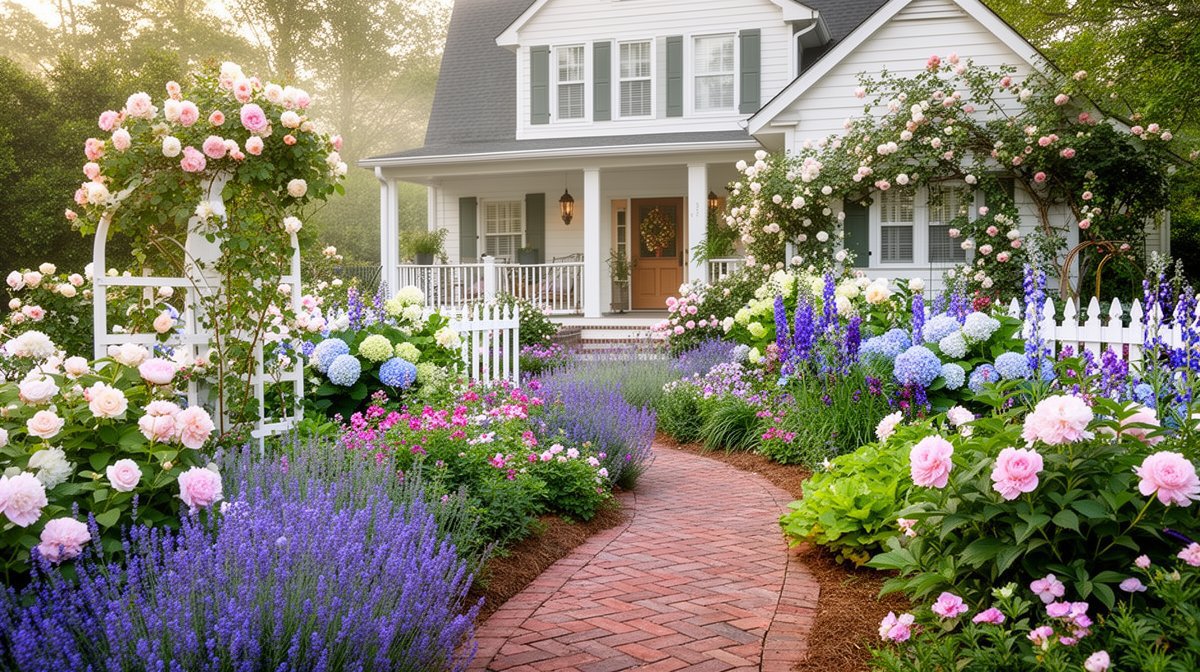
$20–40/sqftA white picket fence runs the frontage of a two-story clapboard house with a full-width porch, and a cedar arbour over the gate carries a yellow Lady Banks rose that blooms in early April just as the Azalea Festival starts. A brick walk on a sand bed runs straight to the steps, with a 5-foot border on each side: blue mophead hydrangeas against the porch skirt where they get morning sun and afternoon shade, then a sunny front strip of roses, salvia and catmint along the fence. The house faces the street on an east or west axis on most of these blocks, so put the hydrangeas on the shaded side and the roses on the side that gets sun by 9 a.m.

AI-generated image
The Old Rose Dooryard
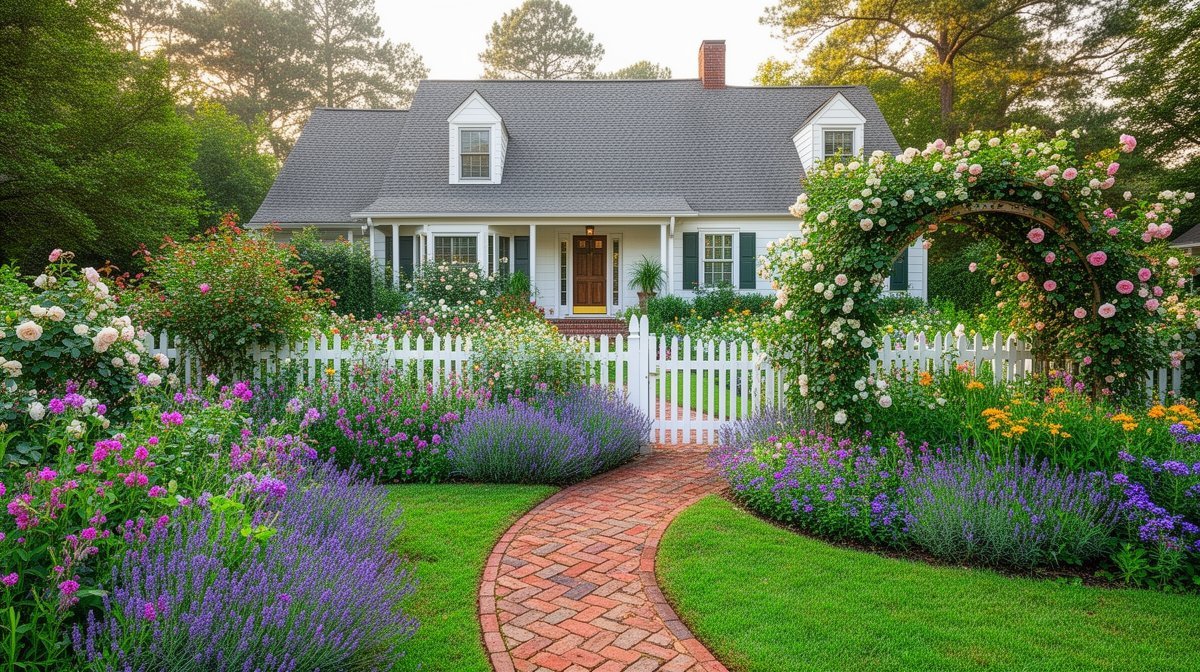
$14–28/sqftA 1930s brick or shingle cottage with a small front yard gives up the lawn entirely to a dense planting of Southern old garden roses, with a narrow stepping-stone path winding through to the door. The roses are the tough China and found-rose types that shrug off humidity, underplanted with gaura, Verbena bonariensis and Shasta daisies so something is always in flower from April to frost. Everything sits in a raised bed of compost-rich sand edged in old brick on end, which lifts the crowns above wet winter ground and makes the garden look a century old the first year.

AI-generated image
The Live Oak Shade Border
$12–25/sqftUnder the canopy of a big live oak hung with Spanish moss, the back garden of a Midtown ranch or Forest Hills Colonial trades sun-loving roses for the shade cottage layer: camellias and oakleaf hydrangeas at the back, hellebores, Southern shield fern and toad lilies in front, and a curving path of pea gravel to a bench. A single bright opening at the drip line carries foxgloves treated as spring annuals and summer phlox. Keep every bed off the root flare of the oak and mulch, do not till, because live oak roots run just under the sand surface.

AI-generated image
The Riverlights Cutting Garden
$15–30/sqftOn a new-construction lot with a modern farmhouse or Lowcountry-style house, two long raised cedar beds run parallel to the back porch with a crushed shell path between them, built to cut flowers for the kitchen table from April to November. The beds are filled with imported soil over the builder's compacted sand, planted with zinnias and Mexican sunflower for summer, Shasta daisies and coneflowers as the perennial backbone, and a hedge of Knock Out-type roses along the back fence for color without spraying. It needs full sun all day, so it works best on the open lots that have not grown shade trees yet.
See how a cottage/english garden looks on YOUR property
Upload a photo of your Wilmington yard and visualize your dream garden in seconds.
Try ProScapeAI Free

AI-generated image
Featured Flowers & Perennials for Cottage/English Gardens
Browse all 150 plants for Wilmington
Water Lettuce
Pistia stratiotes
low-growing ground cover, white blooms in summer. Evergreen year-round.

Bowles' Golden Sedge
Carex elata 'Aurea'
low-growing ground cover, blooms in none.

Tussock Sedge
Carex stricta
low-growing ground cover, blooms in spring. Brown fall color.

Umbrella Sedge
Cyperus alternifolius
grows to 4 feet, blooms in summer. Evergreen year-round.
Zone and sun checks come from our database — confirm with your local nursery before you buy.
Bloom Calendar for Wilmington
spring
Tussock Sedge, Austrian Speedwell, Banana Yuccasummer
Water Lettuce, Umbrella Sedge, Alpine Sea Hollyfall
Autumn Snakerootwinter
Limited bloomsDesign Tips for Wilmington (Zone 8a)
- Get a soil test before you buy plants: Wilmington sand often reads pH 4.5–5.5, which suits camellias and blue hydrangeas but too acidic for roses and Lavandula × intermedia 'Phenomenal', so lime only those beds toward 6.5
- Feed the sand every year: work 3–4 inches of compost into new borders and top up with an inch each autumn, because Coastal Plain sand holds almost no nutrients or water and a cottage border is a heavy feeder
- Use pine straw as the default mulch; it is local, cheap, holds sand in place in a downpour and slowly keeps the shrub layer acidic, while gravel is better around lavender crowns
- Swap the English spires for Southern ones: Salvia guaranitica 'Black and Blue', Verbena bonariensis and Phlox paniculata 'Jeana' give the tall, airy look of delphinium and survive a 90°F July
- Plan for the twelfth month: Camellia sasanqua 'Shishigashira' flowers in late autumn, Camellia japonica follows in winter and pansies bloom straight through a 36°F January, so a Wilmington cottage garden never has to go bare
- Raise beds in low spots and near creeks 8–10 inches, because the water table here is shallow and a single tropical storm can sit on a flat bed for days
- Keep beds and tilling out of the root zone of live oaks; their roots run just under the sand, so plant shade borders in pockets and mulch rather than digging
Where to Source Plants in Wilmington
Skip the big-box stores. These independent Wilmington nurseries specialize in the plants that make cottage/english gardens thrive in Zone 8a.
Five Oaks Nursery (Oleander)
Oleander Drive, Midtown Wilmington
Family-owned nursery founded in 1980, with its own 47-acre growing farm in Burgaw; the Oleander store carries annuals, perennials, roses, azaleas, NC natives, trees and shrubs
Tinga Nursery
Castle Hayne
Family-owned retail and wholesale nursery serving the Wilmington area since 1913, with a deep stock of shrubs and trees for the coastal landscape
Shelton Herb Farm
Leland (Brunswick County)
Nursery on a family-owned century farm since 1986, growing herbs, edible flowers, fruiting plants, native pollinator plants and Southern heirlooms
Cottage/English Landscaping Costs in Wilmington
| Project Scope | Estimated Cost |
|---|---|
| Front cottage border with compost-amended beds (400–600 sqft) | $8,000 – $22,000 |
| Painted cedar picket fence with gate arbour (40–60 linear ft) | $3,000 – $8,000 |
| Brick walkway on a sand and screenings base (100–200 sqft) | $2,500 – $8,000 |
| Raised cedar cutting beds with imported soil and drip (2 beds, 4x16 ft) | $2,500 – $6,000 |
| Drip irrigation zone with timer and rain sensor | $800 – $2,500 |
| Full back cottage garden: patio, arbour, deep borders | $30,000 – $75,000 |
| AI visualization (ProScapeAI) | Free to start |
Estimates based on Wilmington, NC-area contractor rates as of 2026. Actual costs vary by site conditions, materials, and contractor.
Wilmington Climate & Growing Zone
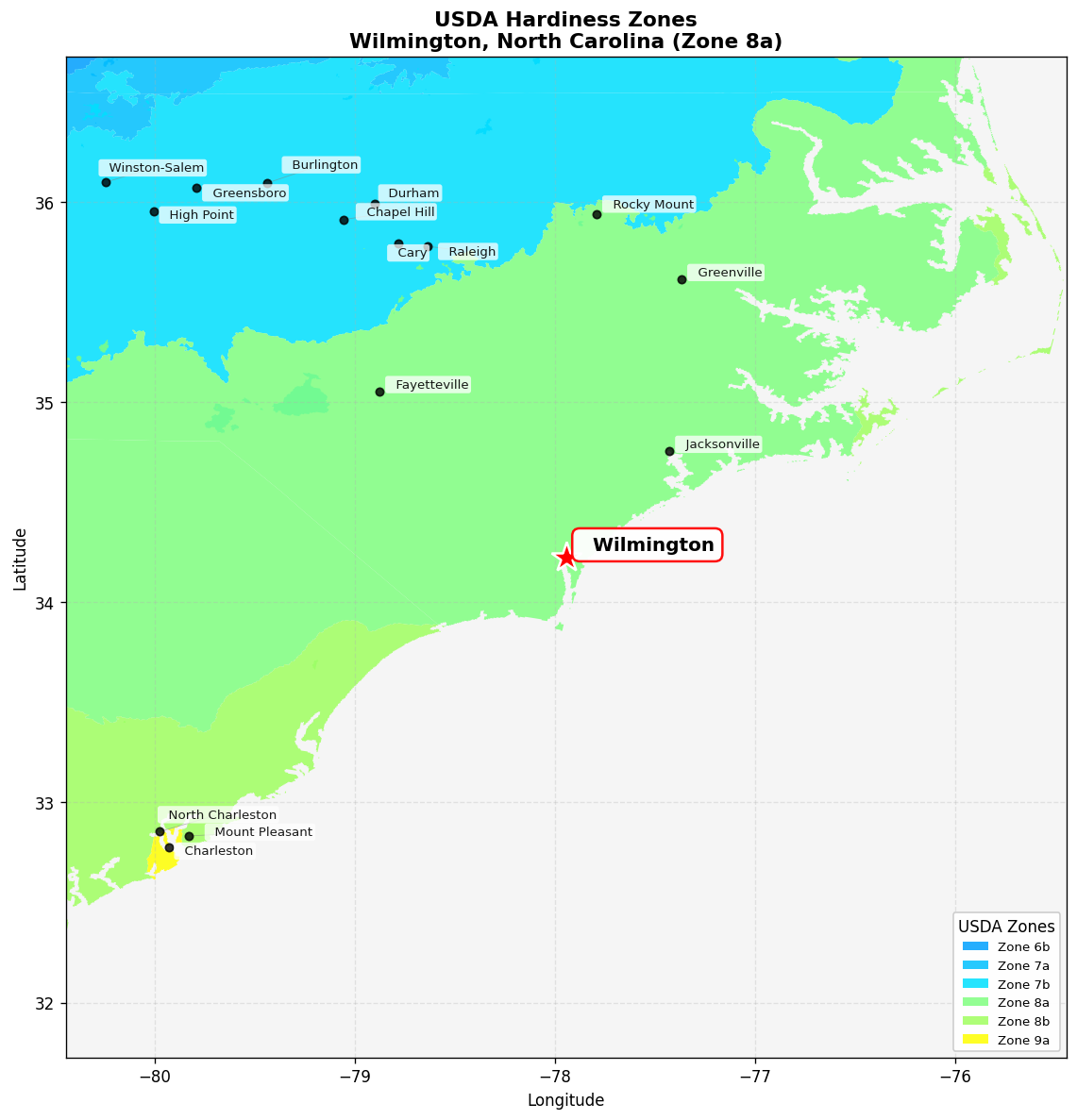
USDA Zone 8a
Hardiness zone for Wilmington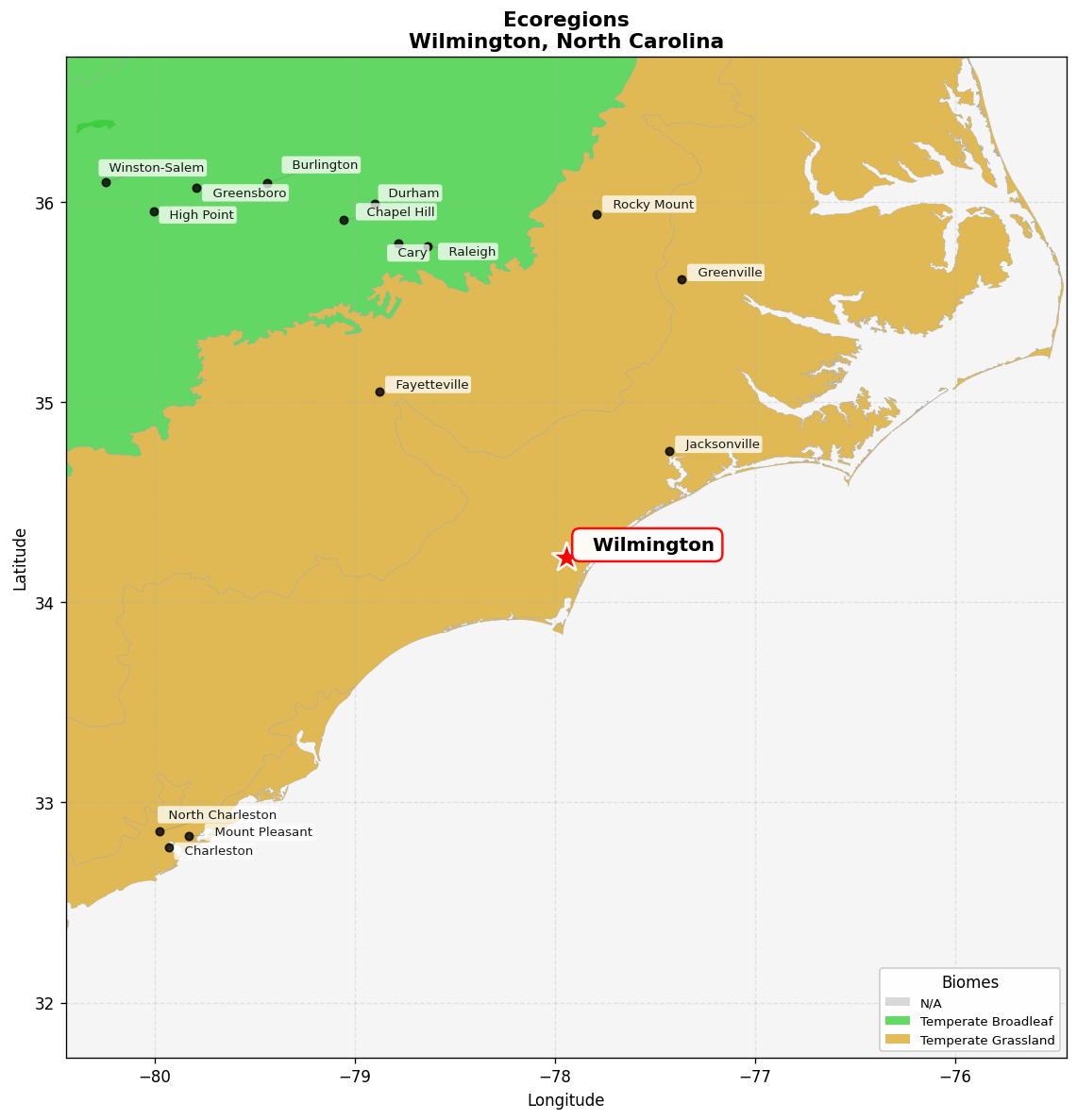
Mid-Atlantic US coastal savannas
Native ecoregionFrequently Asked Questions
How much does a cottage garden cost in Wilmington, NC?
Landscape crews around Wilmington typically bill in the $45–65 per hour range per worker, with design-build firms charging more. A planted front cottage border on a typical 400–600 sqft frontage runs about $8,000–22,000 installed, and a picket fence with a gate arbour adds $3,000–8,000 depending on length. Brick walkways on a sand base land around $25–40 per square foot. A full back garden with a patio, arbour and deep borders commonly runs $30,000–75,000. Doing the planting yourself, with Rosa 'Belinda's Dream' and Hydrangea macrophylla 'Endless Summer' in 3-gallon pots and plenty of compost, can bring a border in under $10 per square foot.
Which roses actually survive Wilmington's heat and humidity?
Choose Southern-proven roses over the English catalogue. Rosa 'Mutabilis', Rosa 'Old Blush' and Rosa 'Duchesse de Brabant' are old China and tea roses that bloom through a coastal summer, Rosa 'Belinda's Dream' and the Knock Out family carry the shrub layer without weekly spraying, and Rosa 'Peggy Martin' and Rosa banksiae 'Lutea' cover an arbour or fence. Most hybrid teas and many David Austin roses defoliate by July here. Give every rose six or more hours of sun with morning exposure, space for airflow, water at the base, and lime the bed toward pH 6.5, because Wilmington's native sand often tests 4.5–5.5.
Can I grow lavender, delphinium and foxglove in Wilmington?
Only some of them, and only some of the time. Lavandula × intermedia 'Phenomenal' is the one lavender with a real chance: plant it high in a gritty, limed bed with gravel mulch and no irrigation head pointed at it. English lavender such as 'Hidcote' and 'Munstead' usually rots out in the first August. Delphinium and lupine do not come back in Zone 8a heat, so treat them as spring annuals or use Salvia guaranitica 'Black and Blue' and Verbena bonariensis for the blue spires instead. Digitalis purpurea 'Camelot Rose' works well planted in October for a May show, then pulled when it fades.
When is the best time to plant a cottage garden in Wilmington?
October and November are the best months. The soil is still warm, the worst heat is over, and roots grow all through a mild winter, so the border arrives at spring ready to flower. The median last frost at the airport is around mid-March and the median first frost around mid-November, so late February through April is a good second window, and pansies, violas and foxgloves can go in all autumn. Avoid planting new shrubs and perennials in July and August, when highs average near 90°F and nights stay above 70°F.
Do I need to water a cottage garden much on the coast?
More than the rainfall total suggests. Wilmington averages close to 60 inches of rain a year, but it comes in heavy bursts and the sand drains it away in hours, so a new border can wilt five days after a downpour. Put the beds on drip, water before sunrise (the Cape Fear Public Utility Authority recommends not watering while the sun is up), and keep 2–3 inches of pine straw on the soil. CFPUA has no mandatory watering days, but irrigation meters are billed at their own irrigation rate, so a timer with a rain sensor pays for itself quickly.
What do I need to know about fences and permits in the historic districts?
Planting needs no permit. If your house is inside one of Wilmington's locally designated historic districts, such as the downtown district or Carolina Heights, changes to fences, walls and other site features visible from the street may need review before work starts, so check with the City's historic preservation staff before you order a picket fence. Outside those districts, normal zoning setbacks and fence height limits apply. On lots near the water, also check whether any buffer or coastal rules apply before you add a patio.
How do I plan a cottage garden around hurricane season?
Plan for wind and water, because August and September bring the heaviest rain of the year. Anchor arbours and pergolas with posts set in concrete, train climbing roses like Rosa 'Peggy Martin' tightly to their supports, and avoid brittle trees such as Bradford pear near the house. Build beds in low spots up 8–10 inches so a tropical storm drains past them, and pick perennials that recover from a flattening: Rudbeckia fulgida 'Goldsturm', Echinacea purpurea 'Magnus' and Salvia guaranitica 'Black and Blue' all regrow from the base within weeks.