4 English Cottage Garden Ideas for Dayton, OH | Zone 6a Design
Native plants from the Southern Great Lakes forests (Zone 6a) — Humid continental (hot summer) climate
Why Cottage/English Gardens in Dayton?
Dayton was practically built for the English cottage garden. The 1830s brick row houses of the Oregon District, the Italianate and Queen Anne porches of St. Anne's Hill and South Park, the Craftsman bungalows of Belmont and Walnut Hills, and Oakwood's 1920s Tudor Revival and Colonial homes along Far Hills all share the two things a cottage border needs most — a strong architectural face worth romancing, and a front yard shallow enough that a deep, layered planting reads clearly from the sidewalk. Add the white picket fences and detached garages of Huber Heights and Vandalia, the broad post-war ranch lots of Kettering and Centerville, and the mature street canopy of Dayton View, and you have a city where rose arbors, brick walks and billowing borders look native rather than imported.
Dayton sits in USDA Zone 6a, where the design winter low is roughly -10°F, inside a humid-continental (Köppen Dfa) climate that delivers about 40 inches of rain and 22 inches of snow across a growing season of roughly 170 frost-free days. Last frost lands near April 25, first frost near October 17, and July averages highs around 85°F with the kind of humidity that decides which cottage plants actually work here. That heat is why Delphinium 'Magic Fountains' behaves as a two-season plant in the Miami Valley while Paeonia lactiflora 'Sarah Bernhardt' and Echinacea purpurea 'Magnus' outperform anything in an actual English garden — peonies need the cold Dayton reliably supplies. It is also why disease resistance beats nostalgia in the plant list: Phlox paniculata 'David' shrugs off the mildew that flattens older phlox by August, and Rosa 'New Dawn' and Rosa 'Olivia Rose Austin' hold clean foliage through blackspot season where a fussier hybrid tea defoliates by Labor Day.
The soil is the local plot twist. Dayton's uplands sit on Wisconsinan glacial till packed with pulverized limestone — Miamian and Crosby silt loams that are heavy, slow-draining and distinctly alkaline, commonly testing pH 7.0 to 7.8. That is bad news for Rhododendron, blueberries and pin oak, which yellow with chlorosis within a few years, and outstanding news for the cottage palette: Lavandula × intermedia 'Phenomenal', Nepeta × faassenii 'Walker's Low', Dianthus 'Firewitch', Clematis 'Jackmanii' and Buxus 'Green Velvet' all prefer sweet soil and will look better in Beavercreek than they do in acid-soil states. The catch is drainage, not chemistry — that same till holds winter water, and a lavender planted at grade in Kettering clay dies of February wet feet, not January cold. Down in the Great Miami, Stillwater and Mad River valleys the picture flips: glacial outwash gravel drains almost too fast, and July borders there need mulch and a soaker line to keep Alchemilla mollis and Astilbe 'Fanal' from crisping.
Water is the thing Dayton has in abundance and still guards closely. The city draws from the Great Miami Buried Valley Aquifer, an EPA-designated sole-source aquifer, and runs one of the country's longest-standing wellfield protection programs — worth knowing before you design a high-input, heavily fertilized garden inside a protection zone. Montgomery County's stormwater district bills by impervious area, so a large sealed patio carries a small permanent cost that a gravel seating circle or a permeable brick walk does not. And the 1913 flood still shapes the ground you are planting in: the Miami Conservancy District's levees and five dry dams mean low-lying Dayton yards can hold water for days after a spring storm. Grade away from the house about six inches over the first ten feet, raise borders four to six inches above the lawn, and a Dayton cottage garden becomes one of the easiest designs in the Midwest to keep alive.
4 Cottage/English Design Ideas for Dayton

The Rose Arbor and Picket Fence Entry
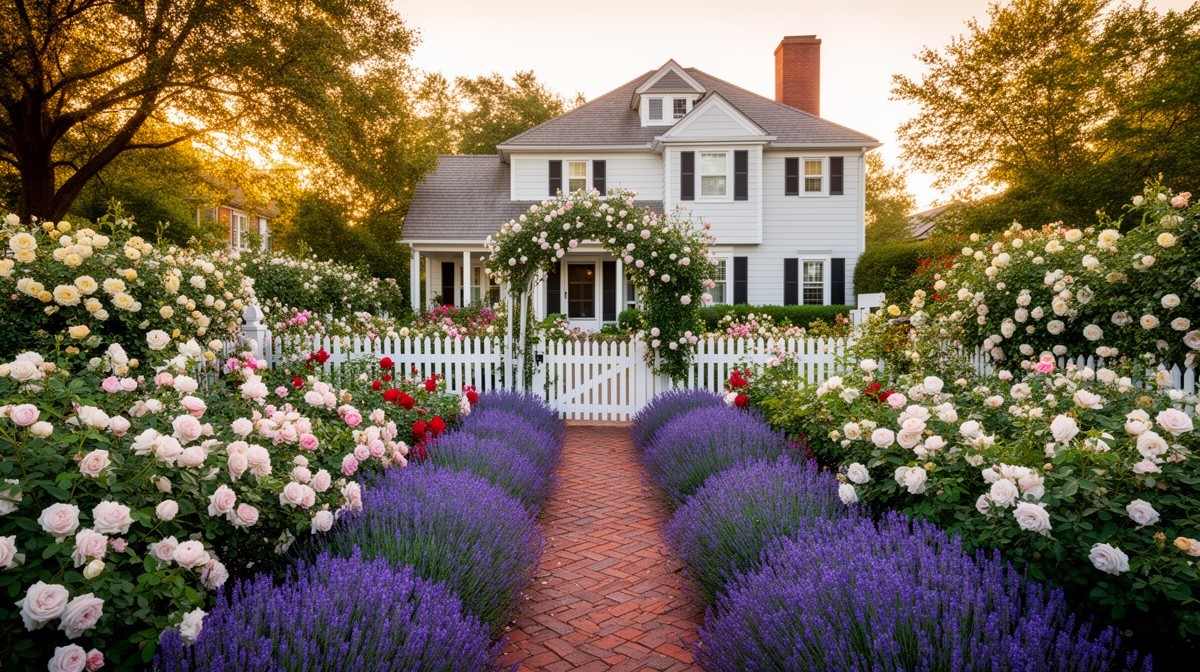
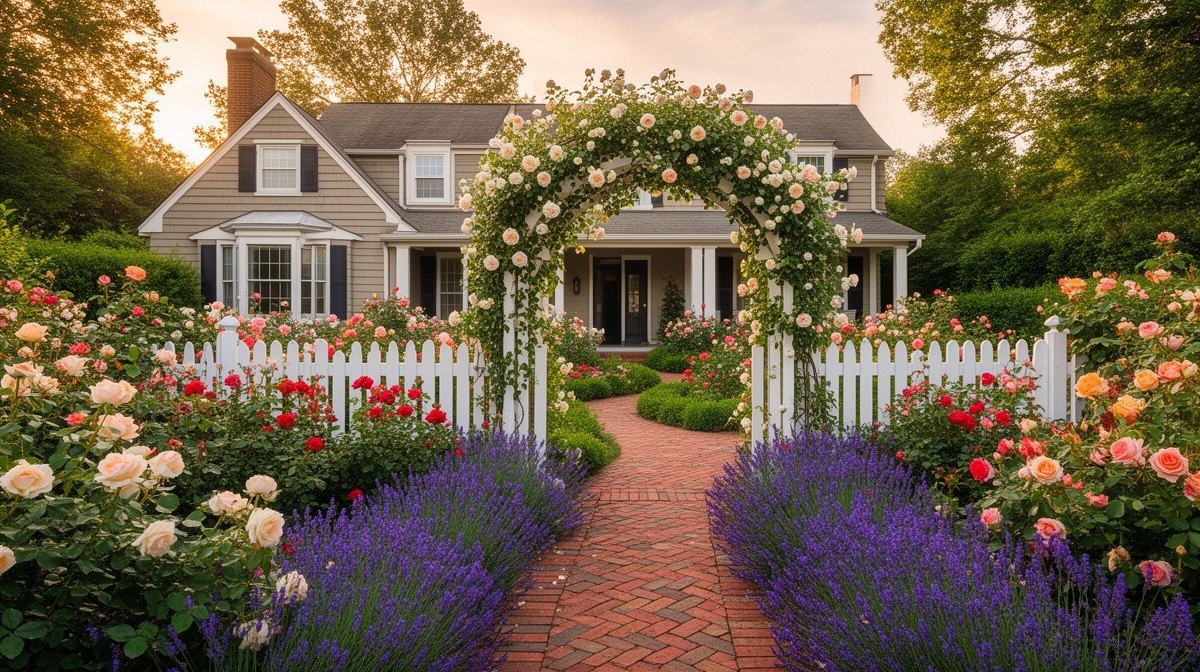
$14–26/sqftA two-storey cream colonial with black shutters, fronted by a low white picket fence and a swinging gate set under a timber arbor buried in cream and blush climbing roses. A running-bond brick paver walk runs from the gate to a brick stoop and a wreathed front door, and the beds either side are built in three clean layers — clipped boxwood domes holding the corners, low mounds of lavender and catmint spilling over the brick edge, and full pink shrub roses standing along the fence line. Spent petals scattered across the brick are the whole point of this design: it is meant to look lived in by June, not manicured.

The Bungalow Porch Border
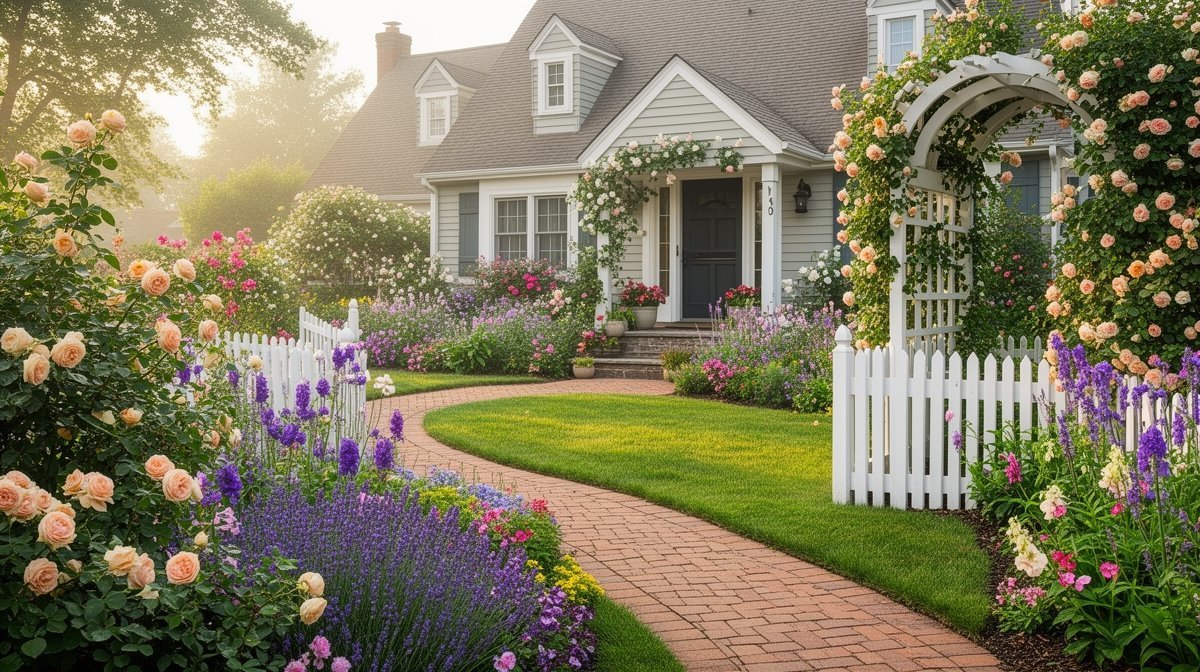
$10–20/sqftA one-and-a-half storey porch cottage with a white painted arched trellis carrying white climbing roses over an irregular flagstone path that curves — never runs straight — from the sidewalk to the porch steps. The lawn is deliberately kept as a green rug between two wide, deep borders packed with spires of salvia and foxglove, orange and gold annuals at the front edge, blue hostas at the shady end under a mature street tree, and daisies and coneflowers carrying the far side into September. Hanging baskets on the porch repeat the border colours so the house and the garden read as one design.

The Flagstone Tea Circle
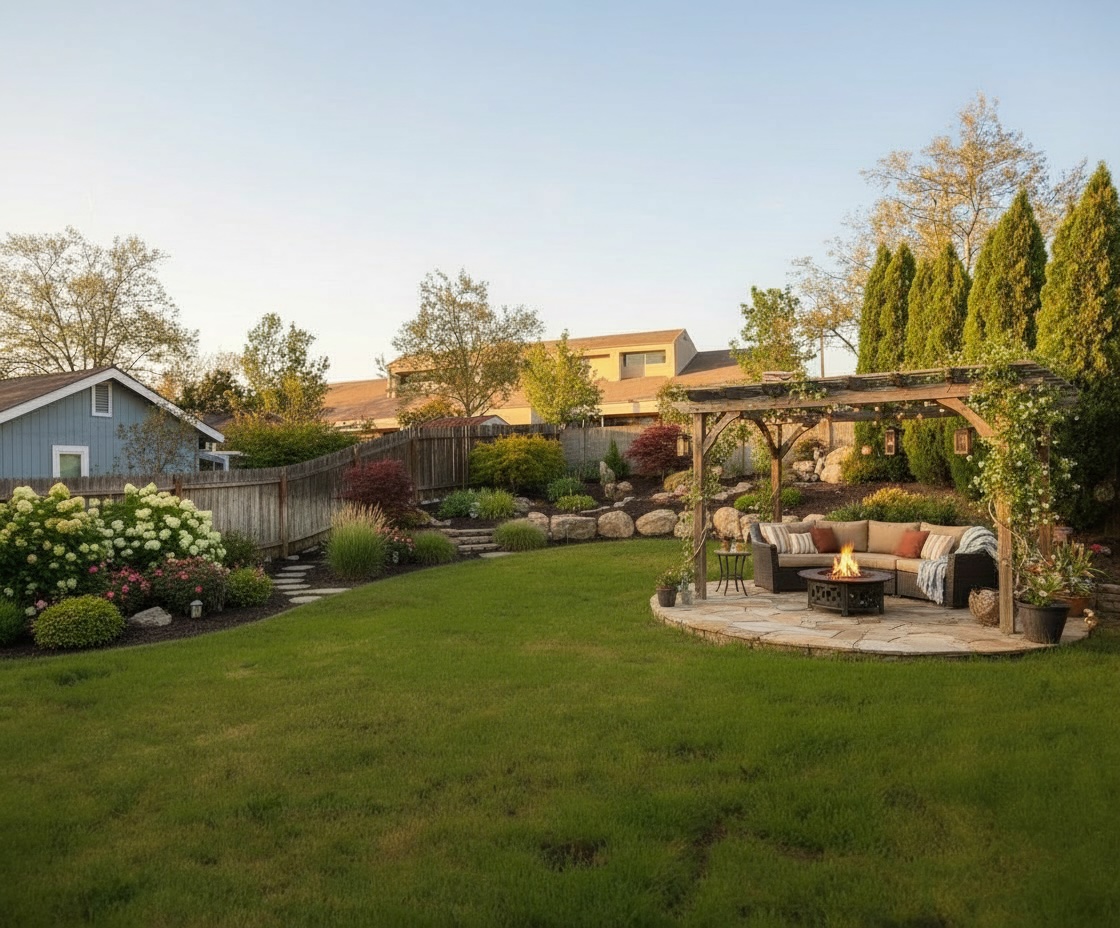
$16–30/sqftA rustic timber arbor straddles a circular flagstone terrace set into the middle of the back lawn, with a small white bistro table, two folding chairs and a jug of cut roses — a two-person destination rather than an entertaining patio. Climbing roses in cream and pink cover the arbor overhead, and the terrace is ringed almost completely by a low hedge of lavender so the whole seat sits inside a band of scent and bee traffic. Deep mixed borders of roses, phlox and white umbels close the space off from the neighbours without a single fence panel.

The Pergola Dining Garden
$20–38/sqftA white painted pergola sits over a modest wood-and-stone dining terrace with a table for four, its beams carrying pink climbing roses trained across the top so the diners eat in dappled shade. Out on the lawn a carved stone birdbath anchors a curved island bed of roses, salvia and clipped boxwood, while a deep perimeter border of roses, campanula and white hydrangea wraps the garden and a clipped hedge screens the neighbour. The design keeps a generous sweep of open lawn in the middle — the trick that stops a heavily planted Dayton backyard from feeling crowded by mid-July.
See how a cottage/english garden looks on YOUR property
Upload a photo of your Dayton yard and visualize your dream garden in seconds.
Try ProScapeAI Free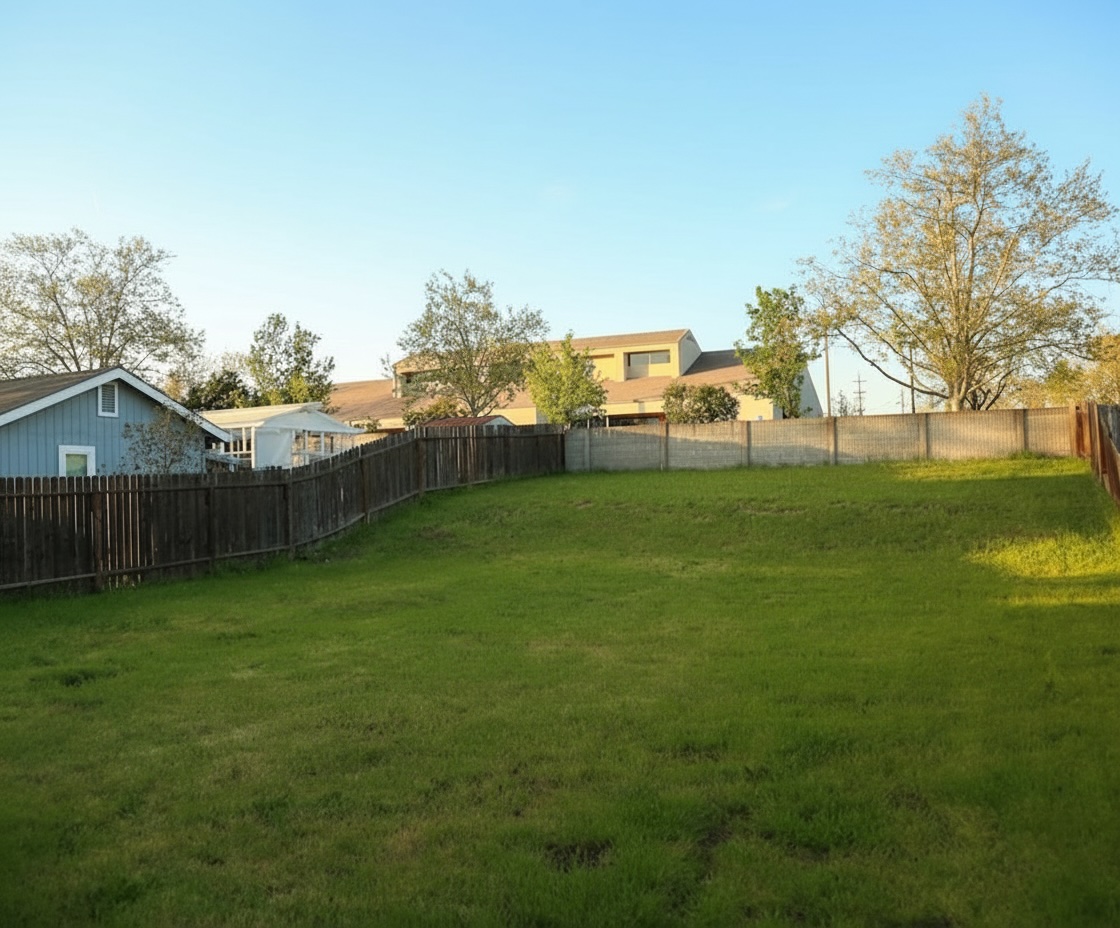
Featured Trees & Shrubs for Cottage/English Gardens
Browse all 248 plants for Dayton
American Black Currant
Ribes americanum
grows to 5 feet, white,yellow blooms in spring. Attracts hummingbirds.

Buttonbush
Cephalanthus occidentalis
medium-sized at 8 feet, white blooms in summer. Attracts butterflies.

Coppertina Ninebark
Physocarpus 'Coppertina'
medium-sized at 7 feet, white blooms in spring. Pollinator-friendly.
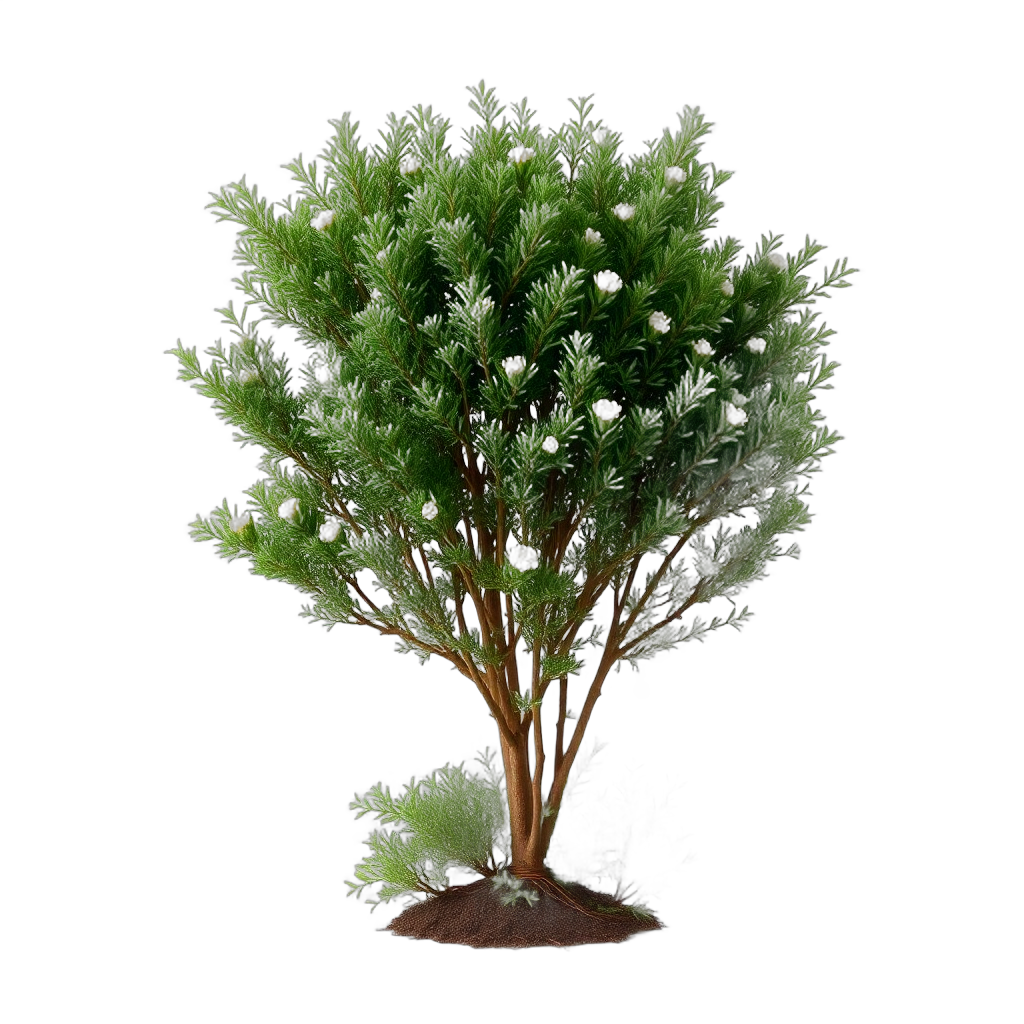
Creeping Juniper
Juniperus horizontalis
low-growing ground cover, blooms in spring. Evergreen year-round.
Featured Grasses & Groundcovers for Cottage/English Gardens
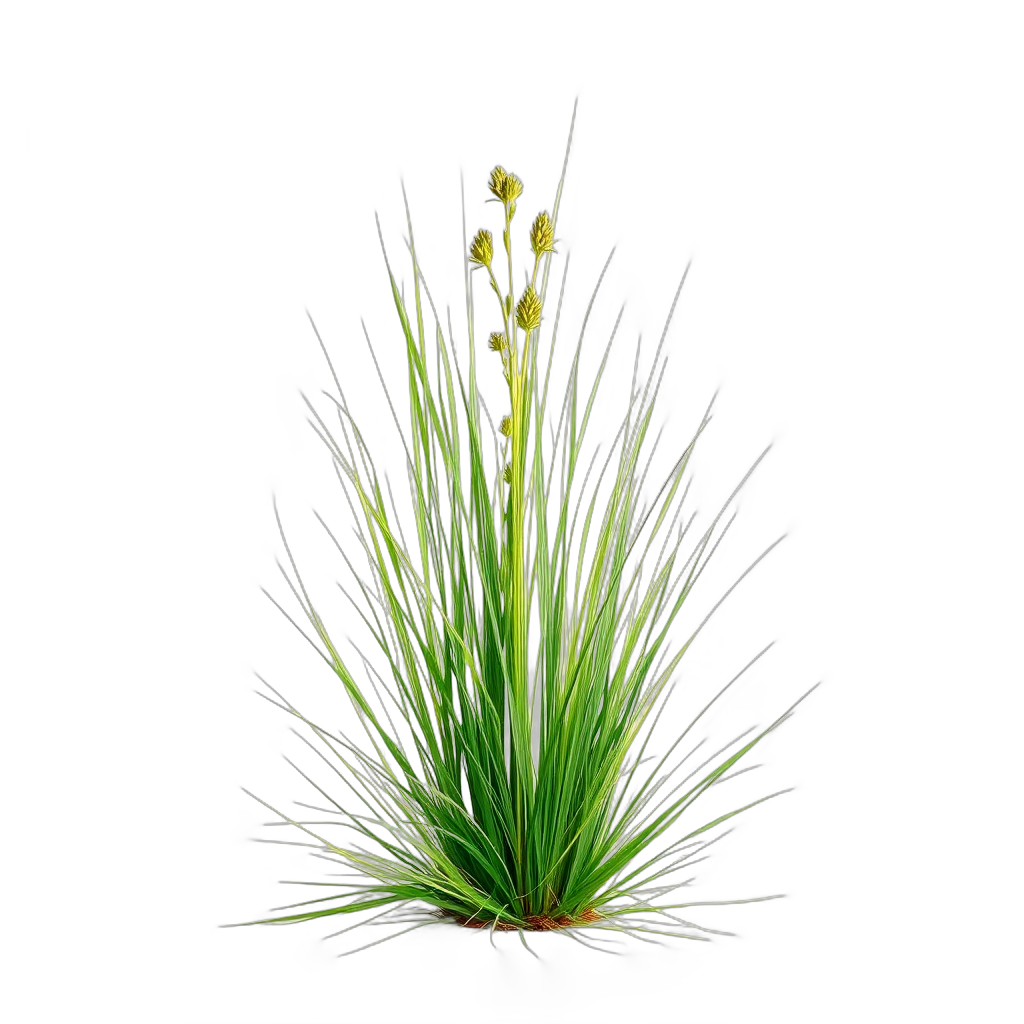
Canada Wild Rye
Elymus canadensis
grows to 4 feet, blooms in summer. Yellow fall color.
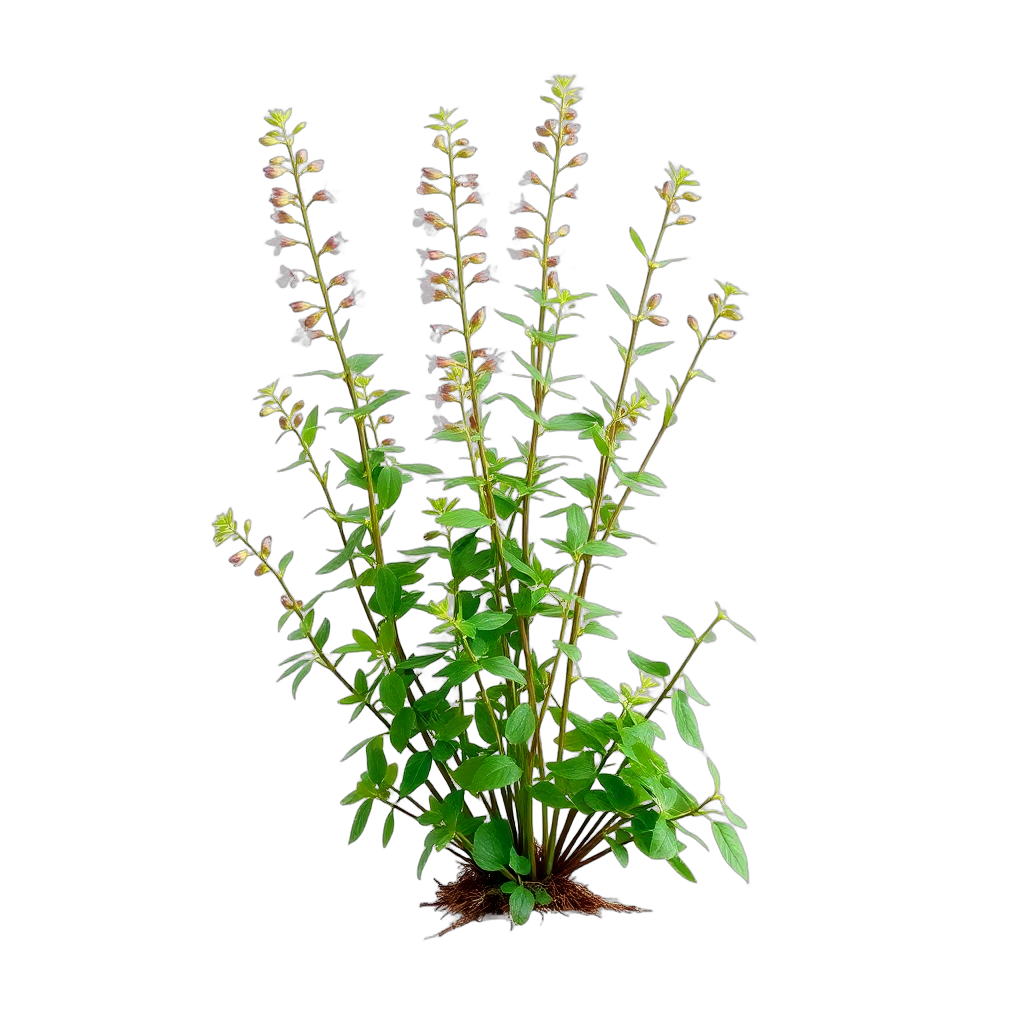
Creeping Jacob's Ladder
Polemonium reptans
low-growing ground cover, blue blooms in spring. Attracts butterflies.

Dwarf Fernleaf Bamboo
Pleioblastus distichus
low-growing ground cover, blooms in none. Evergreen year-round.
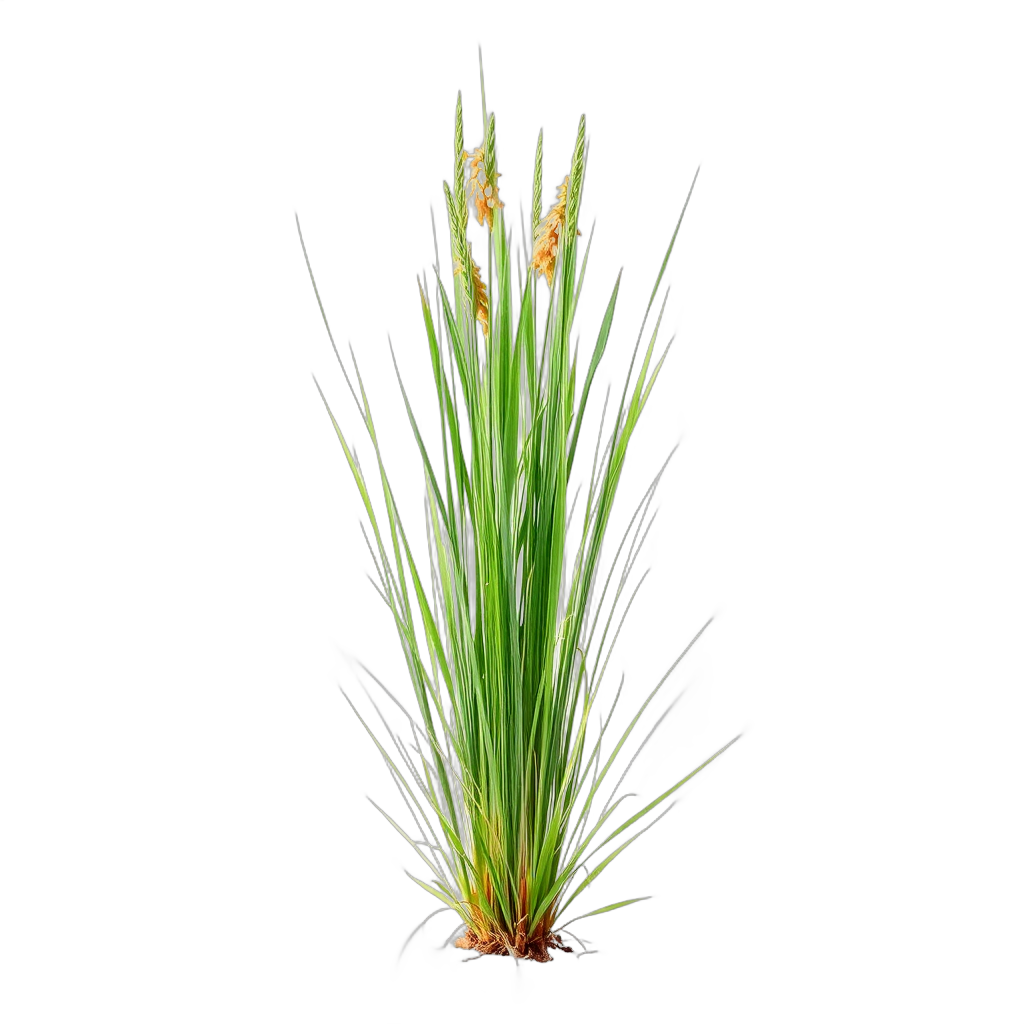
Eastern Gamagrass
Tripsacum dactyloides
grows to 6 feet, blooms in summer. Yellow fall color.
Featured Flowers & Perennials for Cottage/English Gardens
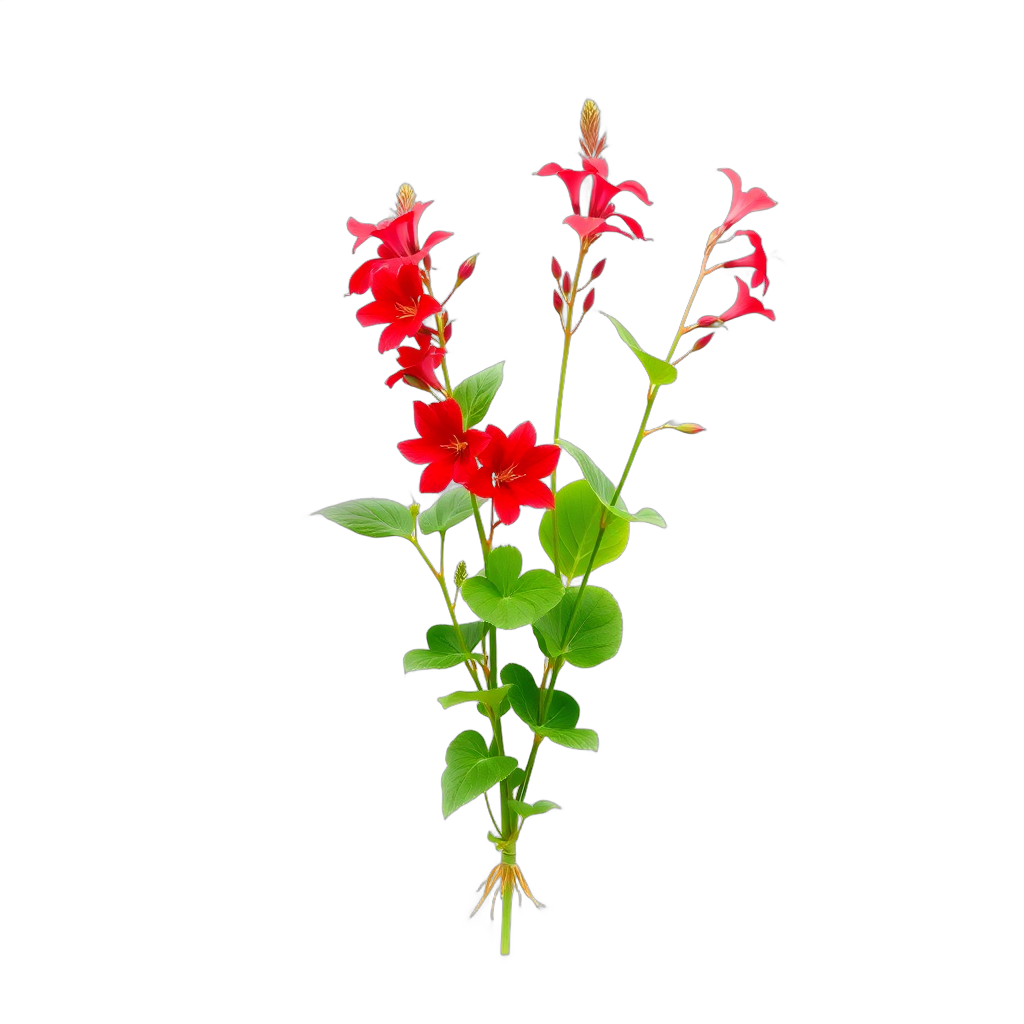
Cardinal Flower
Lobelia cardinalis
grows to 3 feet, red blooms in summer. Attracts hummingbirds.

Hardstem Bulrush
Scirpus acutus
medium-sized at 7 feet, blooms in summer.
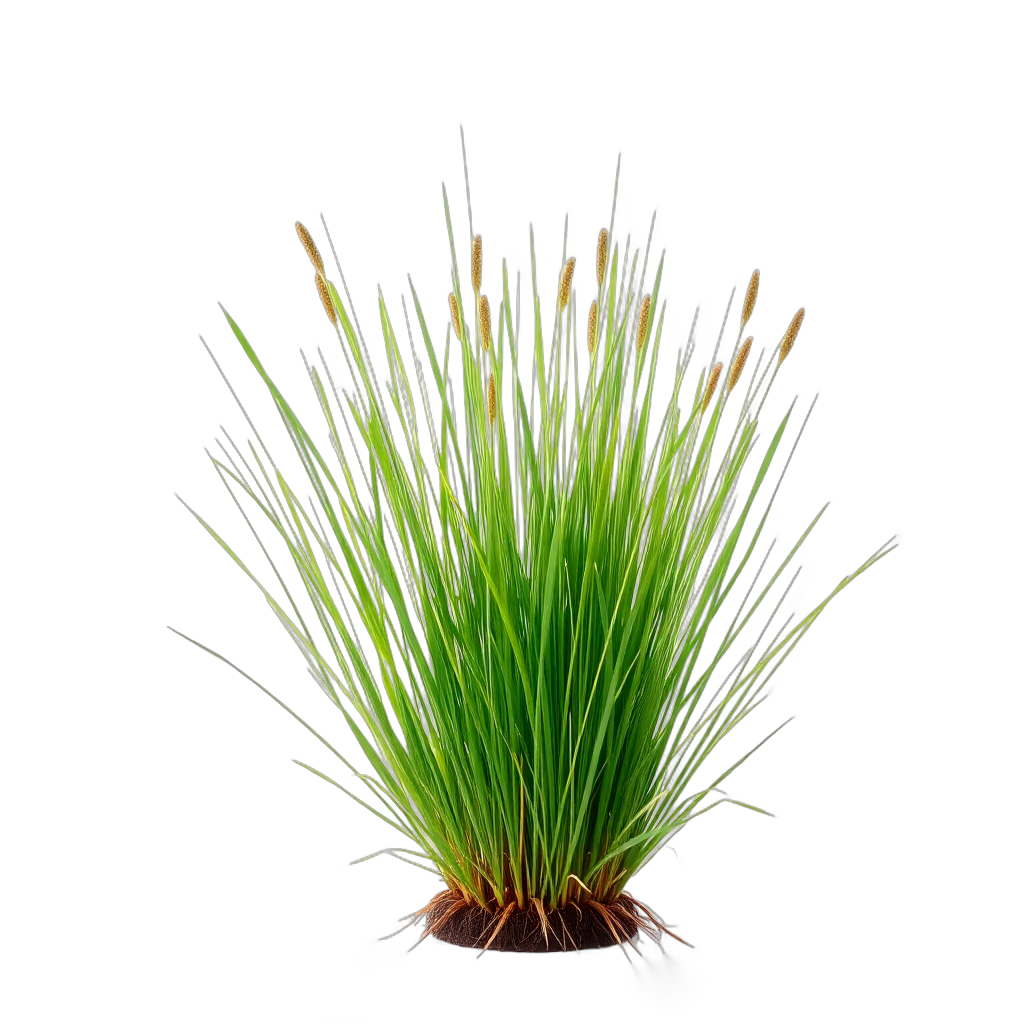
Path Rush
Juncus tenuis
low-growing ground cover, blooms in summer. Evergreen year-round.

Softstem Bulrush
Schoenoplectus tabernaemontani
grows to 4 feet, blooms in summer.
Zone and sun checks come from our database — confirm with your local nursery before you buy.
Bloom Calendar for Dayton
spring
Bellwort, Blue Star, Blue-Eyed Grasssummer
Cardinal Flower, Hardstem Bulrush, Path Rushfall
Canada Goldenrod, New England Aster, Nodding Ladies' Tresseswinter
Limited bloomsDesign Tips for Dayton (Zone 6a)
- Raise every border four to six inches above the lawn — Dayton's Miamian and Crosby silt loams hold February water, and winter wet feet kill more Lavandula and Dianthus in the Miami Valley than the -10°F Zone 6a low ever does
- Design with the alkaline soil instead of fighting it: pH 7.0–7.8 limestone till is a gift to Paeonia, Clematis 'Jackmanii', Nepeta and Buxus, so put your budget there rather than into acidifying a bed for Rhododendron that will yellow within three summers
- Pick mildew- and blackspot-resistant cultivars for a humid Dayton July — Phlox paniculata 'David' over old garden phlox, Monarda 'Jacob Cline' over unnamed bee balm, and own-root Rosa 'New Dawn' over grafted hybrid teas
- Put the rose arbor where it gets morning sun and afternoon air movement; east-facing arches dry their foliage by nine o'clock and cut blackspot pressure roughly in half compared with a still, west-facing corner
- Use permeable brick or dry-laid flagstone rather than a poured slab — Montgomery County's stormwater district bills by impervious area, and a jointed walk also survives the freeze-thaw cycling that cracks slabs poured on Dayton clay without a proper compacted base
- Plan for a bare April: with a 170-day season the borders do not close until early June, so build in structure that carries winter — clipped Buxus 'Green Velvet' domes, a picket fence line, and Narcissus 'Thalia' drifts that flower before the perennials wake
- Fence or spray for deer if you are in Oakwood, Beavercreek or Washington Township; browse pressure there is heavy enough that Hosta 'Halcyon' and unprotected rose canes will be eaten to the ground by May
Where to Source Plants in Dayton
Skip the big-box stores. These independent Dayton nurseries specialize in the plants that make cottage/english gardens thrive in Zone 6a.
Siebenthaler's Garden Center
Beavercreek (also Centerville)
Dayton's oldest green-goods company, growing since 1870 on a 250+ acre Beavercreek nursery; deep bench of roses, peonies, clematis and locally grown shrubs acclimated to Miami Valley till
Knollwood Garden Center & Landscaping
Beavercreek (Dayton-Xenia Road)
Independent neighbourhood garden center repeatedly voted the area's best; strong on roses, cottage perennials, herbs, seeds and hard-to-find border plants
North Dayton Garden Center & Nursery
Old North Dayton / Brandt Pike
Family-run since 1963, growing roughly two million plants and 50,000 trees and shrubs a year on site — the best local source for unusual annuals and vegetable starts
Berns Garden Center
Beavercreek (Indian Ripple Road)
Family-owned since 1956 with its own greenhouses; locally grown annuals, garden phlox, hydrangeas and trees, plus an in-house design studio
Cottage/English Landscaping Costs in Dayton
| Project Scope | Estimated Cost |
|---|---|
| Front-yard cottage border design (two layered beds, 400–600 sqft) | $4,500 – $9,000 |
| Brick paver or flagstone front walk with edging (60–90 ft) | $3,500 – $8,500 |
| Cedar rose arbor with picket fence and gate | $2,500 – $6,500 |
| Flagstone tea circle with lavender ring (10–12 ft) | $6,000 – $12,000 |
| Full back garden: pergola dining terrace, island beds, perimeter border | $18,000 – $45,000 |
| AI visualization with ProScapeAI | Free to start |
Estimates based on Dayton, OH-area contractor rates as of 2026. Actual costs vary by site conditions, materials, and contractor.
Dayton Climate & Growing Zone
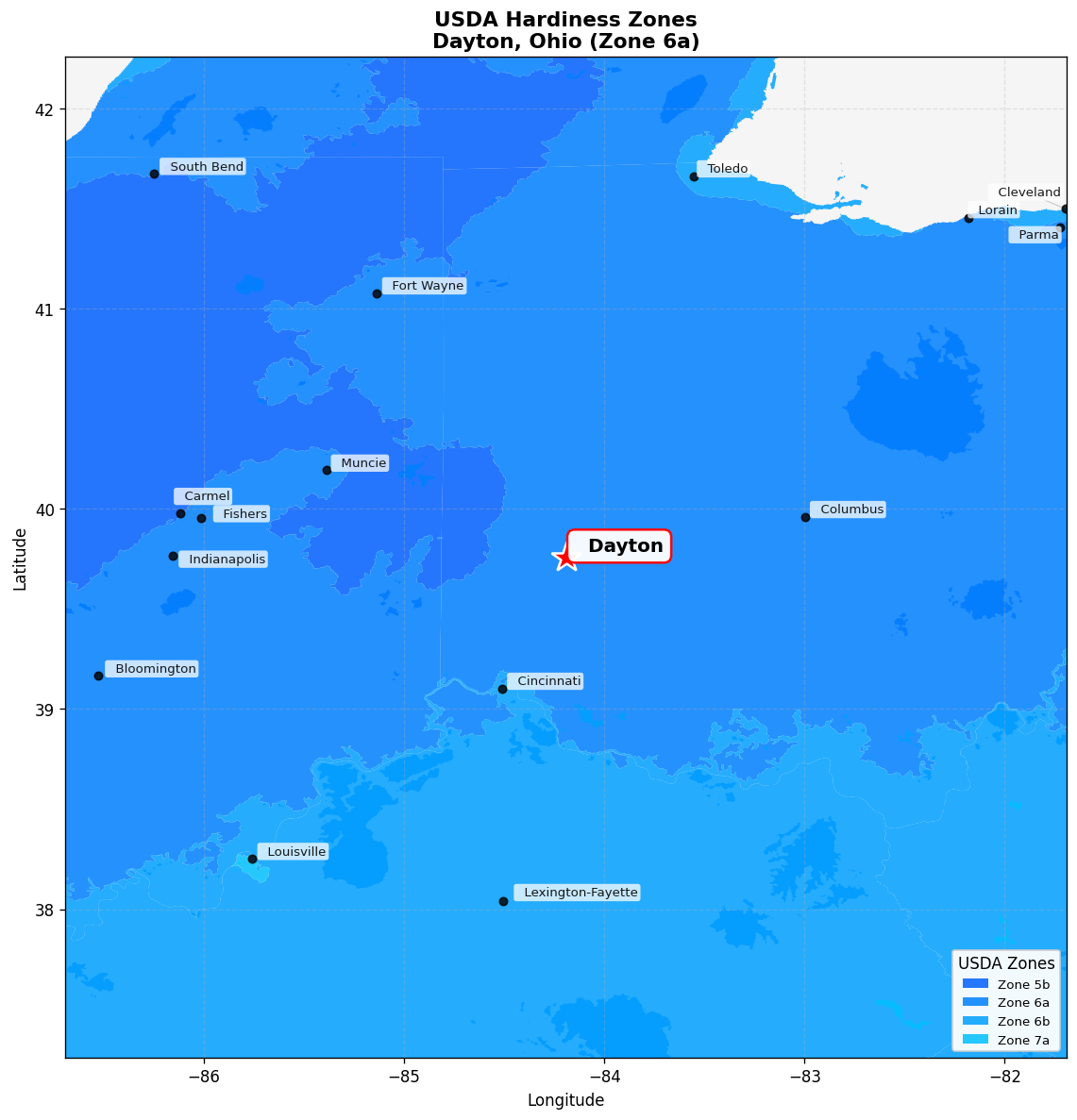
USDA Zone 6a
Hardiness zone for Dayton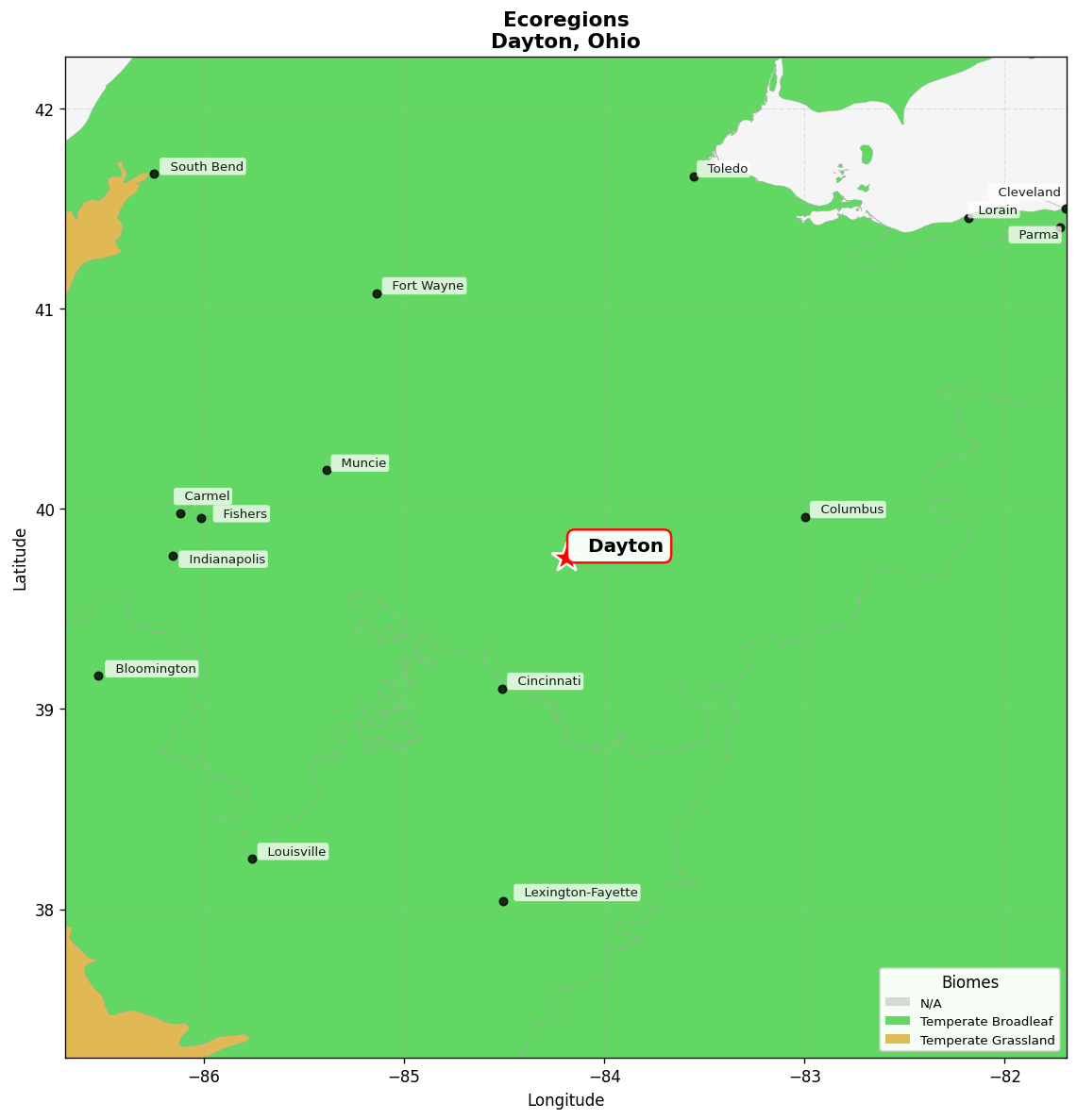
Southern Great Lakes forests
Native ecoregionFrequently Asked Questions
How much does an English cottage garden cost in Dayton?
Miami Valley installation prices run roughly 10–20% below the national metro average, which makes a genuinely deep cottage border affordable here. A front-yard design with a brick or flagstone walk, a rose arbor, picket fencing and two layered borders on a typical 500 sqft front yard runs $7,000–$16,000 installed. A flagstone tea circle with an arbor and a lavender ring lands around $6,000–$12,000. A full back garden with a pergola dining terrace, island beds and a perimeter border is usually $18,000–$45,000. Doing your own planting and paying only for hardscape typically cuts 30–40% off, and a single Rosa 'New Dawn' or Paeonia 'Sarah Bernhardt' from a local grower is $30–$60.
Which roses actually survive Dayton winters and summers?
Choose for Zone 6a hardiness plus blackspot resistance, because Dayton's humid Julys are harder on roses than its -10°F Januaries. Rosa 'New Dawn' is the reliable local climber — hardy to Zone 5, forgiving on an east or north arbor, and it will cover a 7 ft arch in three seasons. For shrub roses, Rosa 'Olivia Rose Austin', Rosa 'Bonica' and the Knock Out group carry clean foliage into October. Climbing 'Iceberg' and Rosa 'Eden' both work but appreciate a wall or fence to buffer February wind. Skip grafted hybrid teas unless you are willing to mound soil over the bud union every November; own-root roses come through Miami Valley winters far better.
Will lavender survive in Dayton's clay soil?
Yes, and it should actually thrive — Dayton's limestone-derived Miamian and Crosby silt loams test around pH 7.0 to 7.8, which is exactly what lavender wants. What kills it here is winter wet, not cold. Plant Lavandula × intermedia 'Phenomenal' or Lavandula angustifolia 'Munstead' on a berm or in a bed raised four to six inches, cut 30–40% pea gravel or limestone screenings into the backfill, mulch with gravel rather than shredded bark right around the crown, and site it in full sun with air movement. Prune by a third in April, never in autumn. Done that way, a lavender hedge in Beavercreek clay will hold for eight to ten years.
When should I plant a cottage garden in the Dayton area?
Two windows. Mid-April through late May, after the roughly April 25 average last frost, is best for perennials, roses and annuals — the soil is warm, the spring rain does your watering, and the plants have a full 170-day season to root. September through mid-October is arguably better for woody plants, peonies and bulbs: the ground is still warm, the October 17 first frost is a soft landing, and roots keep growing until the soil drops below 45°F in November. Avoid planting Hydrangea and Astilbe 'Fanal' in July; even irrigated, they sulk through Dayton's 85°F humid stretch. Hardscape can be built almost year-round, though footings should not be poured into frozen ground.
What should I plant instead of Callery pear and other problem trees?
Ohio banned the sale of Callery pear (Pyrus calleryana, including 'Bradford') as an invasive species, and emerald ash borer has already taken most of the region's ash canopy — so the old Dayton subdivision standbys are off the table. For a cottage garden, replace them with Cercis canadensis 'Forest Pansy', Amelanchier × grandiflora 'Autumn Brilliance', Cornus mas or Malus 'Prairifire', all of which are Zone 6a-hardy, tolerate alkaline till, and flower at the right scale for a picket-fence front yard. For larger canopy, Gymnocladus dioicus and Quercus muehlenbergii are the two best limestone-soil natives in the Miami Valley.
Do I need a permit for cottage garden work in Dayton?
Planting beds, walks, fences below the local height limit and dry-laid patios generally need no permit anywhere in Montgomery or Greene County, but this varies and you should confirm with your own municipality before you build. Permits typically come into play for pergolas and arbors with footings, retaining walls above four feet, decks, and anything inside a floodplain or a Miami Conservancy District easement — and Oakwood, Kettering, Centerville and Beavercreek each run their own review with different thresholds and front-yard fence rules. If your lot sits inside the city's wellfield protection area or near a levee, call the city first; those two overlays trip up more Dayton projects than anything else.