4 Desert Garden Ideas for Garden Grove, CA | Xeriscape Landscape Design in Zone 10b
Native plants from the California coastal sage and chaparral (Zone 10b) — Cold semi-arid climate
Why Desert/Xeriscape Gardens in Garden Grove?
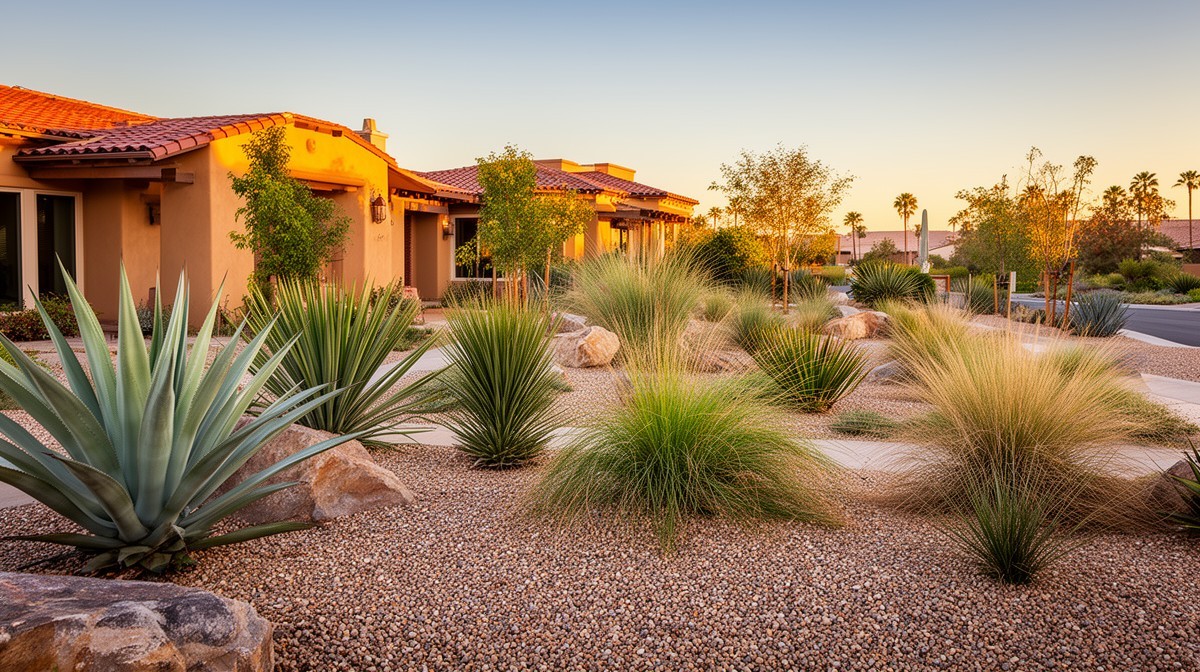
Garden Grove receives roughly 13 inches of rain a year, and virtually all of it falls between December and March. The Köppen classification here is BSk — semi-arid — the same family as Bakersfield, and from May through November a Garden Grove front lawn is a fully irrigated artificial ecosystem propped up by imported Colorado River and State Water Project supply. Xeriscape is not an imported Arizona look in this city; it is a return to the surrounding ecoregion, California coastal sage and chaparral, a landscape built from grey-leafed subshrubs, bunchgrasses, and open mineral ground. The 1950s and 60s tract ranches along Chapman Avenue and Brookhurst Street, and the tile-roofed Mediterranean remodels spreading through West Garden Grove and toward Westminster and Stanton, already carry the right palette — warm stucco, terracotta tile, and decomposed granite belong together.
Zone 10b lets Garden Grove grow the full architectural agave palette with no winter protection whatsoever. Use Agave americana 'Marginata' and Agave americana 'Mediopicta Alba' for the big yellow-and-blue statements, Agave parryi var. truncata and Agave ovatifolia 'Frosty Blue' for tight symmetrical rosettes, and Yucca rostrata 'Sapphire Skies' or Dasylirion wheeleri where you need vertical without a shrub. Hesperaloe parviflora 'Brakelights' flowers red for months on almost no water, and Aloe striata, Aloe 'Blue Elf', and Aloe arborescens carry January and February when nothing else is blooming. The soft filler that keeps a gravel yard from reading as a parking lot should come from natives on the very-low WUCOLS tier: Muhlenbergia rigens (deergrass), Eriogonum fasciculatum 'Warriner Lytle', Encelia californica, Salvia clevelandii 'Winnifred Gilman', Artemisia californica 'Canyon Gray', and Verbena lilacina 'De La Mina'. For a brutal west-facing driveway edge, Opuntia ficus-indica and Opuntia santa-rita take it without complaint.
The rebate math is the reason to do this now. Garden Grove Water Services is a Metropolitan member agency through MWDOC, so the SoCal Water$mart turf replacement rebate pays $2 per square foot on up to 5,000 sqft per year. Two conditions decide approval: the converted area must carry at least three plants per 100 square feet at mature coverage, and no synthetic turf is allowed within it — a bare gravel "zeroscape" gets rejected, and it also collides with Garden Grove's front-setback landscaping standards. Approval and pre-project photos must precede demolition. On budget, Orange County crews bill roughly $85–125 per hour and installed costs run 20–35% above national averages, so the rebate typically covers 10–18% of a professional conversion but most of a DIY one. Two notes decide whether the yard still looks good in year five: grade gravel fields to drain away from the slab, and lay weed fabric only under paths — never under planting beds, where it strangles the self-seeding that fills a xeriscape in.
4 Desert/Xeriscape Design Ideas for Garden Grove
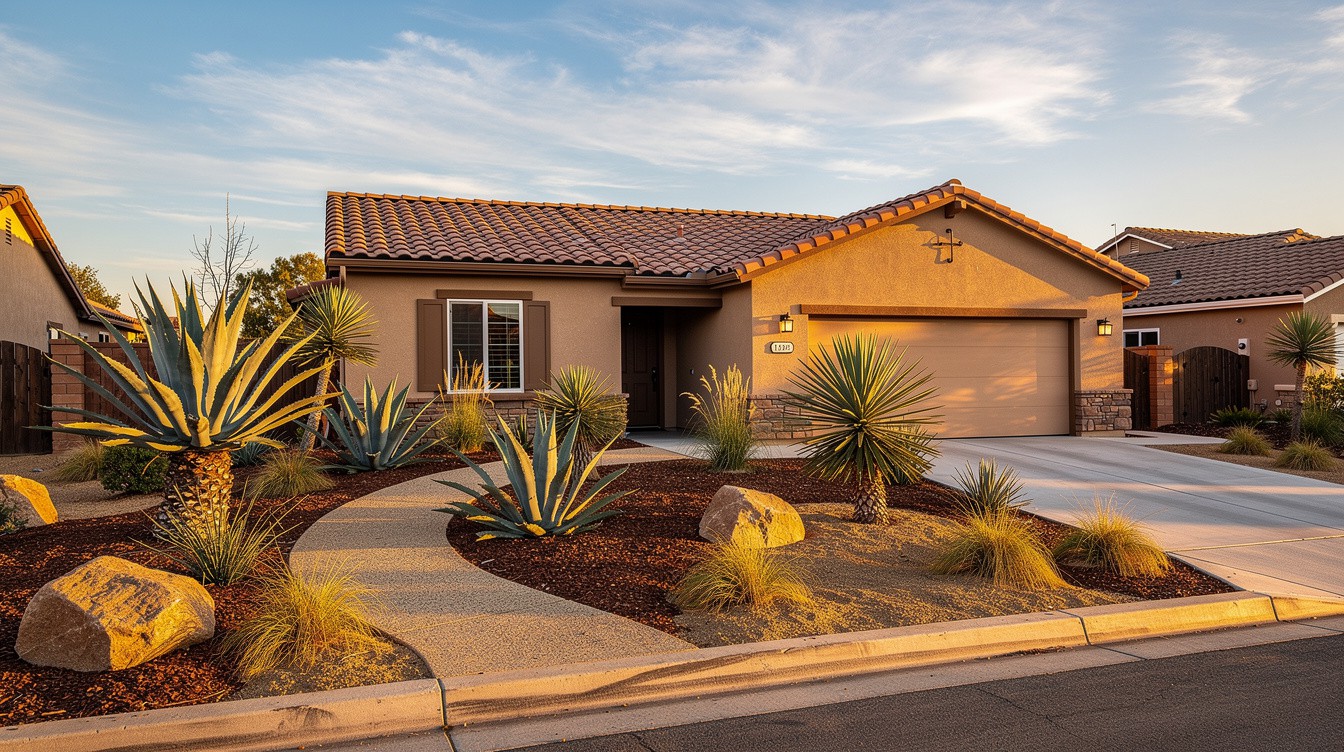
The Ribbon Path Agave Court
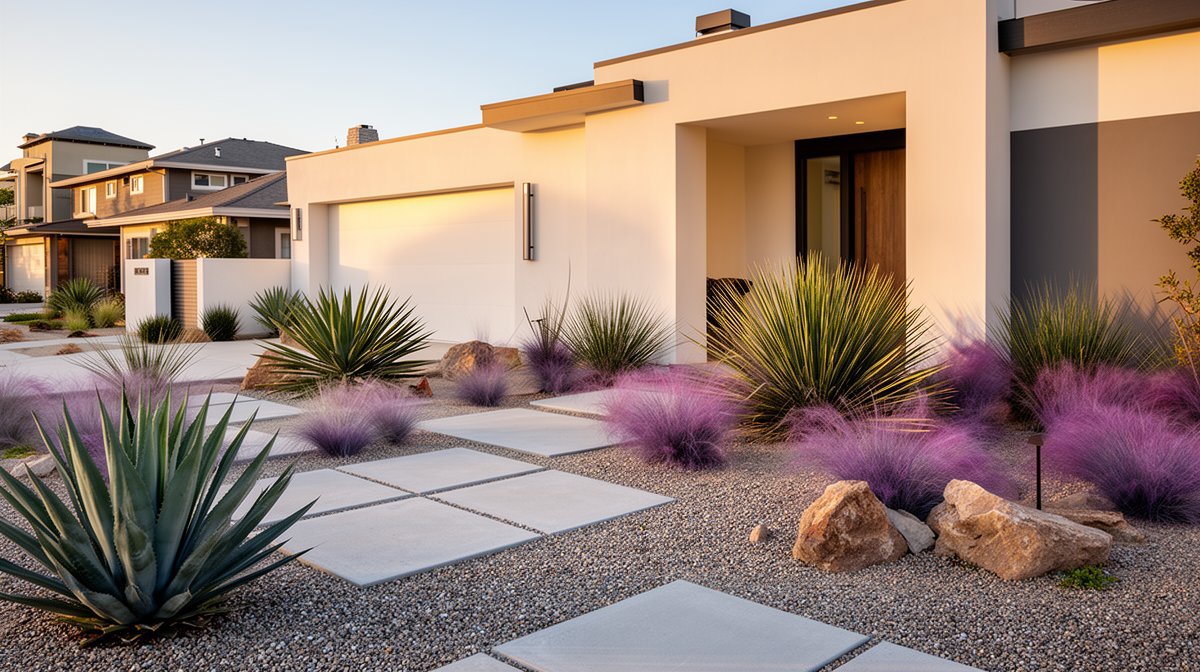
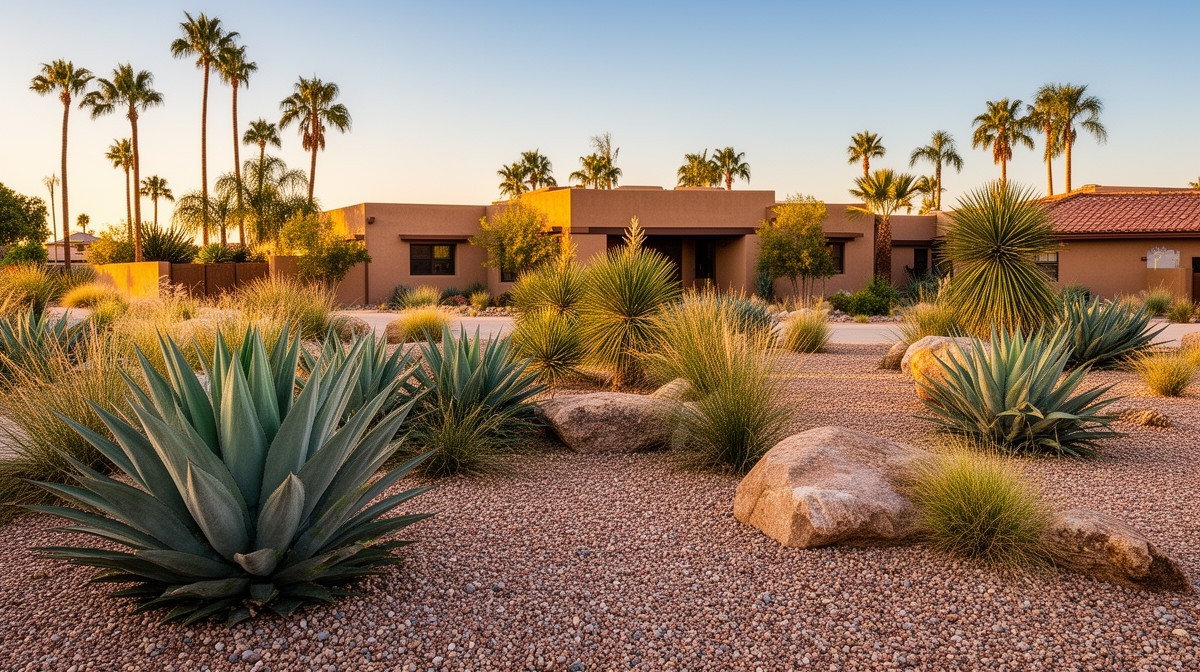
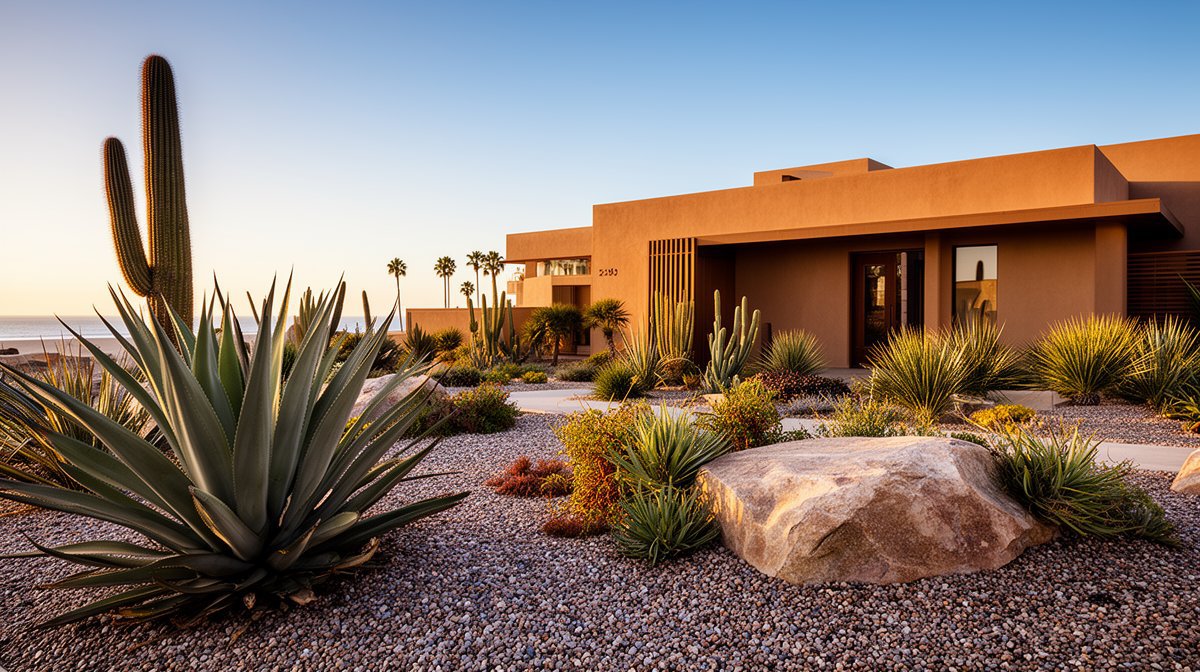
$13–24/sqftA tile-roofed stucco ranch with stone veneer at the garage, fronted by a sweeping ribbon of pale decomposed granite that curves from the driveway to the entry instead of running straight. The DG path is the negative space; everything else is deep red-brown bark bed studded with specimens. Enormous variegated Agave americana 'Marginata' dominate the left side at eye level, smaller blue agaves step down toward the walk, and multi-headed Yucca rostrata provide the vertical beat on the right. Gold granite boulders sit half-buried at the bed edges — half-buried is the whole trick, a boulder sitting on top of mulch always looks delivered. Amber bunchgrasses catch the low sun and soften every hard edge.
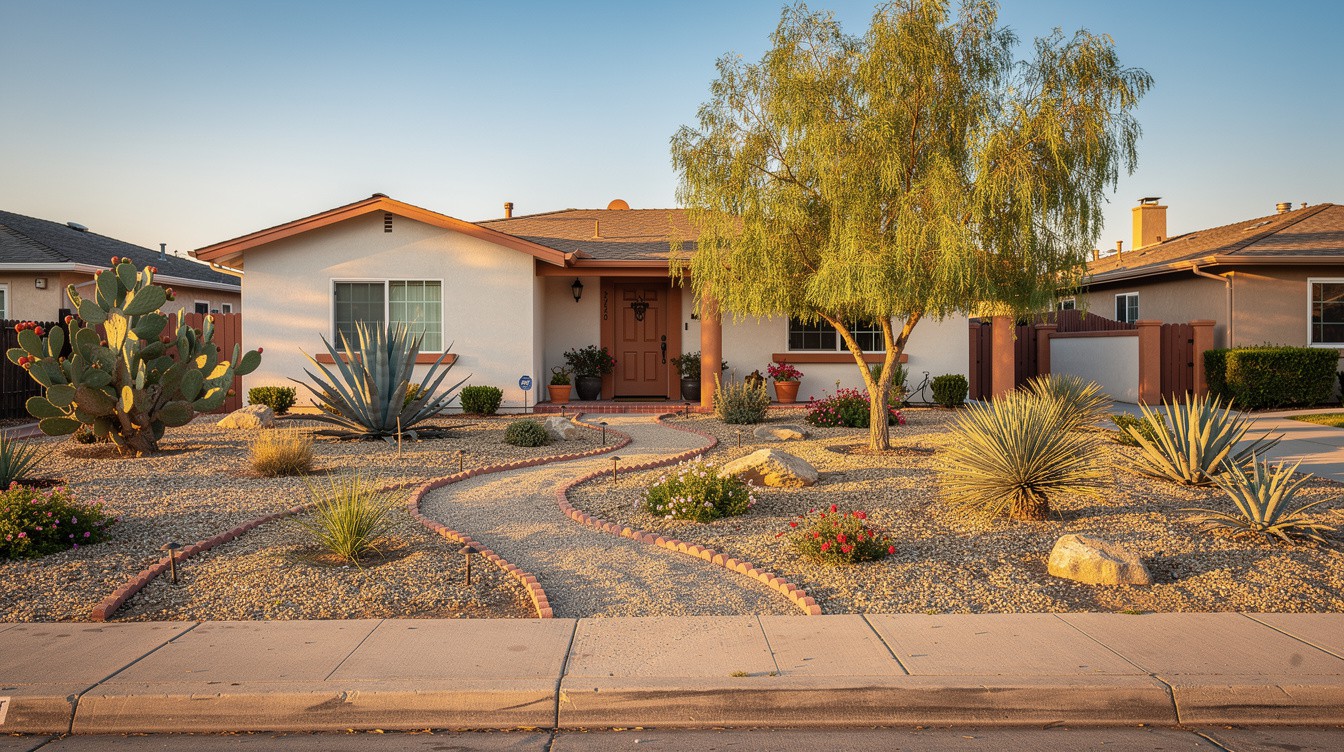
The Brick-Edged Gravel Yard
$9–17/sqftA classic 1960s Garden Grove tract ranch — white stucco, wood trim, brick stoop — with the entire lawn converted to pale washed gravel and organized by curving brick soldier-course edging that ties directly to the existing porch brick. Two looping paths carve through the gravel, one to the door and one to the side gate, with low-voltage path lights spaced along both. A mature Geijera parviflora throws fine weeping shade over the right half, a big Opuntia ficus-indica with red tunas anchors the left corner, and small flowering pockets of Verbena lilacina and Salvia greggii keep it from being all spikes. This is the most budget-realistic of the four: no walls, no grading, mostly material and labor.
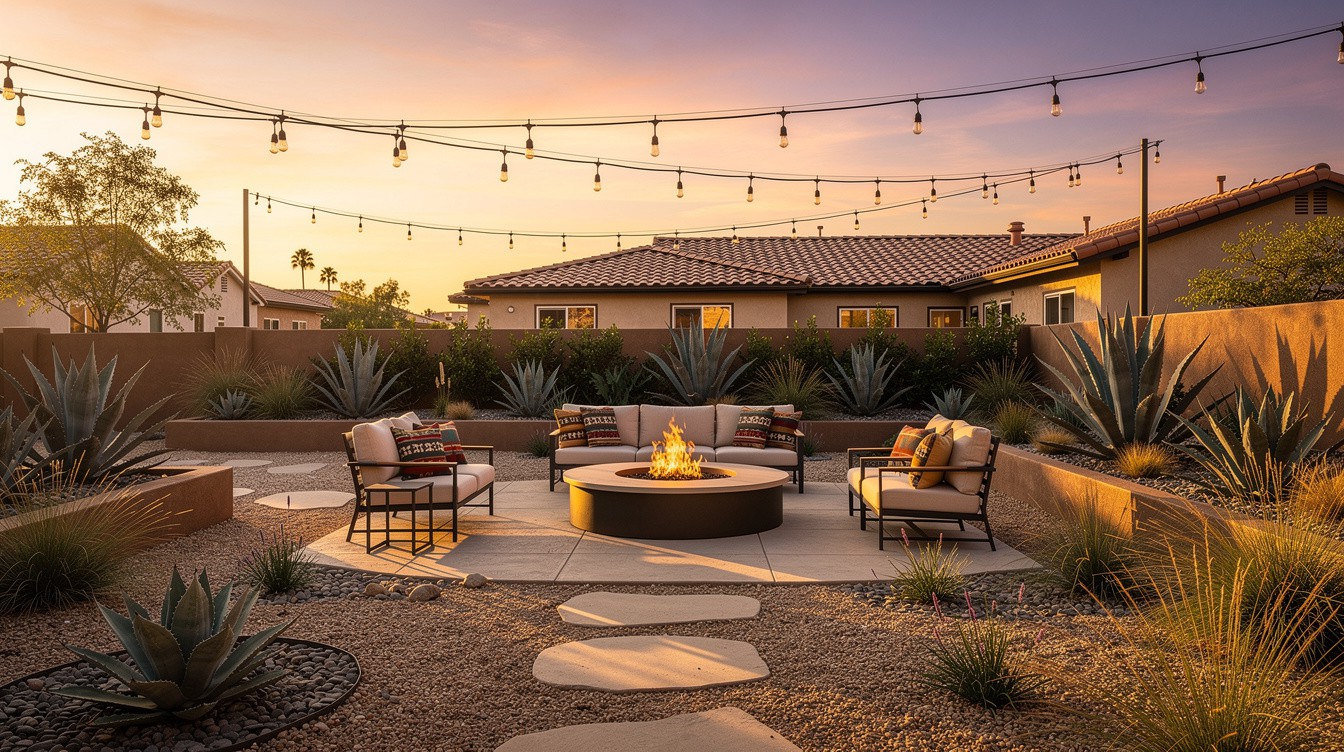
The Sunken Fire Circle
$22–40/sqftTan stucco walls, about knee to waist height, wrap a slightly sunken concrete patio and double as raised planters and casual seating — one structure doing three jobs, which is how you make a small Garden Grove back yard feel like a courtyard. A round gas fire table sits at the center of a circular pad, with a lounge chair and two sofas turned inward. The planter tops are massed with agaves at repeating intervals along the entire wall run, so the enclosure reads as a green horizon line rather than a fence. Beyond the patio, cobble and gravel replace lawn completely, with irregular concrete steppers threading through and bunchgrasses breaking up the mineral field.
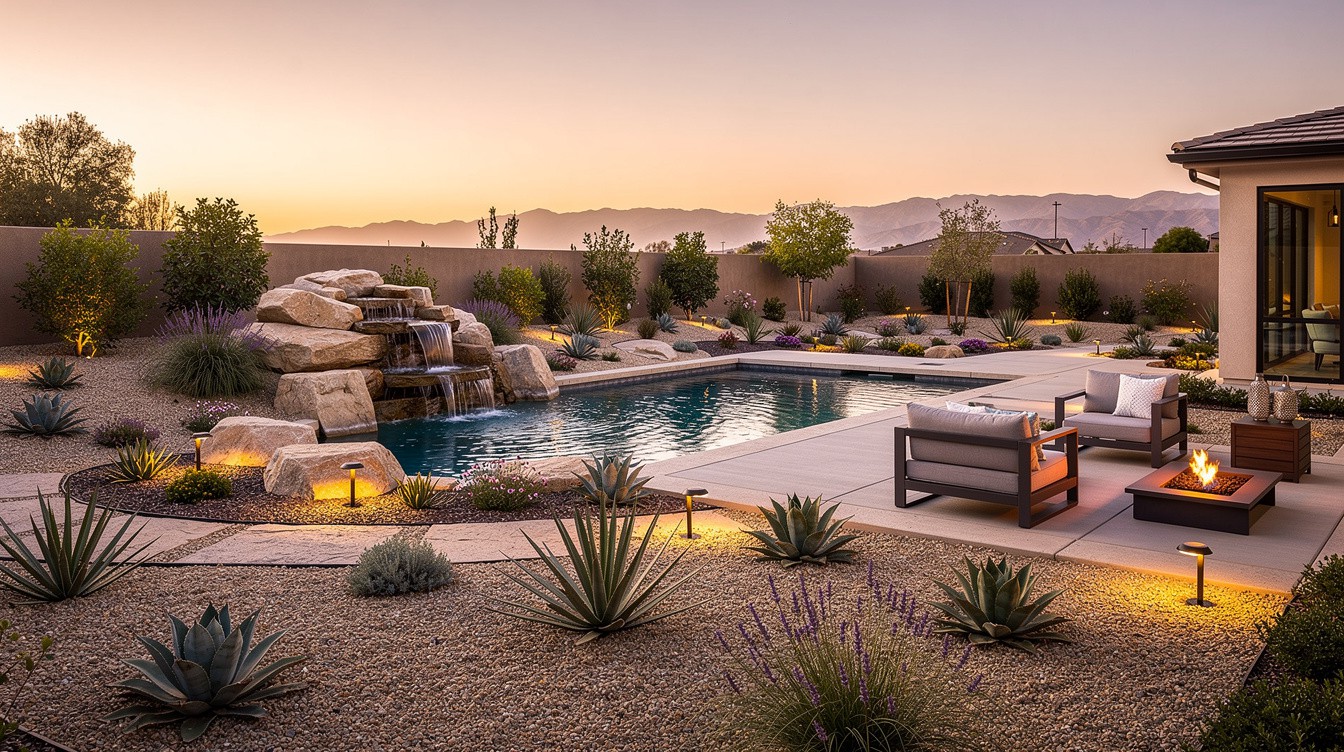
The Boulder Falls Pool
$65–130/sqft (pool and water feature inclusive)A rectangular pool with a stacked-boulder waterfall at one end, set into a gravel landscape rather than a lawn — the combination that makes a pool feel like it belongs in a semi-arid climate instead of fighting it. Blue Agave parryi rosettes are placed as individual objects across the gravel at irregular spacing, each one uplit, with lavender and Salvia drifts filling between and small multi-trunk trees repeating along the tan block wall. A concrete lounge deck runs along the house side with a square fire table, and low path lights trace the transition from deck to gravel. On clear evenings the Santa Ana Mountains and Saddleback sit on the horizon behind the wall, which is what the whole composition is framing.
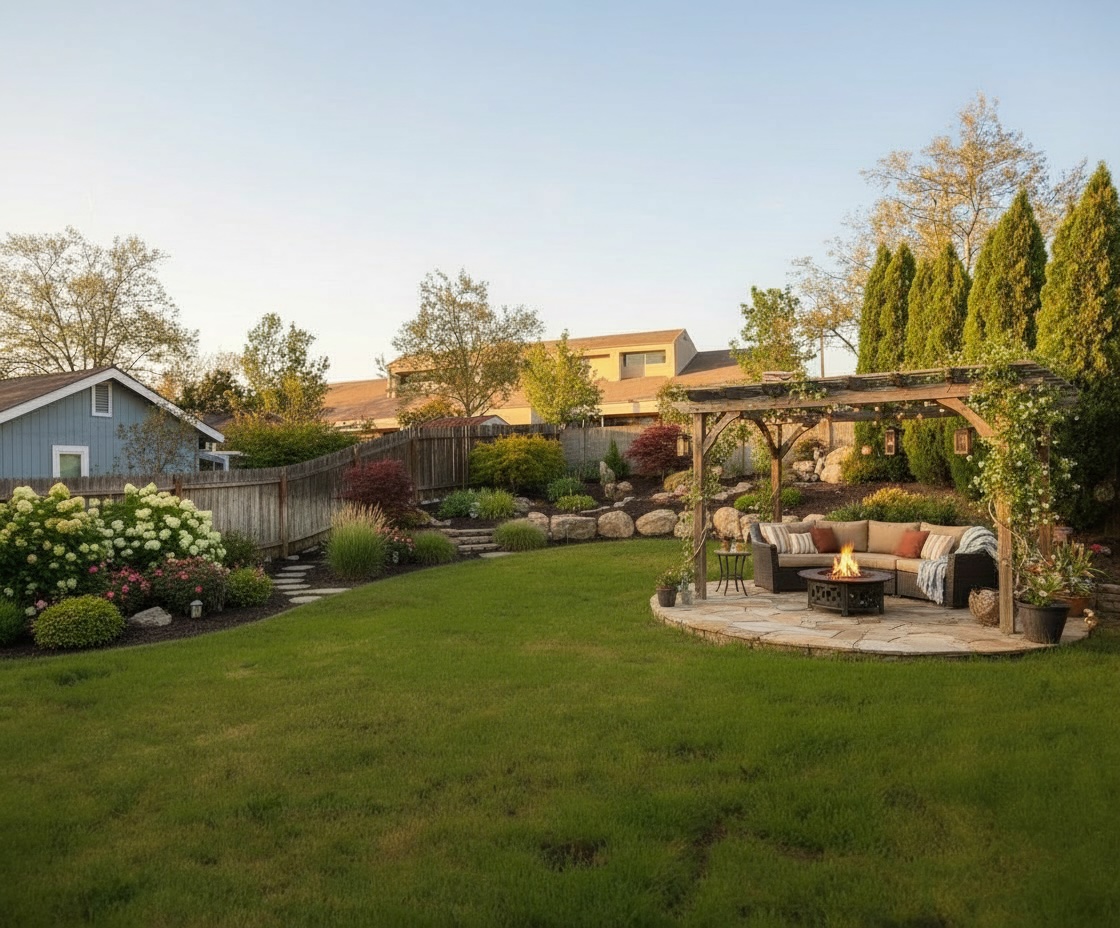
See how a desert/xeriscape garden looks on YOUR property
Upload a photo of your Garden Grove yard and visualize your dream garden in seconds.
Try ProScapeAI Free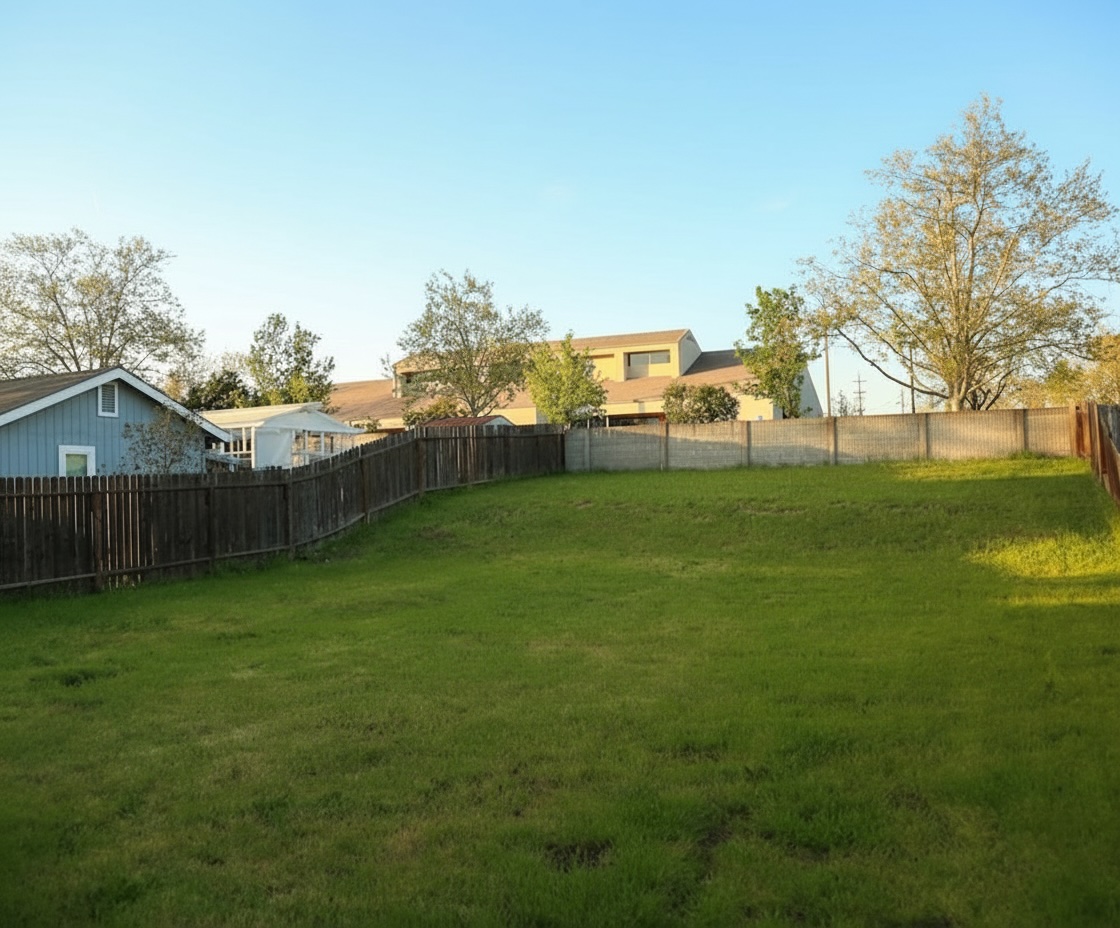
Featured Trees & Shrubs for Desert/Xeriscape Gardens
Browse all 115 plants for Garden Grove
Black Sage
Salvia mellifera
grows to 4 feet, white blooms in spring. Attracts butterflies.
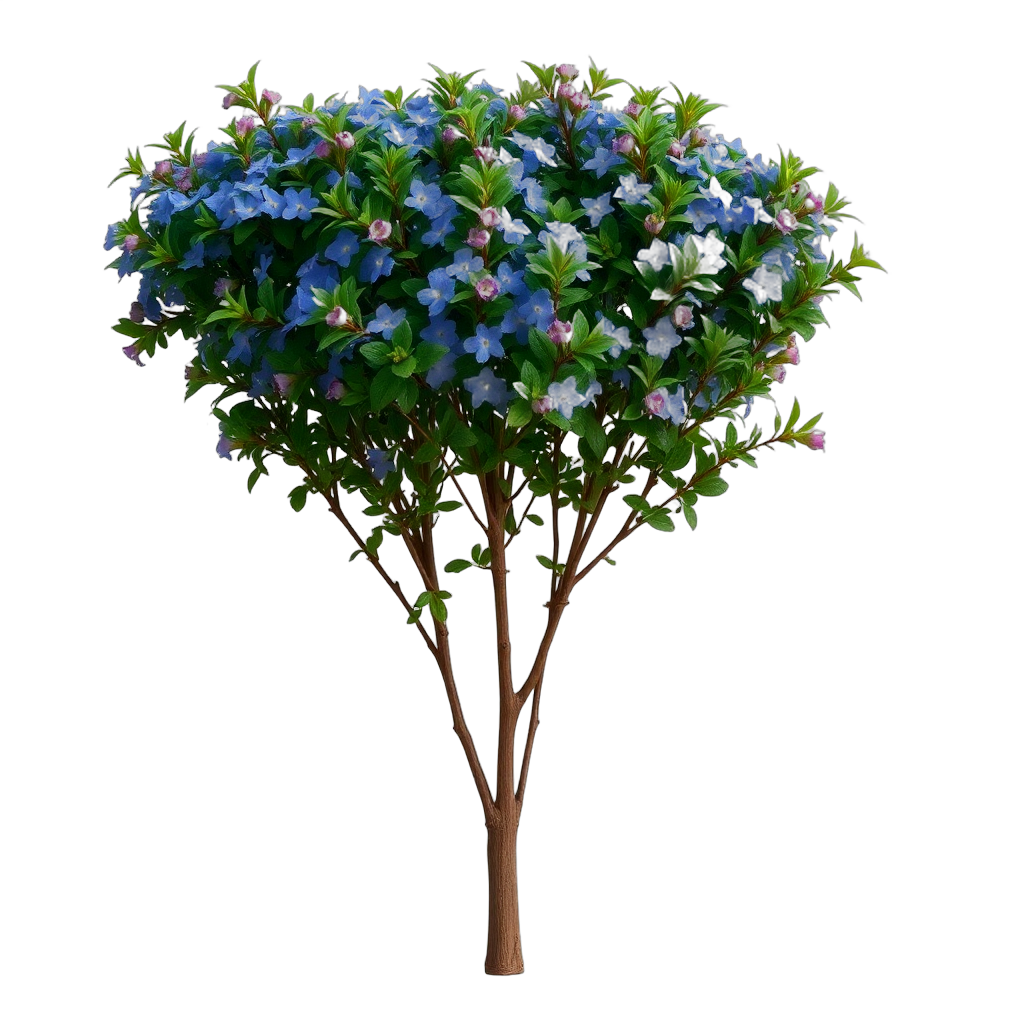
Blue Blossom
Ceanothus thyrsiflorus
medium-sized at 12 feet, blue blooms in spring. Attracts butterflies.
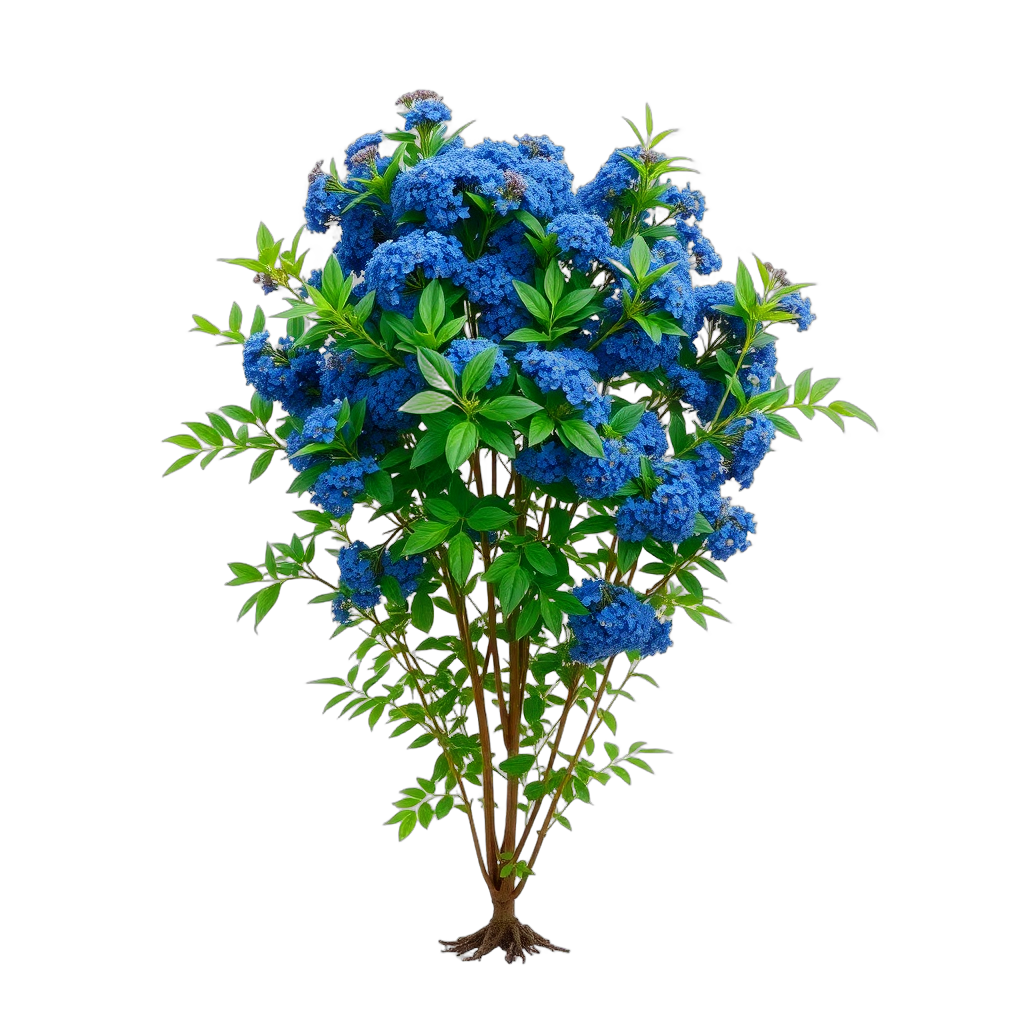
Blue Elderberry
Sambucus cerulea
medium-sized at 15 feet, white blooms in spring. Attracts butterflies.
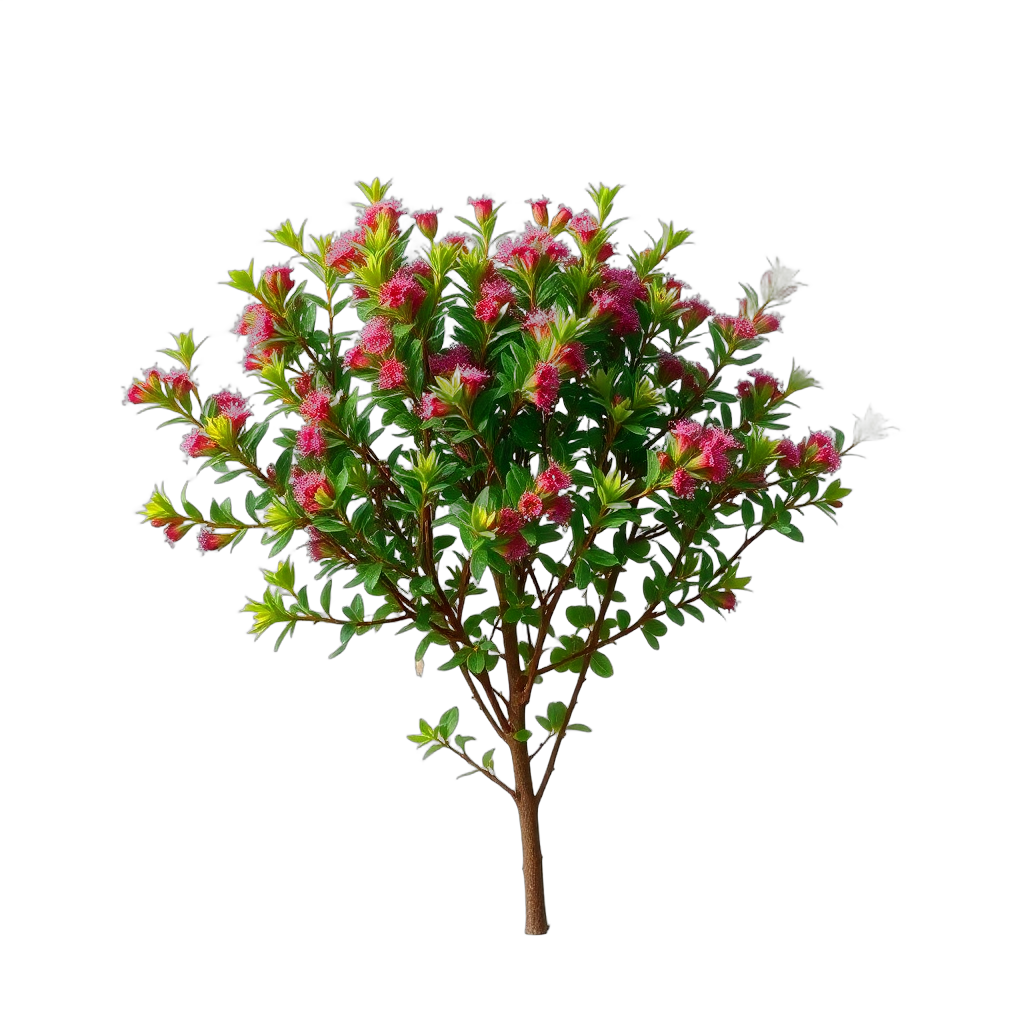
Buckbrush
Ceanothus cuneatus
medium-sized at 7 feet, white blooms in spring. Attracts butterflies.
Featured Grasses & Groundcovers for Desert/Xeriscape Gardens
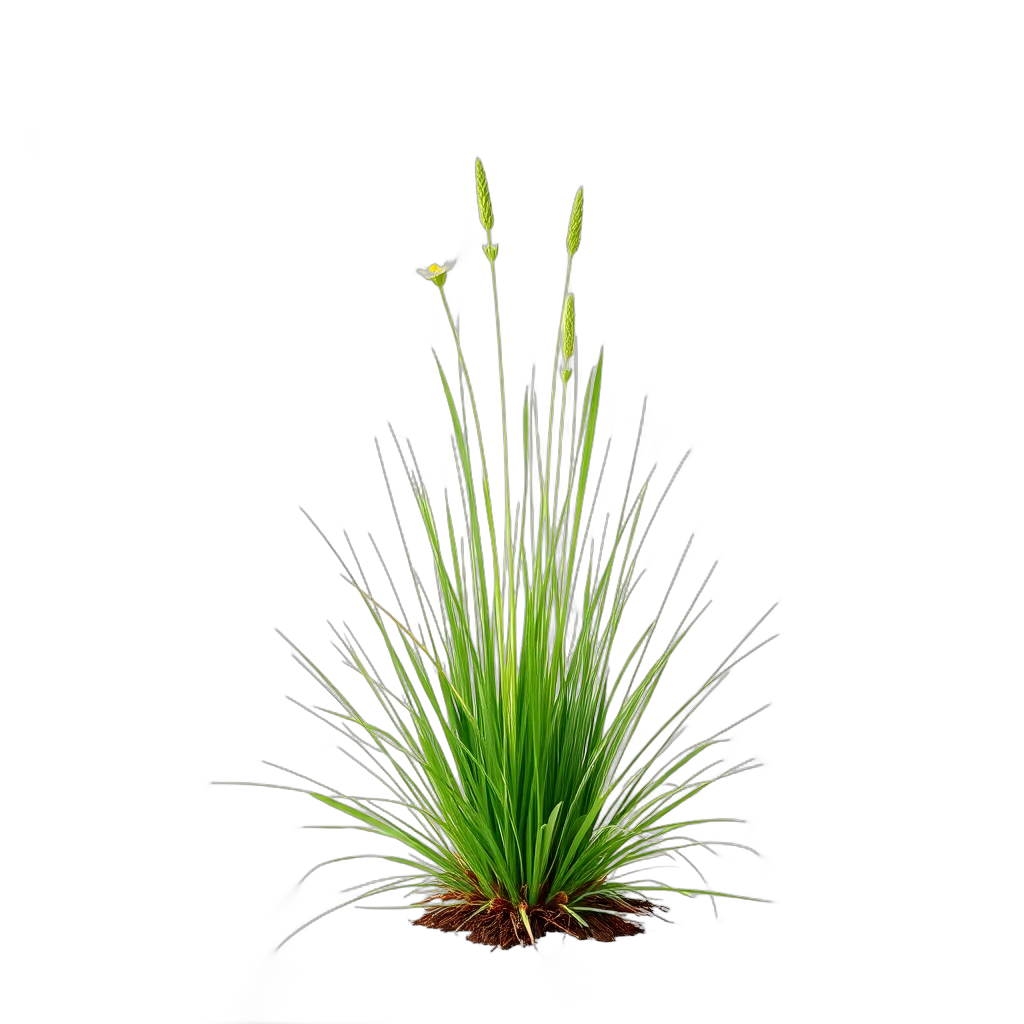
California Brome
Bromus carinatus
low-growing ground cover, blooms in spring. Yellow fall color.
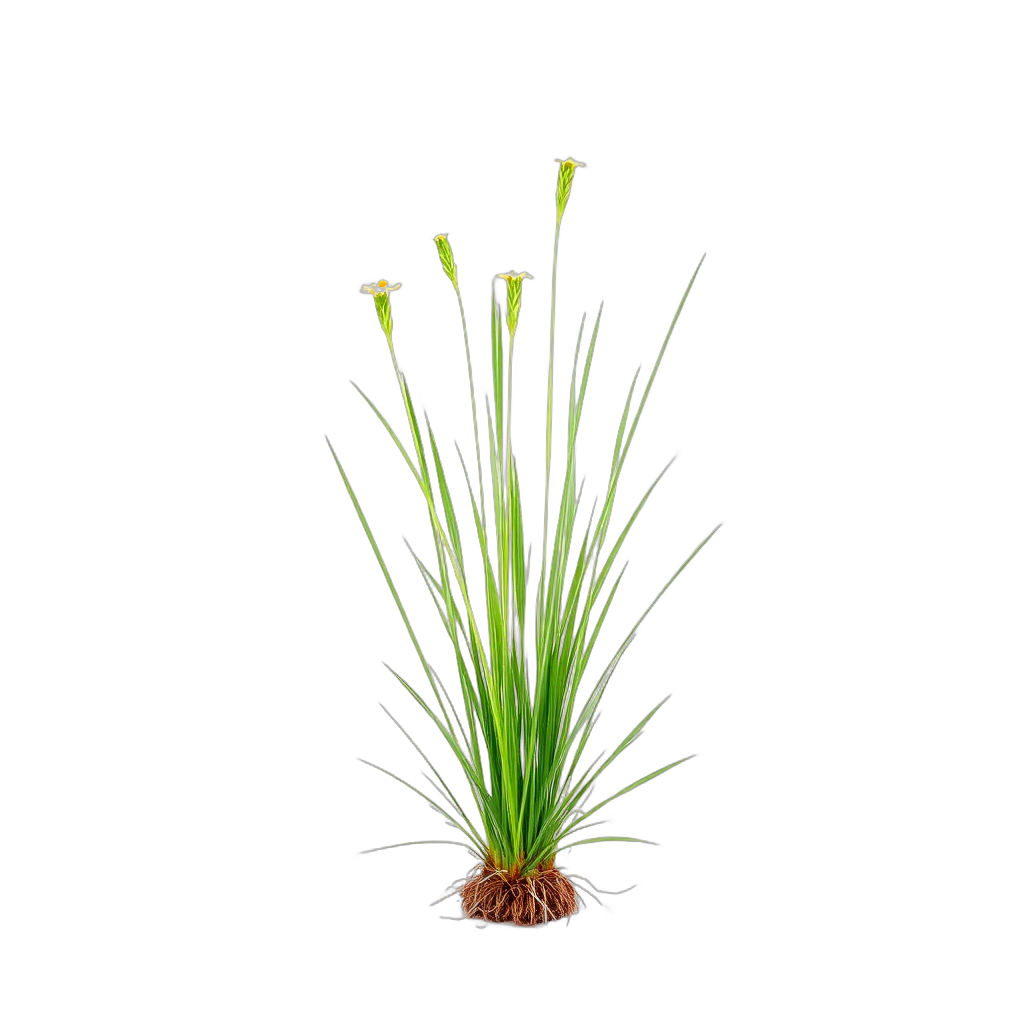
California Melic
Melica californica
low-growing ground cover, blooms in spring.
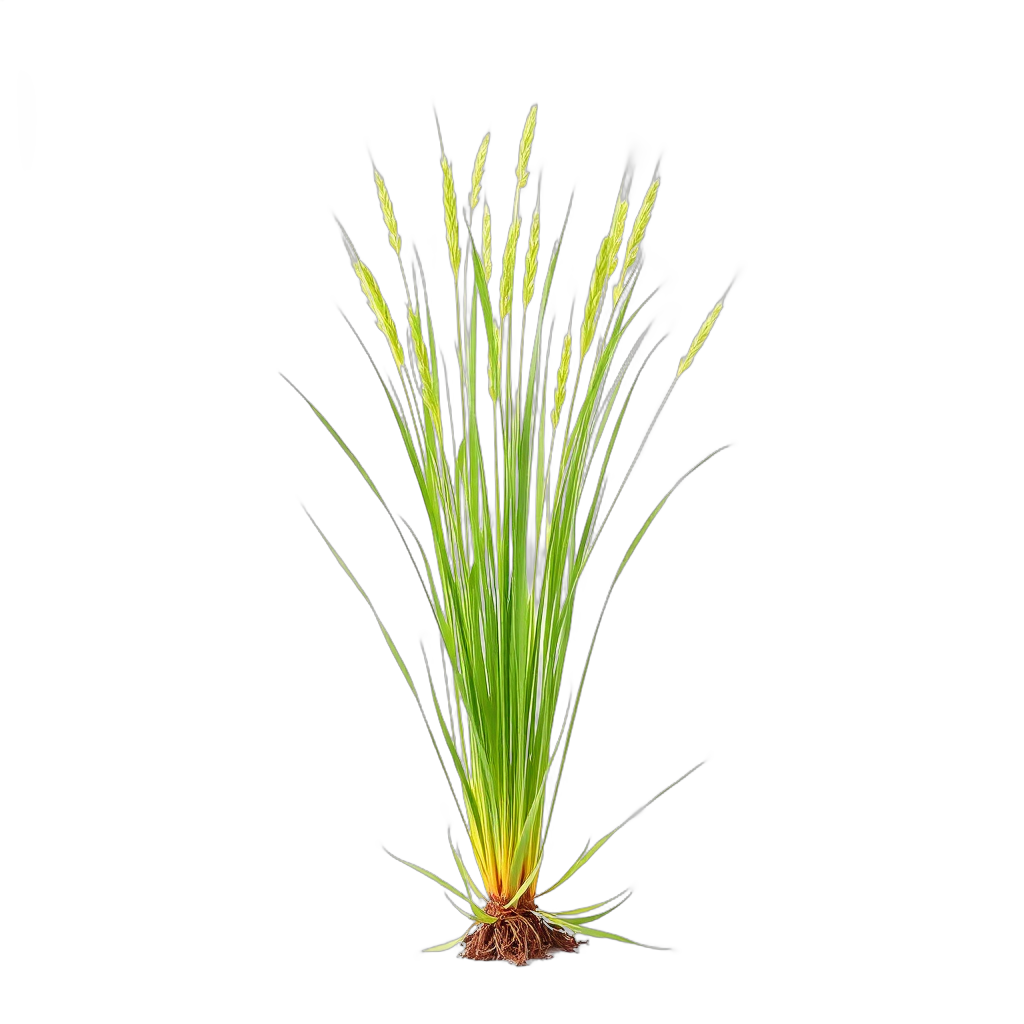
California Oatgrass
Danthonia californica
low-growing ground cover, blooms in spring. Yellow fall color.
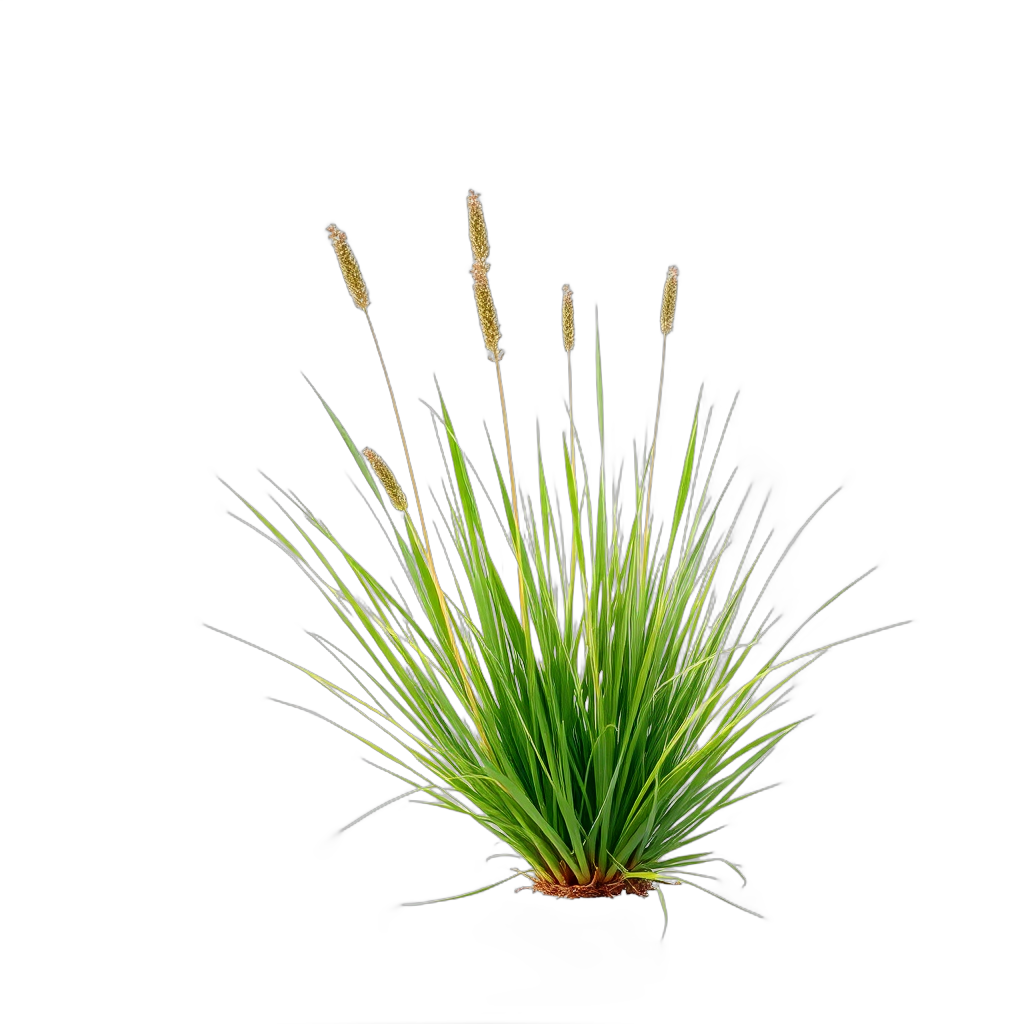
Deer Grass
Muhlenbergia rigens
grows to 3 feet, yellow blooms in fall. Evergreen year-round.
Featured Flowers & Perennials for Desert/Xeriscape Gardens
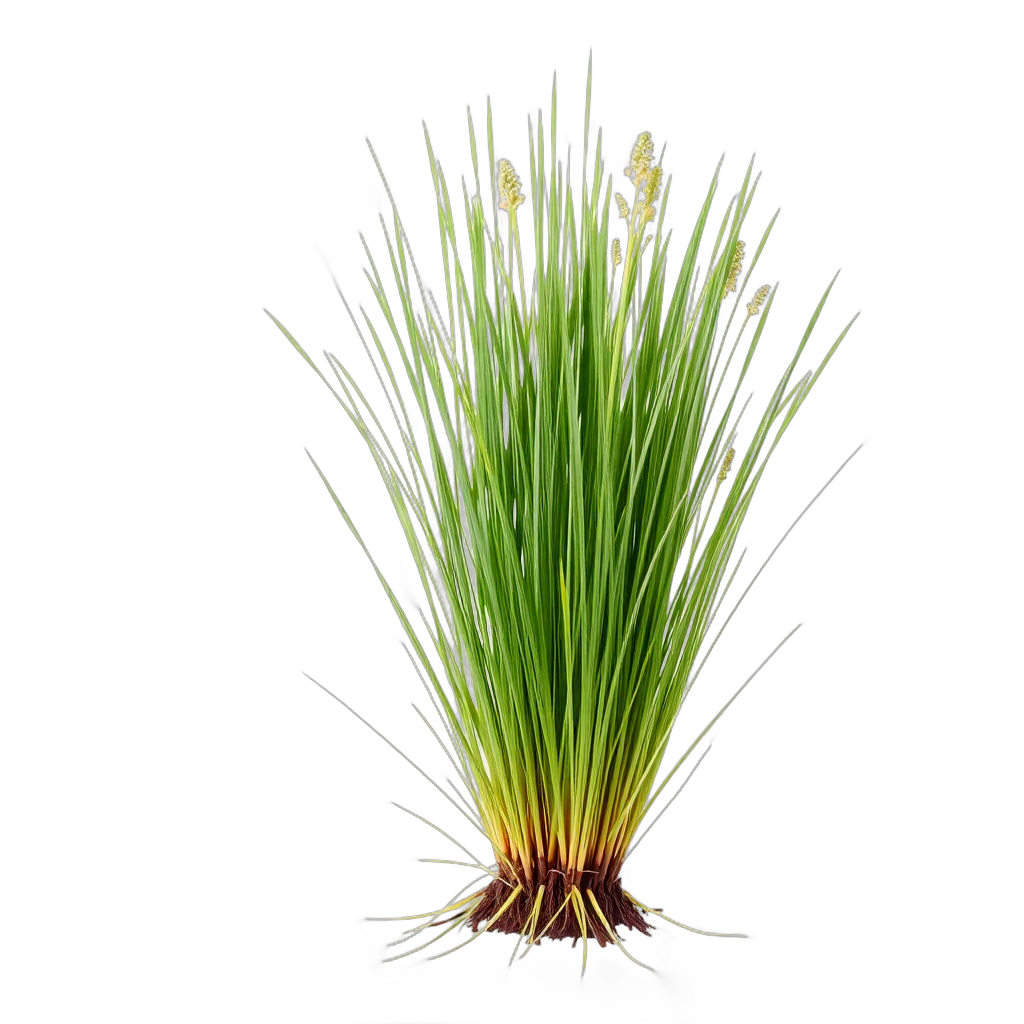
California Gray Rush
Juncus patens
low-growing ground cover, blooms in summer. Evergreen year-round.
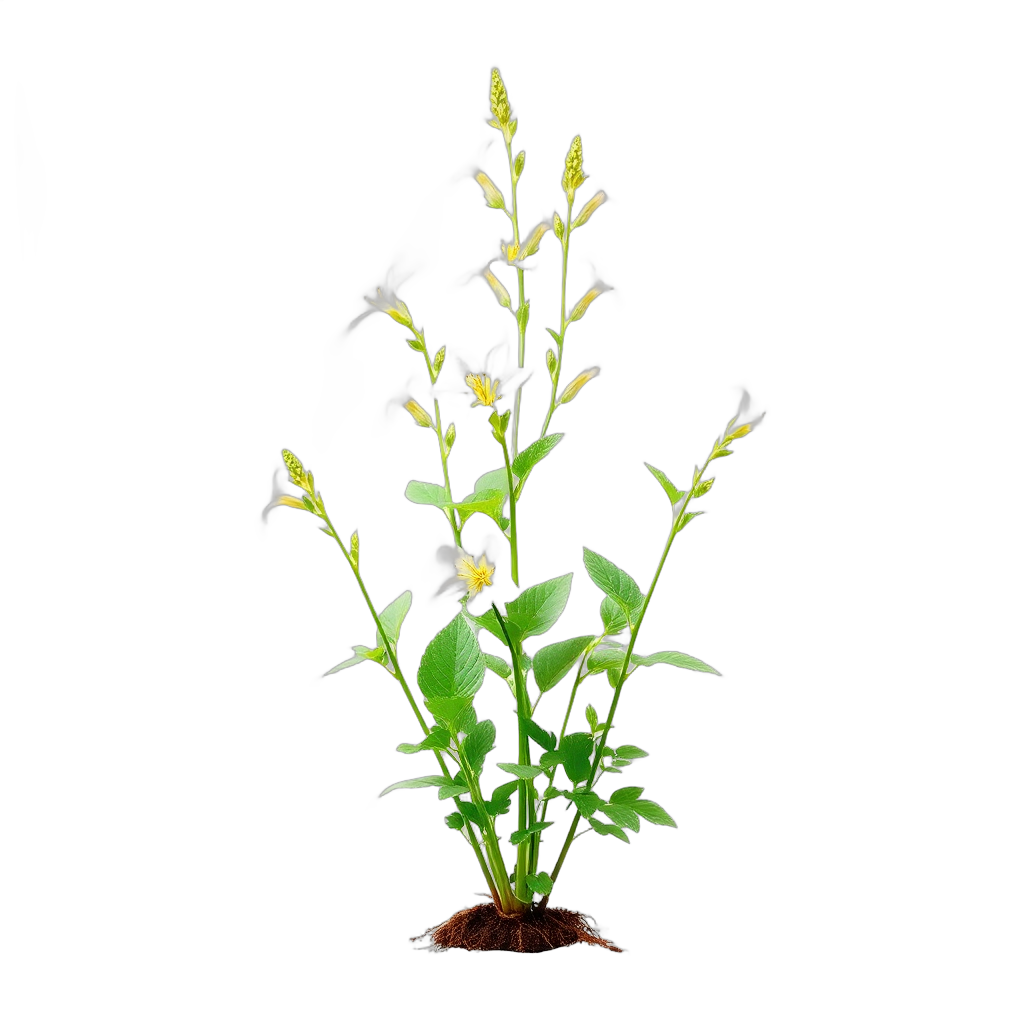
Beach Evening Primrose
Camissonia cheiranthifolia
low-growing ground cover, yellow blooms in spring. Attracts butterflies.
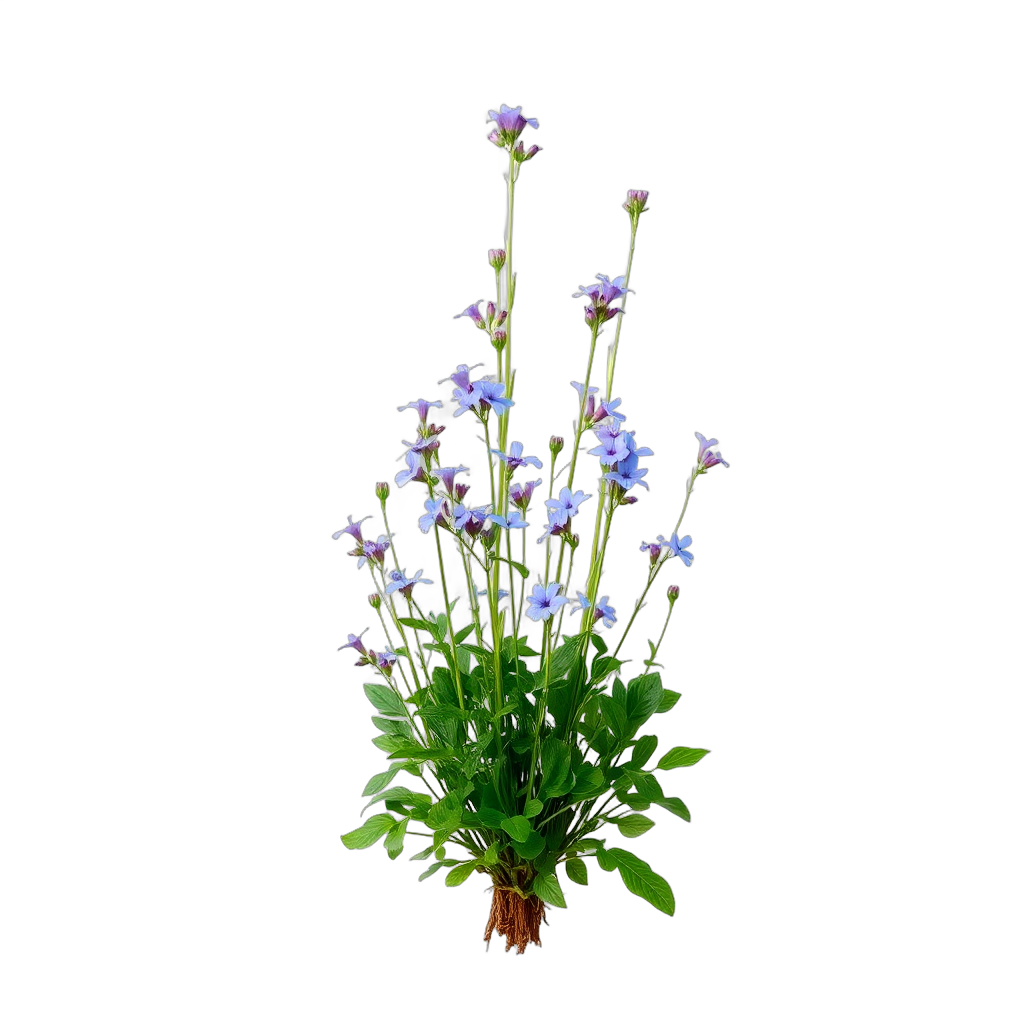
Blue Dicks
Dichelostemma capitatum
low-growing ground cover, blue blooms in spring. Pollinator-friendly.
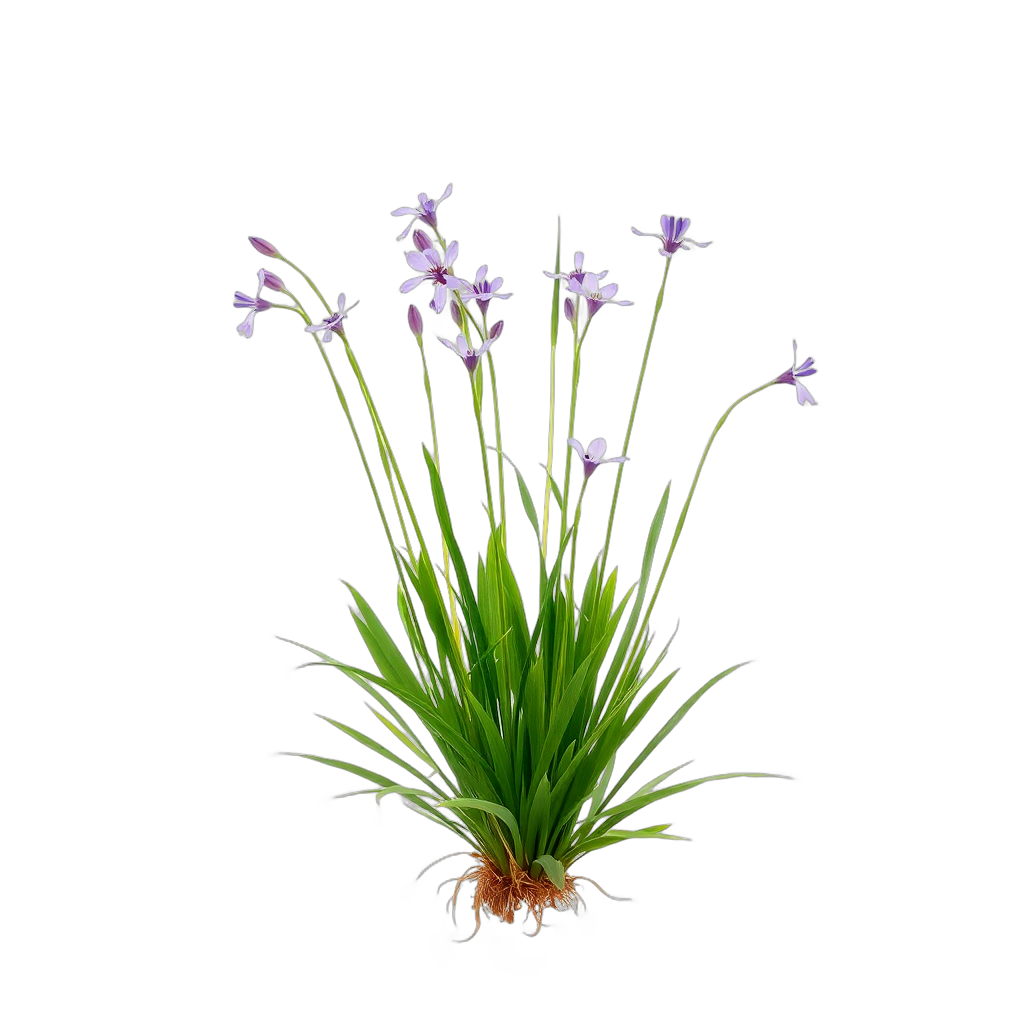
Blue-Eyed Grass
Sisyrinchium bellum
low-growing ground cover, blue blooms in spring. Attracts butterflies.
Bloom Calendar for Garden Grove
spring
Beach Evening Primrose, Blue Dicks, Blue-Eyed Grasssummer
California Gray Rush, Hooker's Evening Primrose, Hummingbird Mintfall
California Fuchsiawinter
Limited bloomsDesign Tips for Garden Grove (Zone 10b)
- Plant three per 100 sqft as a design floor, not a compliance chore — it is the exact density that separates a SoCal Water$mart-approved xeriscape from a rejected gravel lot, and Garden Grove's front-setback landscaping standards enforce roughly the same thing
- Set every boulder at least one-third buried and group them in odd numbers; a Sunburst granite boulder resting on top of bark always reads as delivered, while the same rock sunk into the grade reads as geology
- Use one gravel and one bark, then vary the plants — the Ribbon Path idea works because pale DG paths and dark red bark beds create the contrast, not because there are twenty species in it
- Stabilize any DG that people walk on with a psyllium or resin binder; loose 3/8in DG tracks into the house and washes into the gutter every time a December storm drops an inch on Garden Grove's flat Santa Ana River alluvium
- Keep one small canopy tree in every front-yard plan — Geijera parviflora, Chilopsis linearis 'Bubba', or Arbutus 'Marina' — because a west-facing gravel yard with no shade will raise your afternoon cooling load more than the lawn ever cost you in water
- Convert to inline pressure-compensating drip with separate valves for succulents and for the native shrub zone; Agave parryi and Salvia clevelandii want deep monthly soaks, while newly planted Muhlenbergia rigens needs weekly water through its first summer, and one shared valve kills whichever plant is on the wrong schedule
Where to Source Plants in Garden Grove
Skip the big-box stores. These independent Garden Grove nurseries specialize in the plants that make desert/xeriscape gardens thrive in Zone 10b.
Evergreen Nursery
Garden Grove Boulevard
Rare tropical fruit trees, cacti, succulents, and vegetables with reasonable pricing and knowledgeable staff.
Mimi's Nursery
Euclid Street
Exceptional variety of rare succulents and exotic cacti, specializing in crested aeoniums and imports.
Roger's Gardens
Corona del Mar (Orange County)
Renowned independent garden center with plants, seasonal displays, and home and garden decor.
Desert/Xeriscape Landscaping Costs in Garden Grove
| Project Scope | Estimated Cost |
|---|---|
| Front yard turf-to-xeriscape conversion, ~800 sqft (demo, grading, DG, boulders, drip, plants) | $9,000 – $20,000 (less ~$1,600 turf rebate) |
| Decomposed granite paths + boulder placement (200–400 sqft of path) | $2,000 – $6,500 |
| Specimen agave, Yucca rostrata, or Dasylirion (5-gal to 36in box, planted) | $120 – $2,000 each |
| Backyard fire-circle patio with stucco seat and planter walls | $22,000 – $55,000 |
| Pool with boulder waterfall + full xeriscape surround (Orange County rates) | $95,000 – $240,000 |
| AI visualization with ProScapeAI | Free to start |
Estimates based on Garden Grove, CA-area contractor rates as of 2026. Actual costs vary by site conditions, materials, and contractor.
Garden Grove Climate & Growing Zone
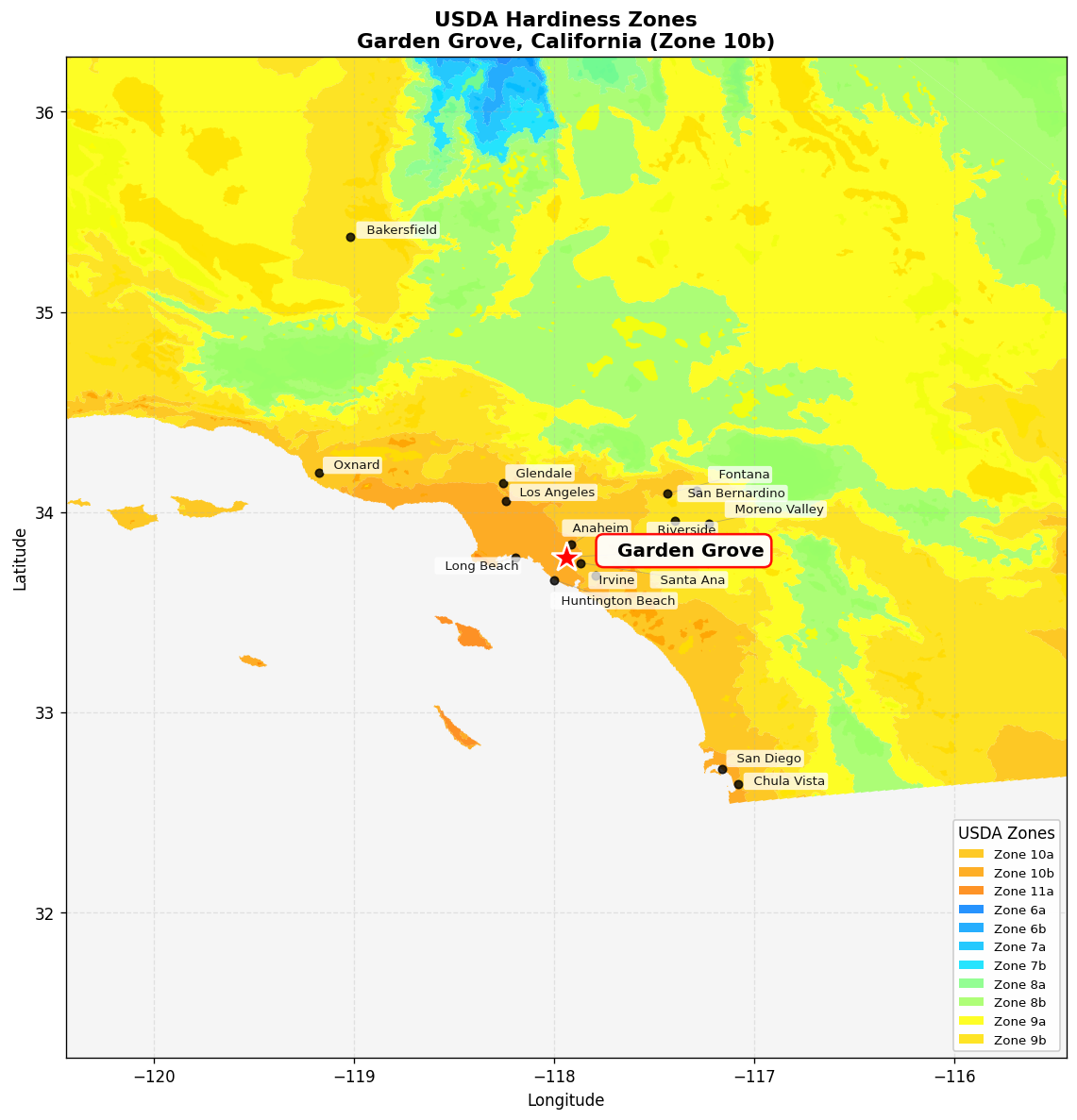
USDA Zone 10b
Hardiness zone for Garden Grove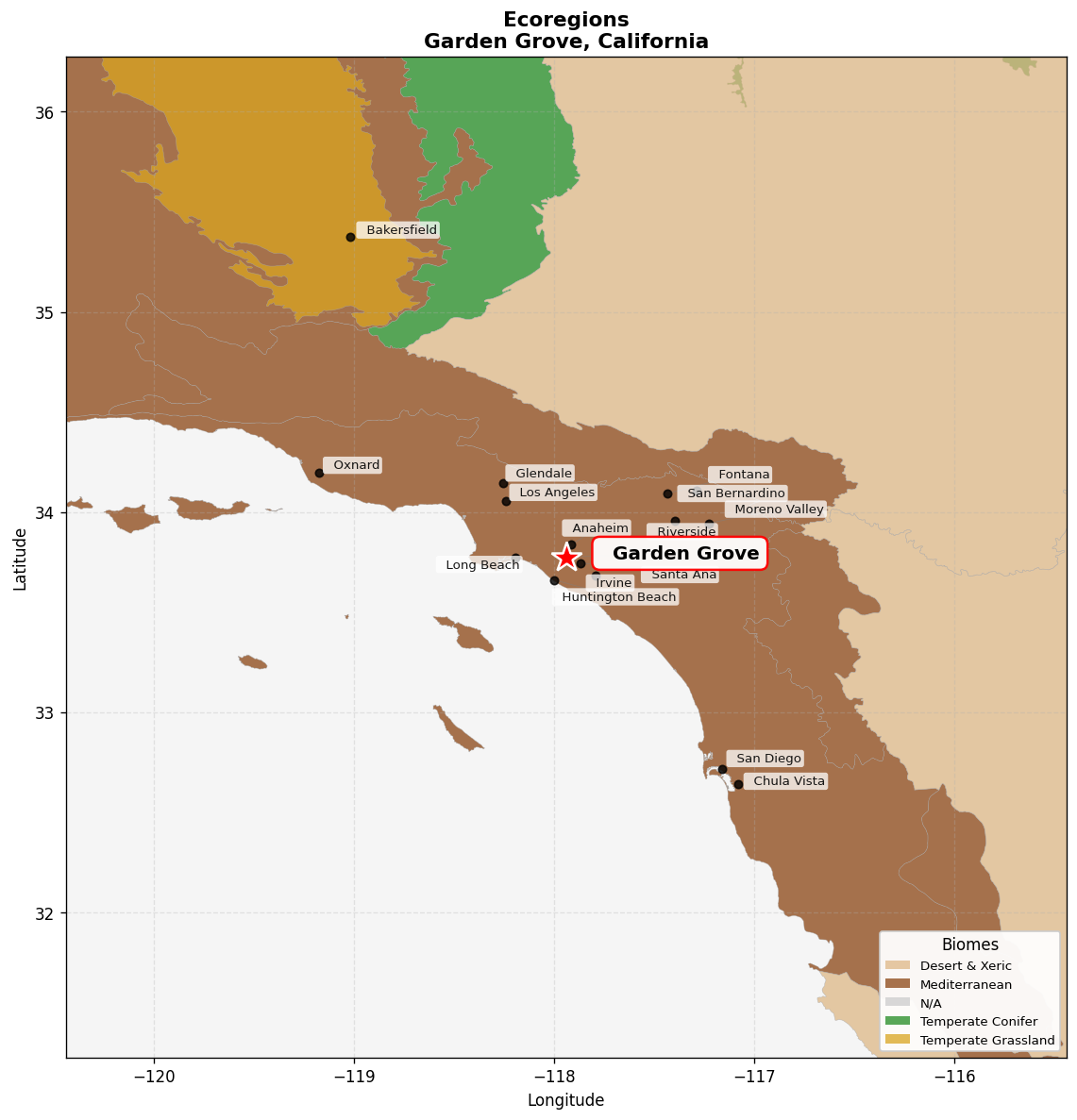
California coastal sage and chaparral
Native ecoregionFrequently Asked Questions
How much does a xeriscape cost in Garden Grove?
A professional front-yard conversion on a typical 800 sqft Garden Grove front yard — turf demolition and haul-off, grading, DG paths, boulders, drip retrofit, and roughly 24 plants to satisfy the rebate density rule — runs $9,000–20,000 installed, with about $1,600 coming back at $2/sqft. Orange County labor is the driver: licensed crews bill $85–125 per hour and installed costs sit 20–35% above national averages. The same yard done DIY over a few weekends typically costs $4,500–8,000 in materials, since gravel and DG run $60–95 per ton delivered and the real expense is your own labor moving it.
Does Garden Grove pay a rebate for removing my lawn?
Yes. Garden Grove Water Services is a Metropolitan member agency via MWDOC, so residents apply through SoCal Water$mart for $2 per square foot on up to 5,000 sqft of turf converted per year, and your own agency may layer a small top-up — check the estimator for your address before you plan the budget. The non-negotiables are three plants per 100 sqft of converted area at mature coverage, no synthetic turf within the converted area, and permeable surfacing so rain infiltrates instead of running to the street. Approval must be in hand before demolition; pre-project photos of the living lawn are required.
Which plants qualify for the rebate and which should I avoid?
Anything on the low or very-low WUCOLS water-use tier qualifies, which covers essentially the whole architectural palette: Agave americana 'Marginata', Agave parryi var. truncata, Agave ovatifolia, Yucca rostrata, Dasylirion wheeleri, Hesperaloe parviflora 'Brakelights', Aloe striata, Opuntia ficus-indica, plus natives like Muhlenbergia rigens, Eriogonum fasciculatum 'Warriner Lytle', Encelia californica, Salvia clevelandii 'Winnifred Gilman', and Ceanothus 'Yankee Point'. Avoid Stipa tenuissima (Mexican feather grass) and Cortaderia selloana (pampas grass) — both are Cal-IPC listed invasives in California and neither belongs next to coastal sage scrub. Pennisetum setaceum is the third to skip; use Muhlenbergia lindheimeri or Bouteloua gracilis 'Blonde Ambition' instead.
Will a gravel yard make my house hotter?
It can, and this is the most common Garden Grove xeriscape mistake. A wall-to-wall gravel field on a west-facing lot radiates heat into the front rooms all afternoon. Three fixes: keep or add a canopy tree — Geijera parviflora, Chilopsis linearis 'Bubba', Cercis occidentalis, and Arbutus 'Marina' all stay under 25 feet and use very little water; choose lighter gravel, since desert gold and Palm Springs gold reflect noticeably more than dark cobble; and hold gravel two to three feet off the foundation with a planted band instead of running it to the stucco. The three-plants-per-100-sqft rebate rule pushes you toward the right answer anyway.
When should I plant a xeriscape in Garden Grove?
October and November are ideal. Soil is still warm, roots move, and the December–March rains do most of the establishment watering for free. February and March work as a second window. Steer away from June installs: the May Gray and June Gloom marine layer keeps agave and aloe foliage damp for weeks and freshly divided pups rot at the base. Whenever you plant, water new agaves deeply but infrequently — roughly every ten to fourteen days for the first summer, then taper to monthly. And guy any Yucca rostrata or boxed tree through Santa Ana season; a 50 mph offshore gust in October will rock an unestablished rootball loose.
Do I need a permit to xeriscape in Garden Grove?
Removing turf, spreading gravel or DG, setting boulders, and converting to drip all need no building permit. Permits are required for retaining or seat walls over four feet from the bottom of the footing, pools and spas, patio covers, new landscape lighting circuits, and gas lines serving fire tables — Building Division, 11222 Acacia Parkway. Watch two Garden Grove specifics: an encroachment permit is needed for anything in the parkway strip between sidewalk and curb, and the zoning code limits how much of the front setback can be hard-paved, so an all-gravel-and-concrete plan can be refused. Permitted landscape work over 500 sqft also triggers the state MWELO irrigation-efficiency requirements.