4 Modern Landscape Ideas for Lancaster, CA | Zone 8b Design
Native plants from the Mojave desert (Zone 8b) — Cold semi-arid climate
Why Modern/Minimalist Gardens in Lancaster?
Lancaster is unusually well suited to modern landscape design, because a large share of the city was built when modernism was simply how houses got made. The aerospace-boom tracts laid out through the 1950s and 1960s around downtown, The BLVD and the grid east of Sierra Highway are full of low ranches and flat- and butterfly-roofed builds with deep eaves, clerestory glass and dark-framed picture windows — mid-century bones that ask for a landscape with the same discipline rather than a softening layer of shrubs. West of 30th Street West and out through Quartz Hill the stucco-and-tile tracts of the 1990s and 2000s give a different but equally workable canvas: long unbroken street elevations that a single strong horizontal line will organise instantly. And the newer Avenue K and Amargosa Creek builds already come with the sliding walls of glass that a modern rear courtyard is designed around. What every one of these lots shares is the Antelope Valley floor itself — dead flat, with front setbacks of 20 to 30 feet and no slope to work with. On flat ground a modern design has to earn its drama from line, plane and material rather than terrain, which is why the successful Lancaster projects are the ones built around one confident concrete ribbon, one crisp band of decomposed granite and one repeated plant form.
The climate sets hard limits on what that plant form can be. Lancaster sits at roughly 2,350 feet on the western floor of the Mojave, with about 6.5 inches of rain a year against something near 65 inches of reference evapotranspiration — the yard wants ten times more water than the sky supplies. July highs average close to 96°F and the city logs well over 100 days above 90°F, yet this is USDA Zone 8b, with typical winter lows of 15–20°F and a 30°F swing between afternoon and dawn for much of the year. That cold is what quietly kills imported modern gardens here. The sculptural plants people photograph in Palm Springs — the tender blue Agave hybrids, Euphorbia tirucalli 'Sticks on Fire', bougainvillea trained flat on a white wall — will not see a Lancaster February. The forms that hold their architecture through a hard frost are the high-desert group: Agave ovatifolia 'Frosty Blue', Agave parryi var. truncata, Yucca rostrata 'Sapphire Skies', Dasylirion wheeleri, Nolina nelsonii and Hesperaloe parviflora 'Brakelights', with Muhlenbergia rigens, Muhlenbergia dubia and Bouteloua gracilis 'Blonde Ambition' supplying the soft counter-texture. For the grey-green Mediterranean note modern facades take so well, fruitless Olea europaea 'Wilsonii' and Westringia fruticosa 'Morning Light' both hold at Lancaster's lows, and Perovskia atriplicifolia 'Blue Spire' and Lavandula x intermedia 'Provence' carry the colour without asking for summer water.
Underneath is sandy loam over caliche, a cemented lime hardpan that can begin six inches down, with a soil pH usually between 7.5 and 8.5. Caliche matters twice in a modern project. Under a specimen it has to be punched through with a bar or auger, or the planting hole becomes a bathtub that rots an Agave in one wet February. Under a slab it is the opposite problem — it is inconsistent, so a large-format concrete terrace needs a uniform compacted base and generously spaced control joints, because the 30°F daily swing works concrete harder here than the mild coastal climate the standard details were written for. Then there is the wind, which is the single most underestimated factor in Antelope Valley design. Spring gusts of 30–50 mph funnel through the Tehachapi and Soledad gaps for weeks at a stretch. They redistribute rounded pea gravel across the driveway within one season, so use angular 3/8 to 3/4 inch decomposed granite. They shred lightweight shade-sail fabric and tip aluminium furniture, so specify weight and marine-grade hardware. And catenary cable, not a bare cord, is what keeps a run of festoon lighting over a patio intact past April. High-elevation ultraviolet finishes the job: cheap powder coat chalks and untreated cedar greys out in two seasons, which is why weathering steel, integrally coloured concrete and anodised or marine-grade aluminium are the honest material choices for Lancaster rather than a stylistic preference.
Water policy is the last local factor and it shapes the plan more than most homeowners expect. Most of the city is served by Los Angeles County Waterworks District 40, Antelope Valley Region, on tiered rates that punish summer turf irrigation, and the basin has been under the Antelope Valley groundwater adjudication since 2015, so pumping is capped and the direction of cost is only up. California's Model Water Efficient Landscape Ordinance applies to new permitted residential landscapes over 500 square feet and rehabilitated landscapes over 2,500 square feet, and it caps turf as a share of the planted area; statewide rules already prohibit irrigation runoff onto sidewalks and watering within 48 hours of measurable rain. None of that means a modern Lancaster front yard has to be lawn-free. One crisp, geometric, genuinely used panel of hybrid bermudagrass — Cynodon 'Tifway 419' or 'Latitude 36', which run on roughly half the water of tall fescue and go dormant gold rather than dead in winter — framed by gravel bands and steel edge reads as a deliberate modern move. What fails here is wall-to-wall fescue with a sprinkler in the middle of it. Lancaster also protects Joshua trees (Yucca brevifolia) under city ordinance on top of the state's Western Joshua Tree Conservation Act, so if one stands on your lot, design the geometry around it and check requirements with the city before touching it — a mature Joshua tree against a flat-roofed white elevation is the best modern focal point money cannot buy.
4 Modern/Minimalist Design Ideas for Lancaster

The Ribbon Walk and Green Panel Front
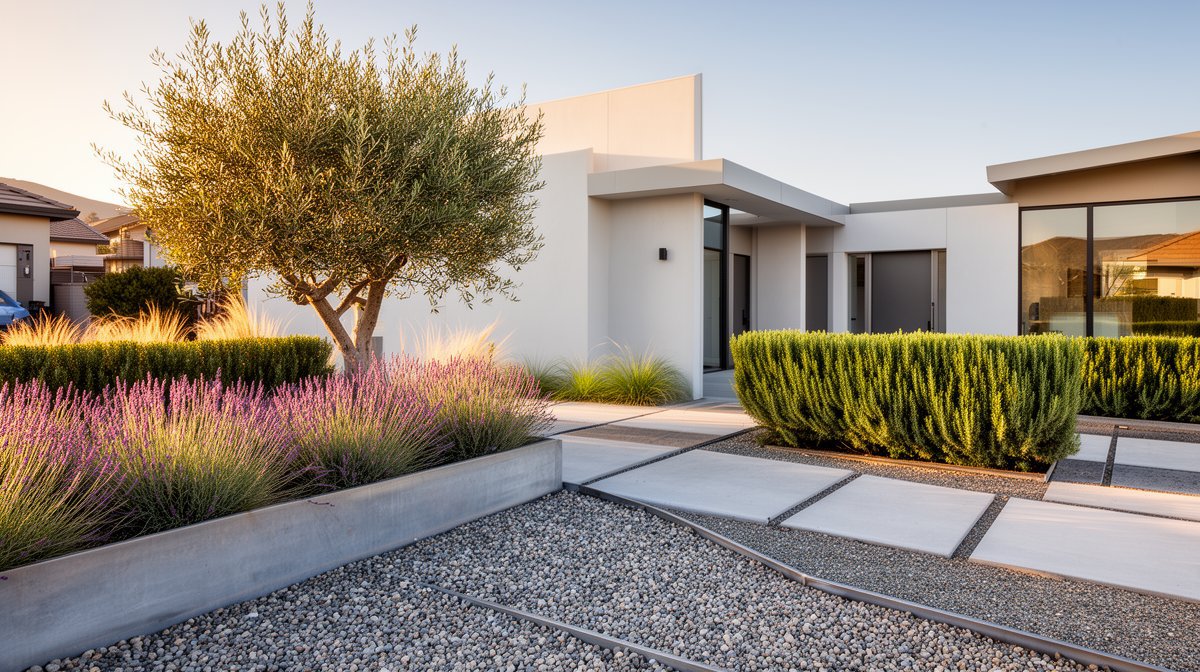
$9-18/sqftA cream stucco ranch with a raised flat-roof entry and dark-framed picture windows, split down the middle by a single poured concrete ribbon that runs straight from the street to the door with no steps, no curves and no border. Either side of it sits a crisp panel of clipped warm-season lawn, and every panel is wrapped in a wide band of pale rounded cobble and decomposed granite planted with drifts of lavender-blue Perovskia and Lavandula, silver Artemisia mounds, blue Agave rosettes and bunched deer grass. A broad-canopied deciduous shade tree stands off-centre in the left panel, throwing late-afternoon shade across the west-facing glass exactly where a Lancaster front room needs it. It is the design for owners who are not ready to give up lawn entirely: the turf becomes a shape rather than a surface, and the water budget drops by two thirds.

The Mid-Century Grid Front
$10-20/sqftA genuinely mid-century Lancaster ranch, flat roof with a slight forward pitch, deep fascia and a dark full-height entry door, fronted by a front yard that has become a drawing. The whole surface is gold decomposed granite, divided into large rectangles by flush weathering-steel edge, and every rectangle is planted as a composition rather than a bed: columnar cacti standing like posts, blue Agave rosettes spaced on a rhythm, golden barrel cacti as repeated spheres, and small silver mounds filling the gaps. Three cream granite boulders sit half-buried where the walk meets the largest panel. Behind the roofline a tall pale-barked tree breaks the horizontal. Zero turf, zero spray heads, and the geometry carries the whole design.

The Concrete Panel Fire Terrace
$16-32/sqftLarge-format sawcut concrete panels form a single clean plane off the back of a stucco house with two banks of sliding glass, and the terrace does one thing well: a round brushed-steel gas fire bowl with four low bronze-framed lounge chairs pulled around it. A single catenary run of festoon lighting crosses the whole space and ties into a multi-trunk olive standing in an oversized dark steel planter at the corner. The terrace edges are not walled in; they dissolve into loose drifts of bunched grasses in decomposed granite, and the rear boundary drops to a low wall with view fencing so the valley and the Tehachapi ridgeline stay in the picture. At 2,350 feet the evenings cool fast, which is what makes a fire feature the correct centrepiece here rather than a decorative one.

The Glass Wall Pool Court
$45-95/sqft (pool area inclusive)A single-storey glass-walled home with a dark flat roof and slim mullions wraps two sides of a rectangular pool set flush into a pale concrete deck, with a low linear gas fire table and lounge seating occupying the strip between the glass and the water. There is no coping fuss, no raised spa, no waterfall: the pool is one clean rectangle and the deck is one clean plane, and everything that softens the space happens at the perimeter, where wide gravel beds carry silver grasses and grey-green mounded shrubs right up to the concrete edge. Multi-trunk small trees at the outer corners frame the view without dropping litter into the water. This is the design for a lot where the house itself is the strongest element and the landscape's job is to hold a line and stay out of the way.
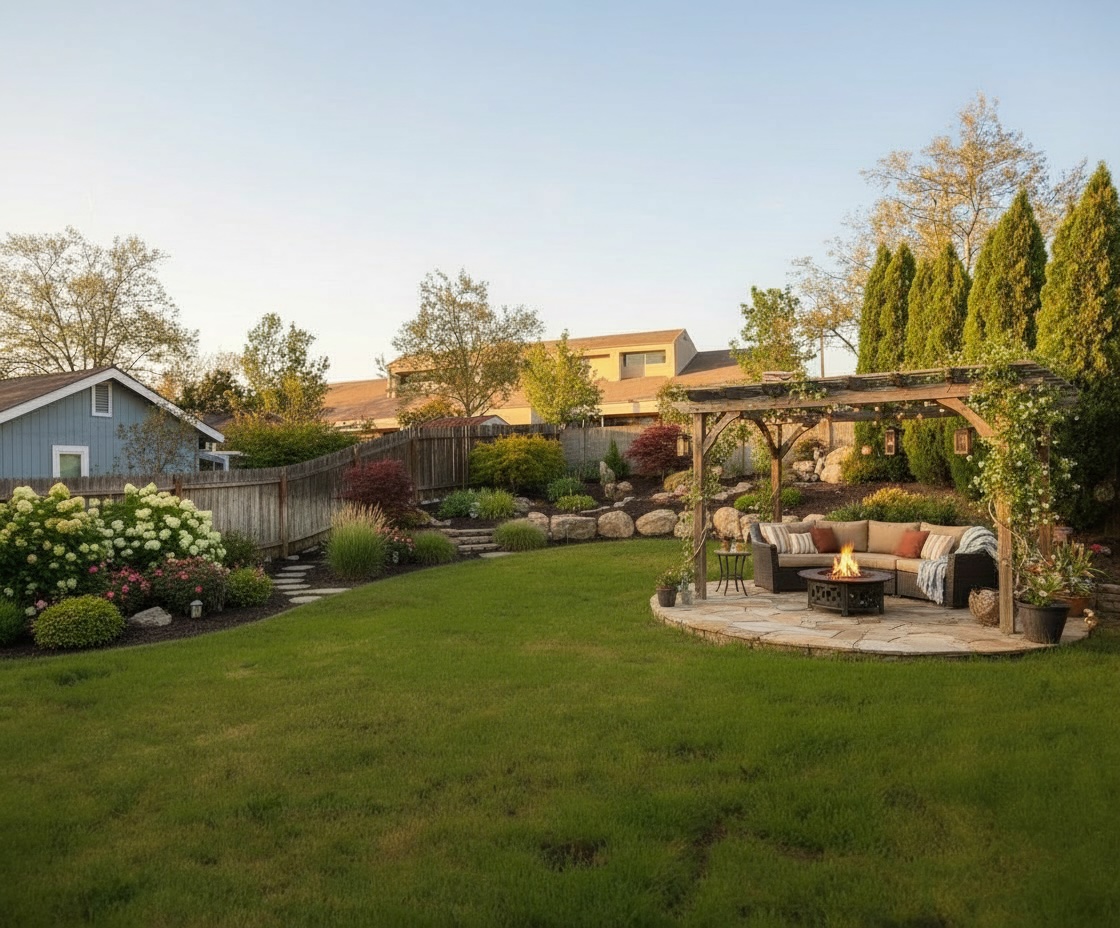
See how a modern/minimalist garden looks on YOUR property
Upload a photo of your Lancaster yard and visualize your dream garden in seconds.
Try ProScapeAI Free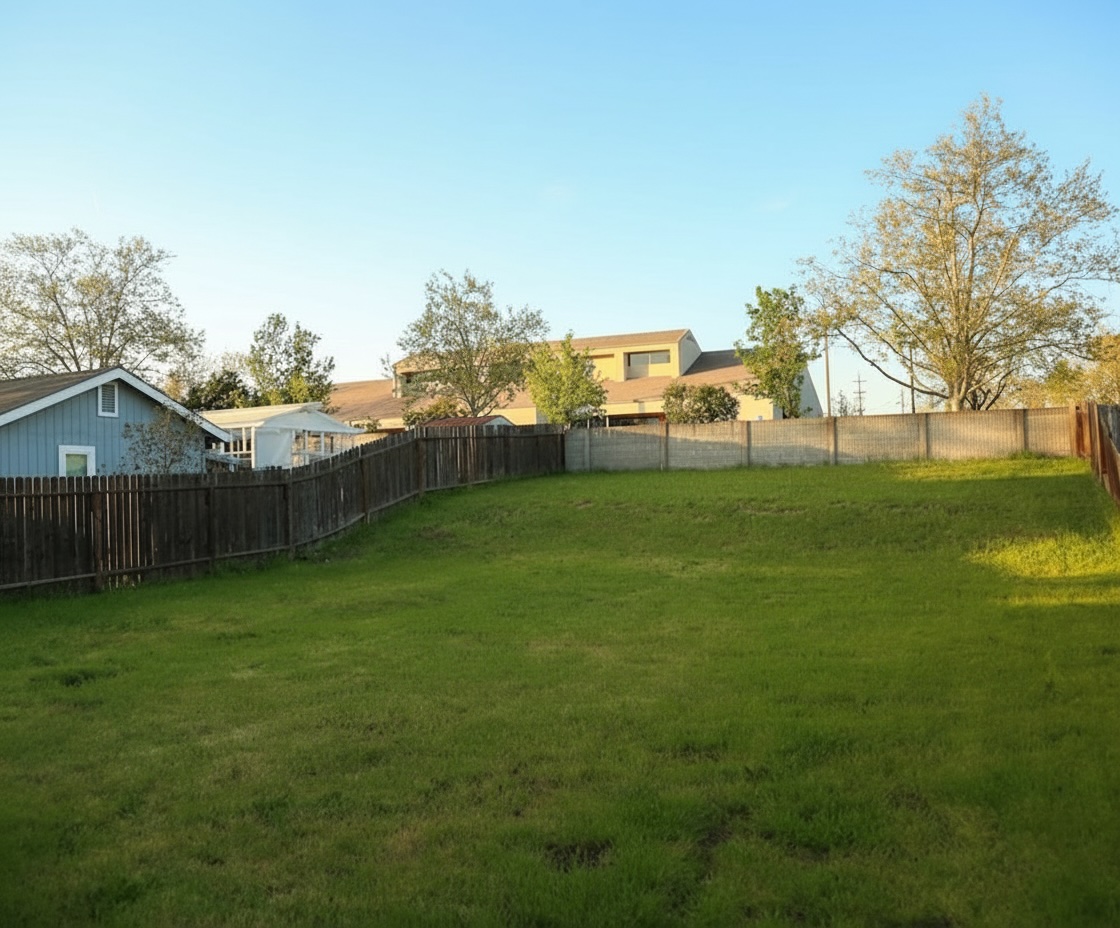
Featured Trees & Shrubs for Modern/Minimalist Gardens
Browse all 169 plants for Lancaster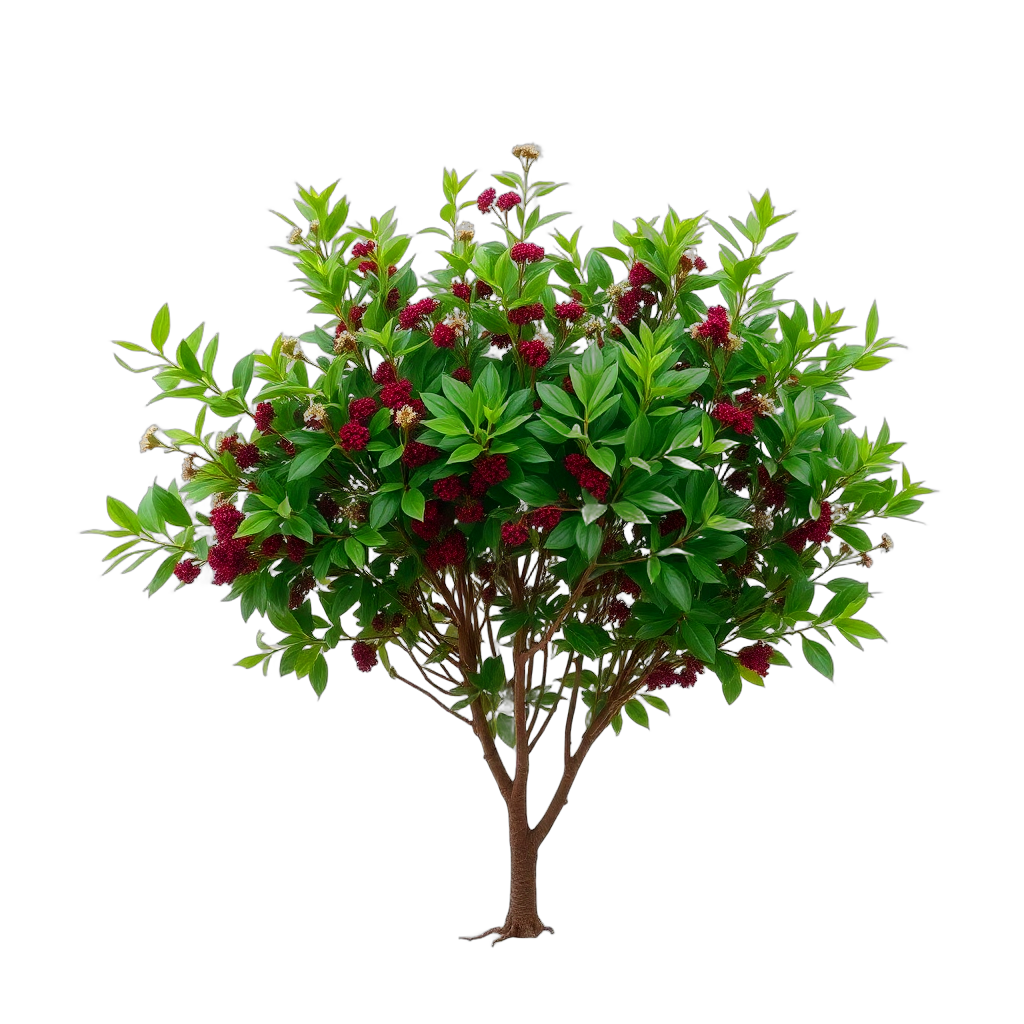
Anderson Wolfberry
Lycium andersonii
grows to 5 feet, purple blooms in spring. Attracts hummingbirds.
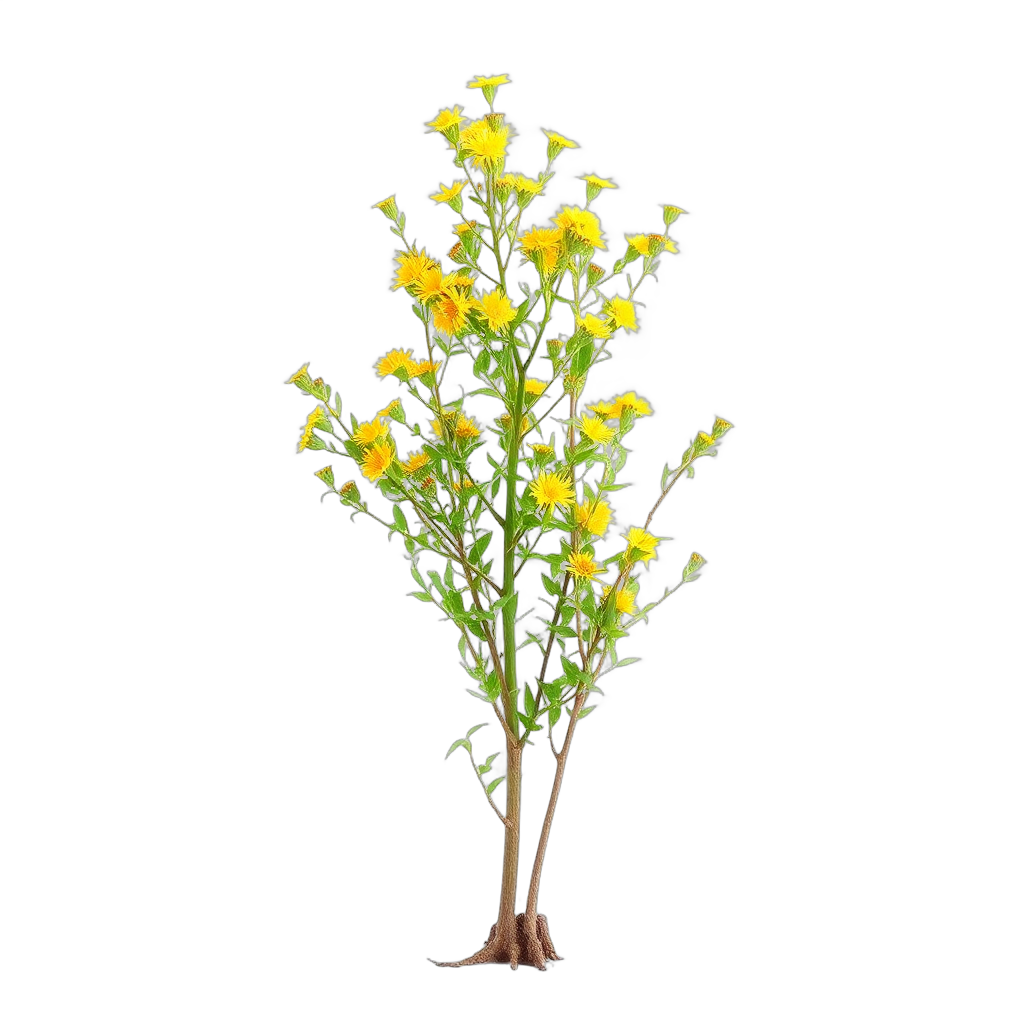
Brittlebush
Enca farinosa
grows to 3 feet, yellow blooms in spring. Attracts butterflies.
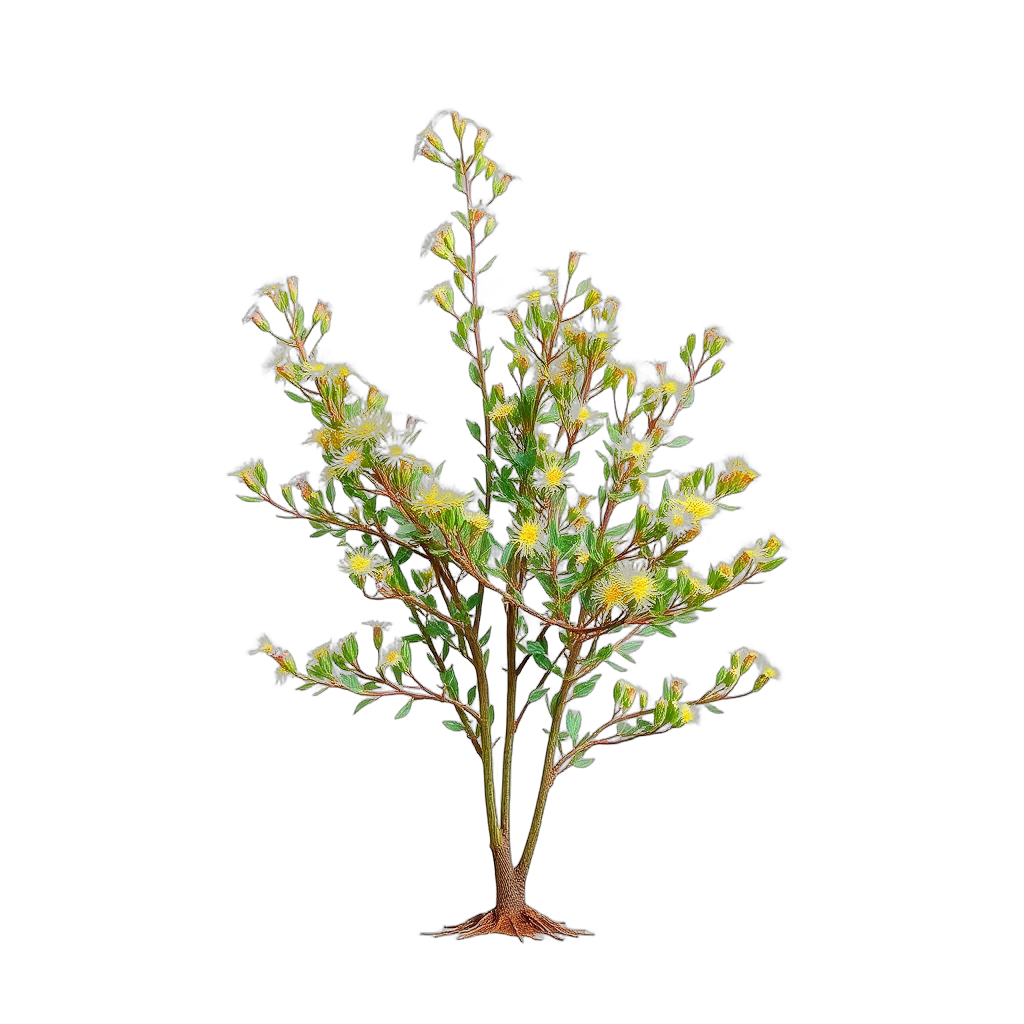
Catclaw Acacia
Acacia greggii
medium-sized at 15 feet, yellow blooms in spring. Pollinator-friendly.
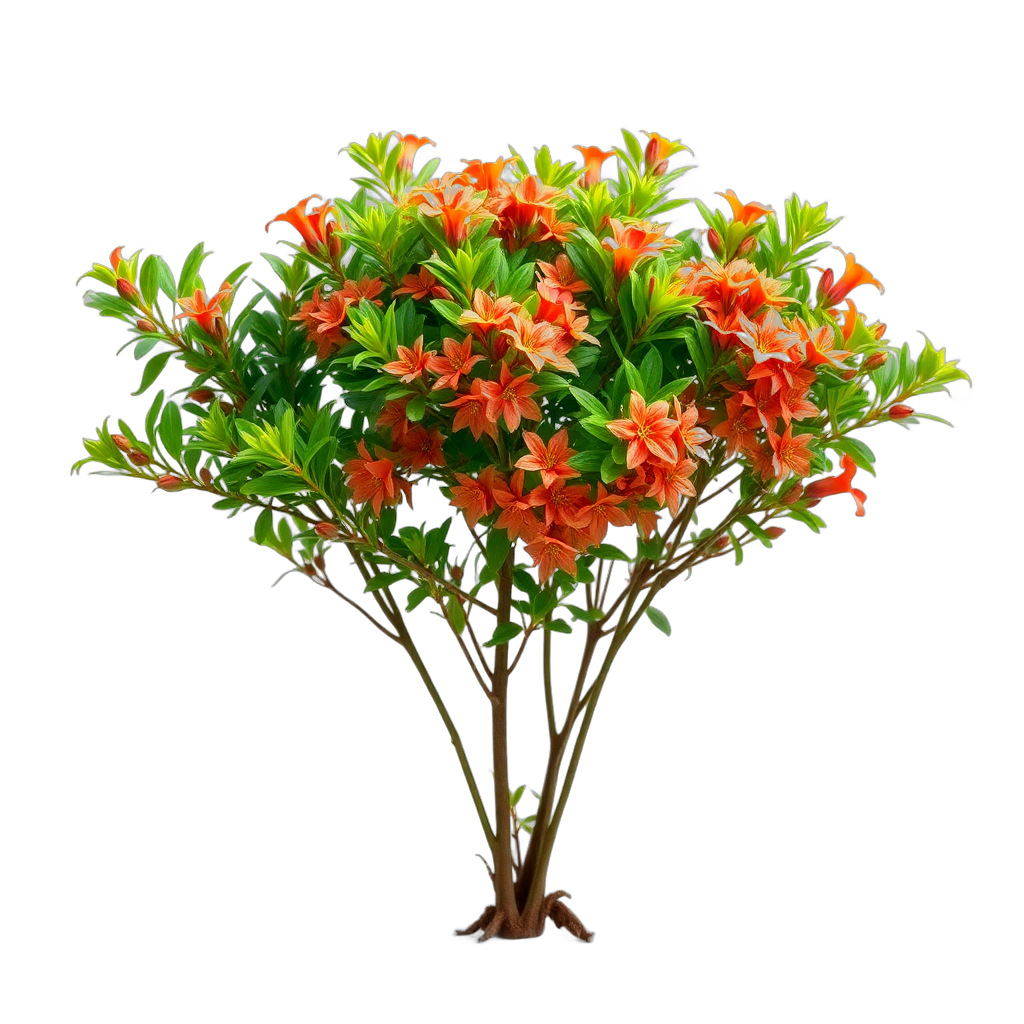
Chuparosa
Justicia californica
grows to 5 feet, red blooms in spring. Attracts hummingbirds.
Featured Grasses & Groundcovers for Modern/Minimalist Gardens
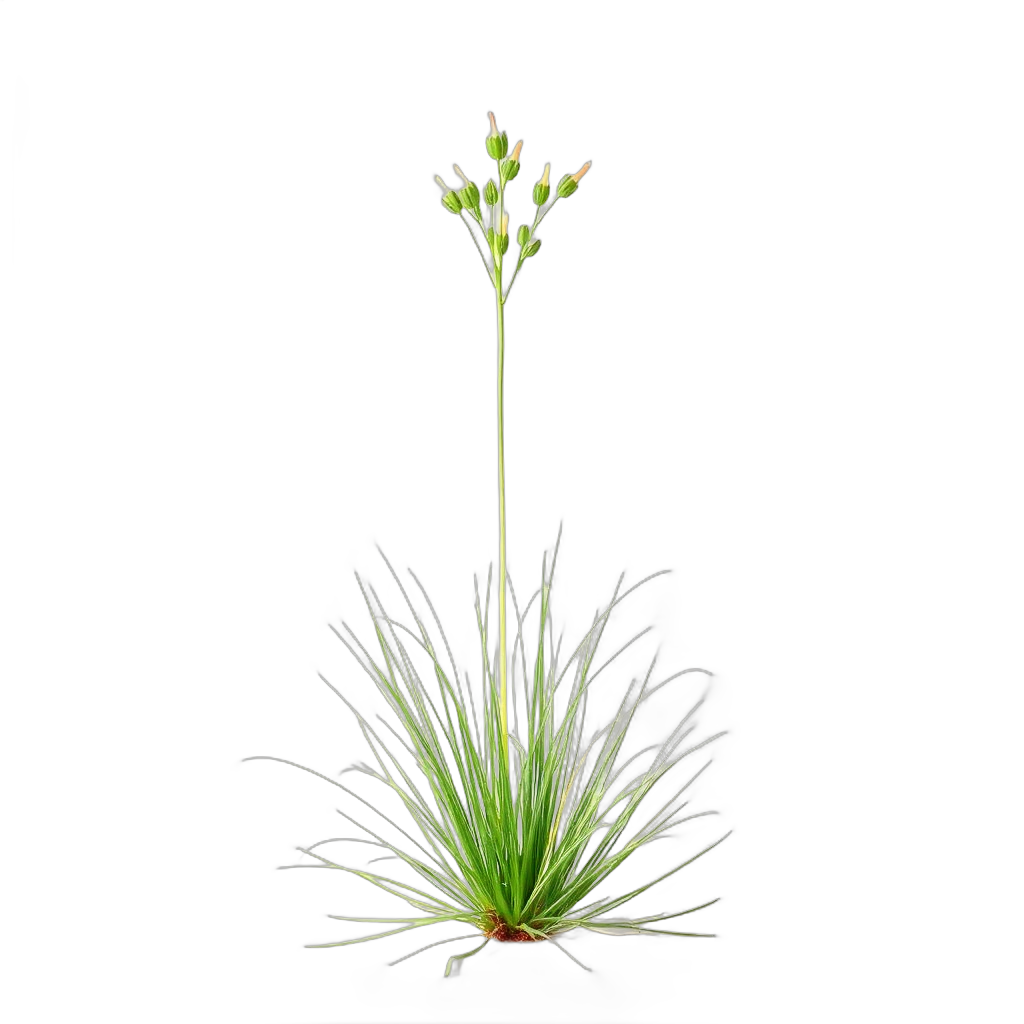
Alkali Sacaton
Sporobolus airoides
grows to 3 feet, blooms in summer. Yellow fall color.
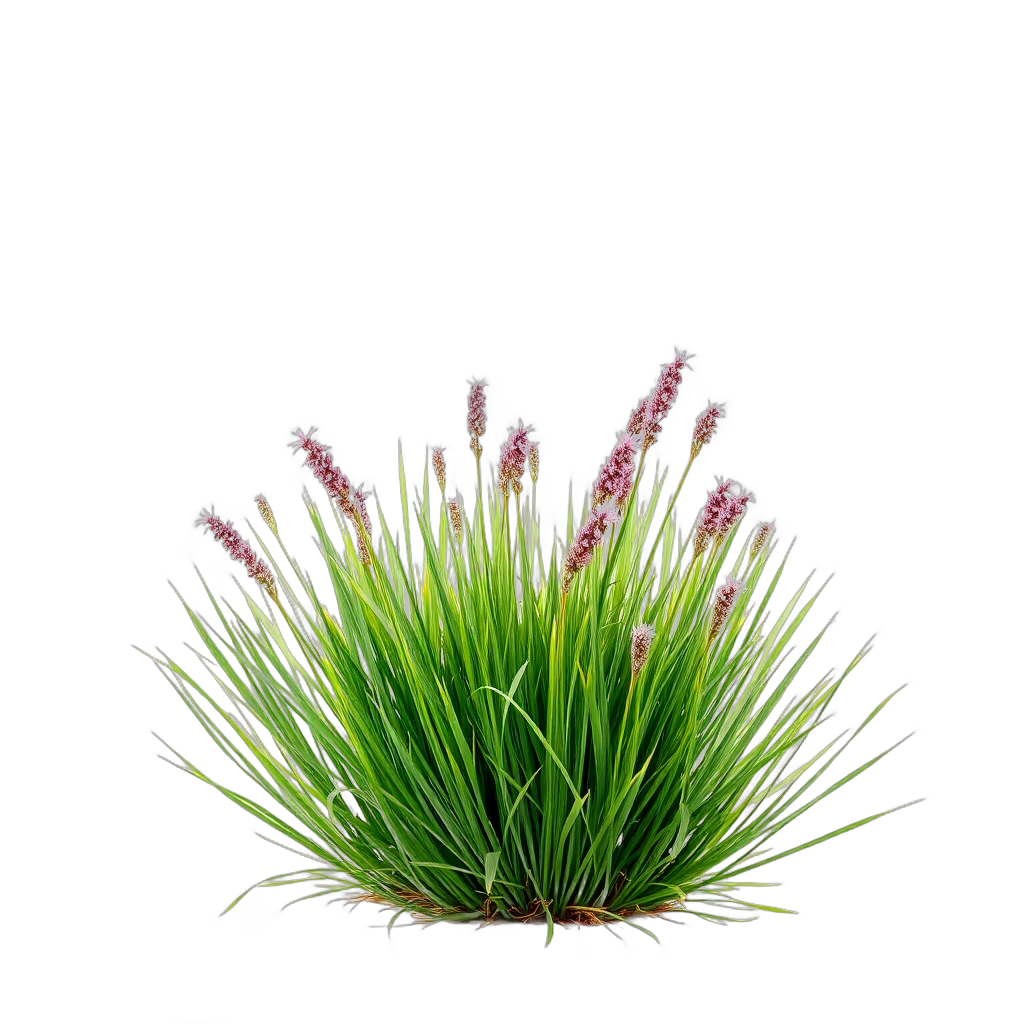
Purple Three-Awn
Aristida purpurea
low-growing ground cover, purple blooms in fall. Yellow fall color.
Featured Flowers & Perennials for Modern/Minimalist Gardens
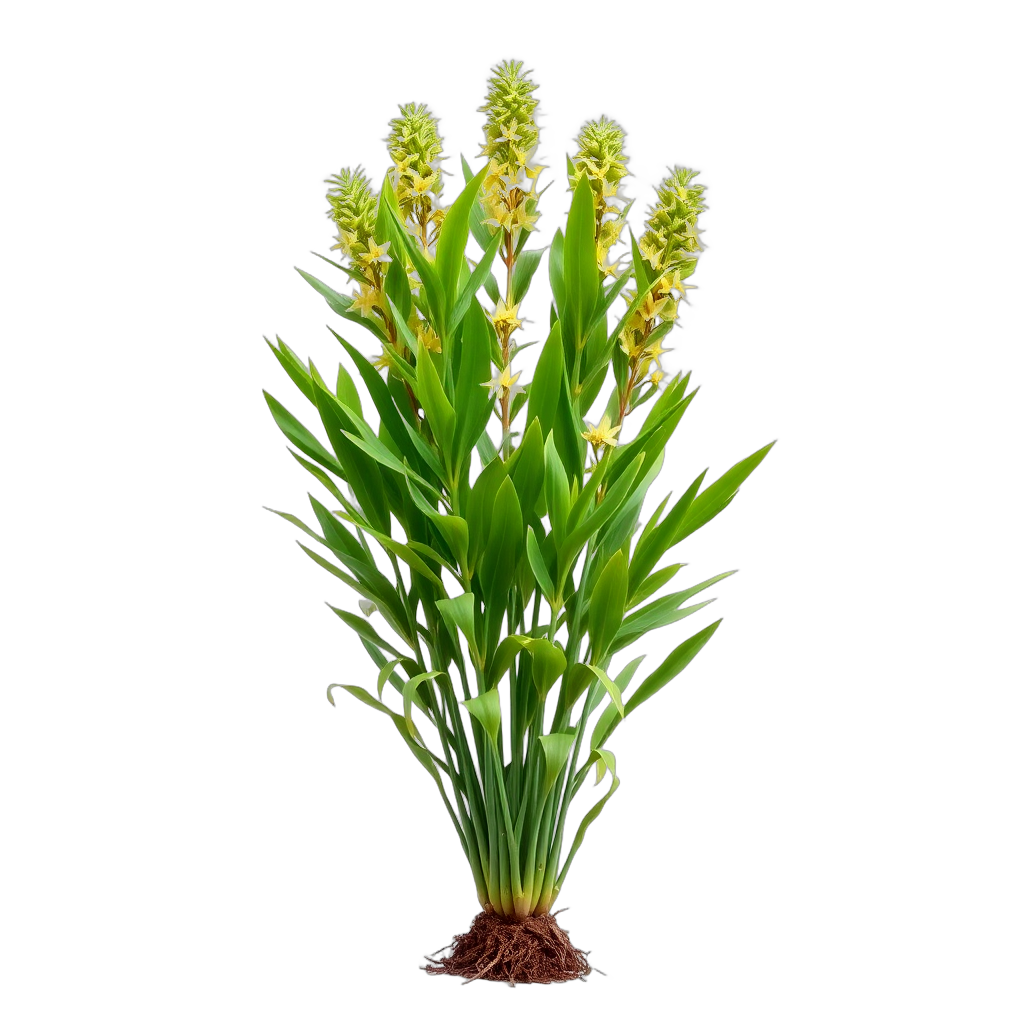
Banana Yucca
Yucca baccata
low-growing ground cover, white blooms in spring. Attracts hummingbirds.

Desert Phlox
Phlox austromontana
low-growing ground cover, pink blooms in spring. Attracts hummingbirds.
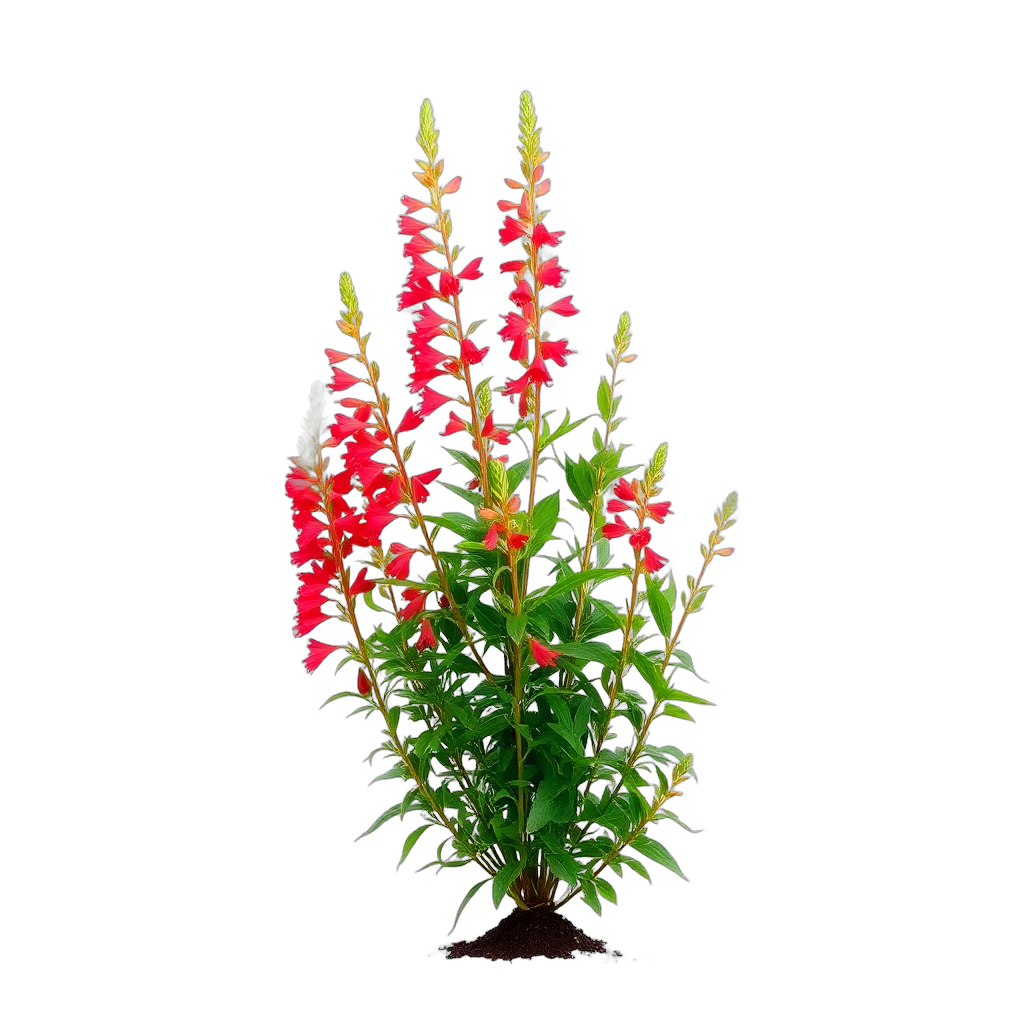
Firecracker Penstemon
Penstemon eatonii
low-growing ground cover, red blooms in spring. Attracts hummingbirds.

Palmer's Penstemon
Penstemon palmeri
grows to 4 feet, pink blooms in spring. Attracts hummingbirds.
Zone and sun checks come from our database — confirm with your local nursery before you buy.
Bloom Calendar for Lancaster
spring
Banana Yucca, Desert Phlox, Firecracker Penstemonsummer
Alkali Sacaton, Quailbushfall
Purple Three-Awnwinter
Limited bloomsDesign Tips for Lancaster (Zone 8b)
- Commit to one strong line and let everything else defer to it - on Lancaster's dead-flat lots a single uninterrupted concrete ribbon from curb to door does more for a modern elevation than any amount of planting, and it costs less than the beds it replaces
- Screen every architectural plant on cold hardiness before drought tolerance; Lancaster's 15-20 degrees F winter lows are what kill the Palm Springs palette, so Agave ovatifolia 'Frosty Blue' and Yucca rostrata 'Sapphire Skies' where a low-desert designer would reach for tender hybrids
- Specify angular 3/8 to 3/4 inch decomposed granite and never rounded pea gravel - 30 to 50 mph spring gusts off the Tehachapi gap will move pea gravel onto your driveway and into your pool skimmer in one season
- If you keep lawn, make it a shape: a single steel-edged panel of Cynodon 'Tifway 419' framed in a wide gravel band reads as deliberate modern design and runs on roughly half the water of the tall fescue it replaces
- Punch through the caliche under every specimen hole and plant crowns 2-3 inches proud of grade; a backfilled hole in hardpan holds water like a bathtub and drowns an Agave in a single wet February
- Spend the material budget where the ultraviolet is: at 2,350 feet, cheap powder coat chalks and untreated cedar greys within two seasons, so weathering steel, integrally coloured concrete and marine-grade or anodised aluminium are practical choices here, not just stylistic ones
- Run festoon lighting on a tensioned catenary cable rather than the bare cord, and buy patio furniture for weight - the same spring wind that ruins a shade sail will empty an under-specified terrace of everything on it
- Repeat one plant form at least five times rather than collecting ten different ones; rhythm is what makes a modern desert planting read as design, and it also means one drip schedule instead of five compromises
Where to Source Plants in Lancaster
Skip the big-box stores. These independent Lancaster nurseries specialize in the plants that make modern/minimalist gardens thrive in Zone 8b.
Quartz Hill Garden Center
Quartz Hill / west Lancaster
High-desert specialist open since 1992 - trees, shrubs, cacti and agaves alongside irrigation supply and fertiliser, all selected for Antelope Valley cold and wind
CDRCD Nursery (Canyons to the Desert Resource Conservation District)
West Lancaster / Avenue I
Conservation district nursery and arboretum selling Mojave natives, desert trees, bunch grasses and wildflower seed; open Thursday to Saturday
Evergreen Nursery
West Palmdale (22nd Street West)
Locally owned since 2014, growing on site for Antelope Valley conditions - low-water shrubs, olives and shade trees, with delivery and planting
California Nursery Specialties (Cactus Ranch)
Reseda - the specimen run over the pass
Over 100,000 cacti and agaves including large field-grown columnar and Agave specimens in the sizes a modern grid planting needs; weekends only
Theodore Payne Foundation
Sun Valley - the native-plant run over the pass
Non-profit native nursery carrying 900-plus California native species and cultivars, including the Muhlenbergia rigens and high-desert material that softens a hard modern plan
Modern/Minimalist Landscaping Costs in Lancaster
| Project Scope | Estimated Cost |
|---|---|
| Front yard modern conversion (turf removal, DG field, steel edging, specimen plants, drip) 900-1,200 sqft | $9,000 - $22,000 |
| Poured concrete ribbon entry walk with lighting (60-100 linear ft) | $3,200 - $8,500 |
| Large-format concrete rear terrace (350-500 sqft) | $12,000 - $30,000 |
| Gas fire bowl or linear fire table, plumbed and set | $3,500 - $11,000 |
| Drip conversion from spray heads plus weather-based controller | $1,400 - $3,800 |
| Rectangular pool, flush coping and full concrete deck | $85,000 - $190,000 |
| AI visualization with ProScapeAI | Free to start |
Estimates based on Lancaster, CA-area contractor rates as of 2026. Actual costs vary by site conditions, materials, and contractor.
Lancaster Climate & Growing Zone
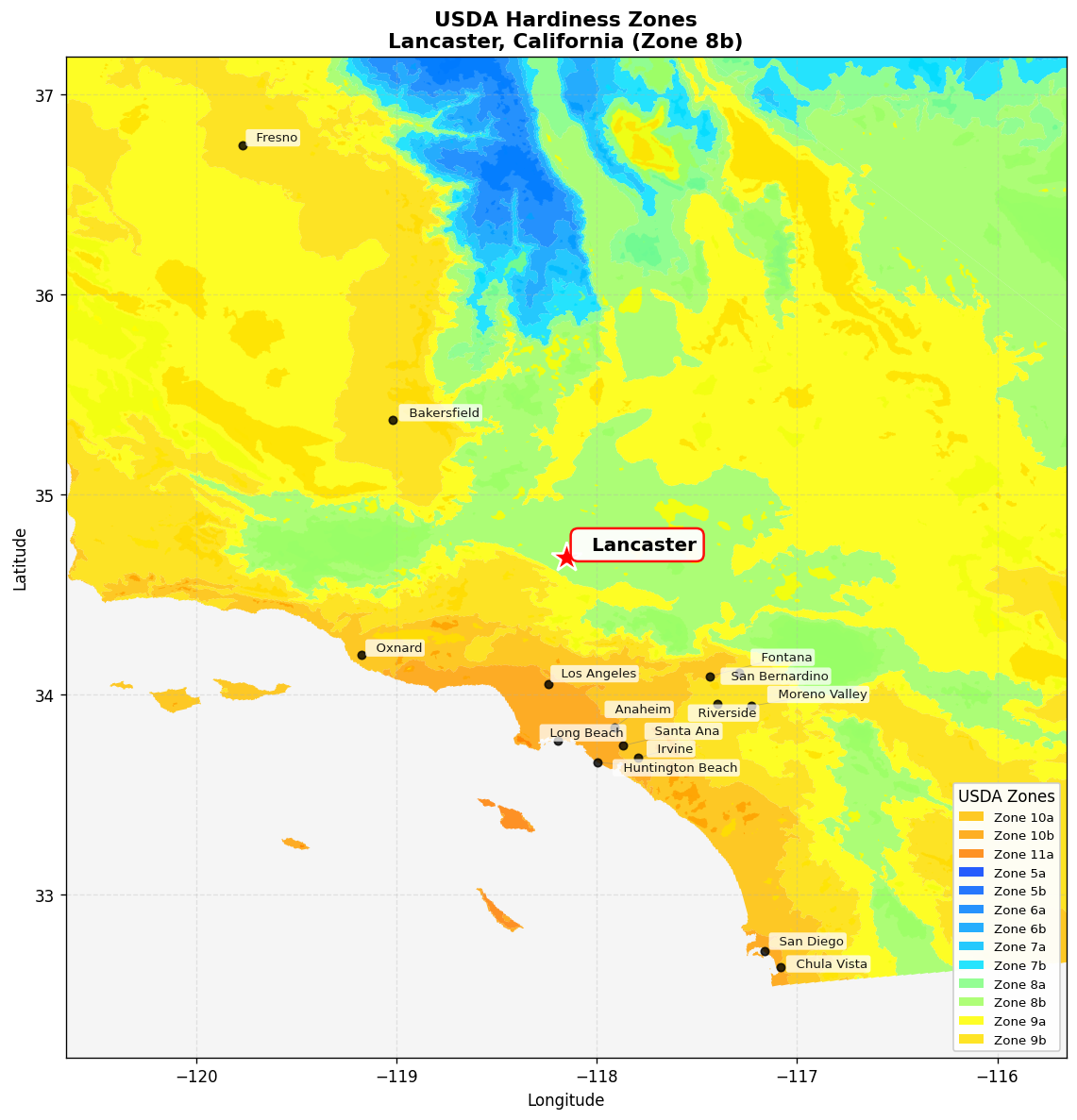
USDA Zone 8b
Hardiness zone for Lancaster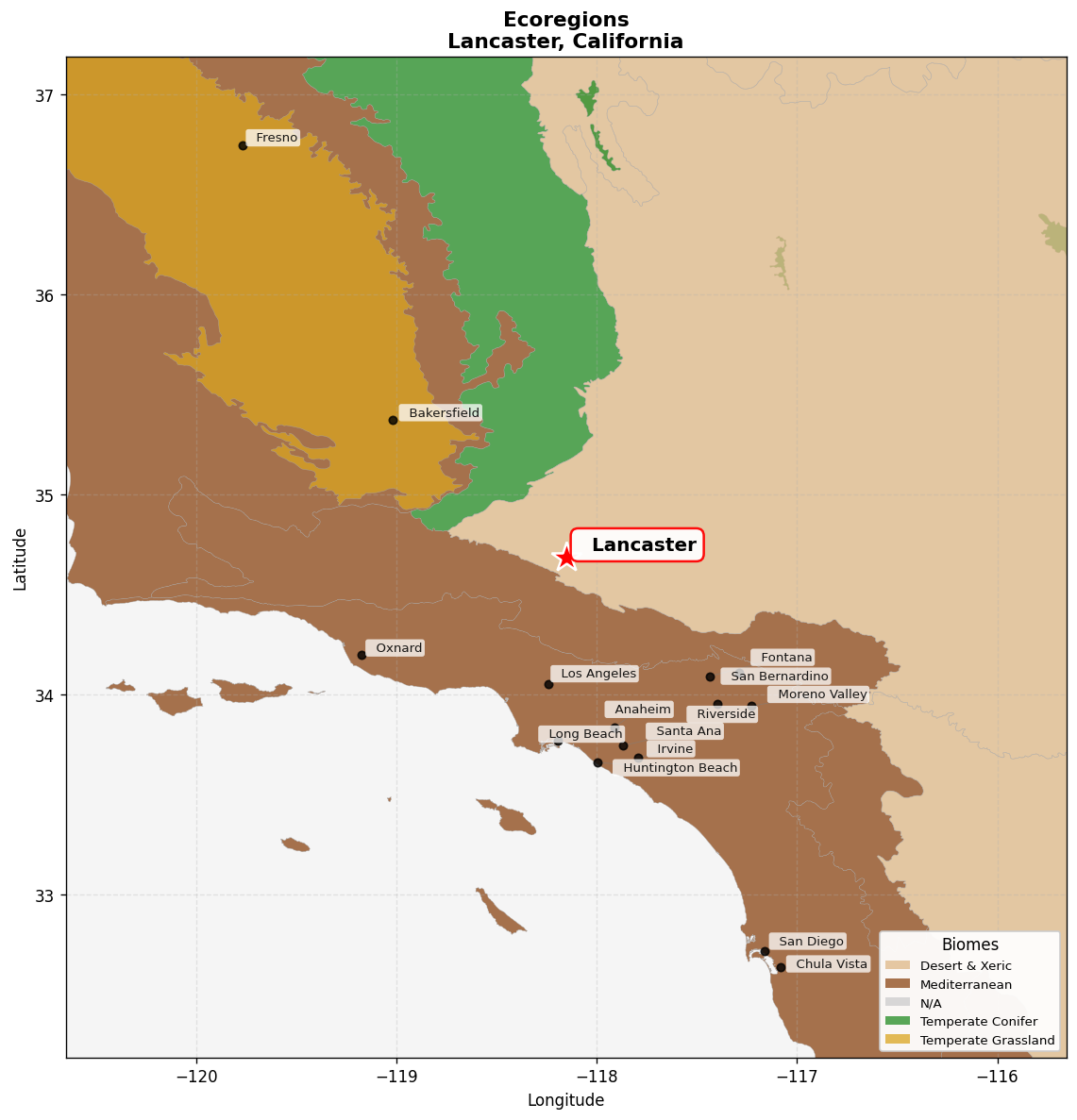
Mojave desert
Native ecoregionFrequently Asked Questions
How much does modern landscaping cost in Lancaster?
Antelope Valley installation prices run below Los Angeles basin rates, mostly on labour, which makes modern work here relatively attainable. A full front-yard conversion on a typical 900 to 1,200 square foot Lancaster setback — turf removal, decomposed granite field, steel edging, concrete ribbon walk, specimen plants and drip — lands between $9,000 and $22,000 installed. A large-format concrete rear terrace of 350 to 500 square feet with a gas fire bowl and lighting runs $18,000 to $45,000. A pool court with flush-coped rectangular pool and full deck typically starts near $85,000 and passes $190,000 on the larger Antelope Acres lots. Doing the gravel-and-plant portion yourself, with a contractor only for the concrete, commonly brings the front yard in under $6/sqft.
Can I keep a lawn in a modern front yard in Lancaster?
Yes, if it is a shape and not a default. California's Model Water Efficient Landscape Ordinance kicks in on new permitted residential landscapes over 500 square feet and rehabilitated landscapes over 2,500 square feet, and it caps turf as a proportion of planted area, so the wall-to-wall approach is finished either way. The move that works is a single geometric panel of hybrid bermudagrass — Cynodon 'Tifway 419' or 'Latitude 36' — which uses roughly half the water of tall fescue in Lancaster's 65-inch evapotranspiration climate and goes dormant gold in winter instead of dying. Frame it in steel edge with a wide decomposed granite band, run it on its own rotary-nozzle zone separate from the drip, and it costs a fraction of what the old fescue rectangle did.
Which architectural plants actually survive a Lancaster winter?
Screen on cold first, drought second — Lancaster's 15 to 20°F winter lows kill far more Palm Springs imports than the 96°F Julys ever do. Reliable structure comes from Agave ovatifolia 'Frosty Blue', Agave parryi var. truncata, Agave victoriae-reginae, Yucca rostrata 'Sapphire Skies', Dasylirion wheeleri, Nolina nelsonii and Hesperaloe parviflora 'Brakelights'. For columnar form, Trichocereus terscheckii takes hard frost where the low-desert cereus species will not. Echinocactus grusonii is worth using but wants a south-facing pocket with reflected warmth and sharp drainage. Skip Euphorbia tirucalli 'Sticks on Fire', tender blue Agave hybrids and bougainvillea entirely; if the plant tag does not state hardiness below 20°F, it is a one-winter purchase.
Will the Antelope Valley wind ruin a modern patio?
It will ruin the wrong one. Spring gusts of 30 to 50 mph run for weeks through the Tehachapi and Soledad gaps, and they punish exactly the details modern design likes. Rounded pea gravel migrates onto the driveway within a season, so specify angular 3/8 to 3/4 inch decomposed granite. Festoon lighting strung on the bare cord snaps at the fittings, so run it on a tensioned catenary cable anchored to posts or the fascia. Shade-sail fabric under 320 gsm shreds, and lightweight aluminium furniture becomes a projectile — buy for weight. A west-side windbreak of Pinus eldarica or Chitalpa tashkentensis 'Pink Dawn' set well back from the terrace cuts the velocity enough that everything downwind establishes faster and needs less water.
What does the caliche layer mean for a concrete terrace?
Lancaster's sandy loam sits on caliche, a cemented lime hardpan that can start six inches down and run a foot thick, and it is inconsistent across a single lot. That inconsistency, not the hardness, is the problem for a large-format concrete terrace — differential support cracks panels. Excavate to a uniform depth, compact a proper crushed-aggregate base rather than pouring on whatever the excavator hit, and space control joints generously, because the 30°F day-to-night swing here works a slab harder than the coastal conditions most standard details assume. For planting, punch through the pan under every specimen hole and set the crown two to three inches above grade. A backfilled hole in hardpan is a bathtub, and it is how most Agave ovatifolia and Yucca rostrata die in this valley.
When is the best time to install a modern landscape in Lancaster?
October into early December is the best window, with March a close second. Planting into cooling soil lets roots establish through the mild winter so specimens face their first July already settled, and installation crews have open schedules. Avoid planting from mid-June through early September — even on drip, a new Agave or Muhlenbergia in a 100°F afternoon with single-digit humidity spends its energy surviving instead of rooting. Concrete is the reverse: pours go well through the cool months but need care in summer, when the low humidity and wind flash-dry the surface. The one season to schedule around is the March-to-May wind, which makes fine grading, decomposed granite spreading and any fabric or sail installation genuinely miserable.
Are there rebates for tearing out my Lancaster lawn?
Check with your own supplier before assuming, because Lancaster is not on the programme most Angelenos have heard of. The city is served by Los Angeles County Waterworks District 40, Antelope Valley Region, whose supplemental supply comes from the Antelope Valley-East Kern Water Agency as a State Water Project contractor — not from the Metropolitan Water District — so the SoCal WaterSmart turf rebates advertised across the basin do not apply here. District 40 runs its own grass replacement rebate and a free water use survey, both with their own per-square-foot amounts and pre-approval steps, and pre-approval matters: tear the lawn out first and you generally forfeit the claim. Independent of any rebate, the tiered rate structure and the capped, adjudicated groundwater basin mean a turf conversion in Lancaster pays back on the water bill regardless.