4 Xeriscape Design Ideas for McAllen, TX | Zone 9b Landscaping
Native plants from the Western Gulf coastal grasslands (Zone 9b) — Hot semi-arid climate
Why Desert/Xeriscape Gardens in McAllen?
McAllen is one of the very few American cities where xeriscape is not an imported look — it is the vernacular. The Tamaulipan thornscrub that surrounds the city is already a gravel-and-spine landscape: Ebenopsis ebano, Cordia boissieri, Leucophyllum frutescens and Opuntia engelmannii grow wild ten minutes past the last subdivision. That gives McAllen homeowners an advantage Phoenix and Las Vegas do not have — the desert palette here is native, so it reads as regional rather than transplanted. It also fits the architecture. The Spanish Colonial stucco and barrel-tile roofs going up around Sharyland, Cimarron and the Tres Lagos edge of North McAllen want warm gravel and sculptural rosettes at their feet, and the 1940s and 1950s brick and stucco homes in the older grid near Main Street, Chicago Avenue and Los Ebanos have the low horizontal lines that a gravel courtyard front yard flatters instantly.
The climate numbers are the real argument. McAllen sits in USDA Zone 9b — average winter lows of 25–30°F — inside a BSh hot semi-arid climate, and the city averages only about 21 inches of rain a year against roughly 60 inches of annual evaporation. That deficit, not the heat alone, is what kills conventional landscaping here. Rainfall is also unhelpfully distributed: May–June and a September tropical-moisture peak deliver most of it in a handful of downpours, while March, April and July–August routinely run bone dry. Add roughly 110 days a year above 90°F and about three weeks above 100°F, and a St. Augustine lawn becomes a machine for converting Rio Grande water into mowing. Xeriscape design flips that: Agave ovatifolia, Yucca rostrata 'Sapphire Skies', Hesperaloe parviflora 'Brakelights' and Muhlenbergia lindheimeri hold their form through a Valley August on almost nothing, and Zone 9b is mild enough that they never go dormant or ugly.
Soil is where most McAllen projects go wrong. The Rio Grande delta left behind Hidalgo and Raymondville clay loams over caliche, and the pH typically runs 7.8–8.3 with free calcium carbonate and, on older irrigated blocks, measurable salt. Anything acid-loving — azalea, gardenia, blueberry, most Japanese maples — will yellow into iron chlorosis within two seasons and no amount of fertilizer will fix it. The clay also drains slowly once you hit the caliche pan, which is a genuine risk for cactus and agave when a tropical system dumps four inches overnight. The fix is the same one that makes the style look good: build beds up. Berm 8–12 inches of native soil cut 50/50 with expanded shale or crushed granite, top with gravel mulch, and set every rosette with its crown proud of grade.
Finally, water policy. McAllen's supply comes off the Rio Grande, which is shared with Mexico under the 1944 water treaty and stored in the Falcon and Amistad reservoirs — both of which have run at historically low levels in recent years. McAllen Public Utility maintains a drought contingency plan that can assign landscape irrigation to specific days and prohibit watering during the middle of the day, and Valley HOAs increasingly write gravel and native planting into their approved-materials lists rather than against them. A xeriscape design here is not a hedge against some future restriction; it is the design that keeps looking good while the restriction is in force.
4 Desert/Xeriscape Design Ideas for McAllen

The Thornscrub Entry Court
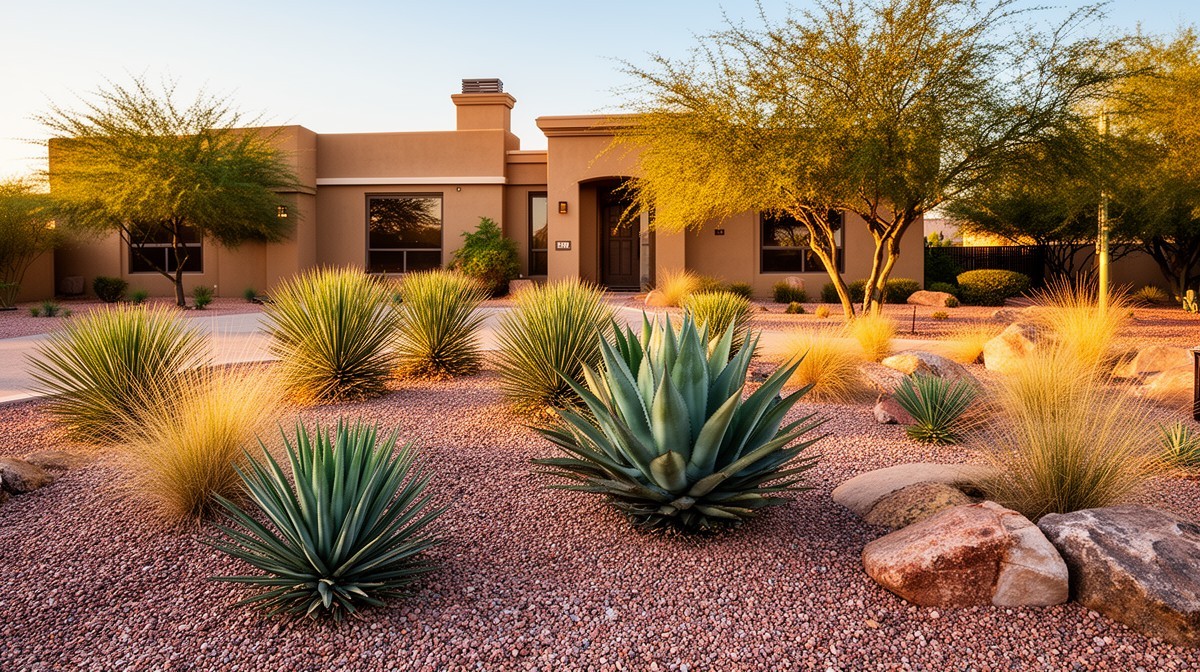
$6–14/sqftA tan stucco single-story with a red barrel-tile roof and an arched wood door, fronted by a curving decomposed-granite path that sweeps from the drive to a small stone-clad entry porch. The lawn is gone entirely: darker brown gravel beds flank the pale path, edged in a soldier course of brick set on end, and the planting is all silhouette — big blue-grey agave rosettes, soft green yucca fountains, buff bunch grasses catching the low sun, and three tawny limestone boulders placed as if the site came with them. A slim multi-trunk desert tree at the street corner and a clipped green sphere by the porch keep the composition from reading as pure spikes.

The Mesquite Shade Courtyard
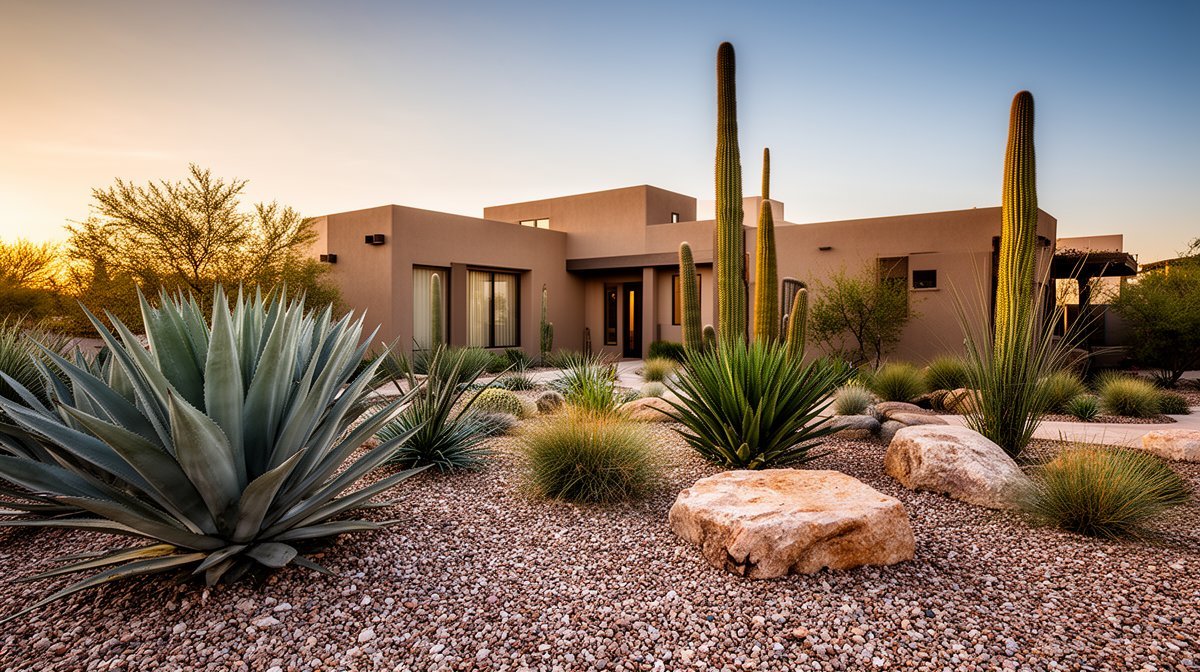
$5–11/sqftA wide adobe-toned ranch with terracotta tile and a deep recessed porch, anchored by one spreading mesquite whose feathery canopy shades half the front yard. Two crushed-granite paths curve out from the entry, each held by a low brick edge, and a band of rounded river cobble runs between them as a shallow dry creek that takes the roof runoff during a September downpour. Blue agave rosettes, tight grey-green cushion rosettes and a big clump of prickly pear are spaced generously through pale gravel, with glazed terracotta pots of red bloom flanking the door for the one hit of colour the palette allows.

The Fire Circle Under String Lights
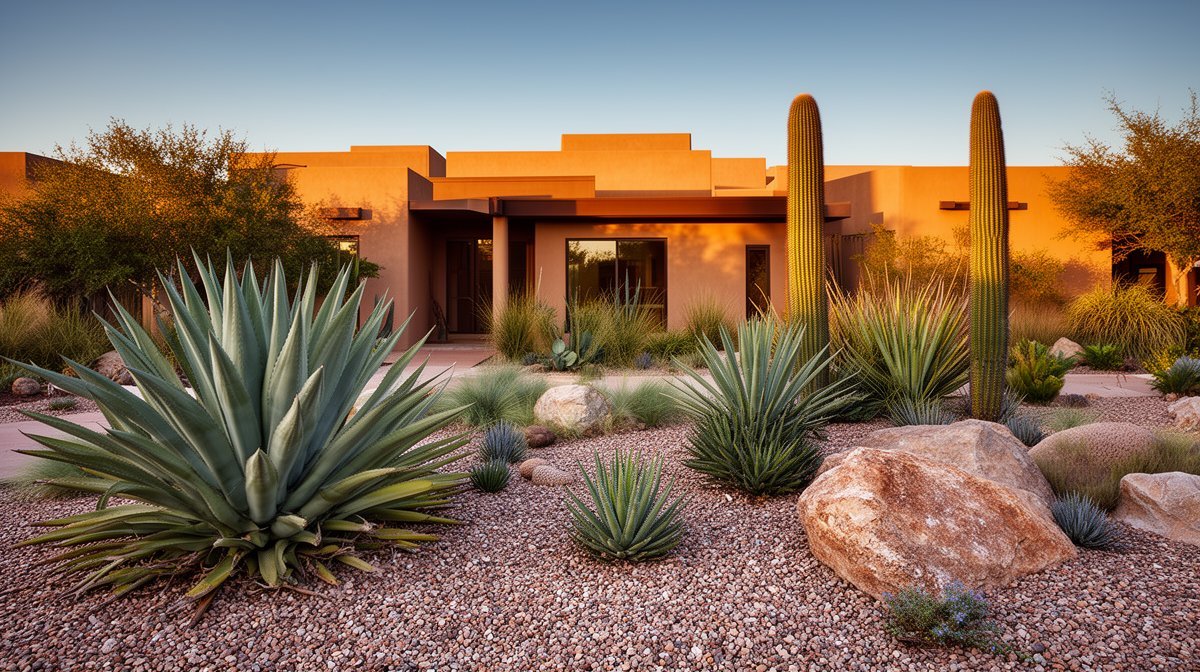
$14–28/sqftA sunset backyard where a beamed ramada shades the sliding glass doors and Edison string lights arc the full width of the lot. At the centre a round stone-veneer gas fire pit sits on a curved paver terrace, ringed first by a collar of river cobble and then by crushed gravel, with two wood-frame lounge chairs and a deep sofa in coral cushions pulled up close. The perimeter does the work: huge blue agave rosettes planted tight against the stucco privacy walls, plumes of pink-flushed bunch grass at the terrace edge, a small anacahuita for scale, and boulders dropped where the gravel meets the wall.

The Boulder Waterfall Pool Garden
$45–85/sqft (pool area inclusive)A rectangular pool set in large-format pale limestone-toned deck slabs, with a stacked-boulder waterfall spilling from a raised planter terrace behind the block wall. The planting reads as one continuous gravel-and-rosette field wrapping the whole yard: silver agaves stepped along the retaining wall, a tall blue-leaved yucca standing above the falls, low bunch grasses feathering the deck edge, and dark mulch pockets under each cluster so the plants read against the stone. Squat modern lanterns light the gravel path, boulders sit half-buried in the beds, and a cobble swirl finishes the corner where the path meets the deck.
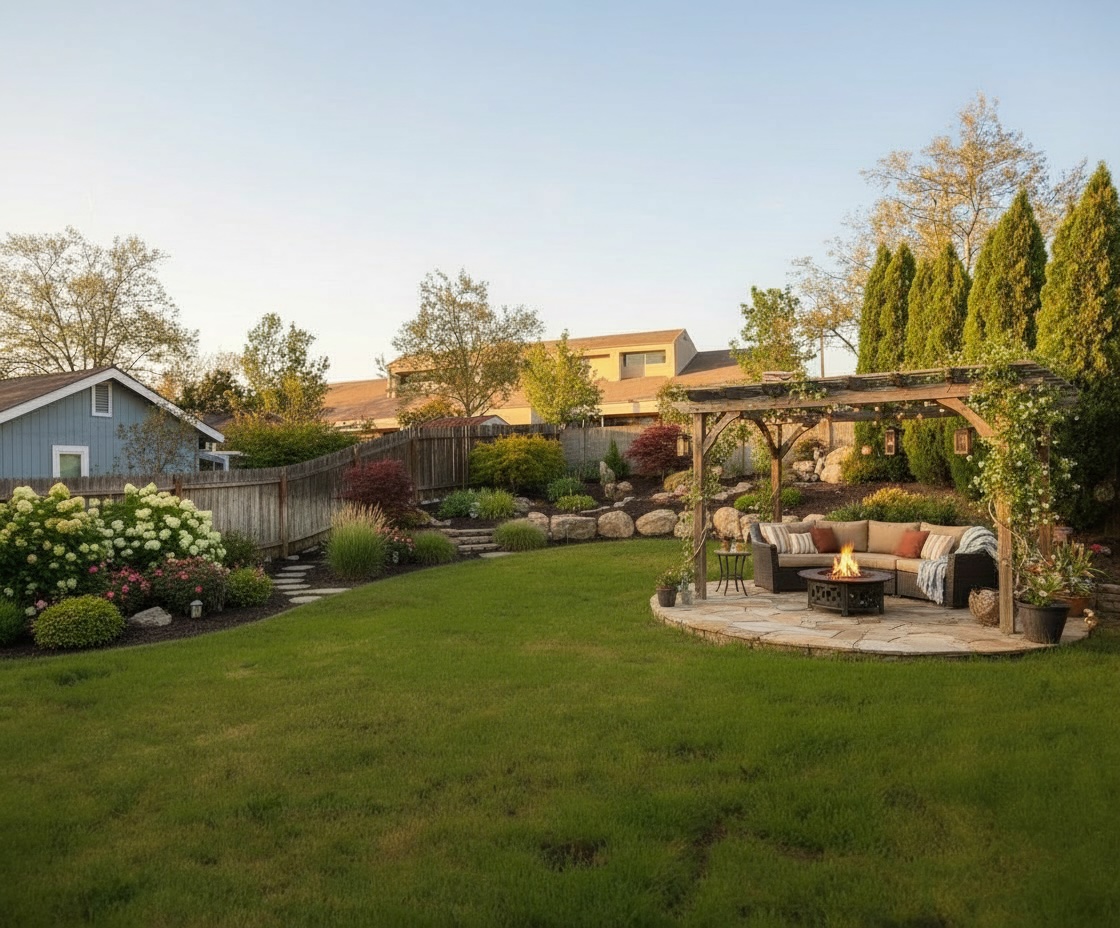
See how a desert/xeriscape garden looks on YOUR property
Upload a photo of your McAllen yard and visualize your dream garden in seconds.
Try ProScapeAI Free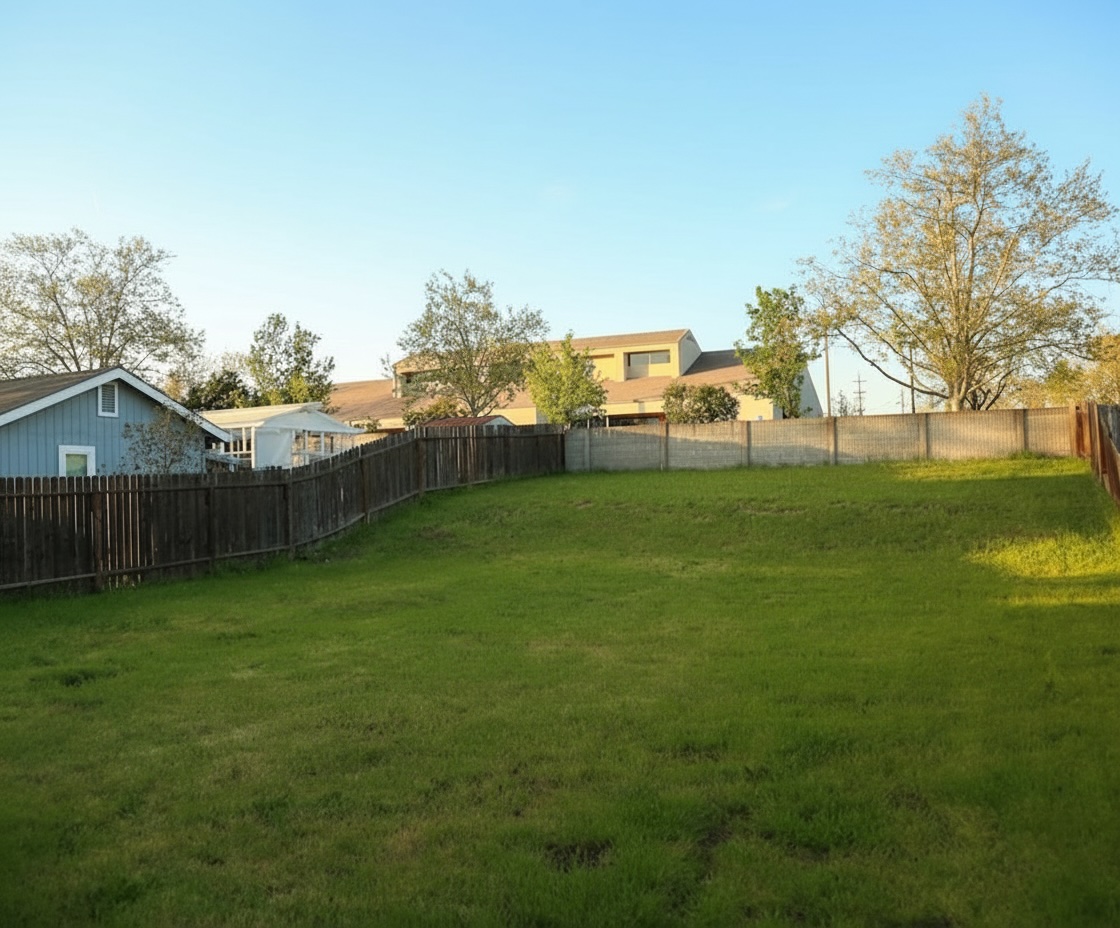
Featured Trees & Shrubs for Desert/Xeriscape Gardens
Browse all 156 plants for McAllen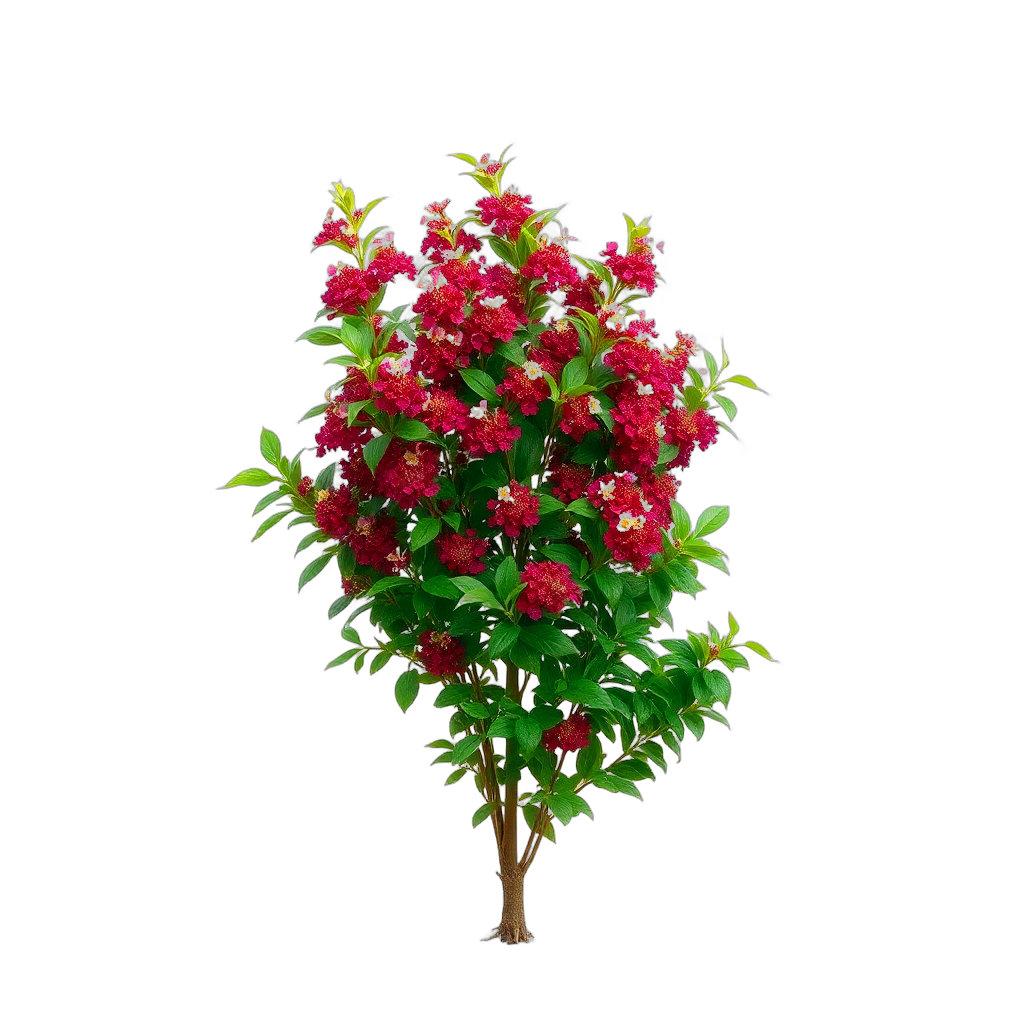
Ruby Spice Summersweet
Clethra alnifolia 'Ruby Spice'
grows to 5 feet, pink blooms in summer. Attracts butterflies.
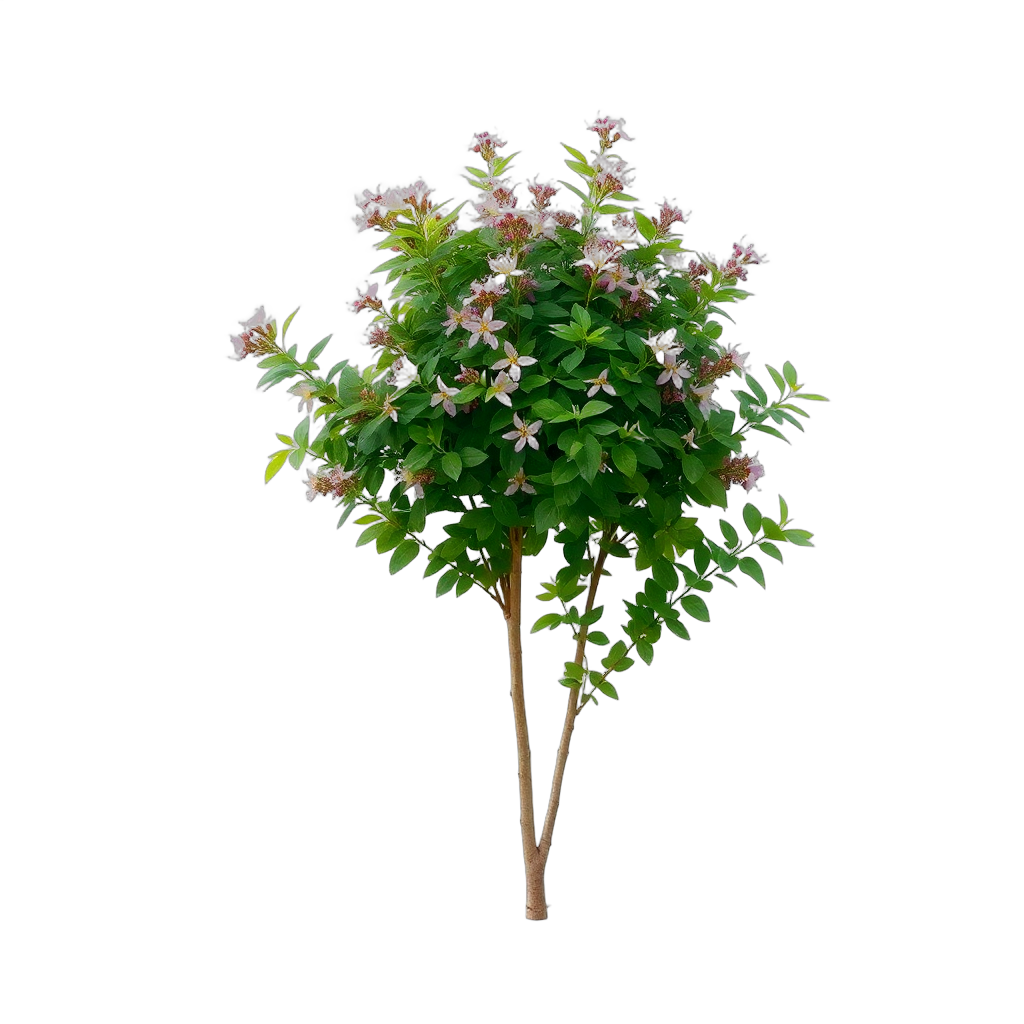
Summersweet
Clethra alnifolia
grows to 6 feet, white blooms in summer. Attracts butterflies.
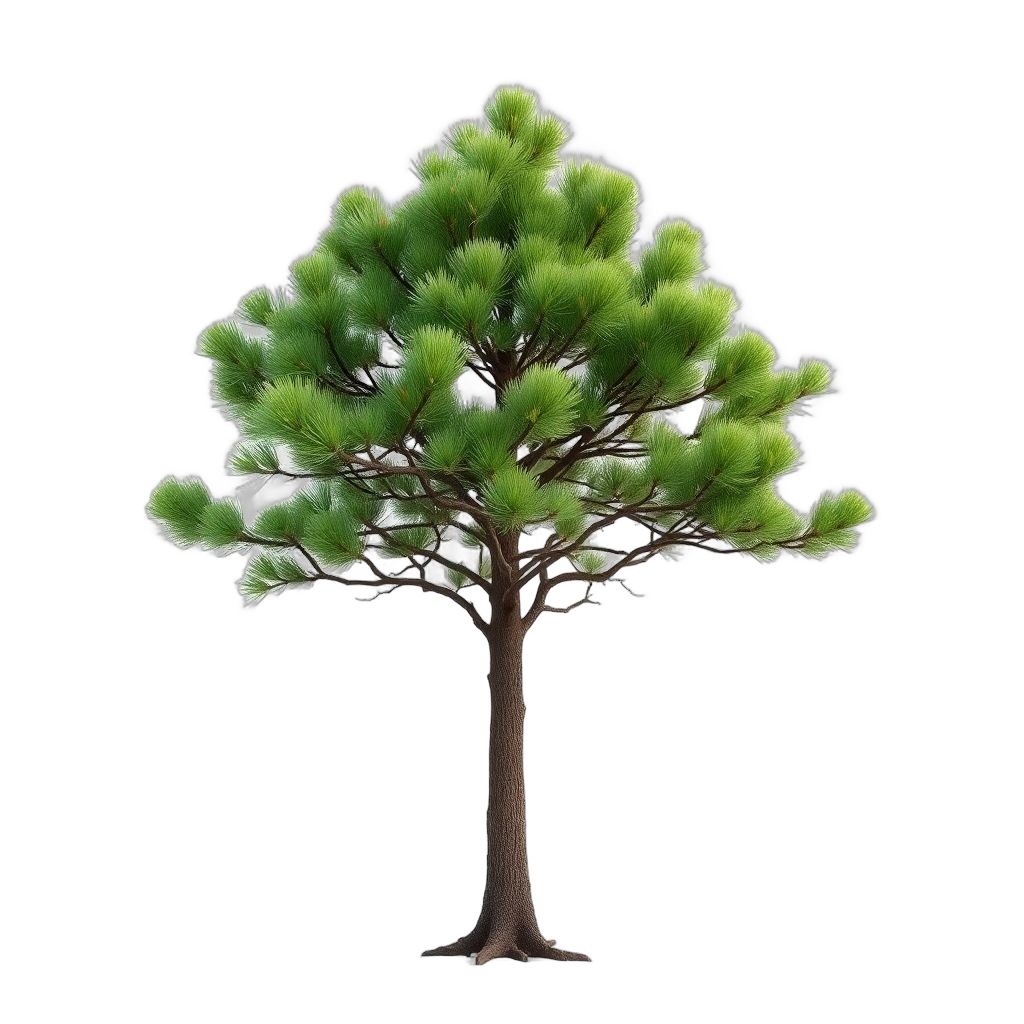
Longleaf Pine
Pinus palustris
large shade tree reaching 90+ feet, blooms in spring. Evergreen year-round.
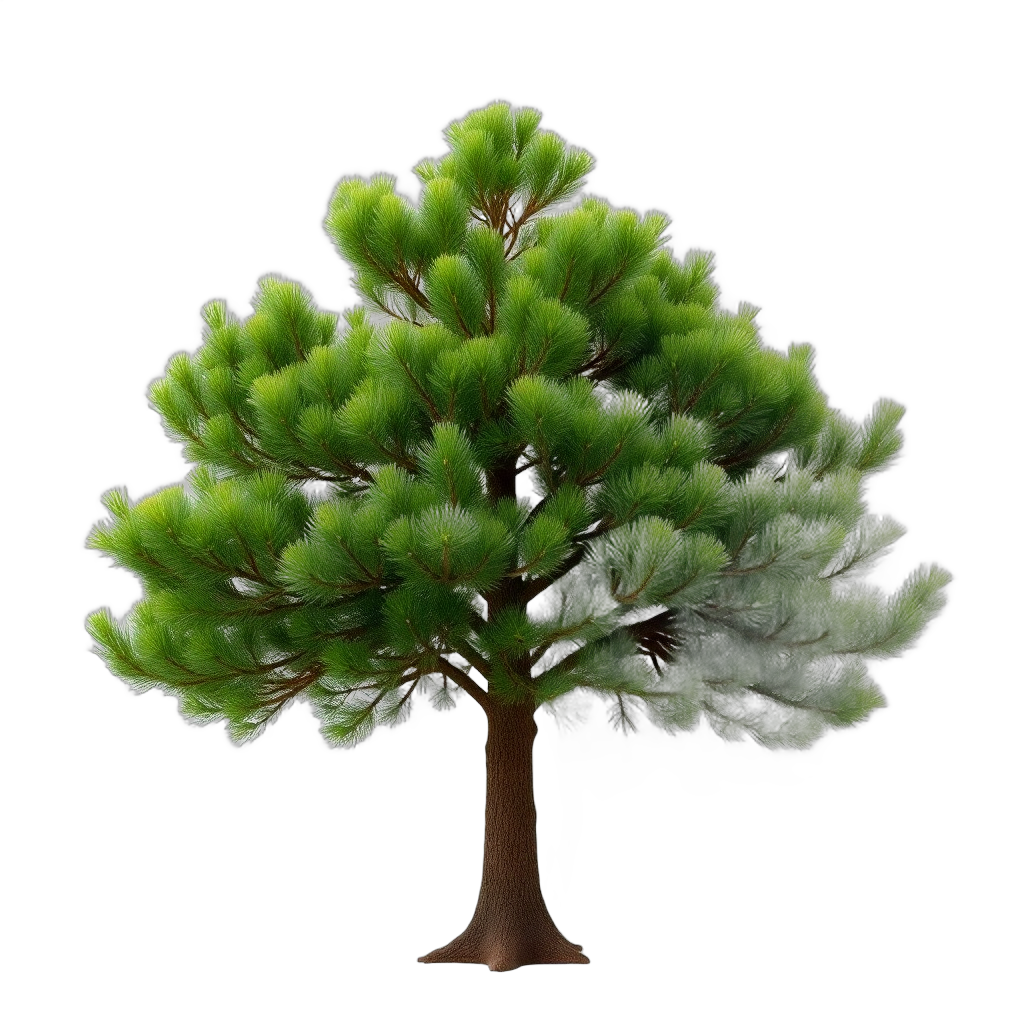
Slash Pine
Pinus elliottii
large shade tree reaching 80+ feet, blooms in spring. Evergreen year-round.
Featured Grasses & Groundcovers for Desert/Xeriscape Gardens

Pink Muhly Grass
Muhlenbergia capillaris
grows to 3 feet, pink blooms in fall.
Featured Flowers & Perennials for Desert/Xeriscape Gardens

Papyrus
Cyperus papyrus
grows to 5 feet, blooms in summer. Pollinator-friendly.

Water Hyacinth
Eichhornia crassipes
low-growing ground cover, purple blooms in summer. Attracts butterflies.

Water Plantain
Alisma plantago-aquatica
low-growing ground cover, white blooms in summer. Attracts butterflies.

Arrow Arum
Peltandra virginica
low-growing ground cover, blooms in spring.
Zone and sun checks come from our database — confirm with your local nursery before you buy.
Bloom Calendar for McAllen
spring
Longleaf Pine, Slash Pine, Sweet Acaciasummer
Ruby Spice Summersweet, Summersweet, Papyrusfall
Pink Muhly Grasswinter
Limited bloomsDesign Tips for McAllen (Zone 9b)
- Berm every bed 8–12 inches above grade — McAllen's caliche pan holds water after a September tropical downpour, and drowning is what kills Agave ovatifolia here, not the 25°F once-a-decade freeze
- Use gravel mulch, never bark: 3/8 in crushed granite stays put when four inches of rain falls in a night, reflects less heat into the house than dark rock, and does not float into the street like shredded hardwood
- Design a mesquite, Texas ebony or anacahuita into the plan before you place a single rosette — at 110 days a year above 90°F, an unshaded gravel yard in McAllen is a radiator, and Ebenopsis ebano casts fine filtered shade that agaves still grow happily under
- Put every plant on inline drip with pressure-compensating emitters and zone the agaves separately from the grasses; Valley water pressure varies and Muhlenbergia lindheimeri wants roughly twice what Yucca rostrata does
- Pick for high pH, not just for drought: cenizo, Cordia boissieri, Hesperaloe parviflora and Sabal mexicana thrive at pH 8, while anything that wants acid soil will be chlorotic yellow by the second Valley summer
- Keep the frost-tender colour — Bougainvillea 'Barbara Karst', plumeria, hibiscus — in glazed pots on the terrace rather than in the ground, so a February cold snap costs you an afternoon of moving pots instead of a replant
Where to Source Plants in McAllen
Skip the big-box stores. These independent McAllen nurseries specialize in the plants that make desert/xeriscape gardens thrive in Zone 9b.
Tree of Life Nursery
San Juan, with Mission and Edinburg yards serving McAllen
Family-run Valley grower with three Rio Grande Valley yards; deep stock of agave, palms, citrus and Tamaulipan thornscrub trees, plus delivery and installation
107 Nursery & Garden Center
Edinburg — Highway 107 corridor, 15 minutes north of McAllen
Local garden center stocking only material proven to thrive in South Texas; also designs and installs drip irrigation and landscape lighting
Rancho Lomitas Native Plant Nursery
Rio Grande City, Starr County — an hour west up US 83
Benito and Toni Treviño's specialist nursery for South Texas natives; custom-grows thornscrub trees, cactus and nectar plants, and takes special orders
Desert/Xeriscape Landscaping Costs in McAllen
| Project Scope | Estimated Cost |
|---|---|
| Front yard xeriscape conversion (turf removal + gravel + specimen agave) | $3,500 – $9,000 |
| Decomposed granite walkway with brick or steel edging (150 linear ft) | $1,800 – $4,500 |
| Boulder placement + dry-creek stormwater channel | $2,500 – $7,500 |
| Paver terrace with stone-clad gas fire pit (300–450 sqft) | $9,000 – $22,000 |
| Inline drip retrofit with smart controller and rain sensor | $1,200 – $3,500 |
| Pool deck + boulder waterfall + full backyard xeriscape | $55,000 – $130,000 |
| AI visualization with ProScapeAI | Free to start |
Estimates based on McAllen, TX-area contractor rates as of 2026. Actual costs vary by site conditions, materials, and contractor.
McAllen Climate & Growing Zone
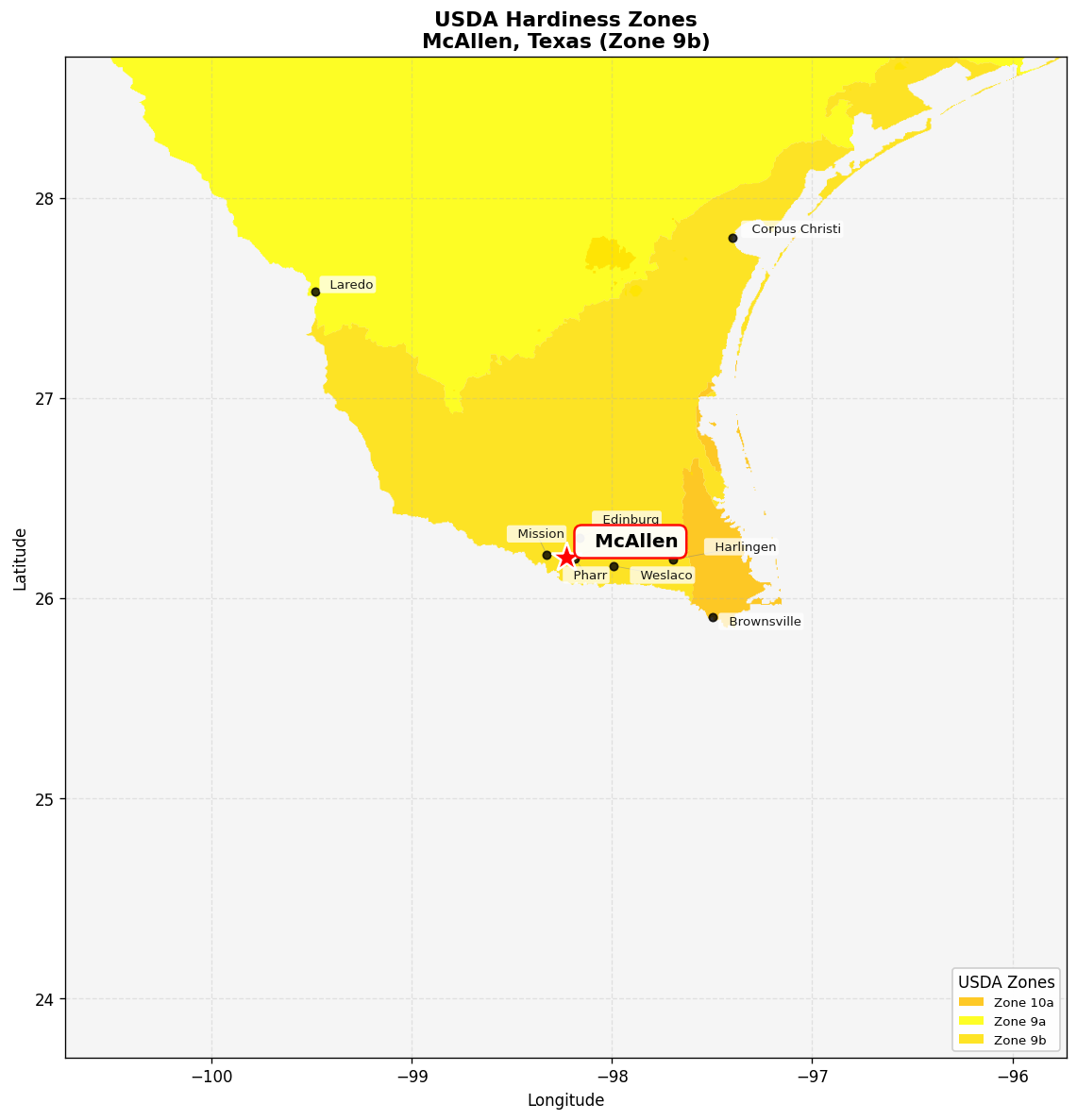
USDA Zone 9b
Hardiness zone for McAllen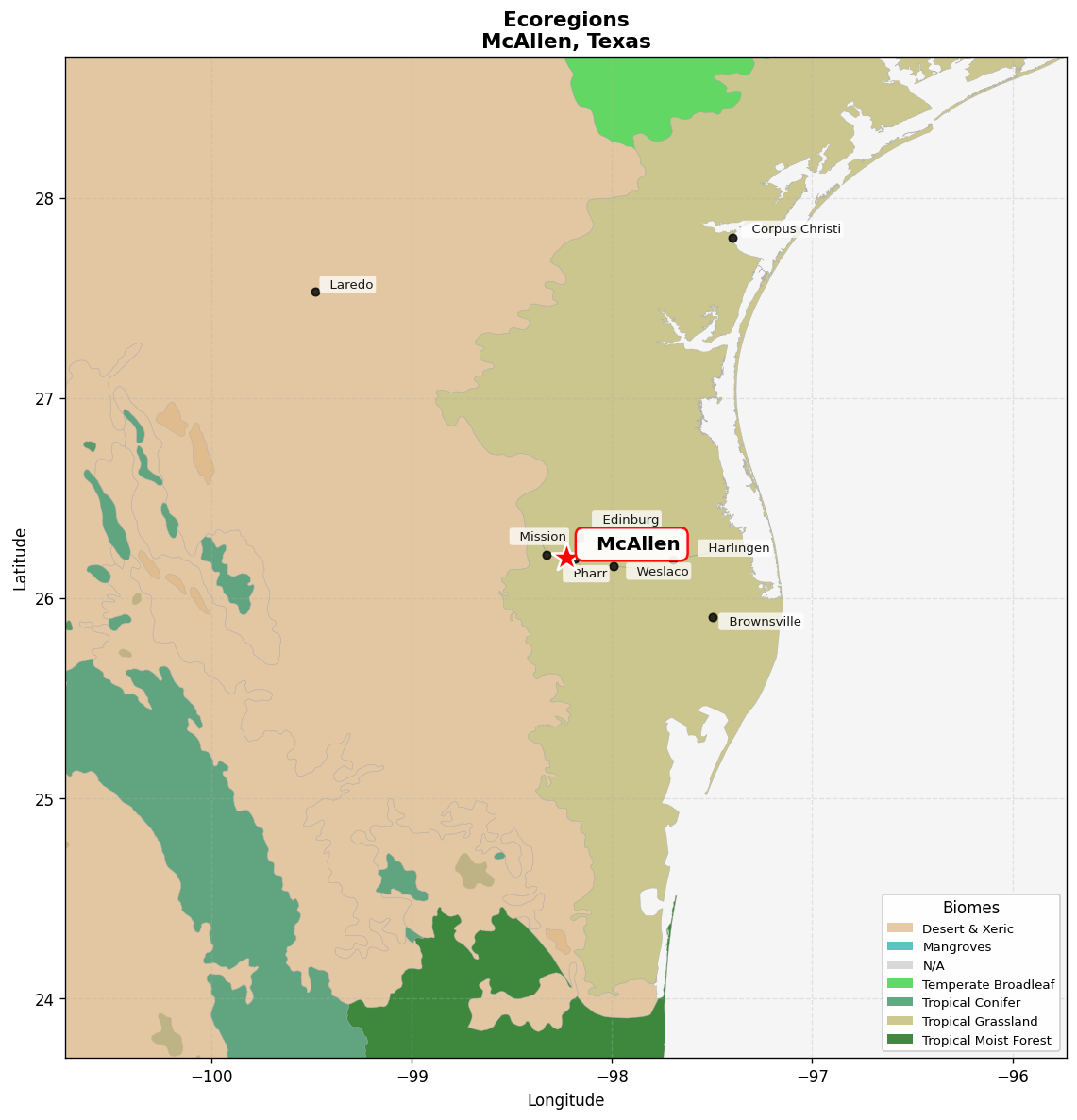
Western Gulf coastal grasslands
Native ecoregionFrequently Asked Questions
How much does xeriscaping cost in McAllen?
Valley installation labour runs roughly 20–30% below national metro averages, which makes xeriscape design unusually affordable here. A full 600 sqft front-yard conversion — turf kill, 4 inches of base and gravel, brick or steel edging, boulders and 15–20 specimen plants such as Agave weberi and Leucophyllum frutescens 'Green Cloud' — typically lands at $3,500–$9,000 installed. A paver terrace with a stone-clad gas fire pit runs $9,000–$22,000. A pool deck with a boulder waterfall and the full surrounding gravel garden is a $55,000–$130,000 project. Doing the gravel and planting yourself, with a nursery delivering plants and a yard delivering base rock, brings the front yard under $4 per square foot.
How much water does a xeriscape actually save in McAllen?
A lot, because the baseline is so high. St. Augustine turf in Hidalgo County wants somewhere near 45–55 inches of water a year to stay green, and McAllen only supplies about 21 inches of that as rain — the rest comes off the Rio Grande through your meter. A gravel garden of Agave ovatifolia, Hesperaloe parviflora 'Brakelights', Dasylirion texanum and Muhlenbergia lindheimeri on inline drip needs deep soakings roughly every 10–14 days in July and essentially nothing from December to March. Most McAllen households that convert a front yard see summer water bills drop by a third or more, and the design keeps its shape during a day-of-week irrigation restriction instead of going brown.
Will agaves and cactus survive a McAllen freeze?
The Zone 9b species will; the tender ones will not. February 2021 dropped McAllen to roughly 20°F and wiped out bougainvillea, plumeria and unprotected tropicals across the Valley, but Agave ovatifolia, Agave americana, Yucca rostrata, Hesperaloe parviflora and Opuntia engelmannii came through it. Design around that event rather than the average winter: use the hardy structural species for anything you cannot afford to replace, keep frost-tender colour such as Bougainvillea 'Barbara Karst' in pots you can drag under the ramada, and remember that wet cold is far more damaging than dry cold — a rosette sitting in saturated clay at 25°F rots, while the same plant in a bermed gravel bed shrugs it off.
What do I do about McAllen's caliche and alkaline soil?
Work with it, not against it. Valley soils typically test pH 7.8–8.3 over a caliche pan, with free lime and sometimes salt from decades of irrigation, so acid-loving plants are simply off the table — azalea, gardenia and blueberry will go chlorotic yellow no matter what you feed them. Choose species that evolved on this chemistry: Ebenopsis ebano, Cordia boissieri, Leucophyllum frutescens, Malvaviscus arboreus var. drummondii and Sabal mexicana are all indifferent to high pH. Where you want cactus and agave, break through the caliche pan or avoid it entirely by berming 8–12 inches of a 50/50 native-soil-and-expanded-shale mix above grade, then mulch with gravel rather than bark, which floats away in a Valley downpour.
When is the best time to install a xeriscape in McAllen?
October through March, with November and February the two sweet spots. Planting in the cool season lets roots establish through a growing season that barely stops — McAllen sees roughly 330 frost-free days and often no freeze at all — so a fall install is essentially established by the following June. Avoid planting from mid-June through mid-September: even xeric species transpire hard at 100°F and new plantings need daily attention they should not need. Hardscape is a different story and can be built year-round, though contractors will schedule around the September tropical-moisture peak, which is McAllen's wettest month and the one most likely to flood a fresh base course.
Are there rules or permits I should check before removing my lawn?
Planting, gravel conversions, drip irrigation and bed edging generally need no city permit anywhere in McAllen, and lawn removal is not restricted. Where you should check first is your HOA: Sharyland Plantation, Cimarron, Tres Lagos and several North McAllen associations maintain approved-materials and minimum-planting rules, and some still specify a percentage of living cover, which a well-planted xeriscape design meets easily but a bare gravel field does not. Retaining walls above a few feet, pools, and anything roofed do fall under City of McAllen permitting and inspection, so confirm current thresholds with the city before you build. If your project changes how water leaves the lot, raise it with the city too — Valley lots are flat and drainage complaints are the most common neighbour dispute here.