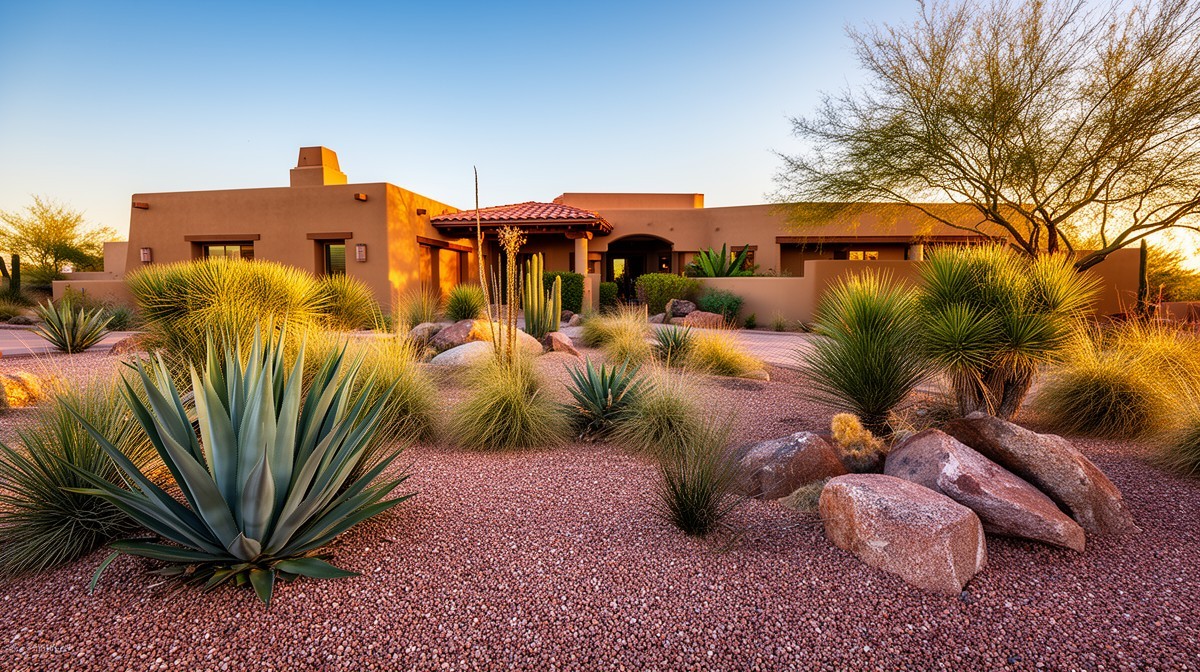
4 Desert Xeriscape Garden Ideas for Peoria, AZ | Sonoran Low-Water Landscape Design in Zone 9b
Native plants from the Sonoran desert (Zone 9b) — Hot desert climate
Why Desert/Xeriscape Gardens in Peoria?
Peoria sits where the Phoenix metro runs out and the Sonoran Desert takes back over, and that gives xeriscape here an advantage almost nowhere else has: the Sonoran is the wettest, most botanically generous desert in North America, so a low-water yard in Peoria can be genuinely lush rather than merely rocky. You are working with a palette that includes Carnegiea gigantea, Fouquieria splendens, Opuntia santa-rita with its purple winter pads, Echinocactus grusonii, Agave parryi var. truncata, Hesperaloe parviflora 'Brakelights', and Muhlenbergia capillaris 'Regal Mist' — plus flowering shrubs like Leucophyllum frutescens 'Green Cloud', Calliandra californica, Tecoma stans 'Gold Star', and Eremophila maculata 'Valentine' that bloom across three seasons on rainfall plus a trickle of drip. Xeriscape does not mean seven rocks and a barrel cactus; it means choosing plants whose water demand matches the 8 inches a year that actually fall here.
The arithmetic is what sells it. Peoria is USDA Zone 9b in a BWh hot-desert climate: roughly 8 inches of annual rain, around 110 days above 100°F, and winter lows in the 25–32°F range — cold enough, briefly, to burn Bougainvillea and Lantana montevidensis to the ground while Agave and Dasylirion never notice. Turf in this climate wants something on the order of 60–75 inches of applied water a year to stay green; a mature desert planting wants a fraction of that. Removing 1,000 square feet of Bermuda and overseeded rye typically cuts thousands of gallons a month off a summer bill, and it removes the two chores nobody in Peoria enjoys: mowing in 108°F heat and October overseeding.
Two site realities decide the outcome. Caliche — cemented calcium-carbonate hardpan — lies 8 inches to 3 feet down through most of northwest Peoria and turns an unbreached planting hole into a bathtub; it kills more agaves than cold ever will, and the only real fix is punching a drainage chimney through the pan with a San Angelo bar or a 4-inch auger. And monsoon microbursts from mid-July through September push 60–80 mph downdrafts that both topple shallow-rooted trees and scour loose gravel out of ungraded yards in a single 40-minute cell. Handle the hardpan, grade for the runoff, water deep and infrequently, and a xeriscape here needs almost nothing from you: one grass cutback in February, a pre-emergent pass in the granite, and drip that runs twice a week in July and hardly at all in January.
4 Desert/Xeriscape Design Ideas for Peoria
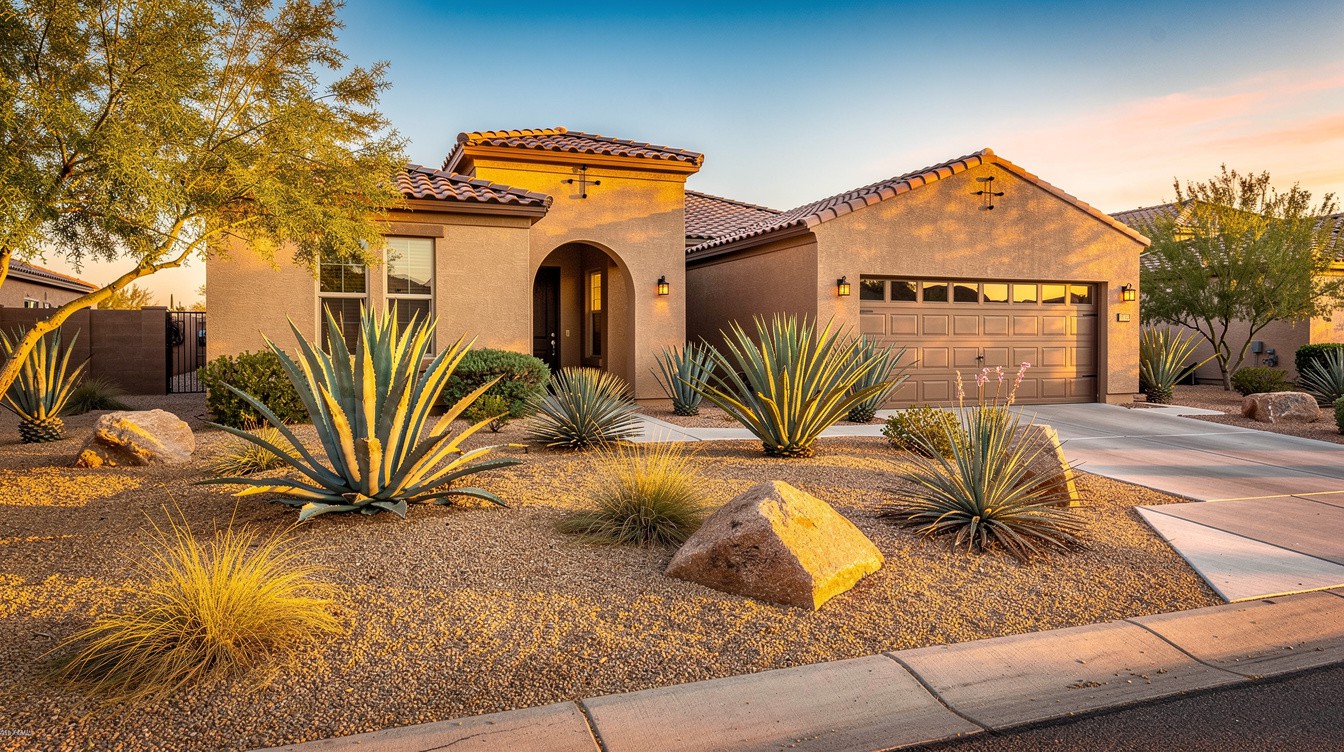
The Specimen Agave Frontage
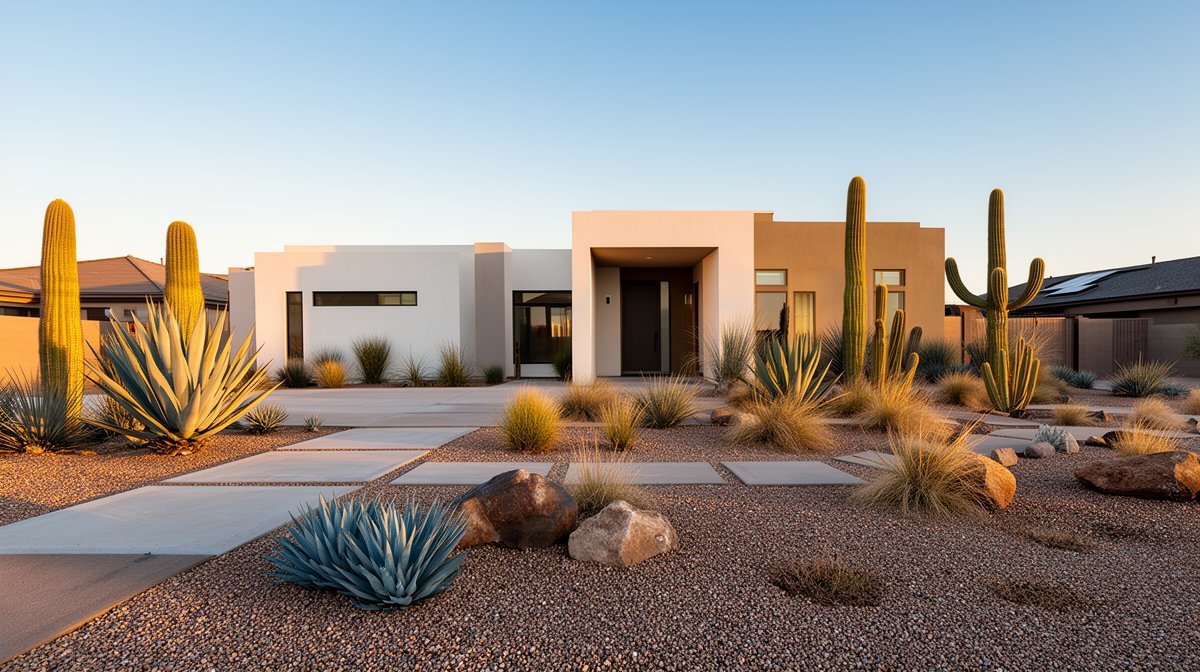
$5–10/sqftA tile-roofed stucco home fronted entirely by gold decomposed granite, with the design carried by a handful of oversized succulent specimens rather than beds. A pair of variegated century agaves anchors the left third at true focal scale — four feet across, yellow-margined leaves catching the last light — while smaller blue rosettes and narrow-leaved yuccas step down toward the driveway in loose triangles. Golden clumps of deergrass and bunchgrass soften the ground plane, a placed granite boulder gives the eye a resting point, and a palo verde at the property line filters afternoon sun off the west wall. No lawn, no edging, no maintenance beyond removing a spent bloom stalk every few years.
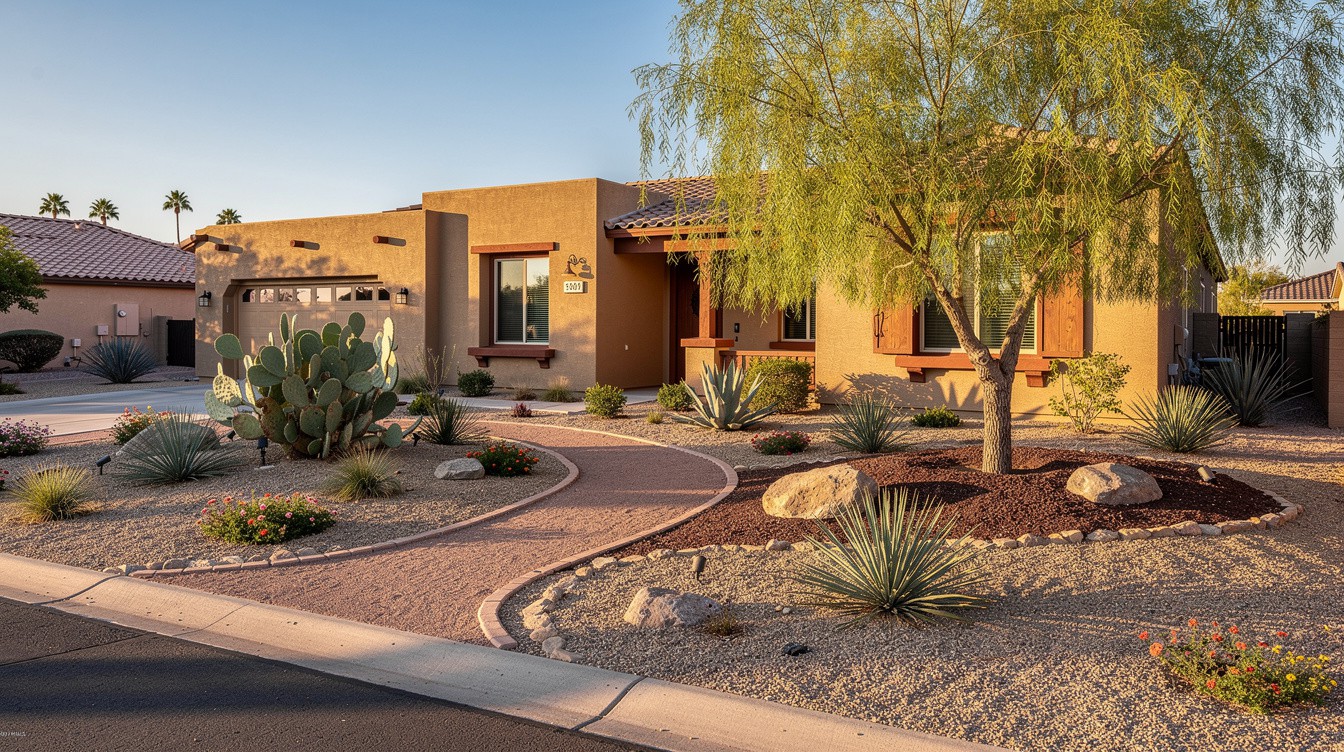
The Curving Granite Walk
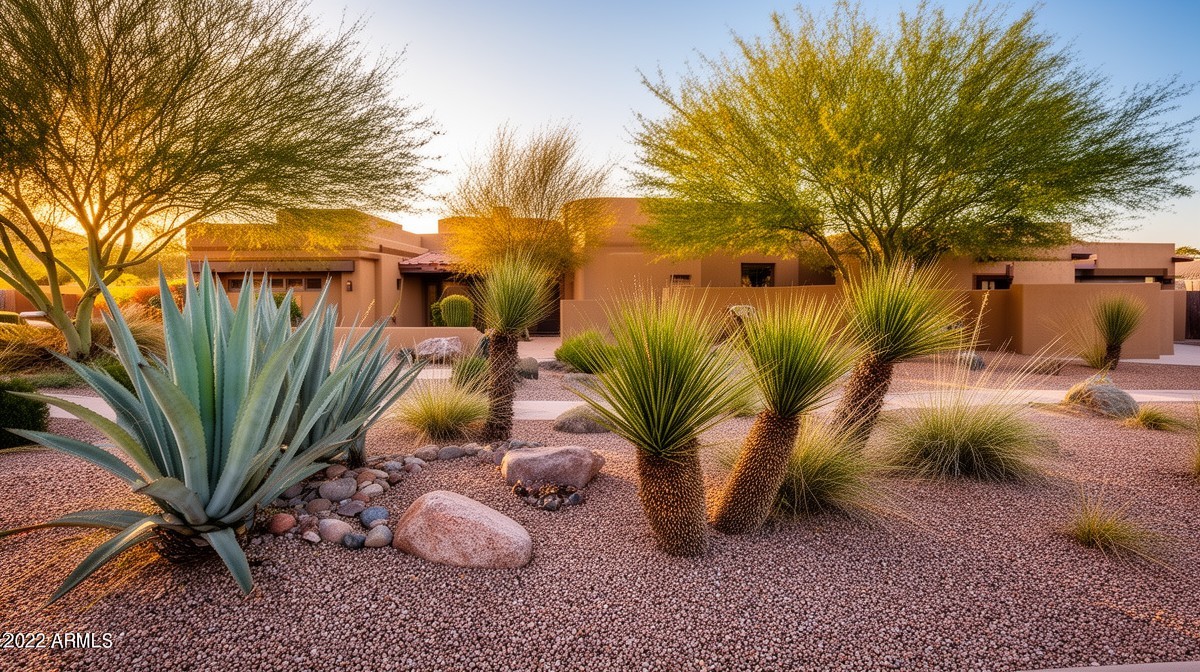
$8–15/sqftA stabilized decomposed granite path swings from the driveway to the entry in a long arc, bordered by a slim paver soldier course that keeps the gravel where it belongs. On one side a big Engelmann prickly pear stands as a living sculpture with clumps of red and orange lantana glowing at its feet; on the other, a mesquite is ringed in a raised bed of red lava rock with cobble at the transition — a deliberate change in rock color that reads as a second room. Low uplights sit at the base of the cactus and the tree, and everything else is knee-high desert accent: narrow yuccas, small agaves, and drifts of flowering groundcover.
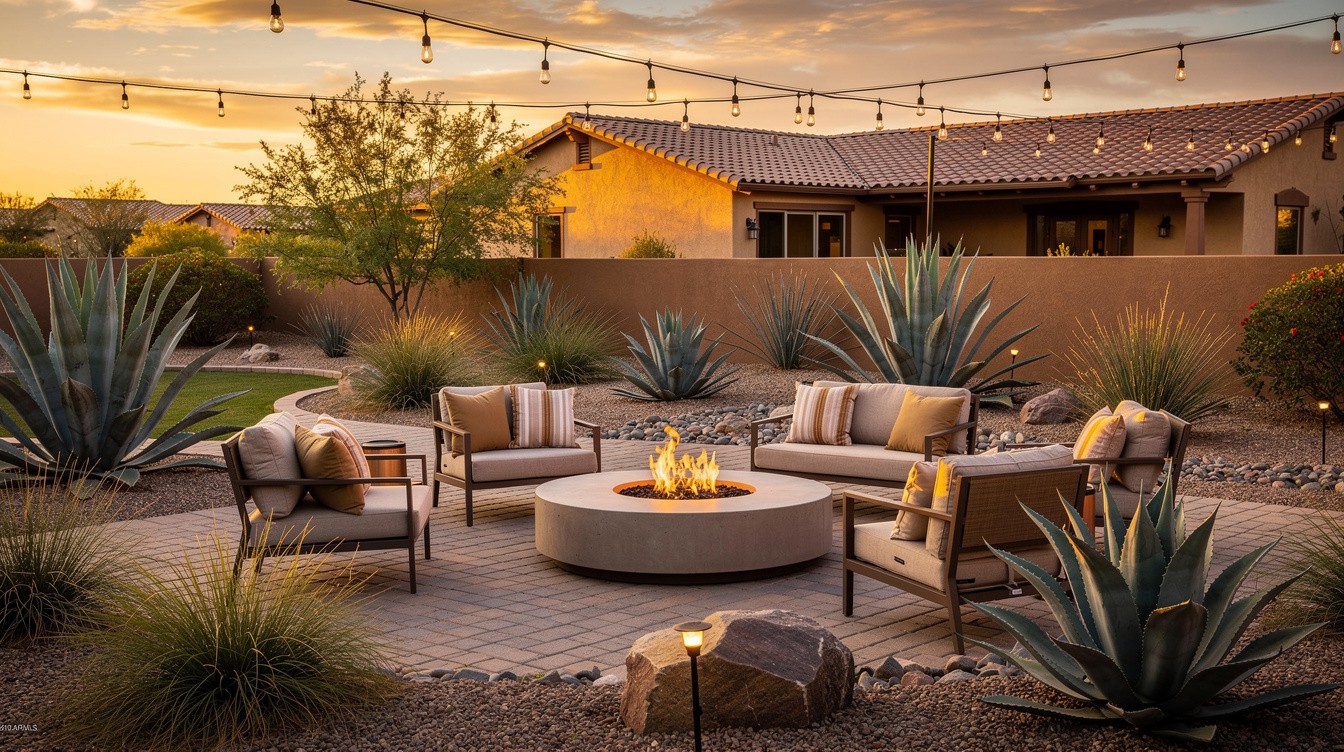
The Agave Fire Circle
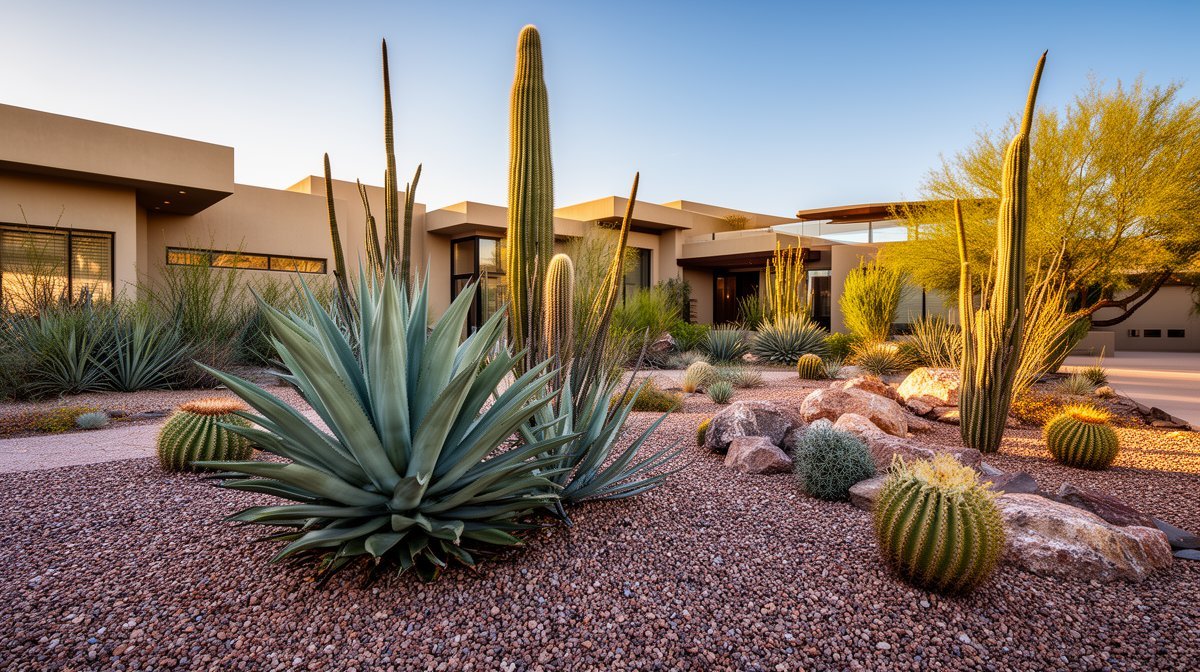
$16–28/sqftA circular paver patio with a round cast-concrete gas fire bowl at dead center and four chairs facing in, ringed by a border of smooth river cobble that separates the pavers from the planting. Beyond the cobble, a collection of massive blue agaves is spaced around the whole perimeter like a colonnade, with muhly and bunchgrasses filling between them and a small strip of turf surviving at the far left for the dog. String lights span the yard from the house to the perimeter block wall, path lights graze the agave leaves from below, and a scarlet bougainvillea covers a section of the wall on the right. This is the classic Peoria backyard done properly — one round gesture, big plants, and light.
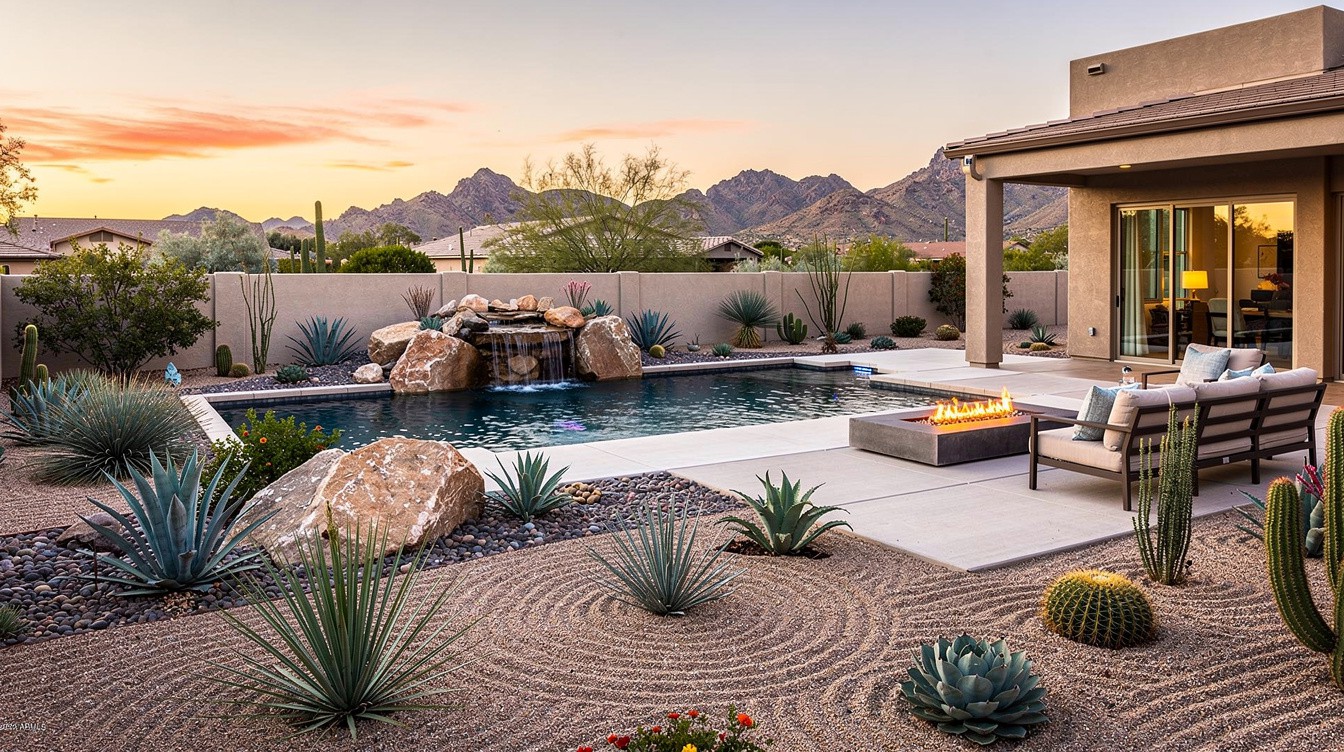
The Zen Pool & Boulder Waterfall
$50–95/sqft (pool area inclusive)A rectangular pool with a stacked-boulder waterfall spilling into the far end, a broad concrete deck holding a low linear gas fire table, and — the move that makes the whole yard — a raked gravel field in the foreground with concentric swirl patterns worked into it. Golden barrel cacti sit in that field like punctuation, joined by compact artichoke agaves, blue-leaved yuccas, and a foreground agave rosette held tight and symmetrical. The perimeter reads as open desert: saguaro and organ pipe silhouettes against the White Tank and Hieroglyphic ranges beyond the wall. The raked gravel is the cheapest square footage in the yard and the most photographed.
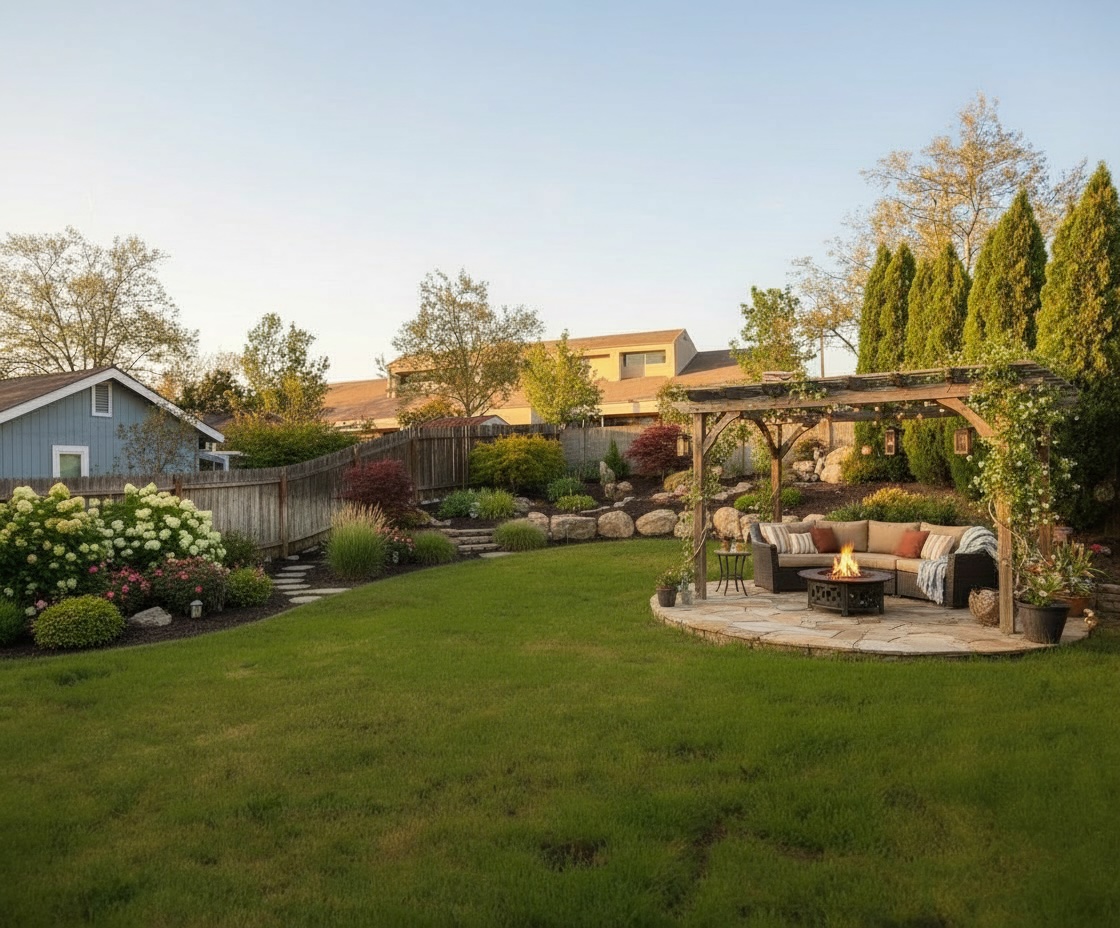
See how a desert/xeriscape garden looks on YOUR property
Upload a photo of your Peoria yard and visualize your dream garden in seconds.
Try ProScapeAI Free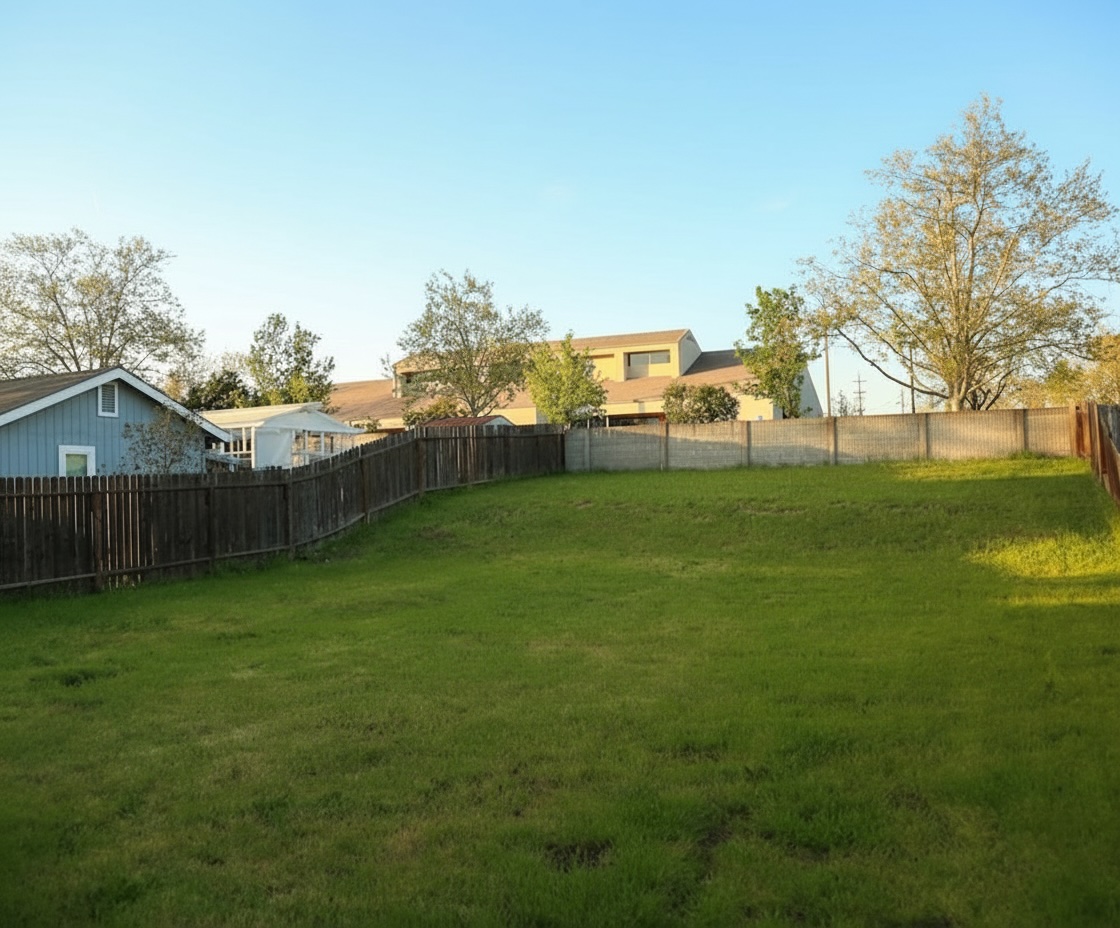
Featured Trees & Shrubs for Desert/Xeriscape Gardens
Browse all 185 plants for Peoria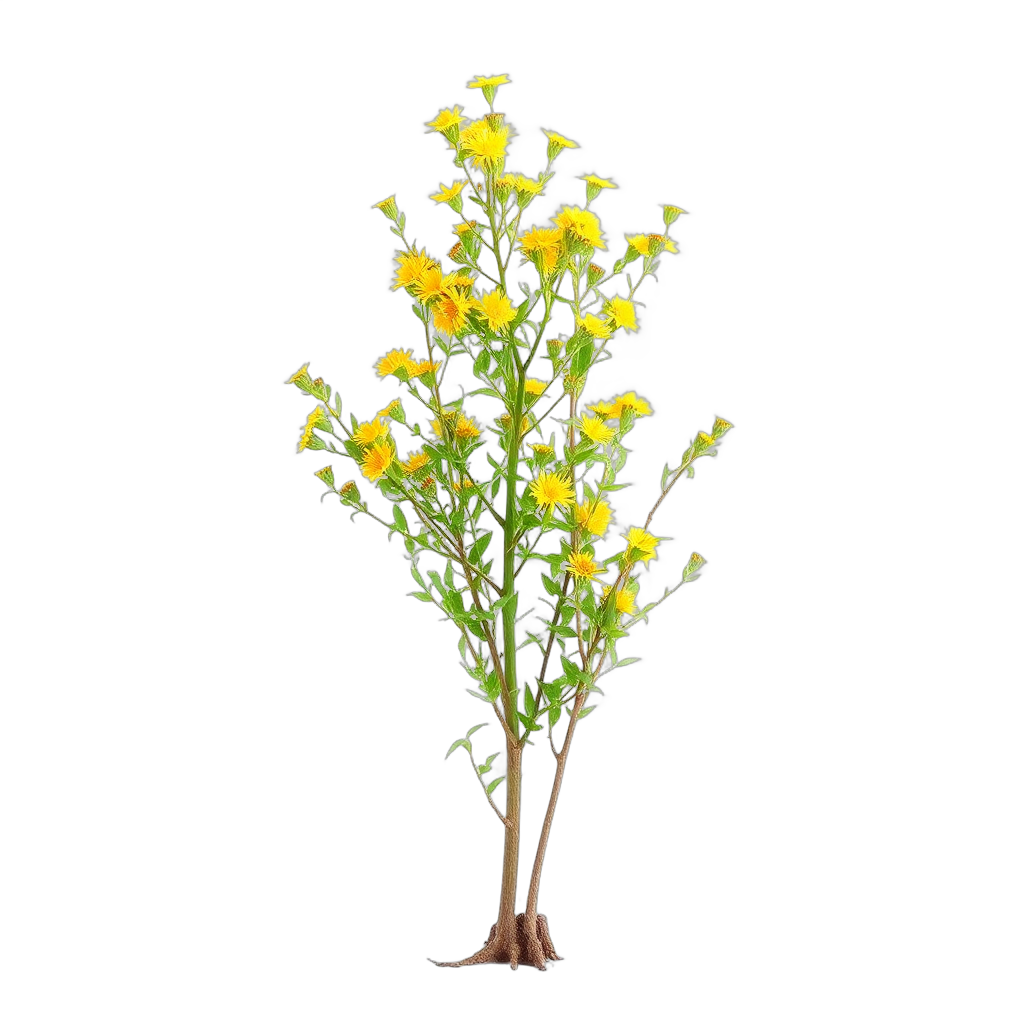
Brittlebush
Enca farinosa
grows to 3 feet, yellow blooms in spring. Attracts butterflies.
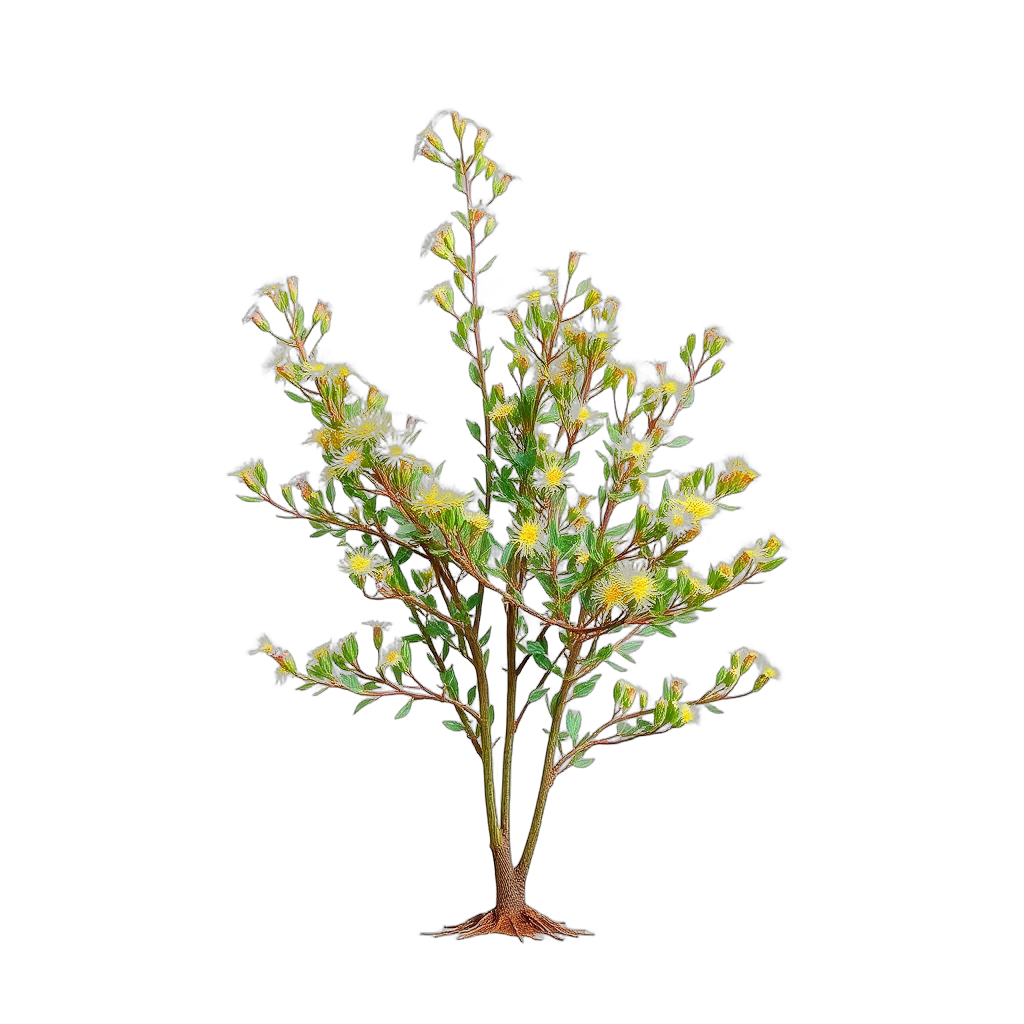
Catclaw Acacia
Acacia greggii
medium-sized at 15 feet, yellow blooms in spring. Pollinator-friendly.
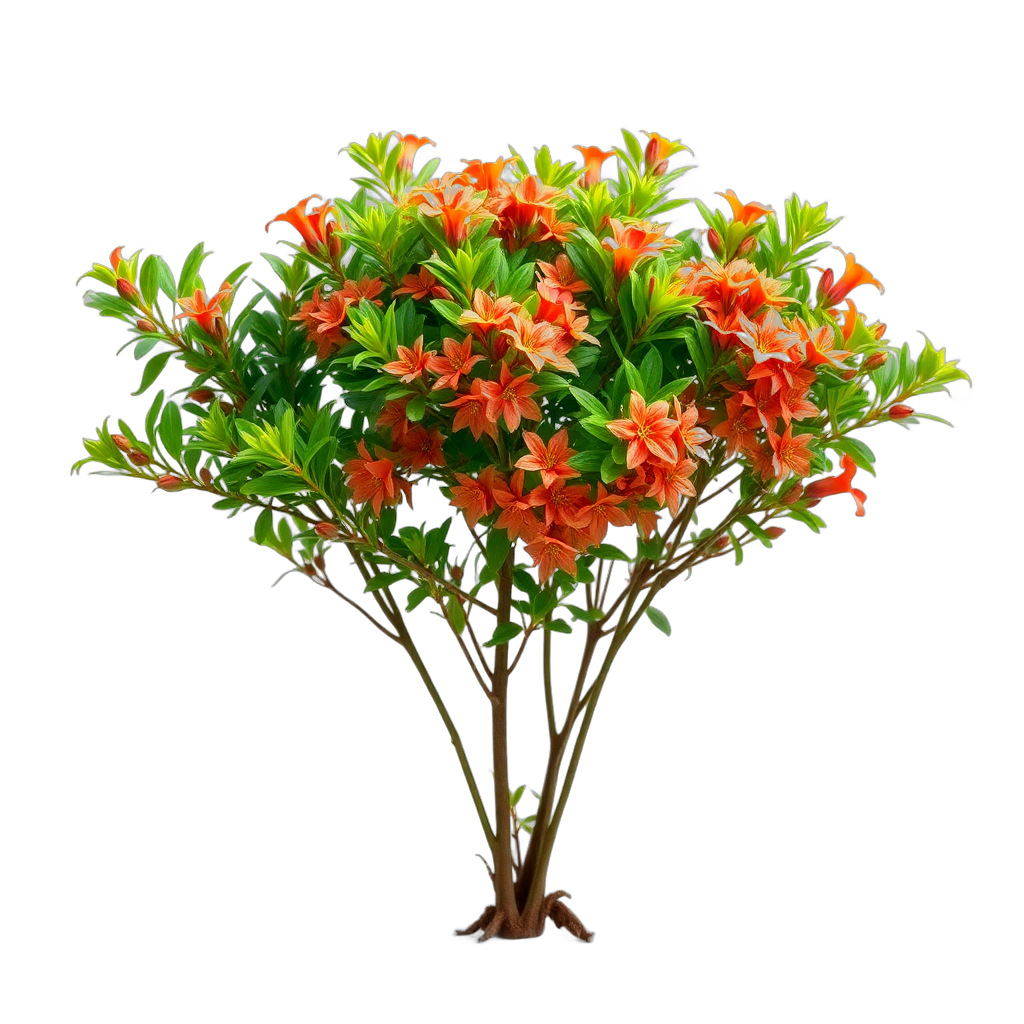
Chuparosa
Justicia californica
grows to 5 feet, red blooms in spring. Attracts hummingbirds.
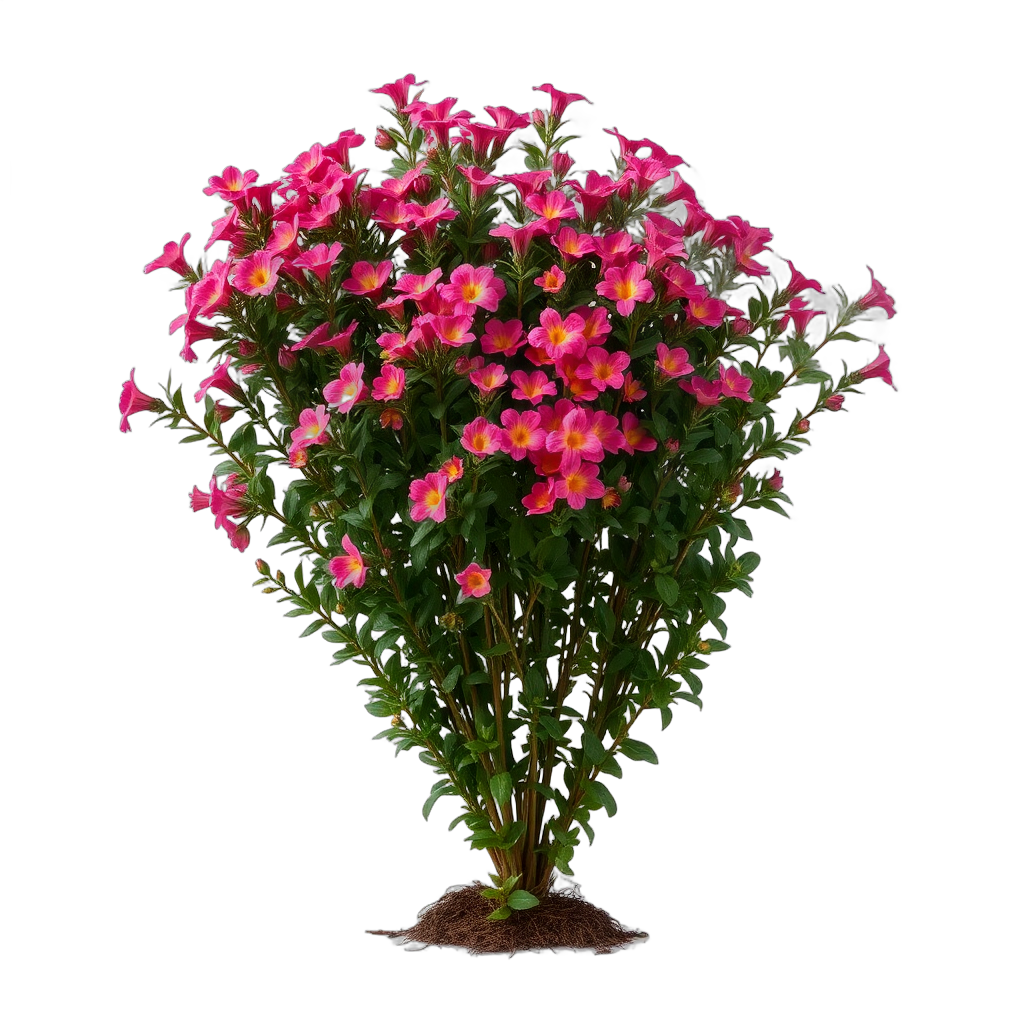
Cliffrose
Purshia mexicana
medium-sized at 8 feet, yellow blooms in spring. Attracts butterflies.
Featured Grasses & Groundcovers for Desert/Xeriscape Gardens
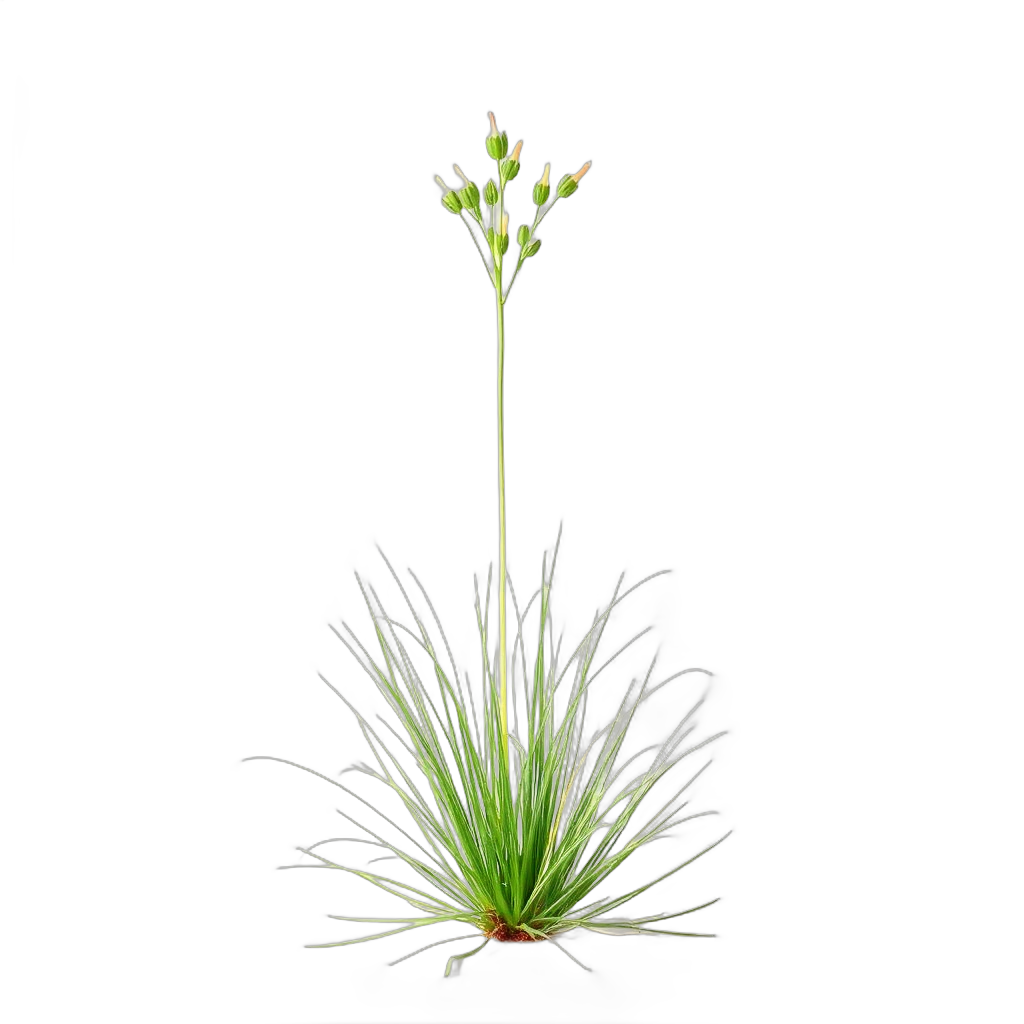
Alkali Sacaton
Sporobolus airoides
grows to 3 feet, blooms in summer. Yellow fall color.
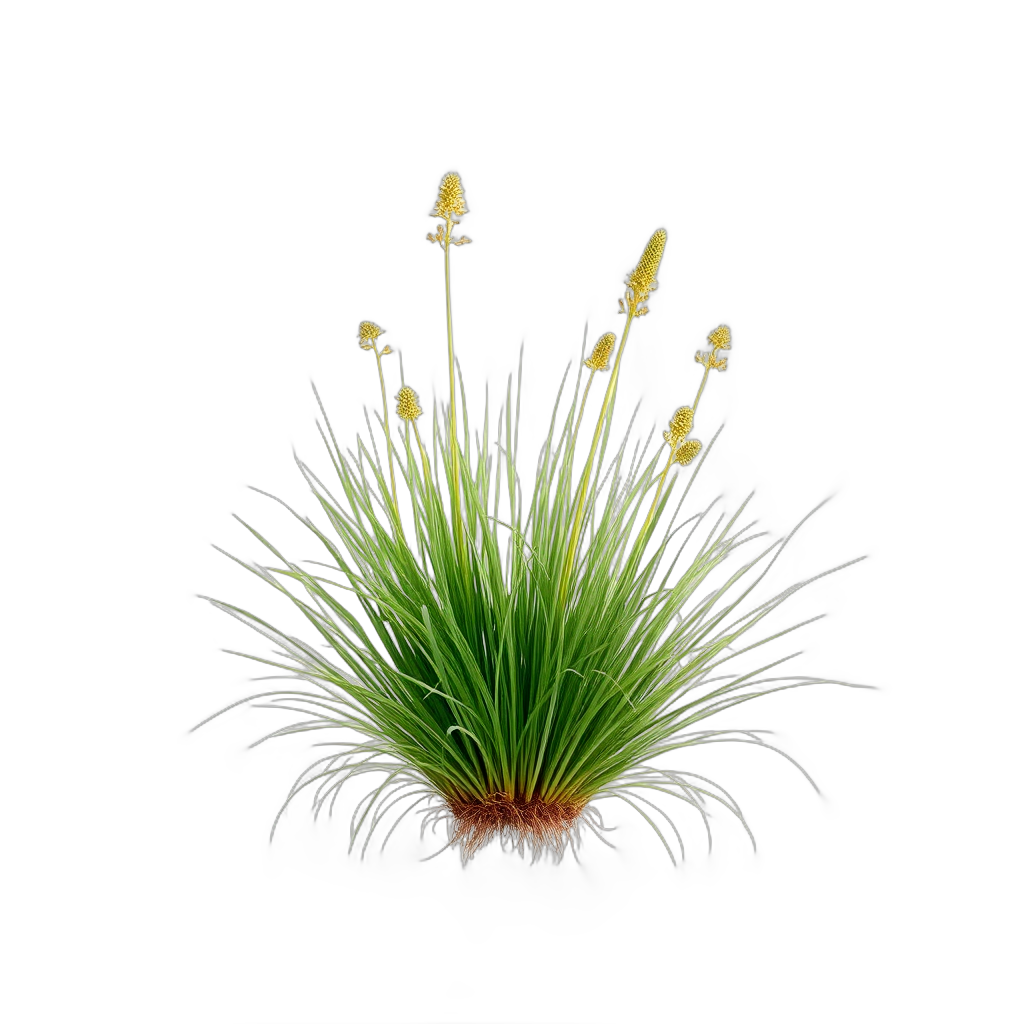
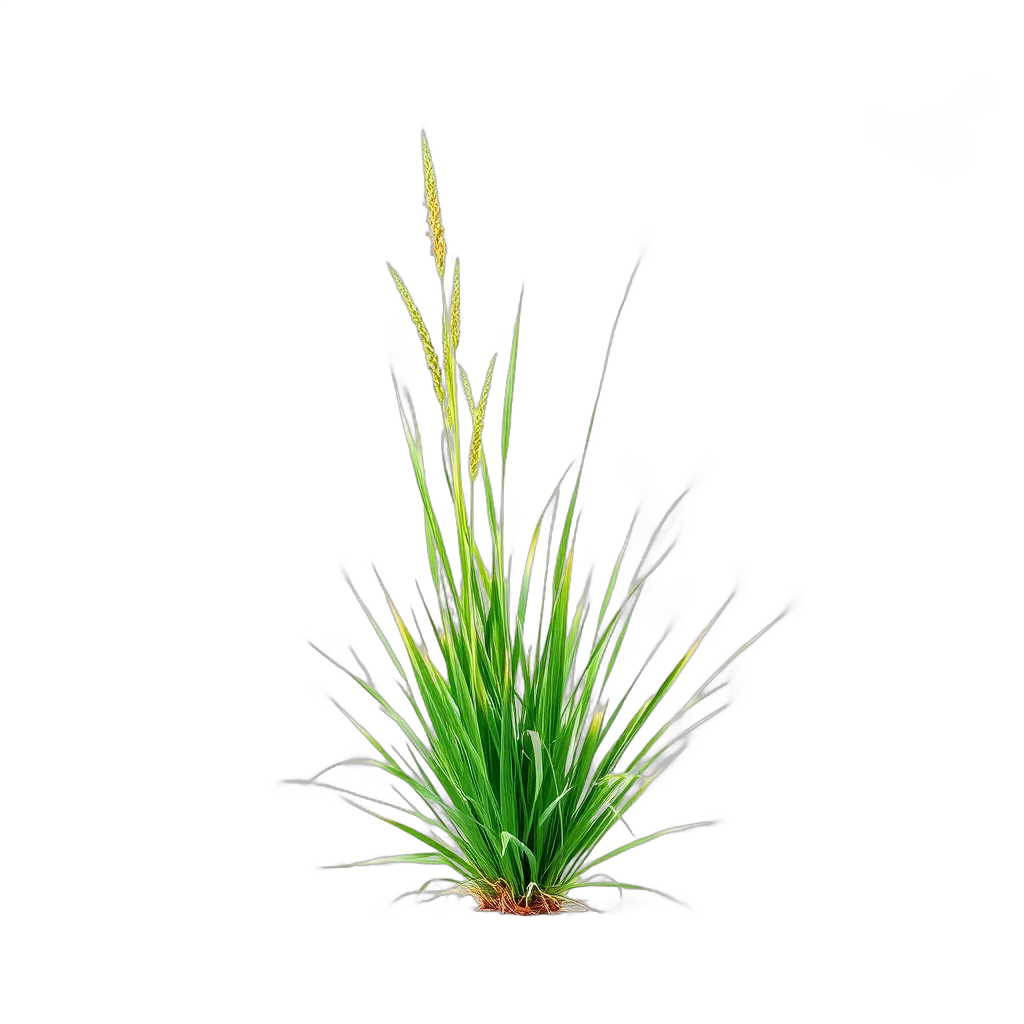
Big Sacaton
Sporobolus wrightii
grows to 5 feet, blooms in summer. Yellow fall color.
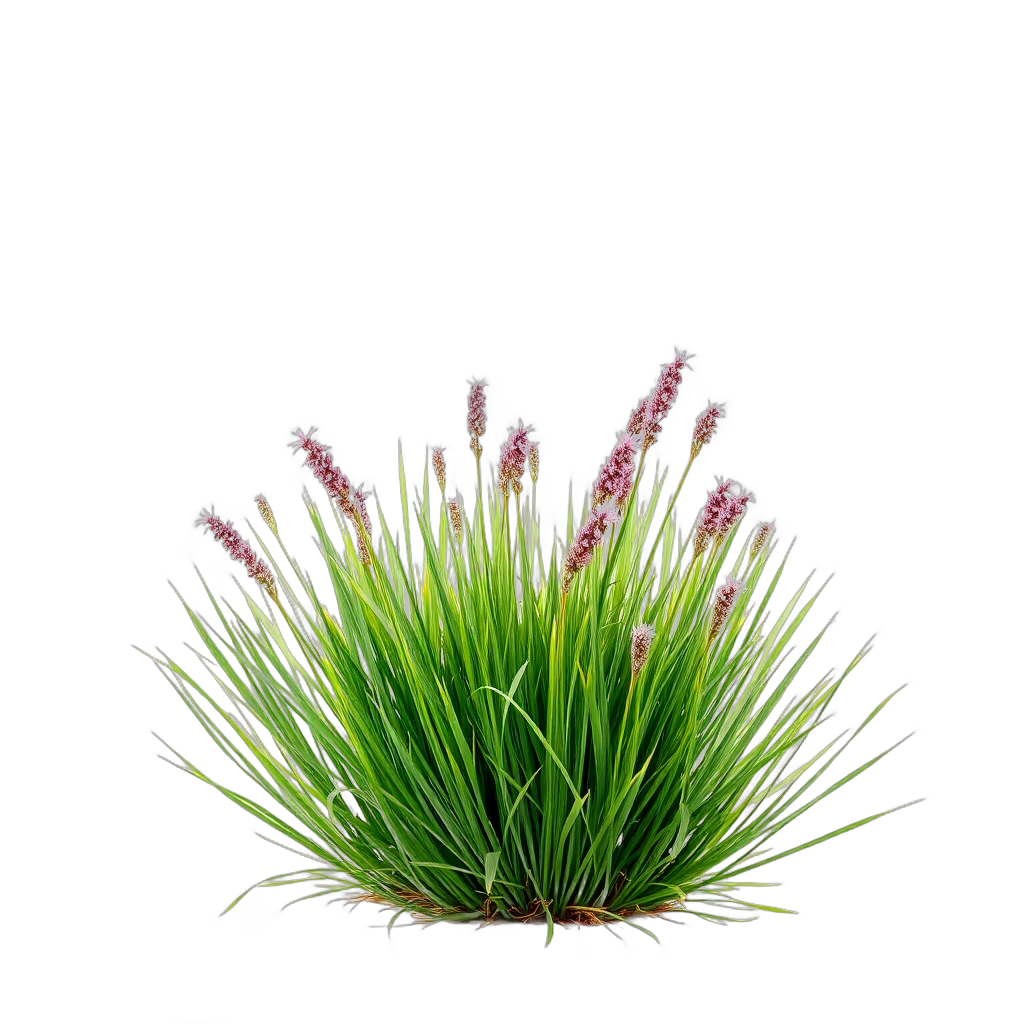
Bull Grass
Muhlenbergia emersleyi
grows to 4 feet, purple blooms in fall. Yellow fall color.
Purple Three-Awn
Aristida purpurea
low-growing ground cover, purple blooms in fall. Yellow fall color.
Featured Flowers & Perennials for Desert/Xeriscape Gardens
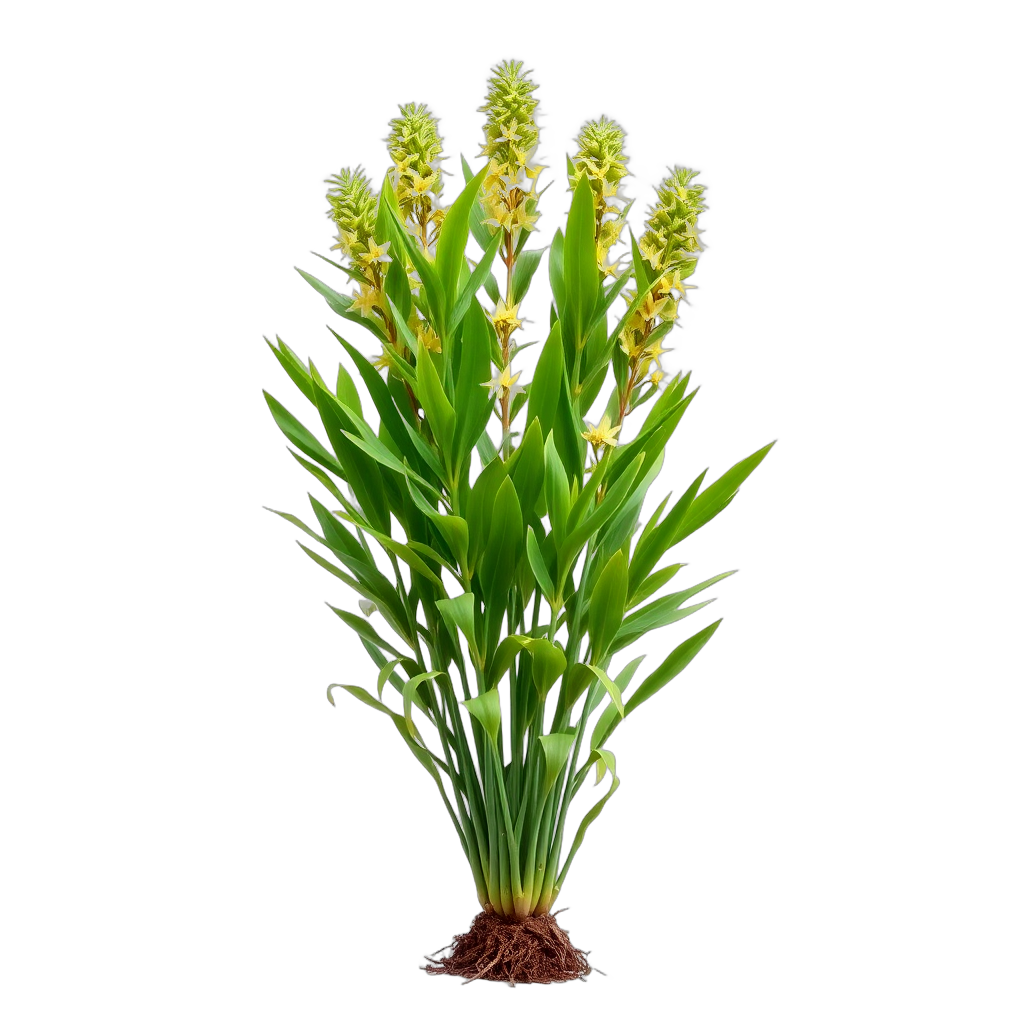
Banana Yucca
Yucca baccata
low-growing ground cover, white blooms in spring. Attracts hummingbirds.
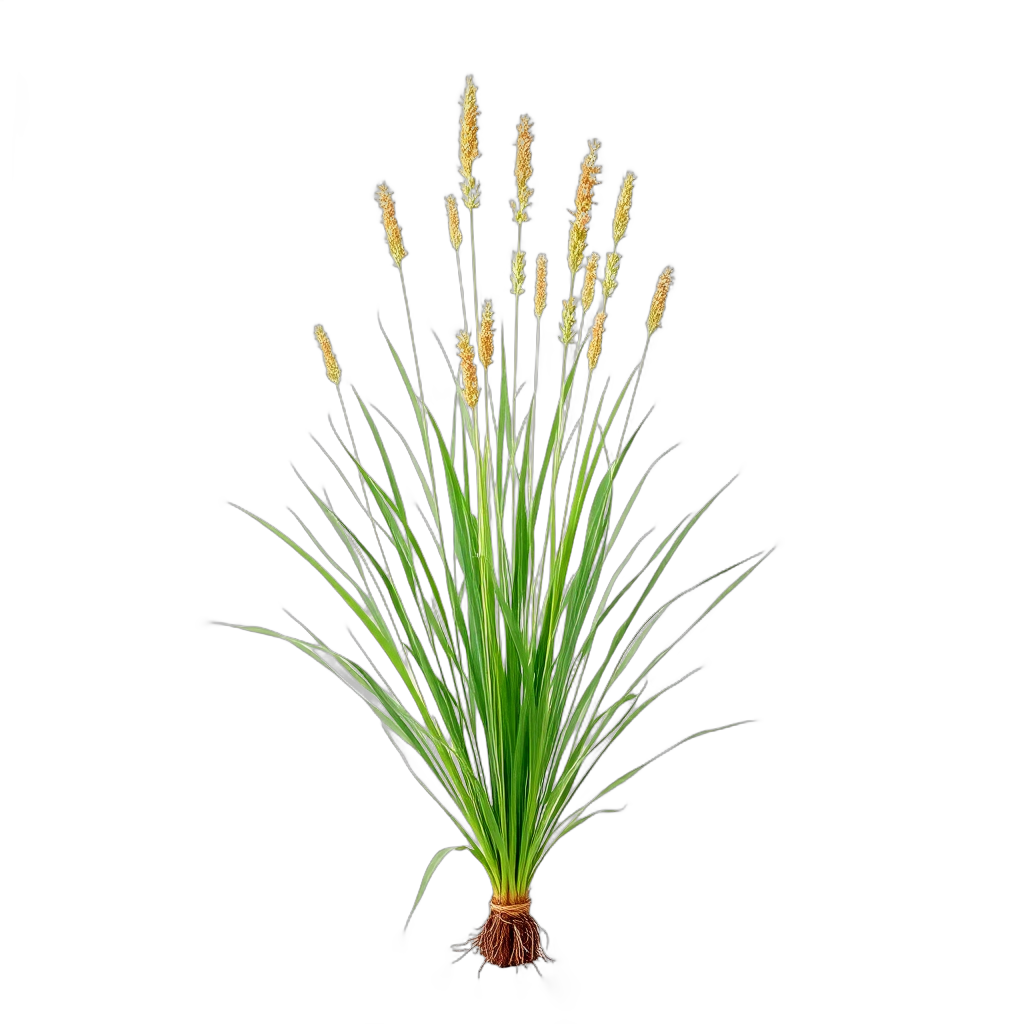
Beargrass
Nolina microcarpa
low-growing ground cover, white blooms in summer. Evergreen year-round.
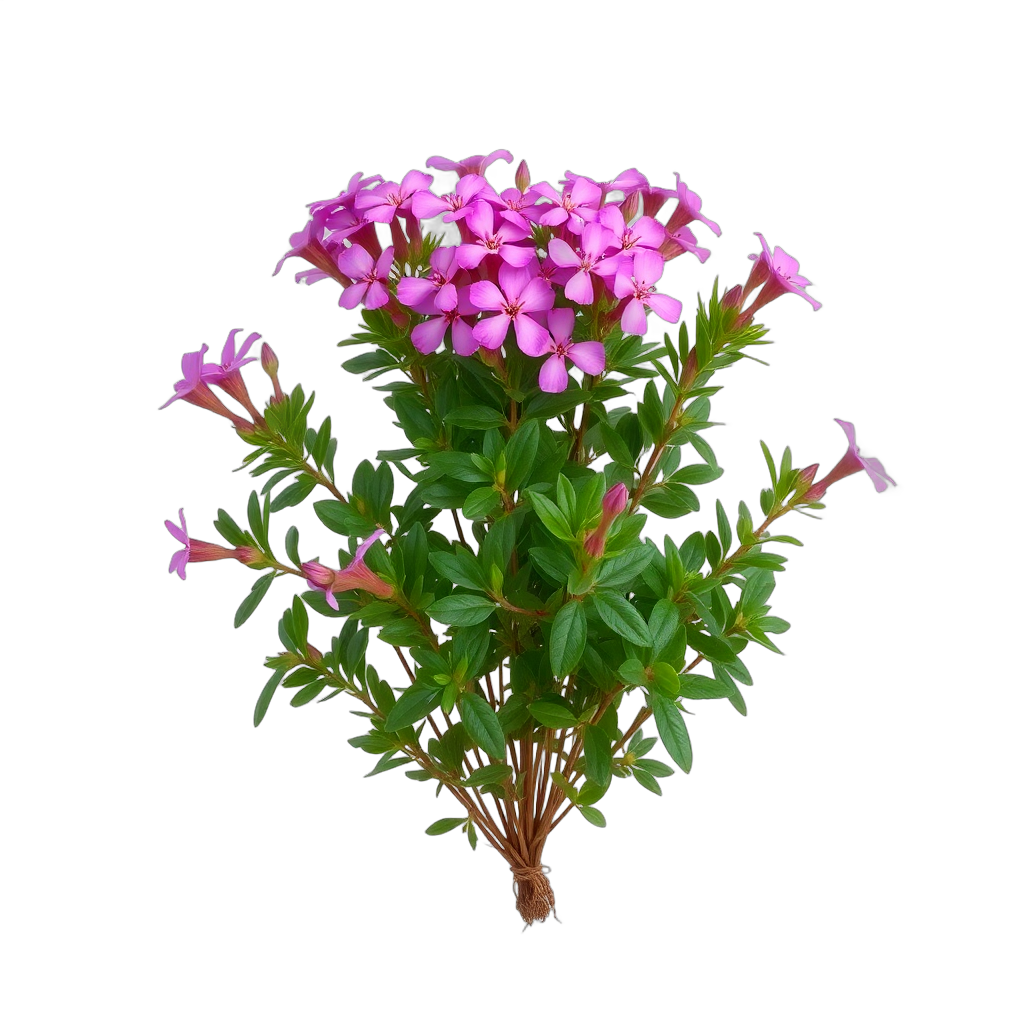
Desert Phlox
Phlox austromontana
low-growing ground cover, pink blooms in spring. Attracts hummingbirds.
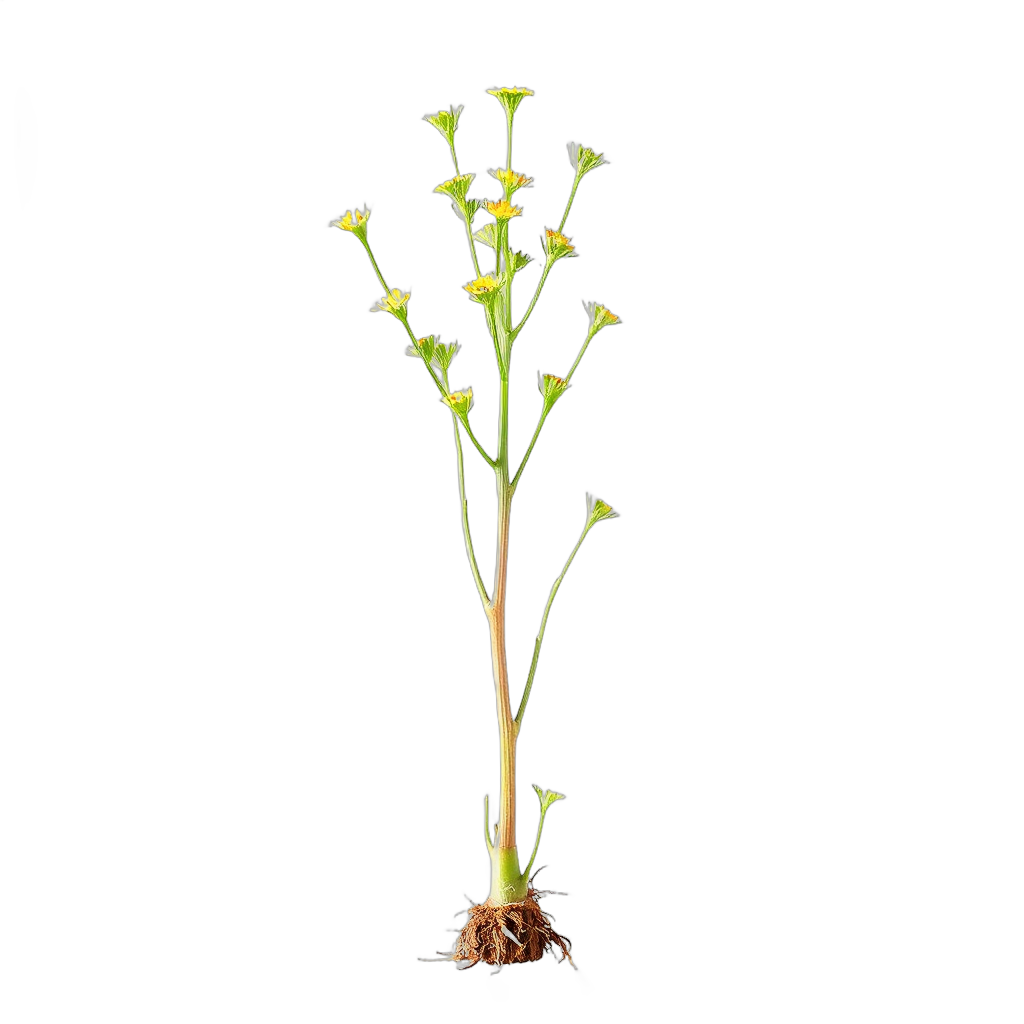
Desert Spoon
Dasylirion wheeleri
grows to 4 feet, white blooms in summer. Evergreen year-round.
Bloom Calendar for Peoria
spring
Banana Yucca, Desert Phlox, Brittlebushsummer
Beargrass, Desert Spoon, Alkali Sacatonfall
Bull Grass, Purple Three-Awnwinter
Limited bloomsDesign Tips for Peoria (Zone 9b)
- Test for caliche before you buy a single plant — fill the hole with water, and if it's still there in 24 hours, punch a drainage chimney clear through the hardpan with a San Angelo bar or 4-inch auger and backfill it with pea gravel, or plant Agave parryi and Echinocactus grusonii on an 18-inch berm instead
- Plant cactus and agave in spring, everything else in fall — an Echinocactus grusonii set in April callus-heals in warm soil, while the same plant set in October sits in cold wet ground and rots at the base by February
- Buy three big plants instead of thirty small ones: one 4-foot Agave americana 'Marginata' or a mature Opuntia engelmannii carries a whole frontage, and gravel between specimens is the composition, not a gap that needs filling
- Change the rock, not just the plants — a red lava tree ring, a Mexican beach pebble band, or a raked 1/4-inch minus field beside standard Madison Gold granite creates distinct outdoor rooms for a couple of dollars a square foot
- Grade every gravel field to fall 2% away from the foundation and cut a cobble swale under the roofline: a single monsoon cell drops an inch in 40 minutes and will float decomposed granite off a flat yard and into the street
- Put pre-emergent on the calendar twice — late January and late June — because weed fabric stops working the moment three years of blown organic debris builds a rooting layer on top of it, and hand-weeding 900 sqft of granite in July is nobody's plan
Where to Source Plants in Peoria
Skip the big-box stores. These independent Peoria nurseries specialize in the plants that make desert/xeriscape gardens thrive in Zone 9b.
Elgin Nursery & Tree Farm
West Phoenix (McDowell Road)
Retail and wholesale tree and plant nursery specializing in locally grown desert-adapted trees and shrubs.
Berridge Nurseries
Camelback East, Phoenix
Valley institution since 1938 with the largest rose selection in the Phoenix area plus cacti and succulents.
Desert/Xeriscape Landscaping Costs in Peoria
| Project Scope | Estimated Cost |
|---|---|
| DIY grass-to-desert conversion (materials only) | $3 – $6/sqft |
| Contractor xeriscape conversion, typical 900 sqft front yard | $5,500 – $12,000 |
| Specimen boulders and cactus (saguaro, golden barrels, ocotillo) placed | $1,500 – $6,000 |
| Paver fire-pit patio with gas bowl and low-voltage lighting | $12,000 – $26,000 |
| Pool with boulder waterfall + full desert backyard | $85,000 – $170,000 |
| AI visualization with ProScapeAI | Free to start |
Estimates based on Peoria, AZ-area contractor rates as of 2026. Actual costs vary by site conditions, materials, and contractor.
Peoria Climate & Growing Zone
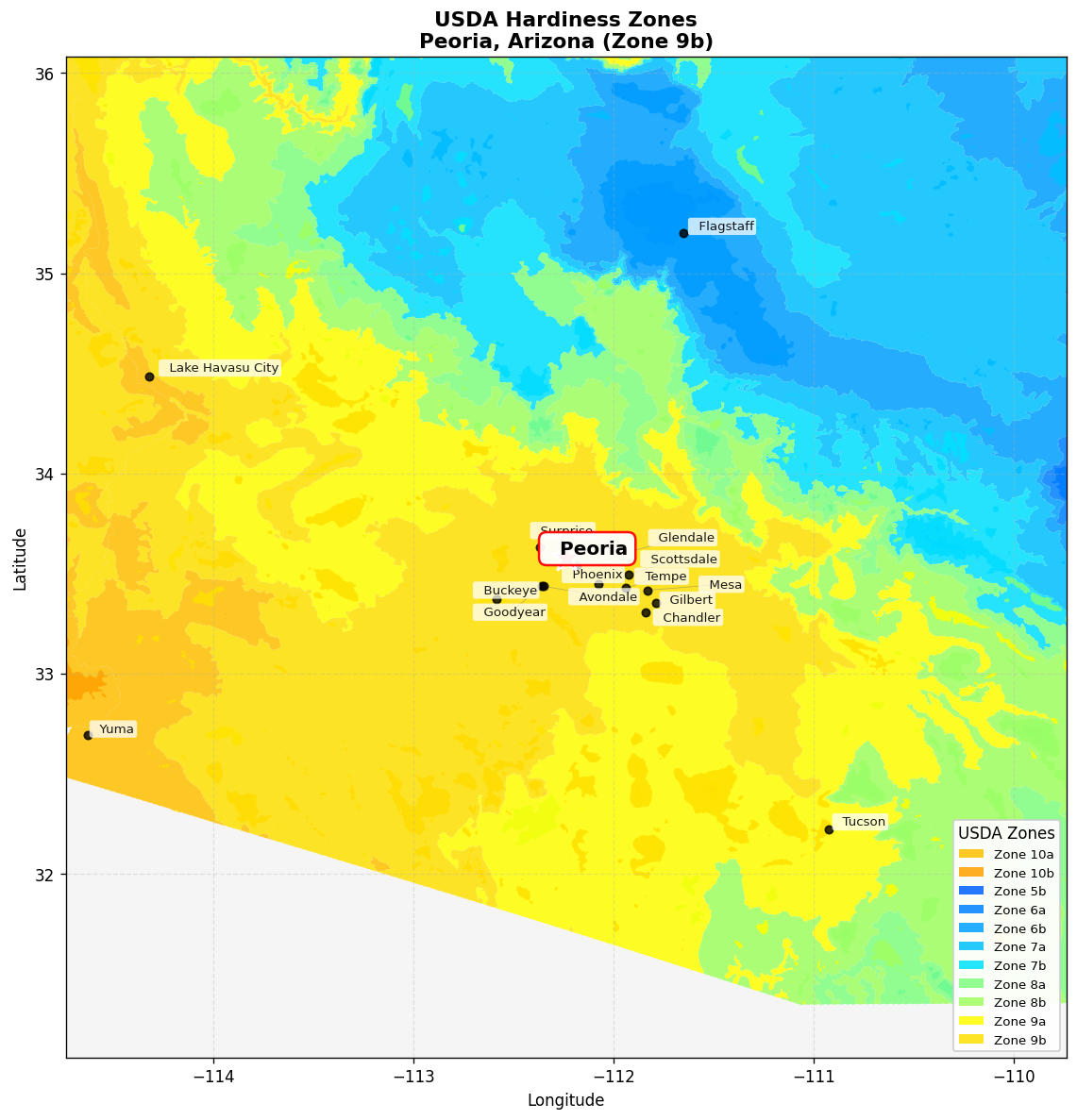
USDA Zone 9b
Hardiness zone for Peoria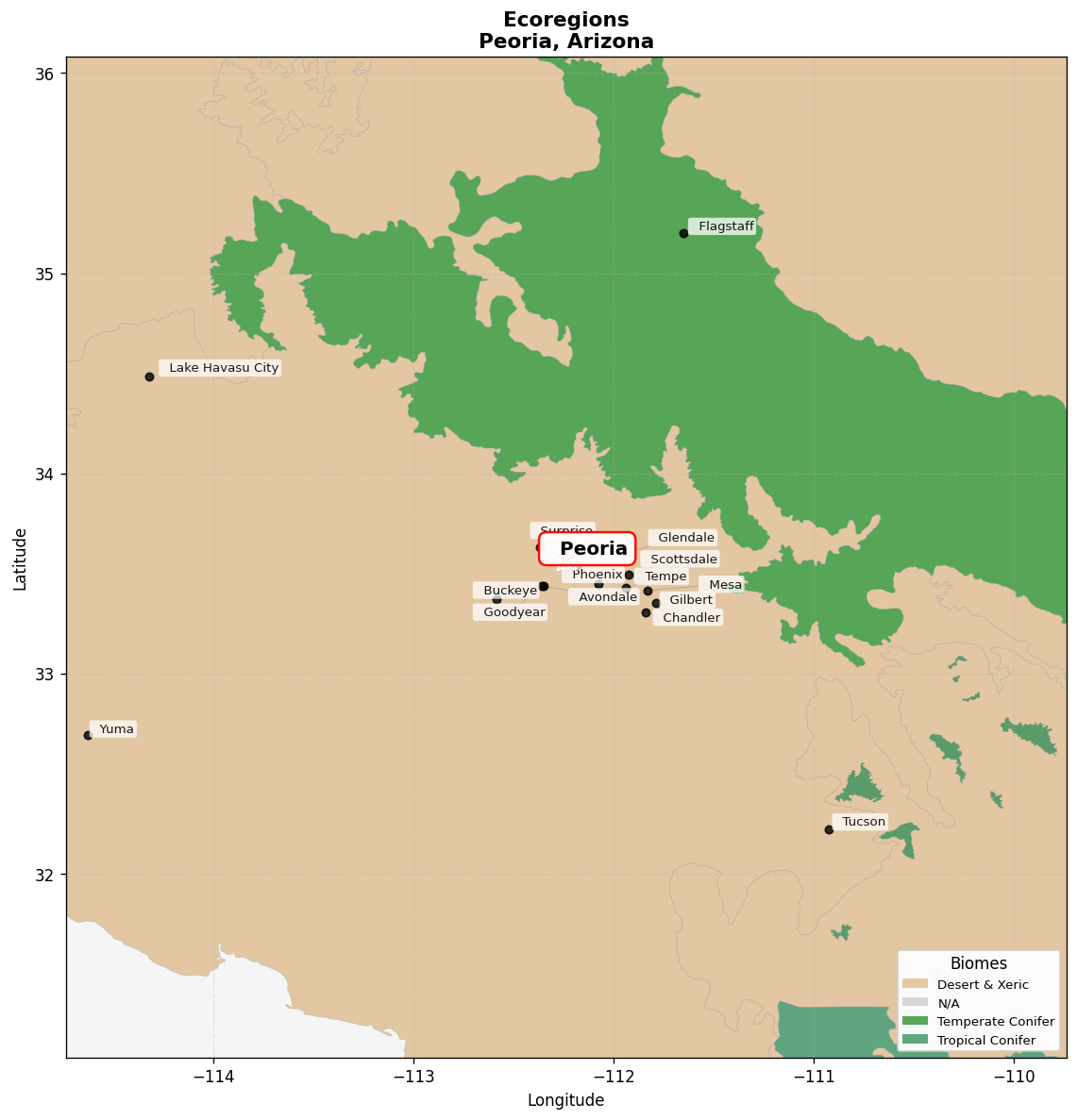
Sonoran desert
Native ecoregionFrequently Asked Questions
How much does a xeriscape conversion cost in Peoria?
DIY grass-to-desert conversion runs $3–6/sqft in materials — herbicide or sod cutter, drip line, weed fabric, and 1/2-inch decomposed granite delivered at roughly $1.50–3.00/sqft installed. Contractor-installed with design, grading, boulders, and specimen plants runs $6–14/sqft in the Phoenix metro, where landscape labor sits around $45–65/hour. A typical 900 sqft Peoria front yard therefore lands at $5,500–12,000 installed. Specimen pricing drives the range fast: a 5-gallon Hesperaloe parviflora 'Brakelights' is $25–40, a 15-gallon Agave ovatifolia is $120–250, a 36-inch box Parkinsonia 'Desert Museum' is $900–1,800, and a nursery-grown 8-foot Carnegiea gigantea with crane placement can run $1,500–4,000.
How much water will I actually save?
Bermuda grass overseeded with winter rye needs roughly 60–75 inches of applied water a year in Peoria to stay green — about 40,000–47,000 gallons per 1,000 square feet annually. A mature Sonoran planting of Leucophyllum, Hesperaloe, Dasylirion wheeleri, and Muhlenbergia rigens on drip typically runs a fraction of that once established, and the savings concentrate in June through September when rates and consumption both peak. Just as important: no mowing at 108°F, no October overseeding, and no fall dethatch. Note that new plantings need supplemental water for their first full summer — the savings arrive in year two, not week two.
Do I need a permit to plant or remove a saguaro or ocotillo?
Nursery-grown plants purchased with proper paperwork can be planted freely. The Arizona Native Plant Law protects saguaro, ocotillo, ironwood, palo verde, barrel cactus, and other natives when they are salvaged from land — a legally sold specimen must carry an Arizona Department of Agriculture tag, and moving protected natives off private land requires notification and permits. Buy tagged stock from a licensed nursery and keep the paperwork; it also matters for insurance and HOA compliance. Removing a protected native from your own developed residential lot is generally permitted, but check with City of Peoria before clearing a lot that adjoins a wash or preserved desert tract, and confirm whether any specimen is a designated HOA landscape feature.
How do I keep weeds out of decomposed granite?
Weed fabric alone fails within three years — organic debris blows in, decomposes on top of the fabric, and weeds root in that layer rather than in the soil underneath. The real program is a pre-emergent herbicide applied twice a year: once in late January or February ahead of the winter annual flush (filaree, London rocket, mustard) and once in late June before the monsoon rains trigger summer grasses and spurge. Keep granite at a full 2-inch depth, since thin spots are where seed germinates, and rake in fresh material every 3–4 years. Spot-treat what escapes rather than blanket spraying near Agave and Opuntia, which are sensitive to glyphosate drift.
Will rabbits and javelina destroy a desert garden in Peoria?
Yes, and it is the most common first-year disappointment in the north Peoria fringe near Vistancia and Lake Pleasant. Cottontails and jackrabbits shear off new Hesperaloe, Muhlenbergia, Lantana, Penstemon, and Dalea at ground level; javelina uproot Agave and Opuntia outright and chew the pads. Practical defenses: cage new plants with 18-inch hardware cloth for their first year, choose armored or unpalatable species near the perimeter — Dasylirion wheeleri, Fouquieria splendens, Leucophyllum candidum 'Silver Cloud', Euphorbia rigida, Aloe 'Blue Elf' — and keep prized Agave parryi and Echinocactus grusonii inside the walled backyard rather than in the open front yard.
What is the right planting season and irrigation schedule?
Plant trees, shrubs, and grasses October through March so roots establish through the mild winter. Plant cactus and agaves April through early June instead — warm soil lets cut roots callus rather than rot, and a spring-planted Echinocactus grusonii establishes far better than an October one. Avoid all planting in July and August. For irrigation, run drip deep and infrequently: roughly twice a week in summer, once every 10–14 days in winter, wetting to 1 foot for groundcovers, 2 feet for Leucophyllum and Hesperaloe, and 3 feet for Parkinsonia and Prosopis. Water at the dripline, never at the trunk, and expand the emitter ring outward each year as the canopy grows.