4 Cottage/English Garden Ideas for Providence, RI | Rose & Perennial Design for Zone 6b
Native plants from the Northeast US Coastal forests (Zone 6b) — Humid continental (warm summer) climate
Why Cottage/English Gardens in Providence?
Providence may be the best cottage-garden city in New England, and the reason is architectural before it is horticultural. College Hill's Colonial and Federal houses, the Victorians along Blackstone Boulevard, and the dense triple-deckers of Federal Hill and Elmhurst mostly sit on lots of roughly 40 by 100 feet with the facade pushed close to the sidewalk — which sounds like a constraint until you remember the English cottage garden was invented for exactly that footprint. A twelve-foot-deep front yard with no room for a real lawn is not a failed lawn; it is a border, and a border is what this style does better than any other. The old housing stock also hands you the vertical surfaces cottage planting depends on: clapboard for Hydrangea anomala subsp. petiolaris, porch posts and gate arbors for Rosa 'New Dawn', and picket fences that read as authentic here rather than as costume.
Zone 6b winter lows of -5°F to 0°F are genuinely generous by New England standards and open up nearly the whole English palette, from Delphinium 'Blue Bird' to Digitalis purpurea 'Camelot Lavender'. The complication is water: Providence gets about 47 inches of precipitation spread evenly across all twelve months, with no dry season to bake fungus out of the garden. That makes airflow, not irrigation, the design priority — blackspot and powdery mildew are the real local rose problems. Build around disease-resistant cultivars like Rosa 'New Dawn', Rosa 'Sally Holmes' and salt-proof Rosa rugosa 'Alba', and space Phlox paniculata 'David' generously. Lavender is the one classic that fights back: Lavandula angustifolia 'Munstead' survives the cold easily but rots in soggy winter soil, so give it raised, gritty beds or plant Lavandula x intermedia 'Phenomenal', the only reliable performer through a wet Rhode Island February.
Below ground, Providence is glacial till — rocky, acidic, often pH 4.8 to 5.5. You will hit stone; budget for it. That acidity is a gift to Hydrangea macrophylla 'Endless Summer', which turns true blue with no amendment, and a problem for Buxus 'Green Mountain', Nepeta 'Walker's Low' and dianthus, which all want lime added bed by bed. Frost depth runs roughly 42 inches, so mortared walls, arbor footings and pergola posts must reach below it or heave. Dry-laid brick and bluestone on a compacted open-graded base simply float through freeze-thaw. And any bed within ten feet of the curb takes road salt every nor'easter — that strip belongs to Rosa rugosa, Hemerocallis 'Stella de Oro', Sedum 'Autumn Joy' and Panicum virgatum 'Shenandoah', never boxwood.
4 Cottage/English Design Ideas for Providence
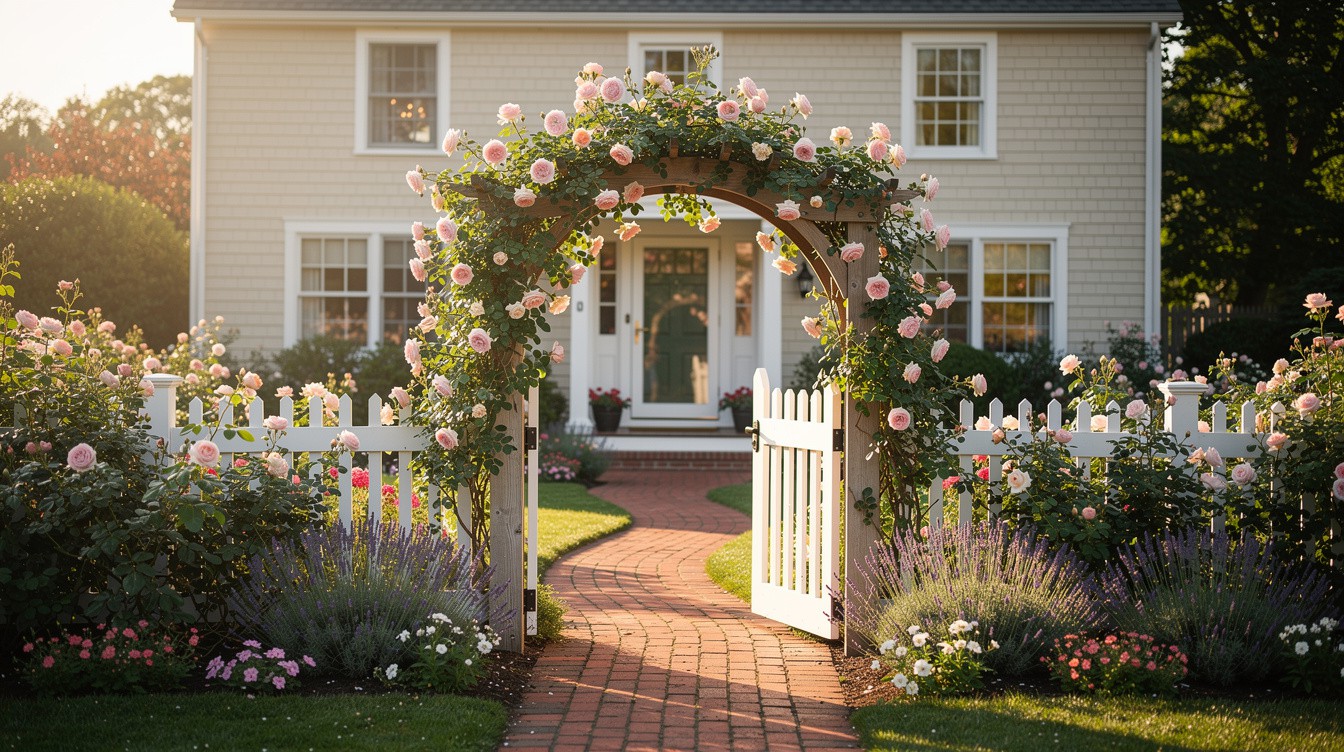
The Benefit Street Arbor Gate
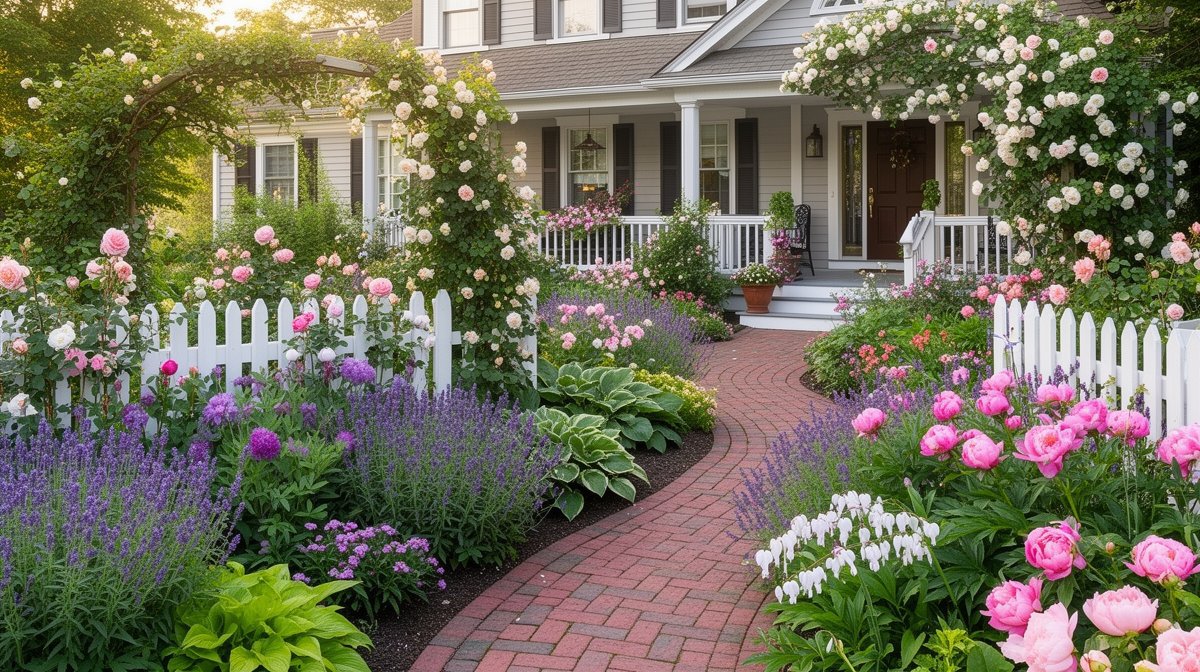
$28–48/sqftA cream clapboard Colonial with a deep-green front door, screened from the street by a low white picket fence and entered through a cedar arbor buried in blush climbing roses. A curved running-bond brick walk — the same red clay brick that paves half of College Hill — swings from the gate to a brick stoop, and the beds either side are layered simply: a front rank of silver-grey lavender, a middle mass of pink shrub roses, and a back screen of taller roses tumbling over the pickets. It is a shallow, wide front yard doing everything a Providence front yard can do, with the arbor supplying the height the lot cannot.
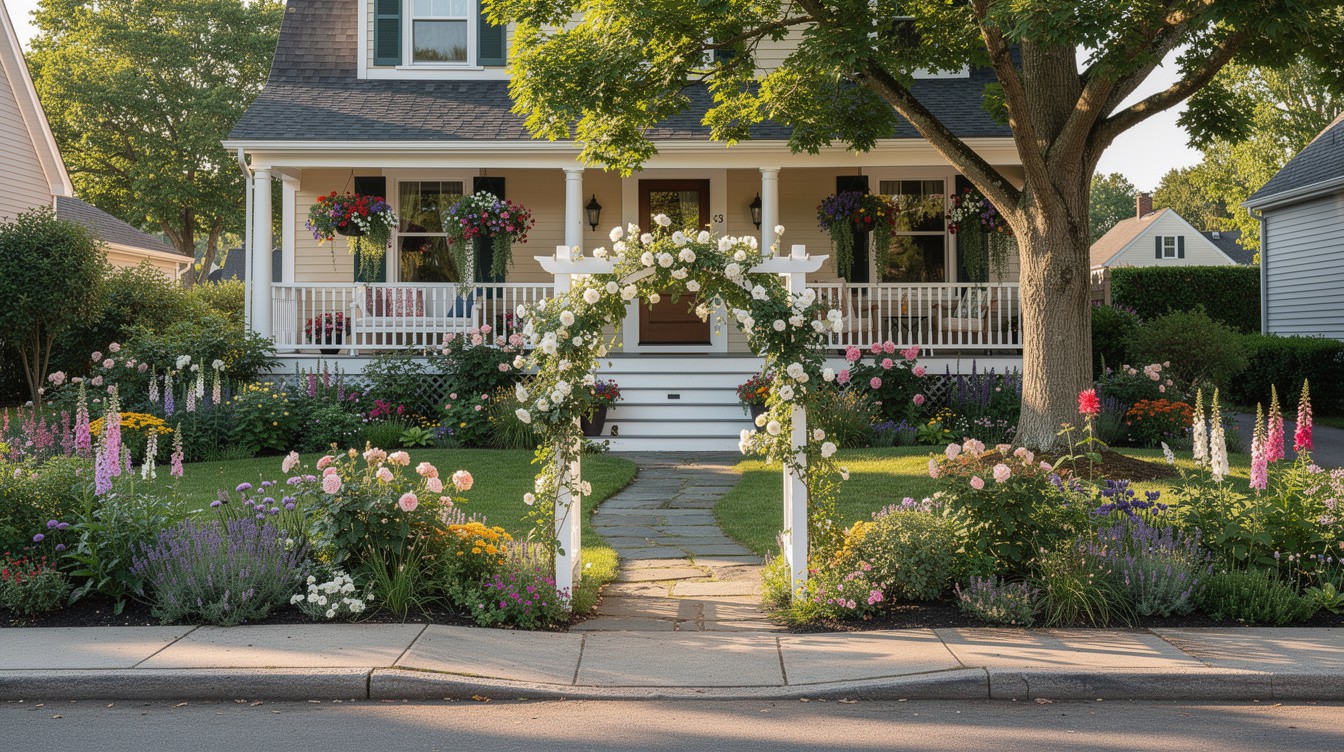
The Sidewalk-to-Porch Cottage Border
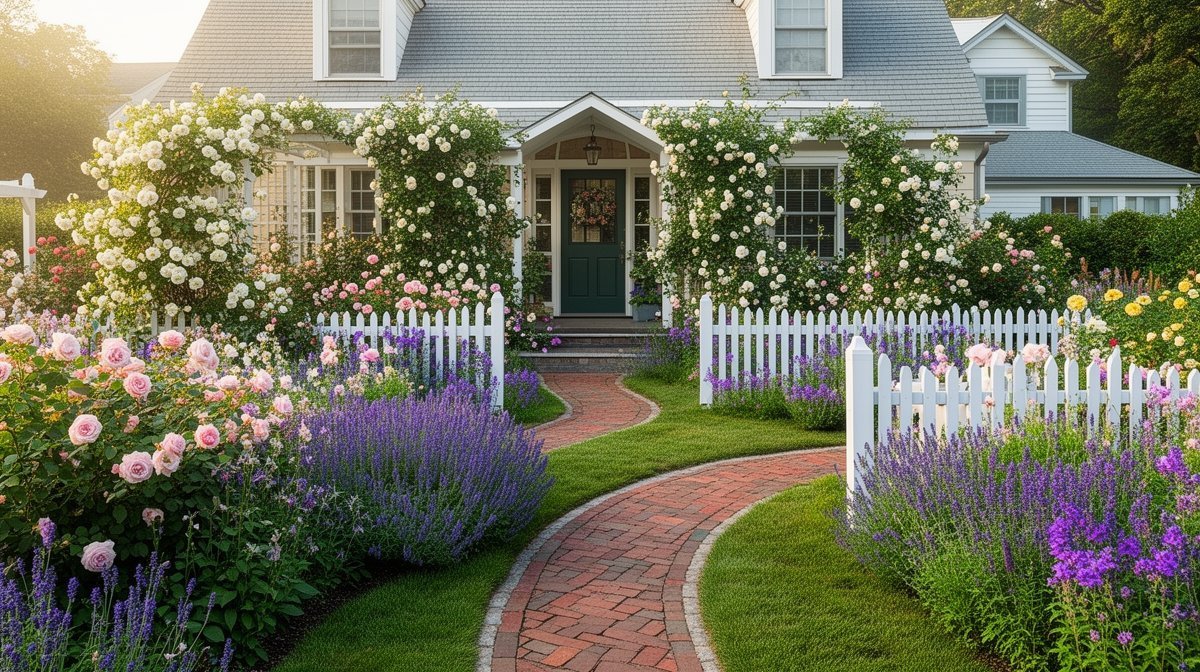
$22–40/sqftA dormered cape with a full-width farmer's porch, hanging baskets on every post, and a white lattice arbor of ivory climbing roses marking the entry. The lawn survives only as a narrow green carpet; everything else is a deep mixed border that runs straight to the public sidewalk, packed with spires of foxglove, drifts of lavender and catmint, and a scatter of hot dahlias and coreopsis for late colour. A mature street maple throws half the bed into afternoon shade, so the planting quietly shifts from sun-lovers at the curb to astilbe and hosta under the canopy — the split every Providence front yard has to solve.
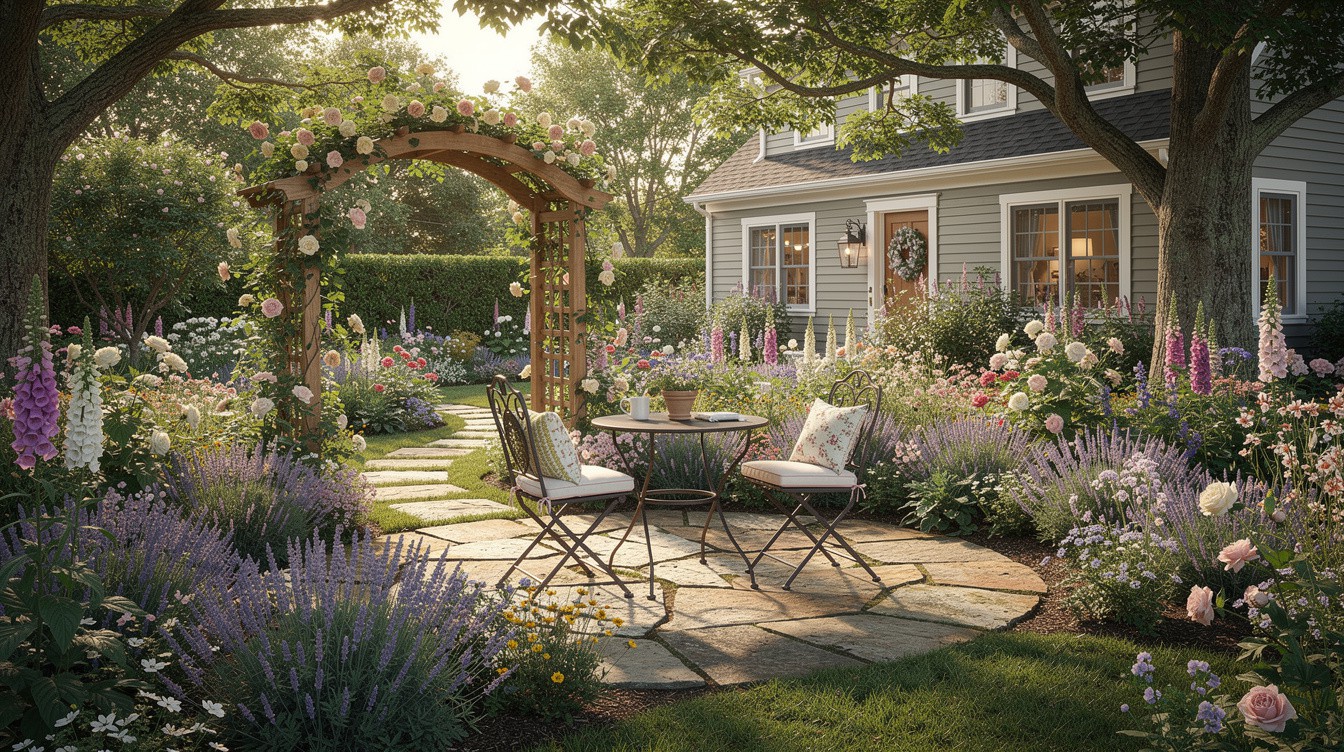
The Shaded Flagstone Tea Garden
$35–60/sqftTwo mature canopy trees frame a small circular terrace of irregular bluestone flagstone with an iron bistro set at the centre, reached by a line of stepping stones set flush in the lawn. A cedar arbor smothered in pink and cream roses marks the transition from lawn to terrace, and a clipped hornbeam hedge behind it erases the neighbour's driveway. The planting is deliberately loose and tall — foxglove and delphinium spires above billowing lavender, catmint and peonies — so the garden feels enclosed rather than small, which is the whole trick on an East Side back lot.
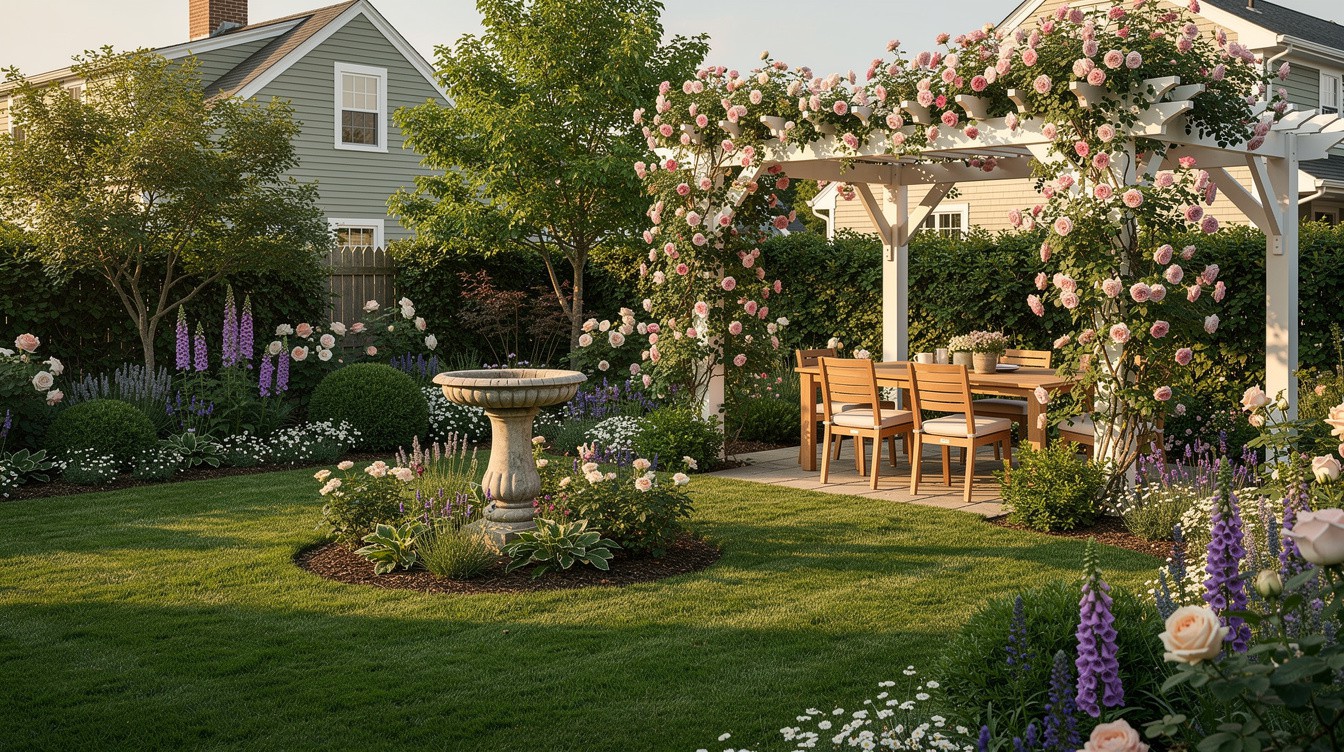
The Blackstone Boulevard Rose Pergola
$40–75/sqftA white-painted pergola against the property line, completely taken over by pink climbing roses, shelters a teak dining table for six on a modest bluestone pad. In front of it, an open circle of lawn is anchored by a carved stone pedestal birdbath in an island bed of clipped box spheres, lamb's ear and low roses, and a tall dark hedge along the fence line makes the neighbouring house disappear. This is the most formal of the four — hedge, lawn circle, pergola, focal ornament — and it is the design that best fits the larger Victorian lots on the boulevard.
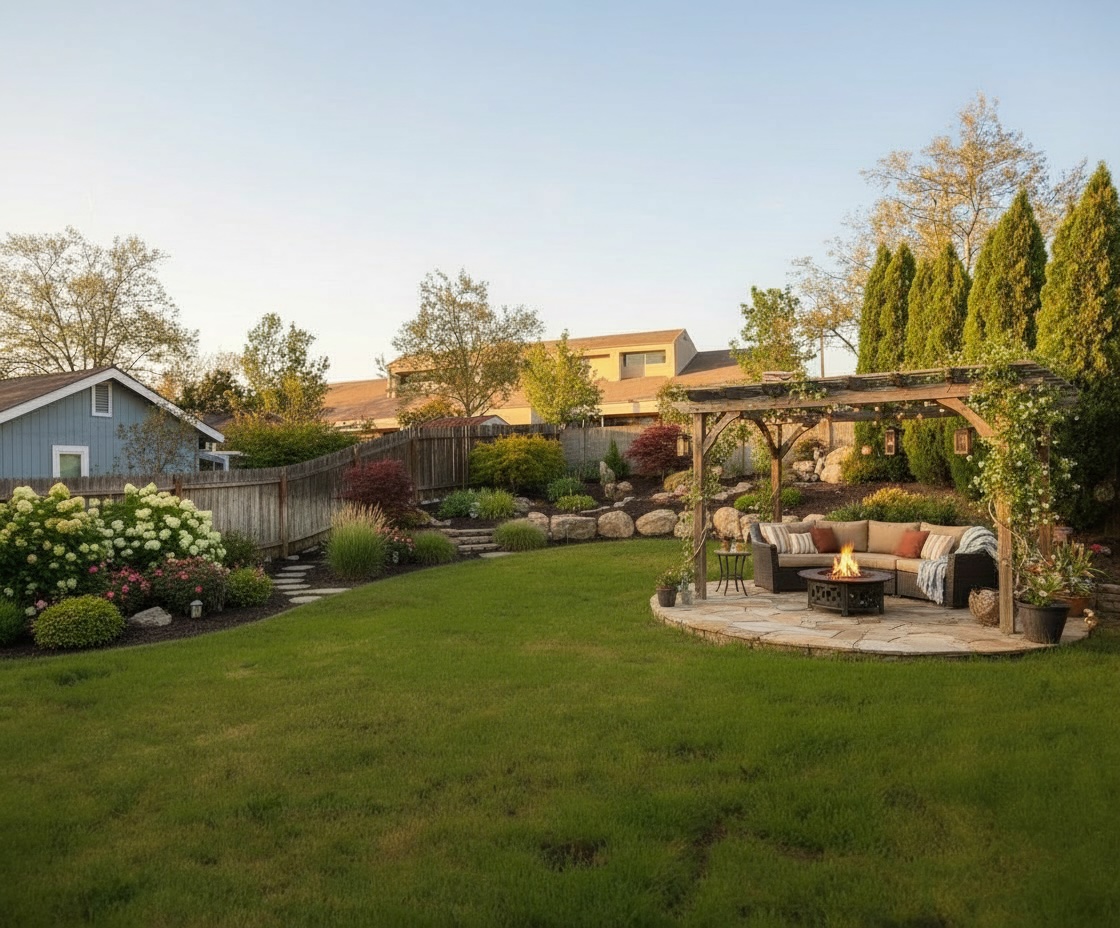
See how a cottage/english garden looks on YOUR property
Upload a photo of your Providence yard and visualize your dream garden in seconds.
Try ProScapeAI Free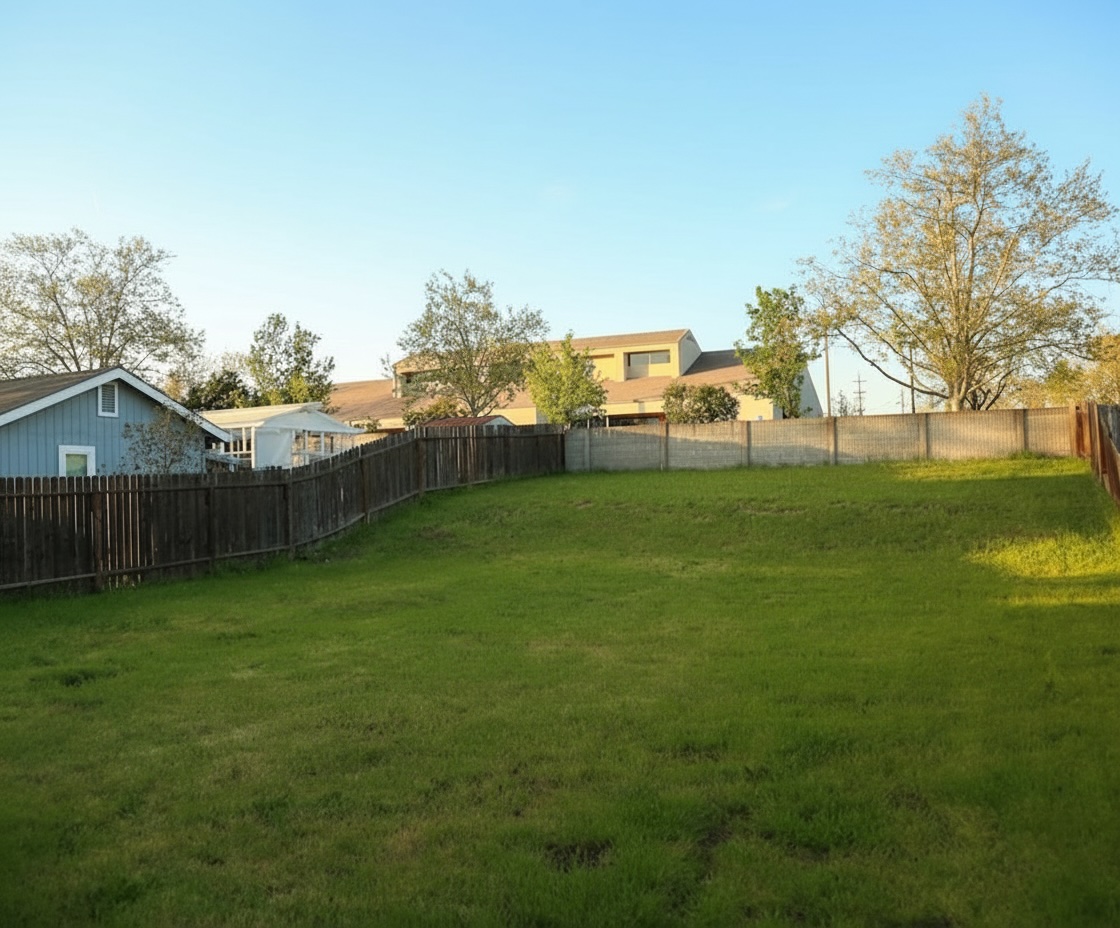
Featured Trees & Shrubs for Cottage/English Gardens
Browse all 38 plants for Providence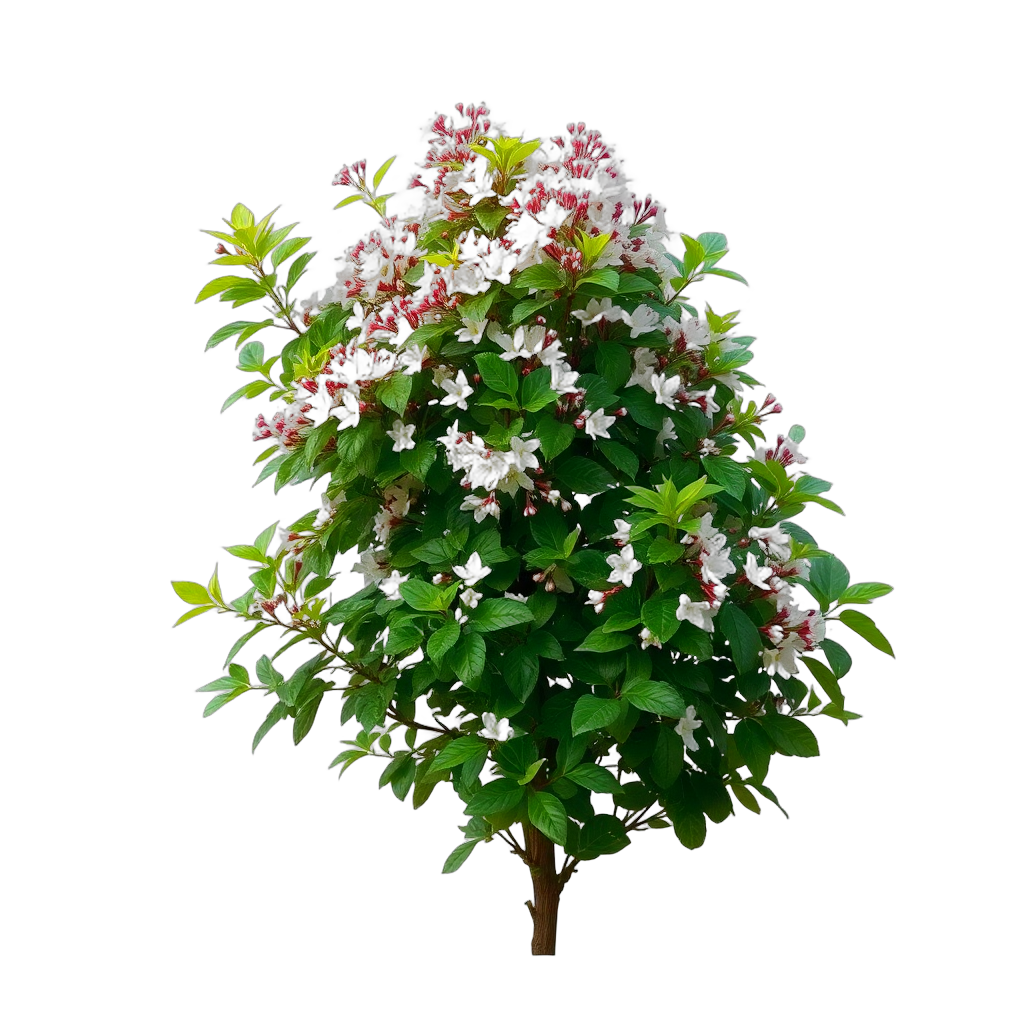
Arrowwood Viburnum
Viburnum dentatum
medium-sized at 10 feet, white blooms in spring. Pollinator-friendly.
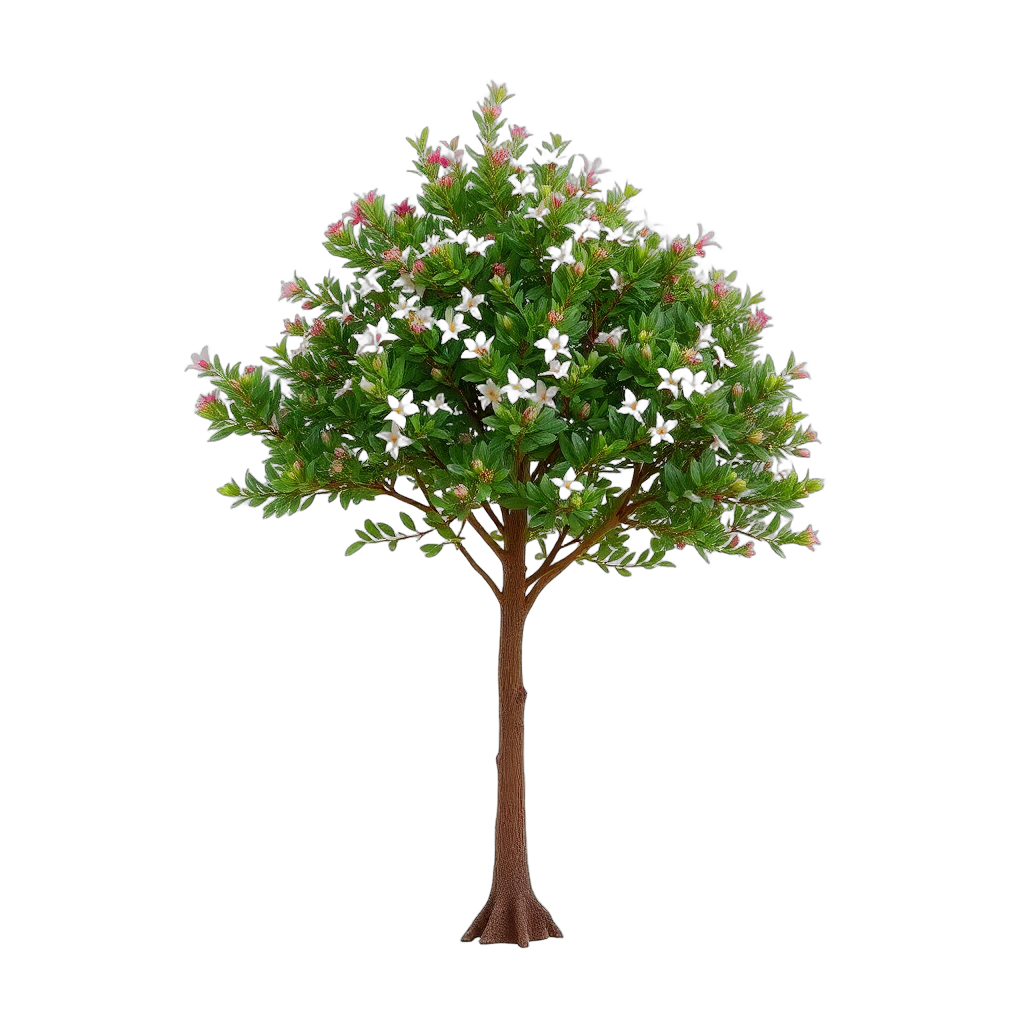
Coastal Leucothoe
Leucothoe axillaris
grows to 3 feet, white blooms in spring. Evergreen year-round.
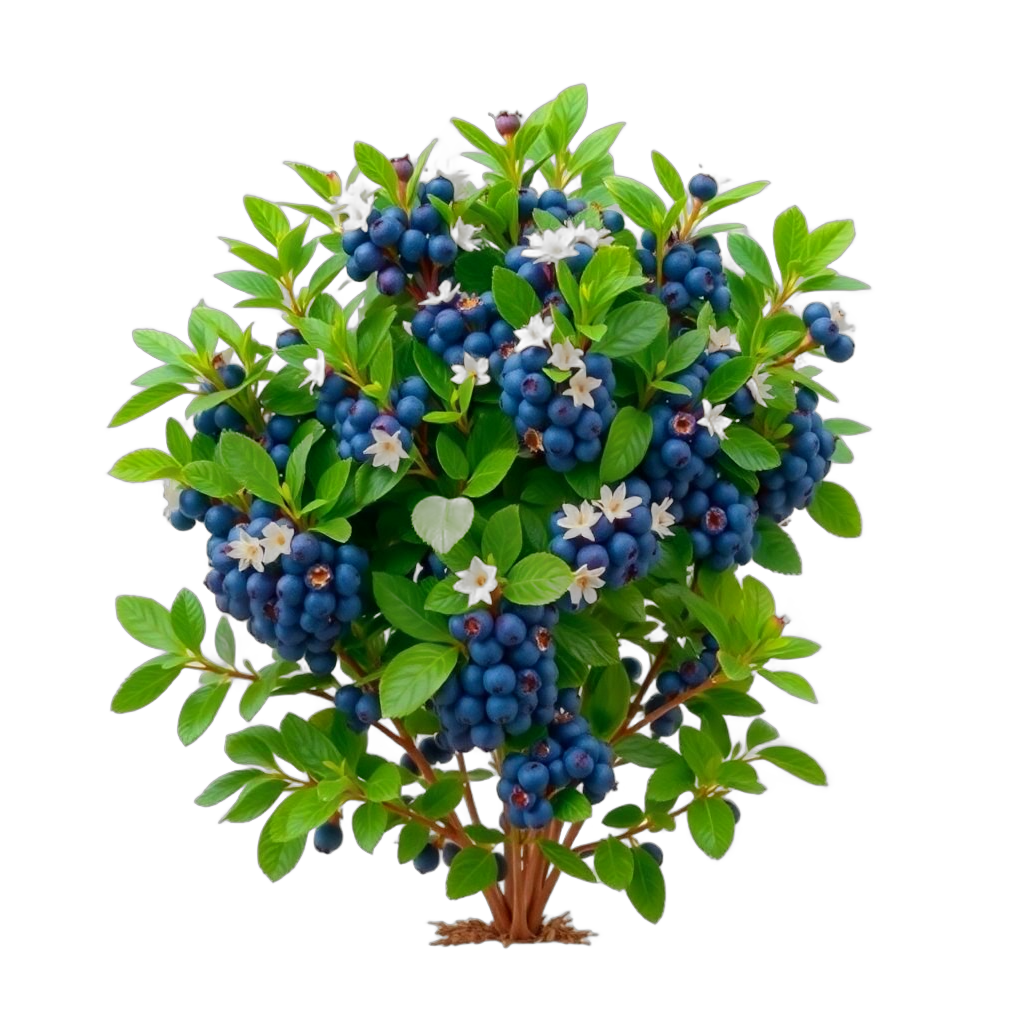
Highbush Blueberry
Vaccinium corymbosum
medium-sized at 7 feet, white blooms in spring. Attracts butterflies.

Inkberry
Ilex glabra
medium-sized at 8 feet, white blooms in spring. Pollinator-friendly.
Featured Grasses & Groundcovers for Cottage/English Gardens
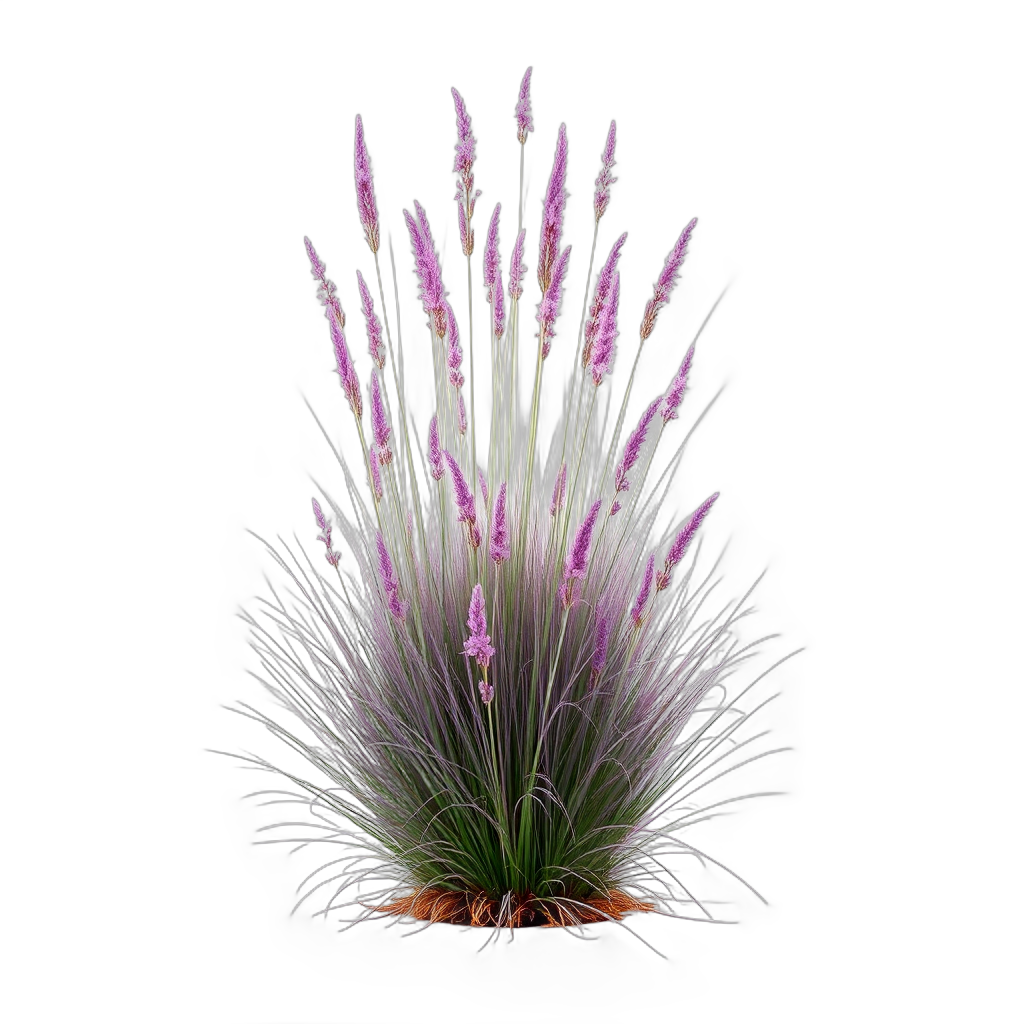
Purple Love Grass
Eragrostis spectabilis
low-growing ground cover, purple blooms in fall. Orange fall color.

Kentucky Bluegrass
Poa pratensis
low-growing ground cover, blooms in spring. Brown fall color.
Featured Flowers & Perennials for Cottage/English Gardens
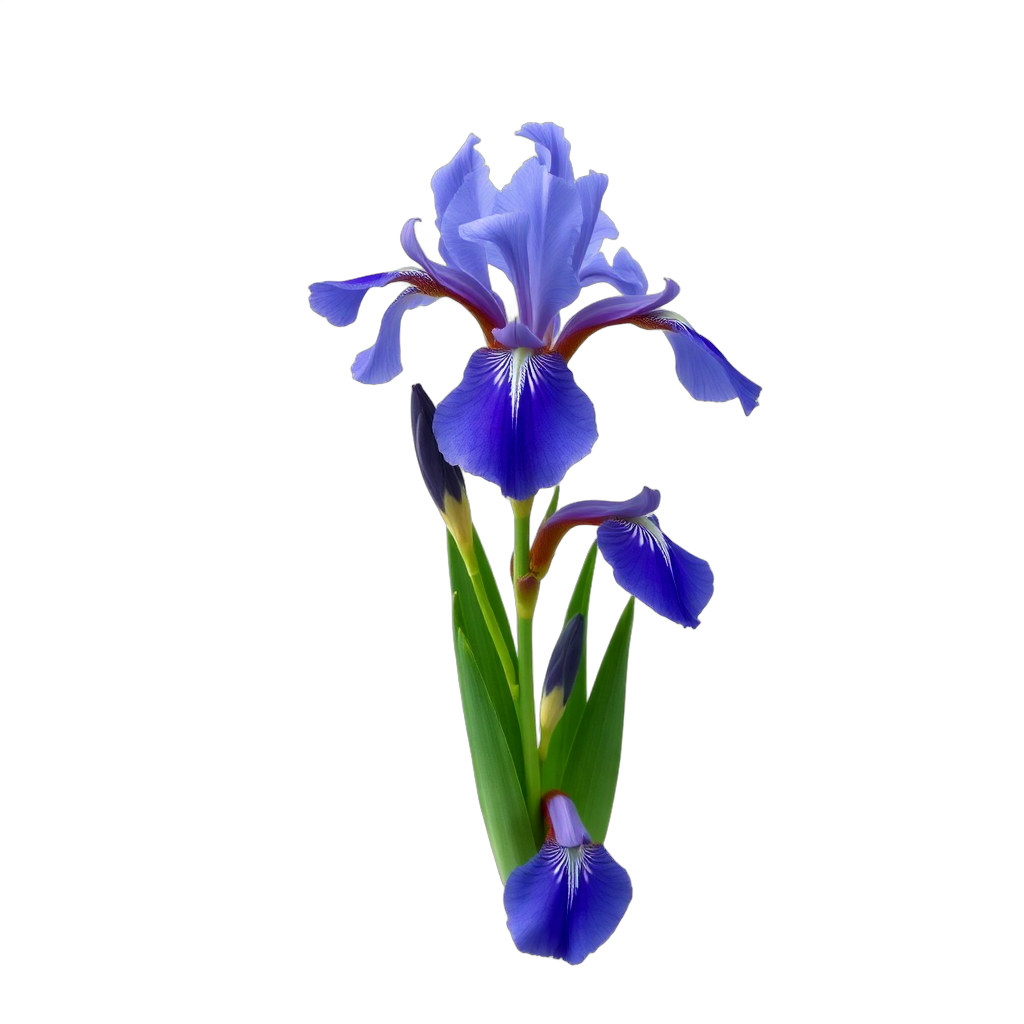
Blue Flag Iris
Iris versicolor
low-growing ground cover, purple blooms in spring. Attracts butterflies.

New York Ironweed
Vernonia noveboracensis
grows to 6 feet, purple blooms in fall. Attracts butterflies.
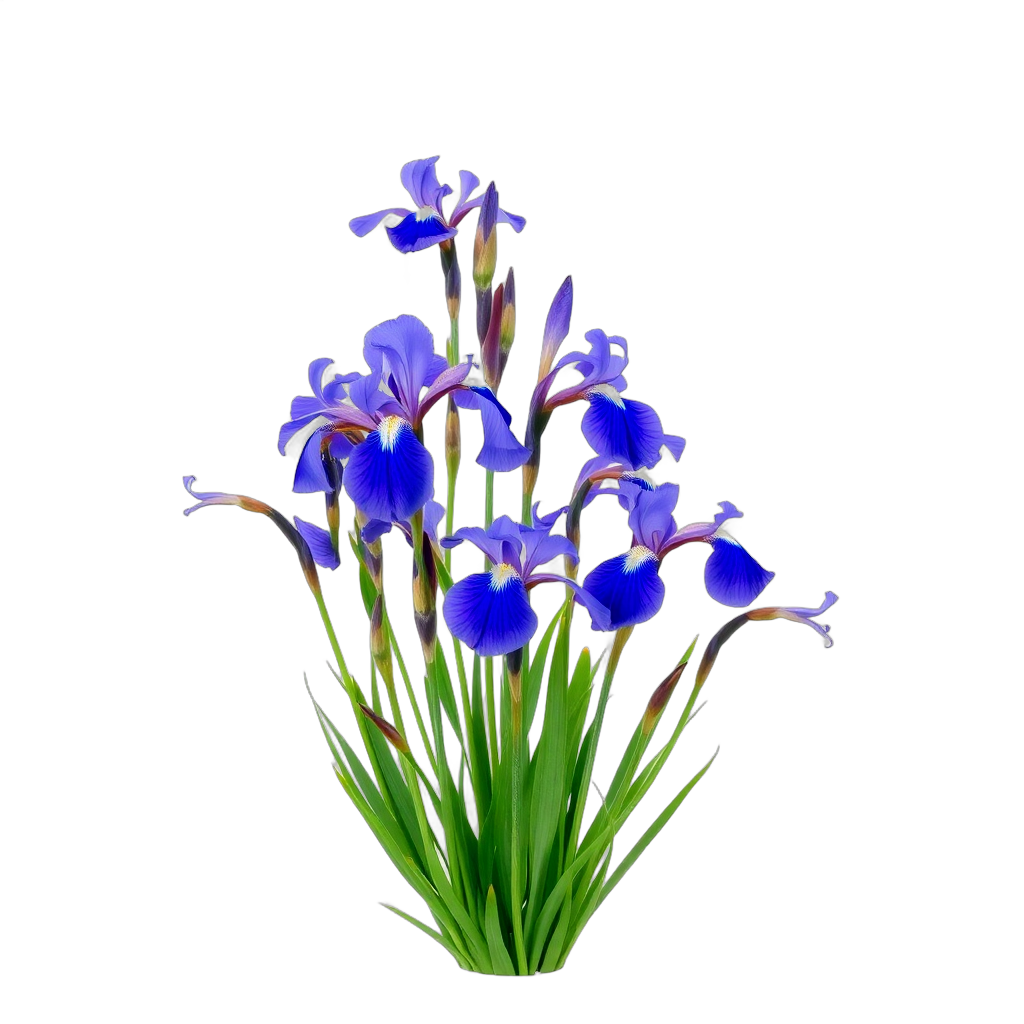
Southern Blue Flag
Iris virginica
low-growing ground cover, blue blooms in spring. Attracts butterflies.

Eastern Prickly Pear
Opuntia humifusa
low-growing ground cover, yellow blooms in summer. Attracts butterflies.
Bloom Calendar for Providence
spring
Blue Flag Iris, Southern Blue Flag, Arrowwood Viburnumsummer
Ruby Spice Summersweet, Summersweet, Eastern Prickly Pearfall
New York Ironweed, Purple Love Grasswinter
Limited bloomsDesign Tips for Providence (Zone 6b)
- Buy height instead of width — on a 40-foot-wide lot an arbor of Rosa 'New Dawn' or a wall of Hydrangea anomala subsp. petiolaris delivers more garden than any amount of extra bed depth ever will
- Test soil pH bed by bed: Providence glacial till at pH 4.8–5.5 makes Hydrangea macrophylla 'Endless Summer' bloom true blue for free, while Buxus 'Green Mountain', Nepeta 'Walker's Low' and Lavandula all need lime worked in before planting
- Raise every silver-leaved plant 6–10 inches above grade in gritty backfill — with 47 inches of rain and no dry season, Lavandula x intermedia 'Phenomenal', Stachys byzantina 'Helene von Stein' and Perovskia die of wet feet, never of cold
- Space for airflow, not for coverage: Providence humidity turns tight plantings of Phlox paniculata and roses into mildew factories, so allow full mature width and thin the interior canes of shrub roses every March
- Set arbor and pergola posts below the ~42-inch frost line on concrete footings, and dry-lay brick and bluestone on 6 inches of compacted open-graded base so the paving floats through freeze-thaw instead of cracking
- Cut back and stake before the snow, not after — a 30-inch New England snow load plus a February nor'easter will flatten Delphinium 'Blue Bird' and split unpruned Hydrangea paniculata 'Limelight'; leave Panicum and Sedum 'Autumn Joy' standing for winter structure instead
Where to Source Plants in Providence
Skip the big-box stores. These independent Providence nurseries specialize in the plants that make cottage/english gardens thrive in Zone 6b.
Homegrown
Pawtucket
Organically-grown native Rhode Island plants and perennials, hard-to-find species from native seed.
Wildwood Nursery & Garden Center
East Greenwich
Established independent nursery serving Rhode Island with a broad plant selection and landscape services.
Hattoy's Nursery & Garden Center
Coventry
Full-service garden center with plants, shrubs, trees, and landscaping services.
Cottage/English Landscaping Costs in Providence
| Project Scope | Estimated Cost |
|---|---|
| Front-yard cottage border (150–300 sqft, amended soil + 60–90 plants) | $6,500 – $16,000 |
| Reclaimed brick or bluestone front walk (60–120 sqft) | $4,500 – $11,000 |
| Cedar arbor + 50 ft painted picket fence | $6,000 – $15,000 |
| Dry-laid bluestone patio (250–400 sqft) | $12,000 – $30,000 |
| Cedar pergola + dining terrace + hedge screening | $25,000 – $60,000 |
| AI visualization with ProScapeAI | Free to start |
Estimates based on Providence, RI-area contractor rates as of 2026. Actual costs vary by site conditions, materials, and contractor.
Providence Climate & Growing Zone
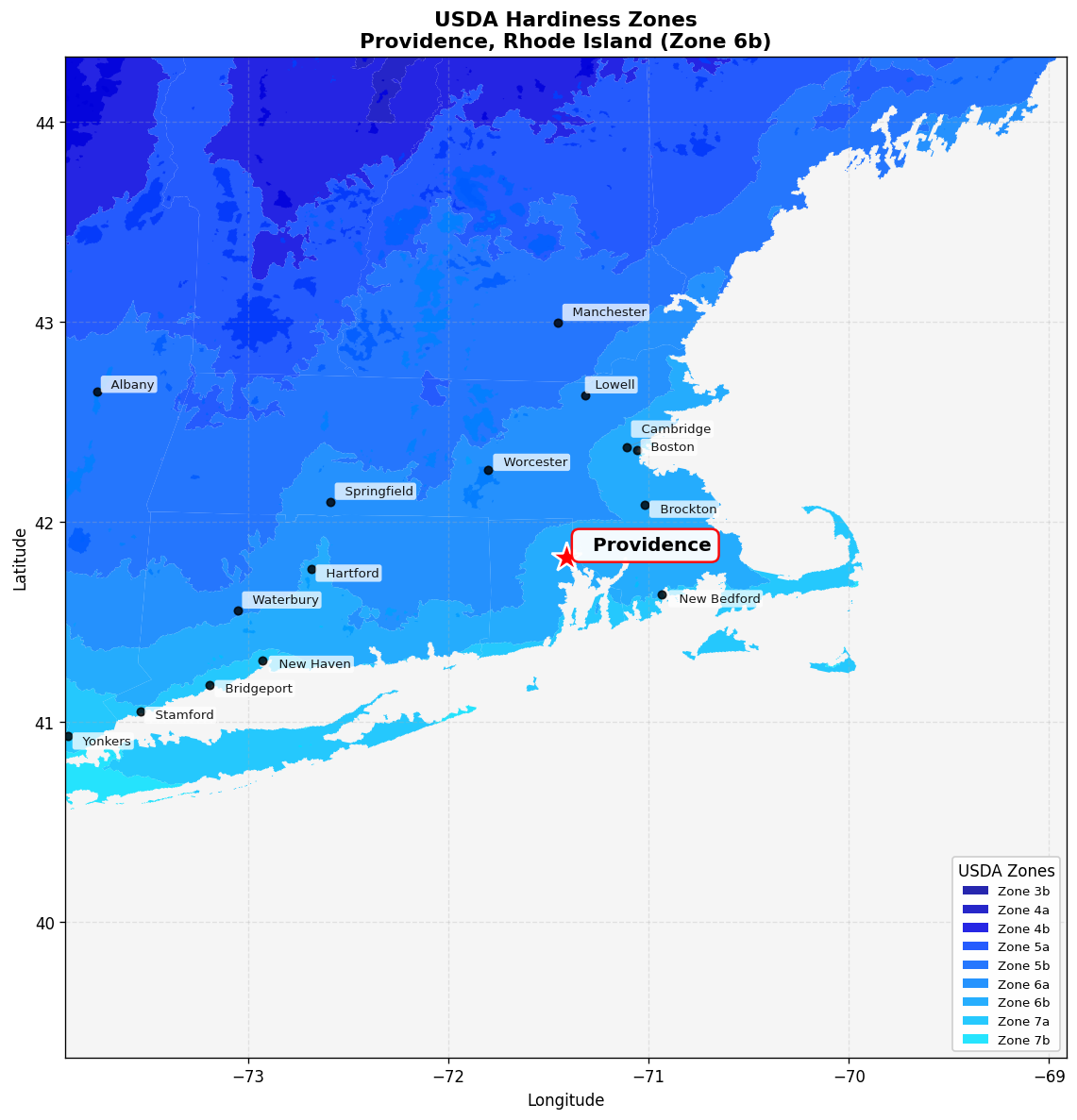
USDA Zone 6b
Hardiness zone for Providence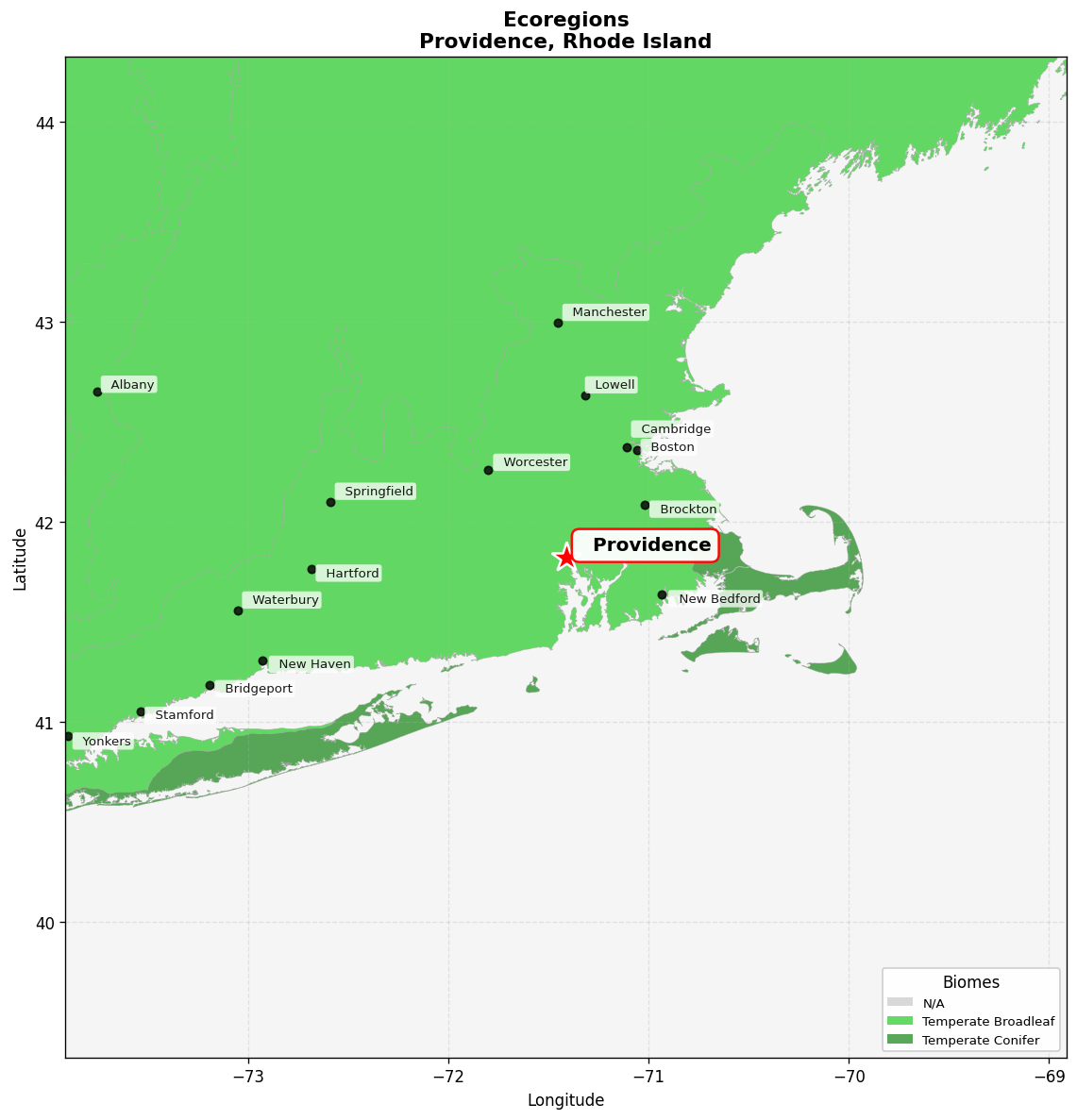
Northeast US Coastal forests
Native ecoregionFrequently Asked Questions
How much does a cottage garden cost in Providence?
New England labor is expensive — Providence installation rates run 20–30% above the national average, and rocky glacial till slows every excavation. A planted front-yard cottage border of 150–300 square feet, properly amended and stocked with 60–90 plants, runs $6,500–16,000 installed. A reclaimed brick or bluestone front walk costs $4,500–11,000. A cedar arbor plus 50 feet of white picket fence lands around $6,000–15,000, and a dry-laid bluestone back terrace of 250–400 square feet runs $12,000–30,000. Doing the planting yourself and hiring out only the masonry is the single biggest cost lever here.
Which roses actually thrive in Providence's humid, rainy climate?
Choose for disease resistance, not fragrance catalogues. Providence's ~47 inches of evenly spread rain and Narragansett Bay humidity make blackspot and powdery mildew the limiting factor. Rosa 'New Dawn' is the region's proven arbor climber — Zone 5 hardy, shade tolerant, and near-bulletproof. Rosa 'Sally Holmes', Rosa 'Bonica', Rosa 'Iceberg' and the Knock Out series all hold clean foliage through August. For curbside and coastal exposure nothing beats Rosa rugosa 'Alba', which shrugs off road salt and salt spray. Avoid modern hybrid teas unless you enjoy spraying; they defoliate by Labor Day on the East Side.
Will lavender survive a Rhode Island winter?
Cold is not the problem — Zone 6b lows of -5°F to 0°F are well within range for Lavandula angustifolia 'Munstead' and 'Hidcote'. Winter wet is what kills it. Providence receives rain and snowmelt in every month, and glacial-till subsoil holds it. Plant lavender in beds raised 6–10 inches above grade, cut 30–40% coarse grit or crushed stone into the backfill, mulch with gravel rather than bark, and add lime to counter the pH 4.8–5.5 native soil. Lavandula x intermedia 'Phenomenal' is the most reliable cultivar in southern New England and the one to plant if you only plant one.
What should I plant in the strip between the sidewalk and the curb?
Treat it as a separate, hostile microclimate. City and state plows throw road salt onto everything within about ten feet of the curb, and Providence's tight lots mean your best planting real estate is often exactly there. Salt-tolerant performers include Rosa rugosa and Rosa rugosa 'Alba', Hemerocallis 'Stella de Oro', Sedum 'Autumn Joy', Panicum virgatum 'Shenandoah', Perovskia atriplicifolia 'Blue Spire', Achillea 'Moonshine' and native Myrica pensylvanica. Never put Buxus 'Green Mountain', Taxus or hydrangeas at the curb — they brown out on the street side by March. Flushing the strip deeply in early April also helps leach accumulated salt.
How do I keep a cottage garden from looking messy on a small city lot?
Structure carries the informality. On a 40-by-100-foot Providence lot the planting can be as loose as you like as long as one hard element holds the line: a white picket fence, a clipped Buxus 'Green Velvet' or Taxus hedge, a brick edge, or a repeated rhythm of box spheres. Keep the plant list short and repeat it — five or six perennials in generous drifts always reads better than thirty singletons. Give every bed a crisp cut edge or steel edging, and choose one focal object per view, whether a rose arbor or a pedestal birdbath. Height matters more than area: arbors, pergolas and climbing roses buy you garden without buying square footage.
Do I need a permit or historic approval for a fence, arbor or patio in Providence?
Planting beds need nothing. Fences generally require a zoning check on height — six feet is the usual rear and side maximum, with lower limits in front yards. The bigger issue is that Providence has local historic districts, including College Hill, Broadway–Armory and Stimson Avenue, where the Providence Historic District Commission reviews exterior changes visible from the street: fences, walls, arbors, walkway materials and off-street parking all typically need a Certificate of Appropriateness. Ironically, this favours cottage design — picket fences and brick walks are exactly what the commission approves. Structures with footings, retaining walls over four feet and any work touching the sidewalk also need city permits.