4 Cottage Garden Ideas for Rancho Cucamonga, CA | Heat-Proof English Borders for Zone 10a
Native plants from the California coastal sage and chaparral (Zone 10a) — Mediterranean (hot summer) climate
Why Cottage/English Gardens in Rancho Cucamonga?
Rancho Cucamonga is a far better cottage-garden town than its climate data suggests. Armstrong Nurseries was founded just down Euclid Avenue in Ontario in 1889 and spent the better part of a century breeding roses for exactly this valley — hot, bright, low-humidity summers that produce a fraction of the blackspot and mildew pressure an actual English garden fights all season. The architectural bones are here too: the deep lots and horse-property frontages of Alta Loma, the 1900s farmhouses and eucalyptus windrows of historic Etiwanda, the Craftsman bungalows around Red Hill, and the tidy HOA streets of Terra Vista and Victoria Groves, where a white picket fence and a rose arch read as a genuine act of personality. What has to change is the plant list, not the idea.
A literal English border fails here — Zone 10a in Rancho Cucamonga means roughly 17 inches of rain, nearly all of it between November and March, followed by six months of 95–105°F afternoons. Delphinium, astilbe and Alchemilla mollis will not see July. The substitutions are easy and they look right: Rosa 'Iceberg' and Rosa 'Julia Child' for relentless repeat bloom, Rosa 'Sally Holmes' and David Austin's 'Olivia Rose Austin' where you want that blowsy, many-petalled look, and Rosa 'Eden' (Pierre de Ronsard) or climbing 'Cécile Brunner' over an arch. Trade English lavender for Lavandula × intermedia 'Provence' and Lavandula dentata, which actually enjoy inland heat, then fill between the roses with Nepeta × faassenii 'Walker's Low', Achillea 'Moonshine', Salvia leucantha 'Santa Barbara', Penstemon 'Margarita BOP' and a haze of Erigeron karvinskianus. Digitalis purpurea 'Camelot Rose' still earns its spires — just treat it as a cool-season annual set out in October, never a perennial.
Three local realities shape the build. The soil is alluvial fan — Tujunga and Hanford sandy loam washed out of Cucamonga Canyon, fast-draining, cobbly and nearly devoid of organic matter, so borders need three to four inches of compost tilled in, three inches of mulch on top, and inline drip run short and often rather than long and rarely. Santa Ana winds funneling out of Cajon Pass regularly hit 50–60 mph across Etiwanda and Day Creek from October through March, which means arbors get concrete footings instead of stakes and standard roses get tied low and early. And north of Banyan Street the Alta Loma and Etiwanda foothills sit inside a Very High Fire Hazard Severity Zone — the same ground the 2003 Grand Prix Fire ran through. Keep juniper, pampas grass and woody rosemary out of the first five feet around the house, and let irrigated roses, lavender and a gravel mow-strip do that work instead.
4 Cottage/English Design Ideas for Rancho Cucamonga
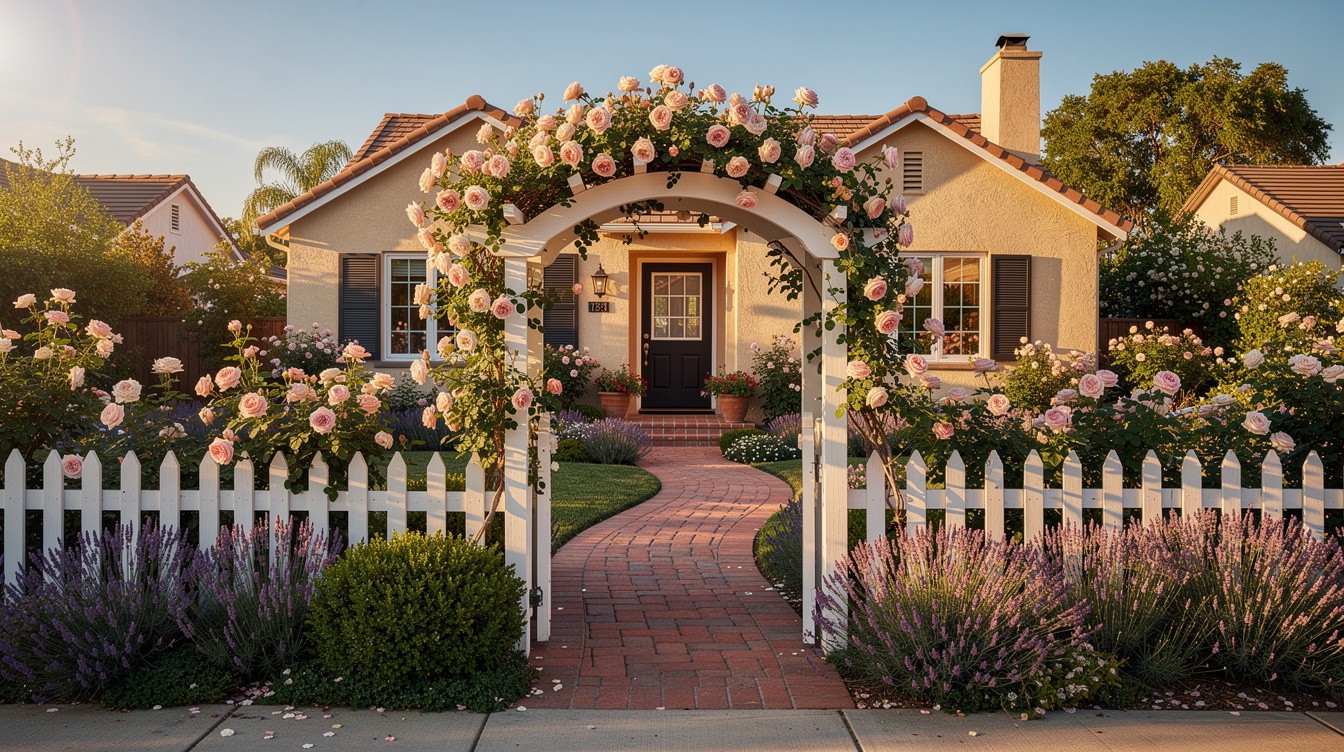
The Rose Arch Behind a Picket Fence
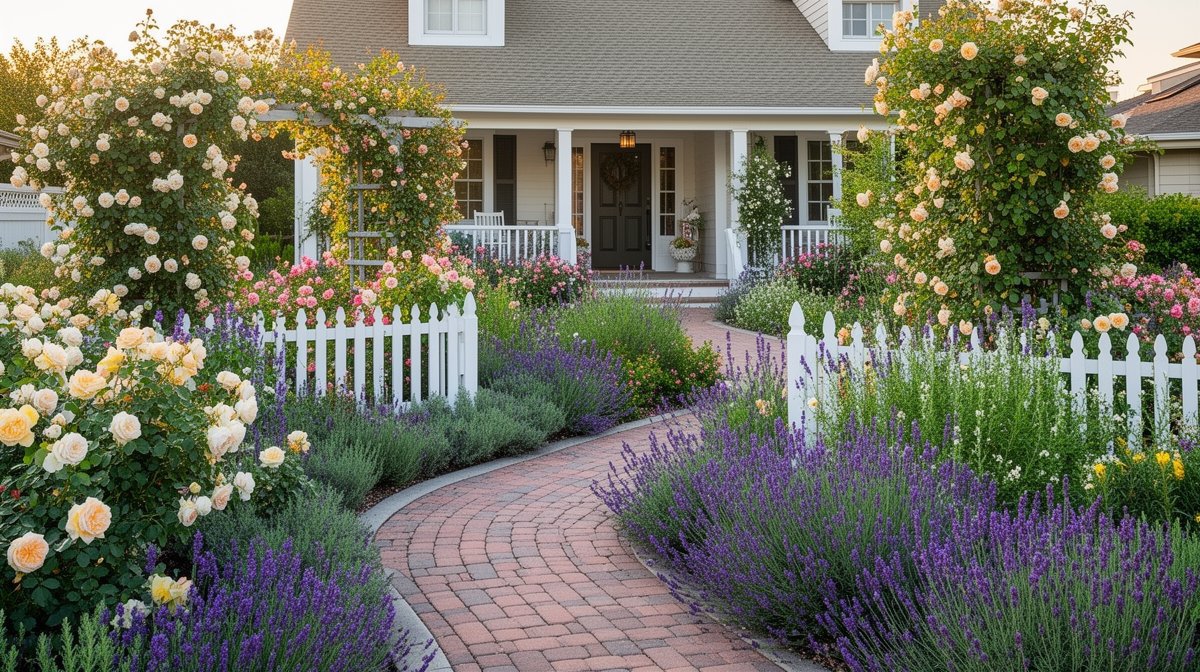
$18–34/sqftA cream stucco cottage with a clay tile roof and charcoal shutters sits behind a low white picket fence, and the whole composition hangs on one gesture: a timber arch over the gate completely swallowed by pink climbing roses. A curved clay-brick walkway runs from the gate to a black-painted door, edged by a narrow ribbon of lawn. Inside the fence, waist-high shrub roses in blush and rose-pink press up against the pickets; outside on the parkway strip, a continuous band of lavender takes the street-side heat and the reflected glare off the sidewalk — the one place in a Rancho Cucamonga front yard where nothing thirsty ever survives.
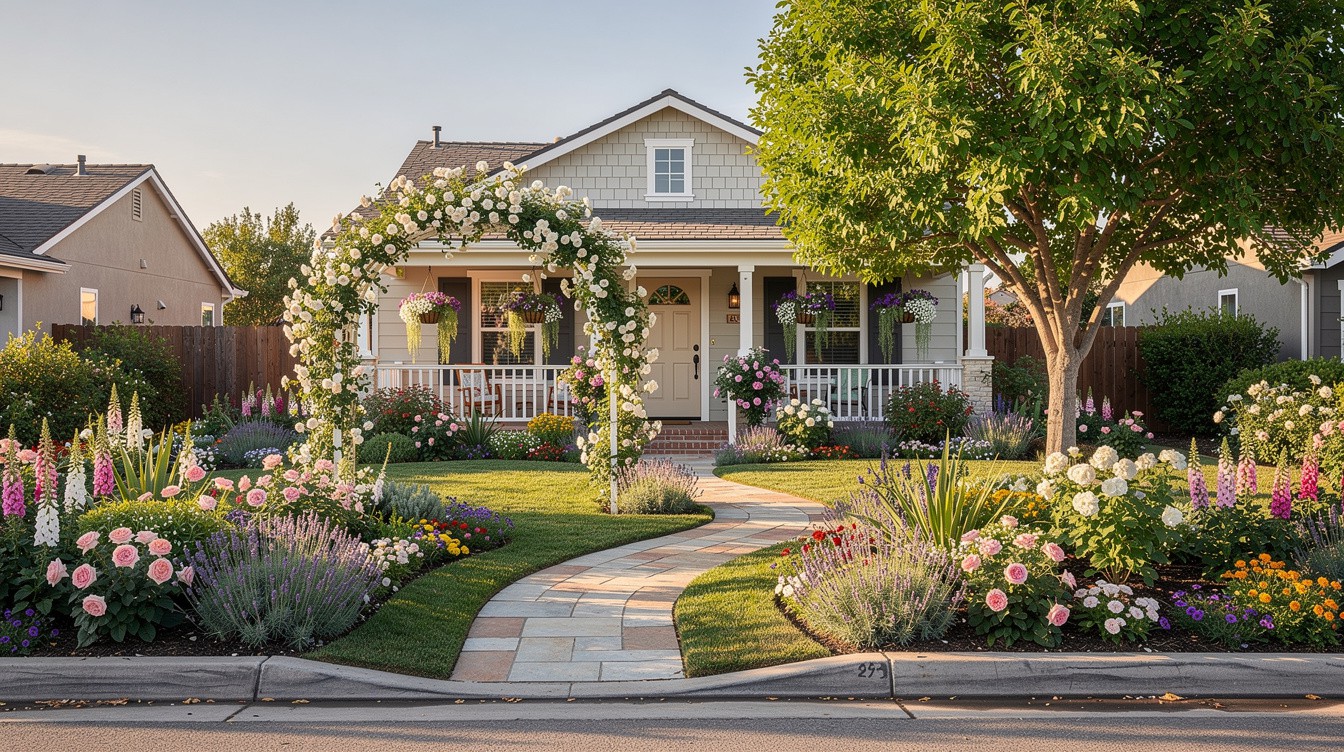
The Bungalow Arbor Walk
$16–30/sqftA gray-shingled Craftsman with a deep porch, hanging baskets and a paneled front door, approached through a white-painted arbor smothered in creamy climbing roses. The walkway is cut sandstone flagstone that curves rather than runs straight, and it is flanked by genuinely deep mixed borders — pink and white foxglove spires punching above shrub roses, lavender, and low mounds of catmint and yarrow, with a few blocks of hot annual color for contrast. A young deciduous shade tree stands in the remaining lawn on the right, doing the important job of throwing afternoon shade across a west-facing porch in August.
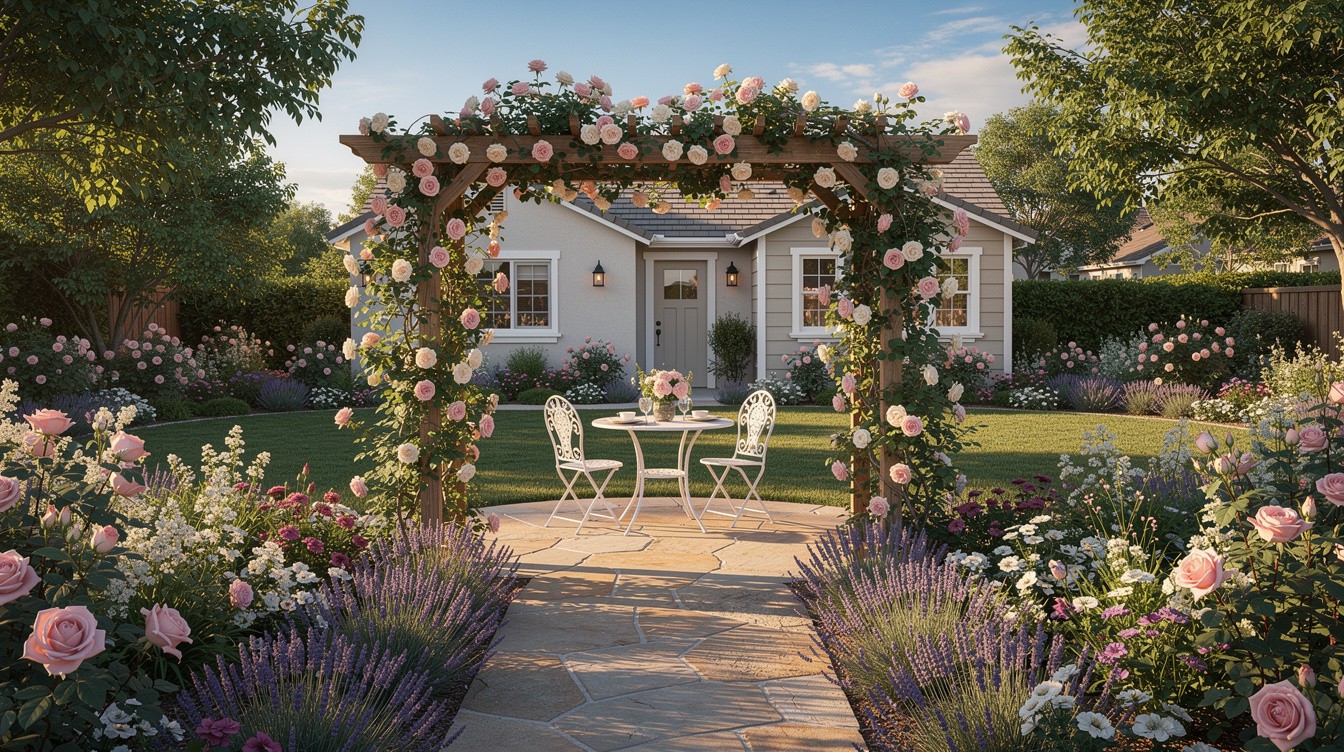
The Rose Pergola Tea Garden
$22–40/sqftBehind the house, a rough-sawn cedar pergola stands free in the lawn, draped end to end in pink and cream climbing roses, sheltering a small flagstone landing and a white wrought-iron bistro set. The lawn is kept deliberately small — a green rug, not a field — and the perimeter does all the work: layered beds of roses, lavender, Shasta daisies and purple salvia running to a clipped evergreen hedge that hides the neighbor's fence. A flagstone path splits the front beds and pulls you through the pergola, which is the whole trick; a cottage backyard should make you walk through something.
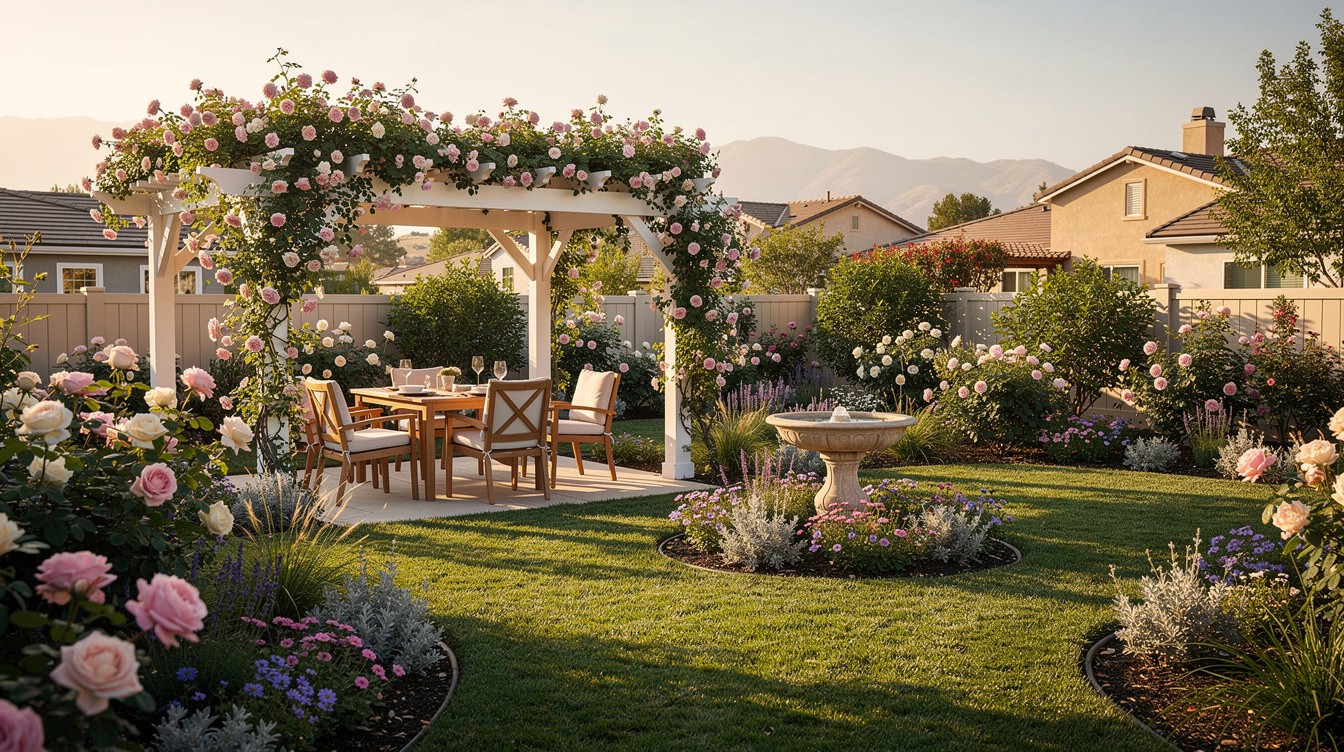
The Fountain Court with the San Gabriel Backdrop
$22–45/sqftA white pergola loaded with pink climbers covers a poured-concrete dining terrace and a teak table, and the lawn beyond is punctuated by a circular island bed holding a two-tier cast-stone fountain ringed in silver-foliage perennials. Steel edging keeps every bed line crisp against the grass. A continuous rose hedge softens the vinyl side fence, and the San Gabriel Mountains close the view to the north — which is the real design decision here: nothing tall goes in the middle of the yard, so the mountains stay the focal point and the fountain plays second.
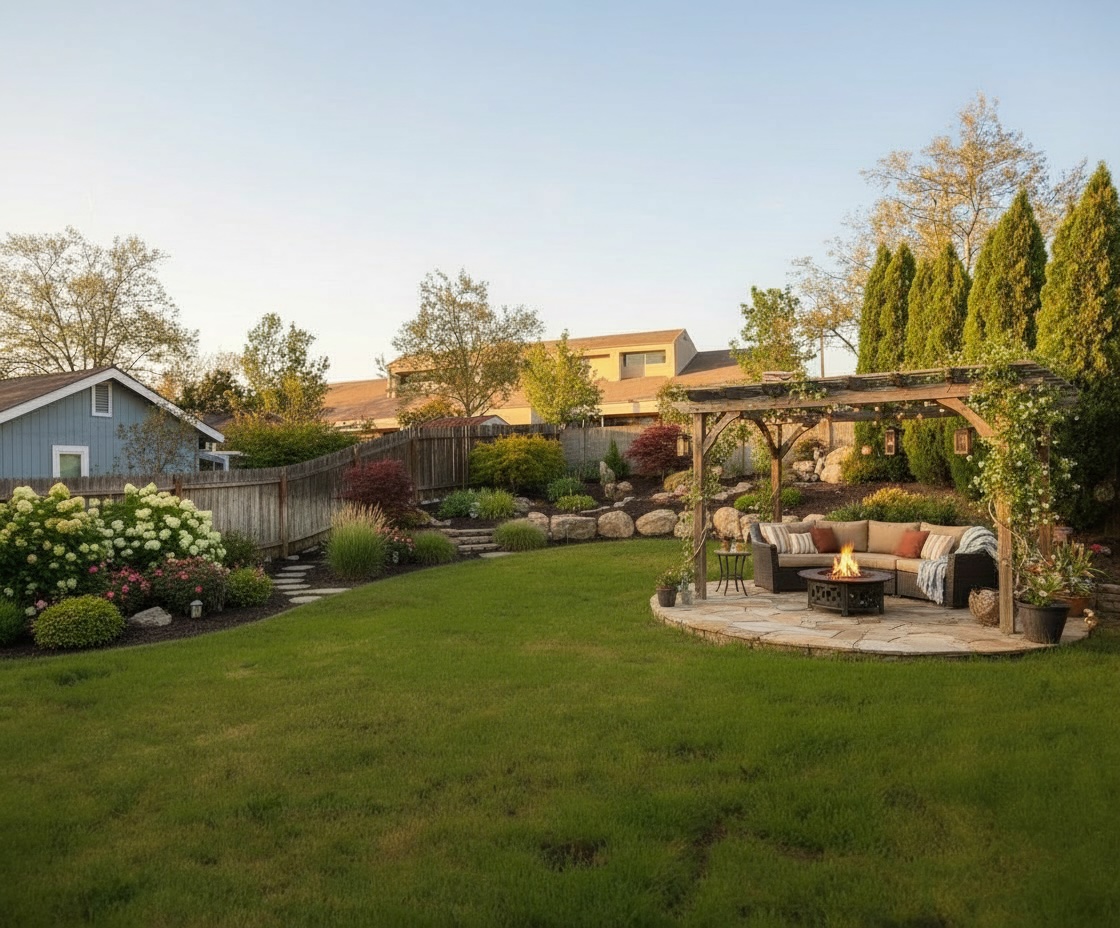
See how a cottage/english garden looks on YOUR property
Upload a photo of your Rancho Cucamonga yard and visualize your dream garden in seconds.
Try ProScapeAI Free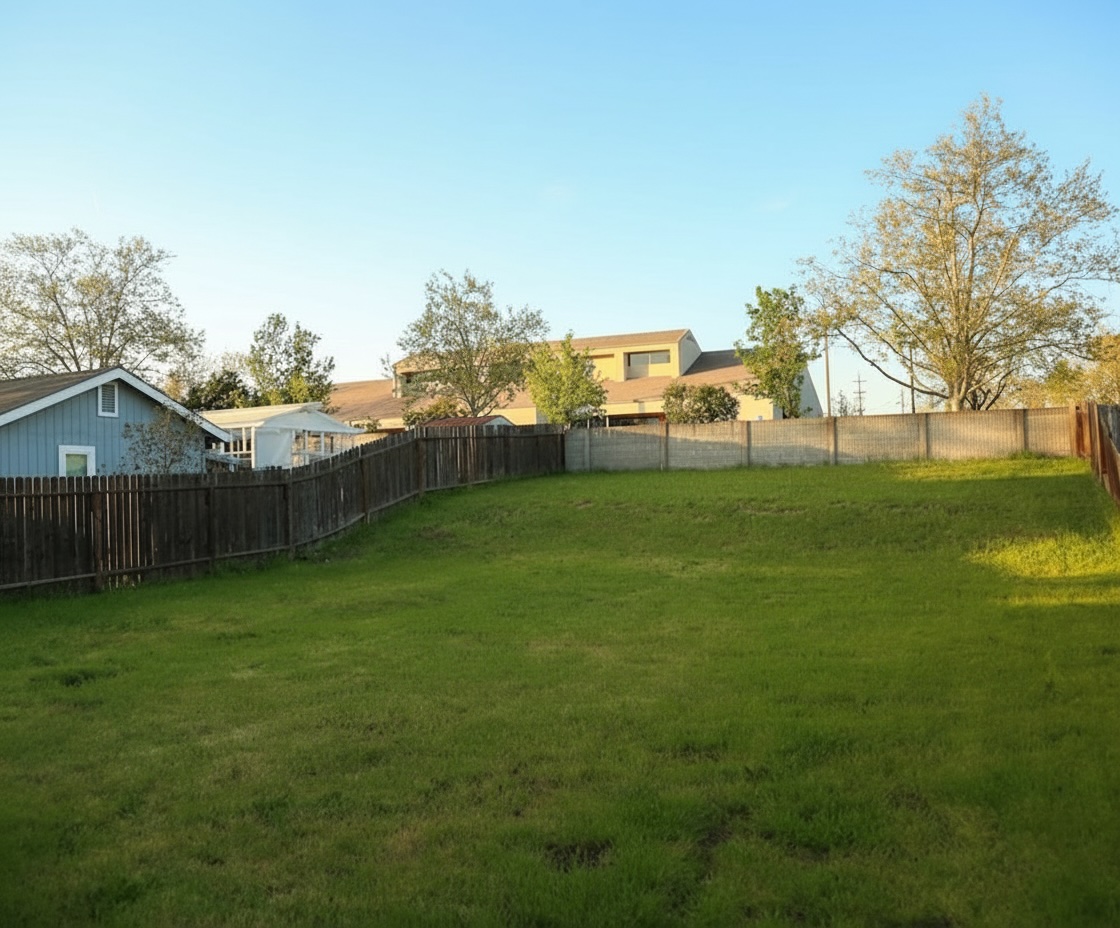
Featured Trees & Shrubs for Cottage/English Gardens
Browse all 115 plants for Rancho Cucamonga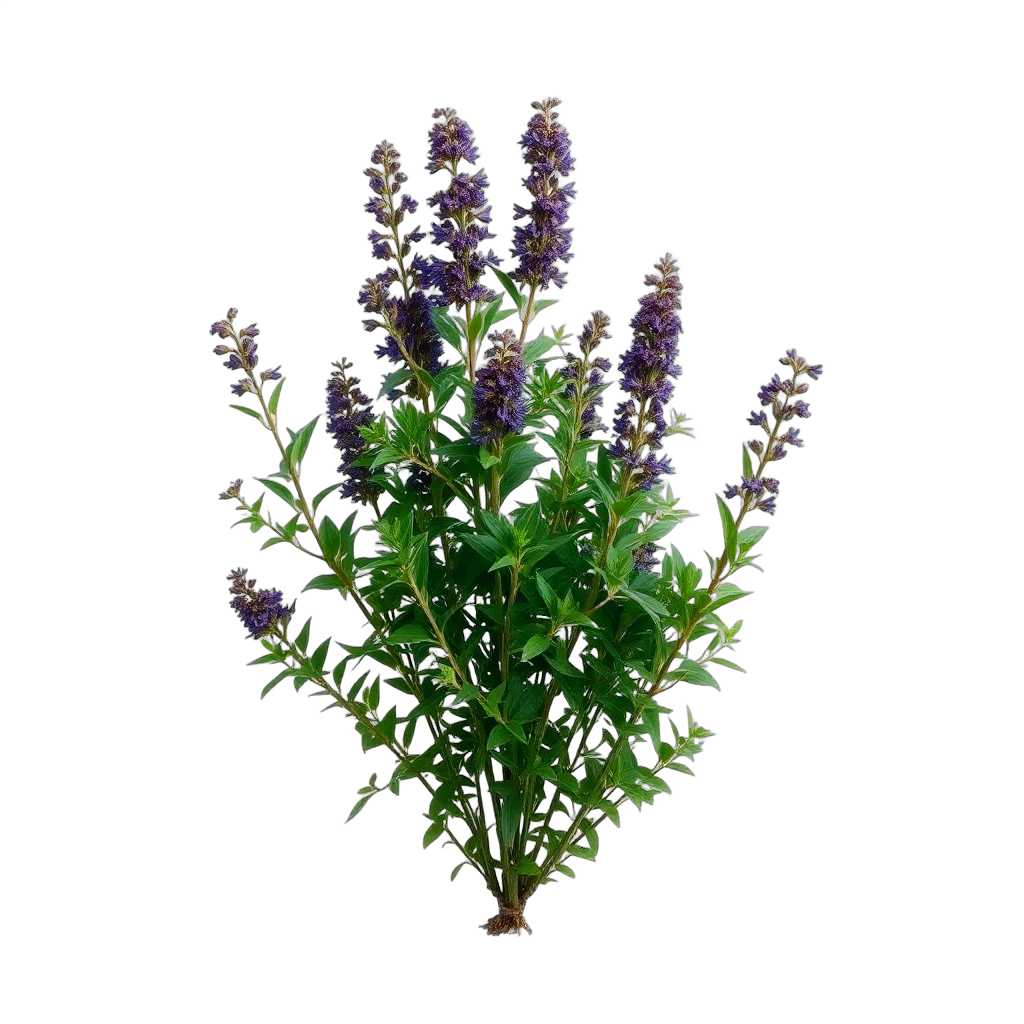
Black Sage
Salvia mellifera
grows to 4 feet, white blooms in spring. Attracts butterflies.

Blue Blossom
Ceanothus thyrsiflorus
medium-sized at 12 feet, blue blooms in spring. Attracts butterflies.

Blue Elderberry
Sambucus cerulea
medium-sized at 15 feet, white blooms in spring. Attracts butterflies.

Buckbrush
Ceanothus cuneatus
medium-sized at 7 feet, white blooms in spring. Attracts butterflies.
Featured Grasses & Groundcovers for Cottage/English Gardens
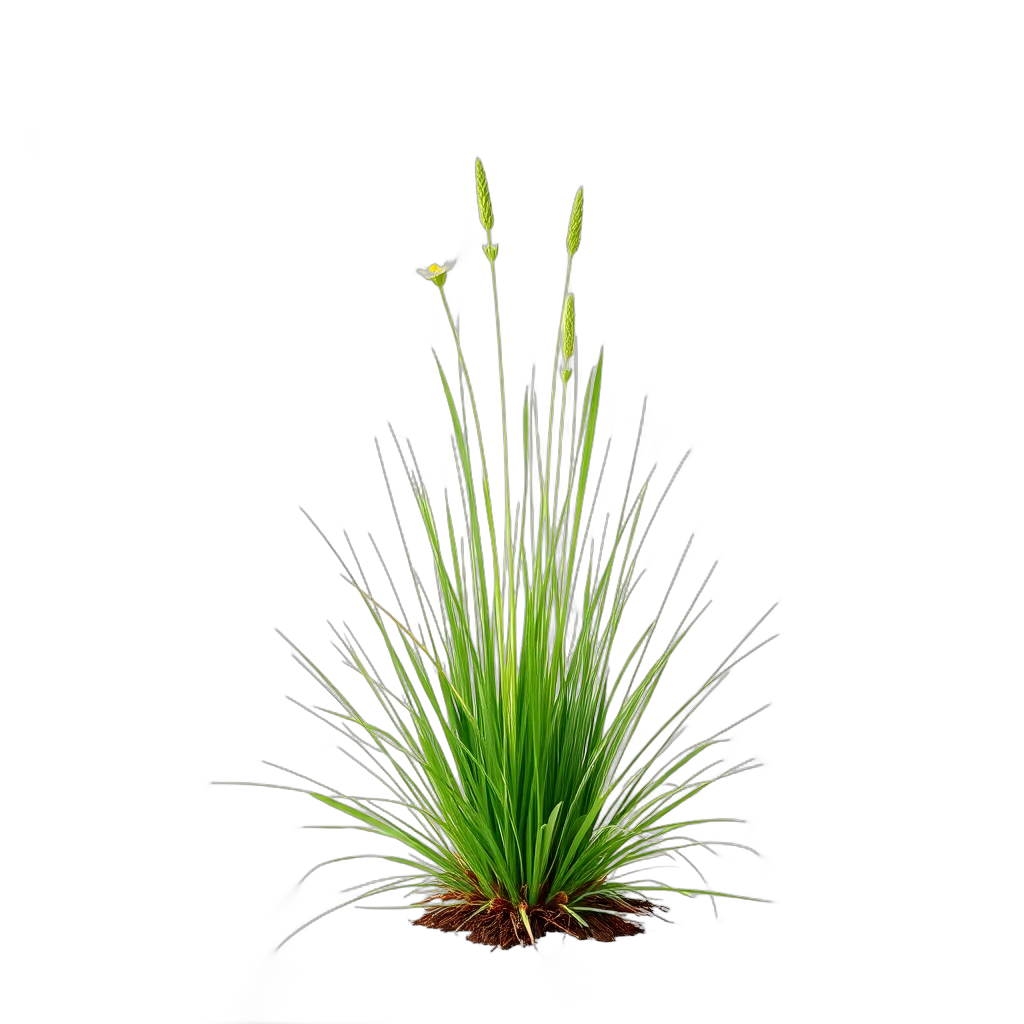
California Brome
Bromus carinatus
low-growing ground cover, blooms in spring. Yellow fall color.
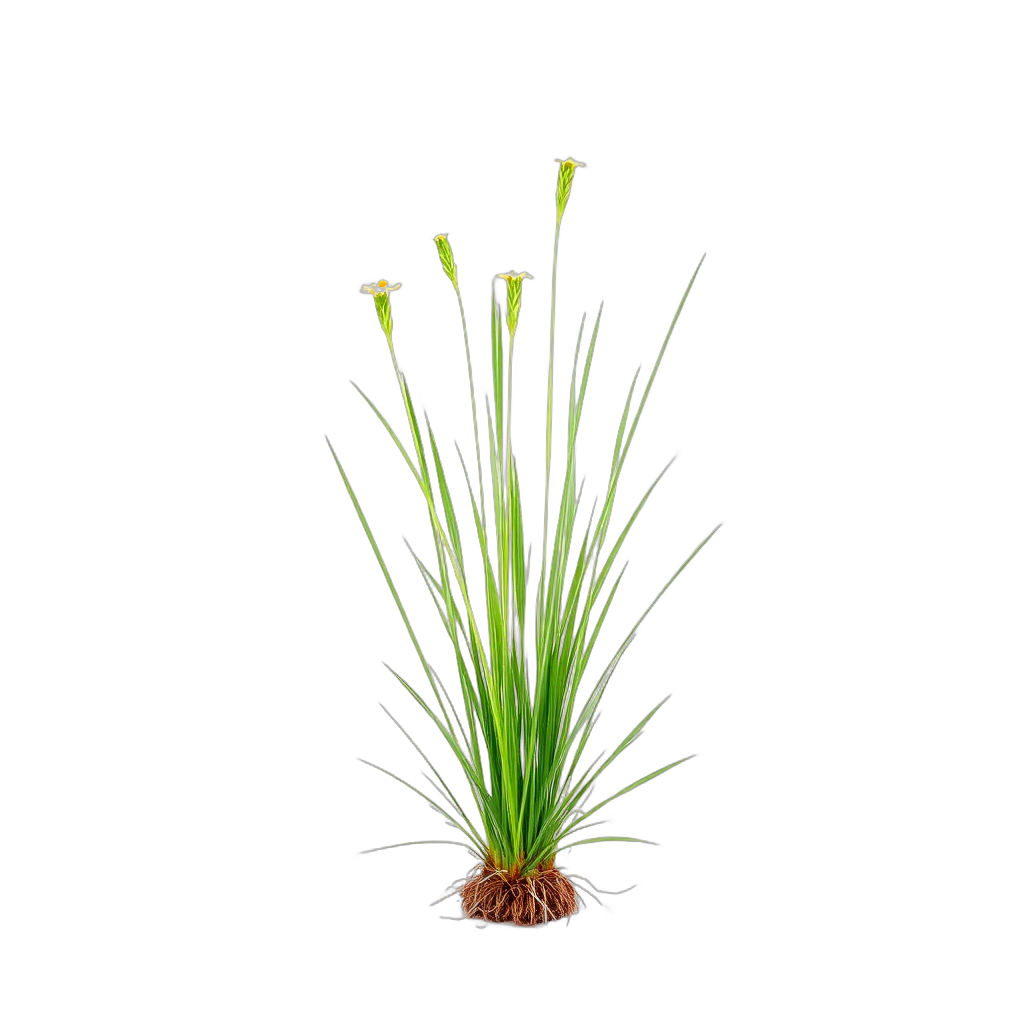
California Melic
Melica californica
low-growing ground cover, blooms in spring.
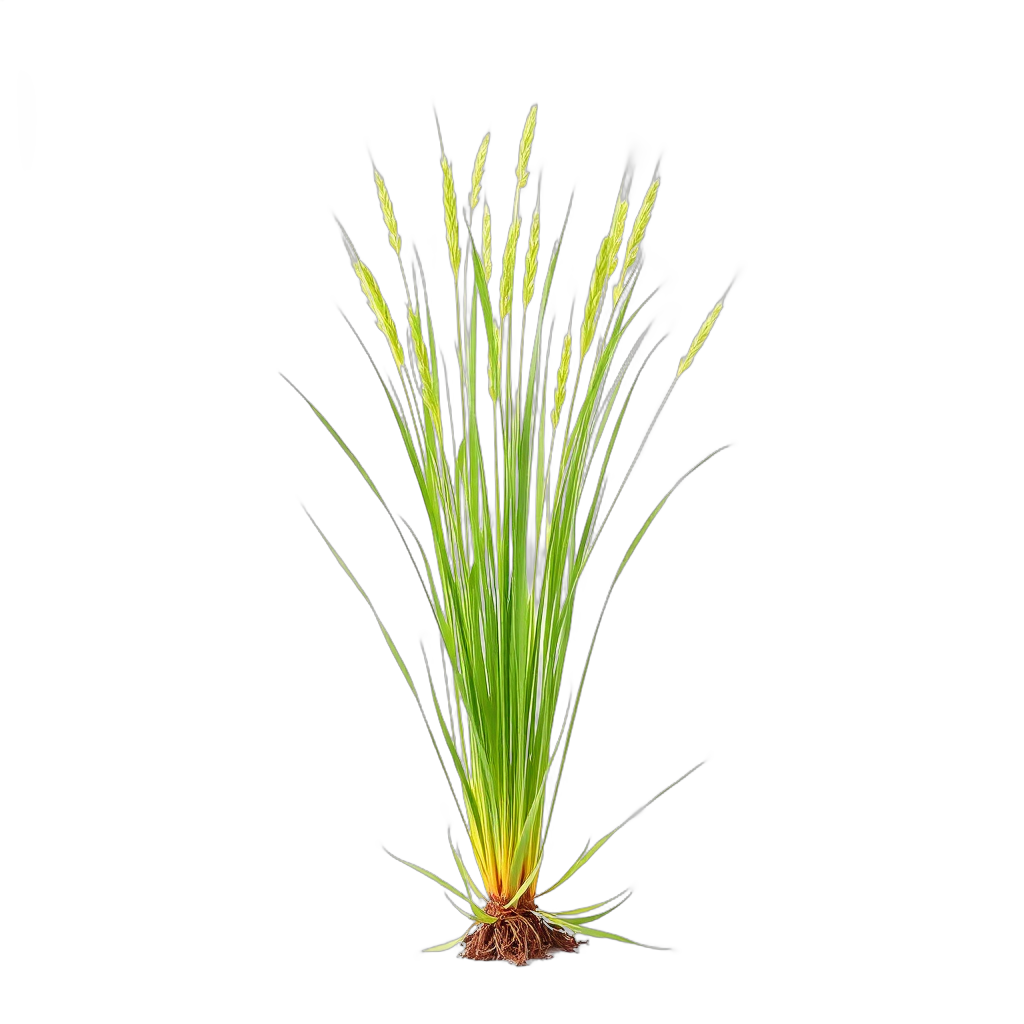
California Oatgrass
Danthonia californica
low-growing ground cover, blooms in spring. Yellow fall color.
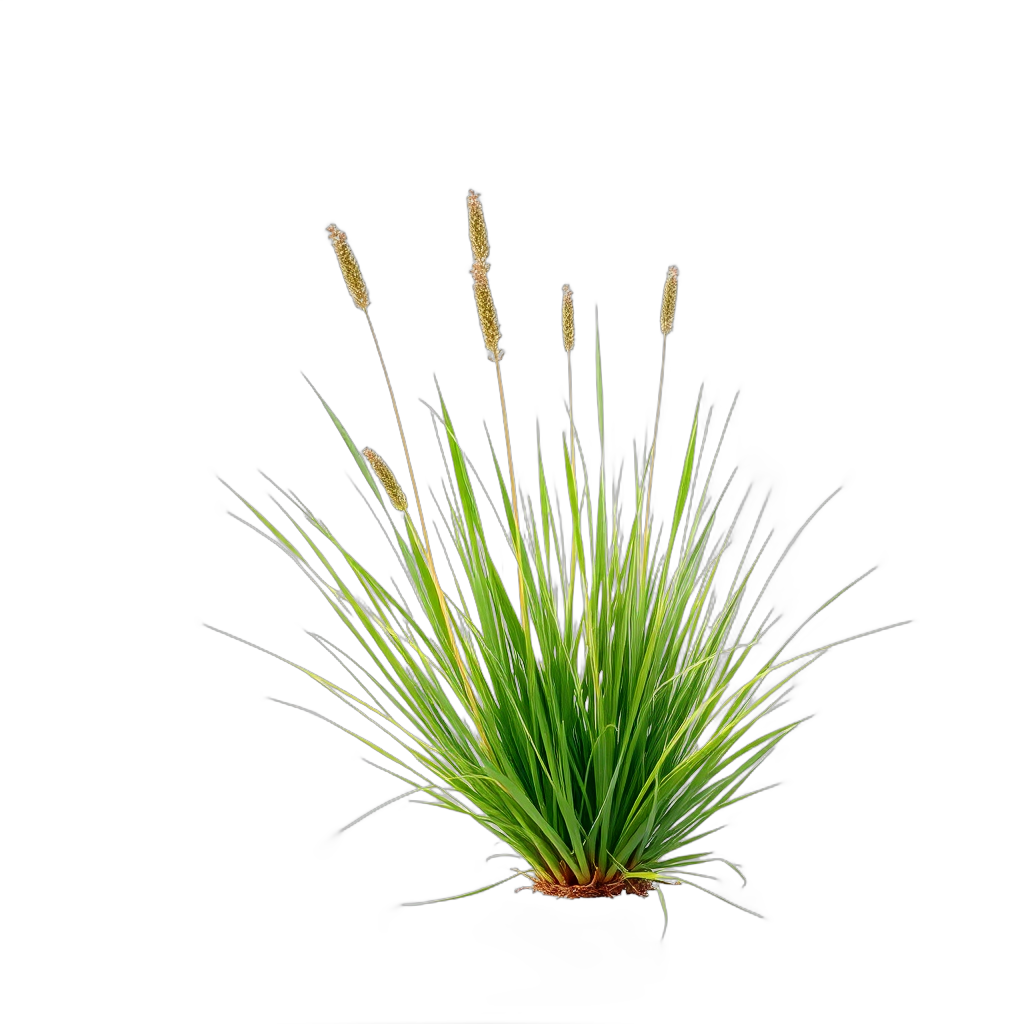
Deer Grass
Muhlenbergia rigens
grows to 3 feet, yellow blooms in fall. Evergreen year-round.
Featured Flowers & Perennials for Cottage/English Gardens
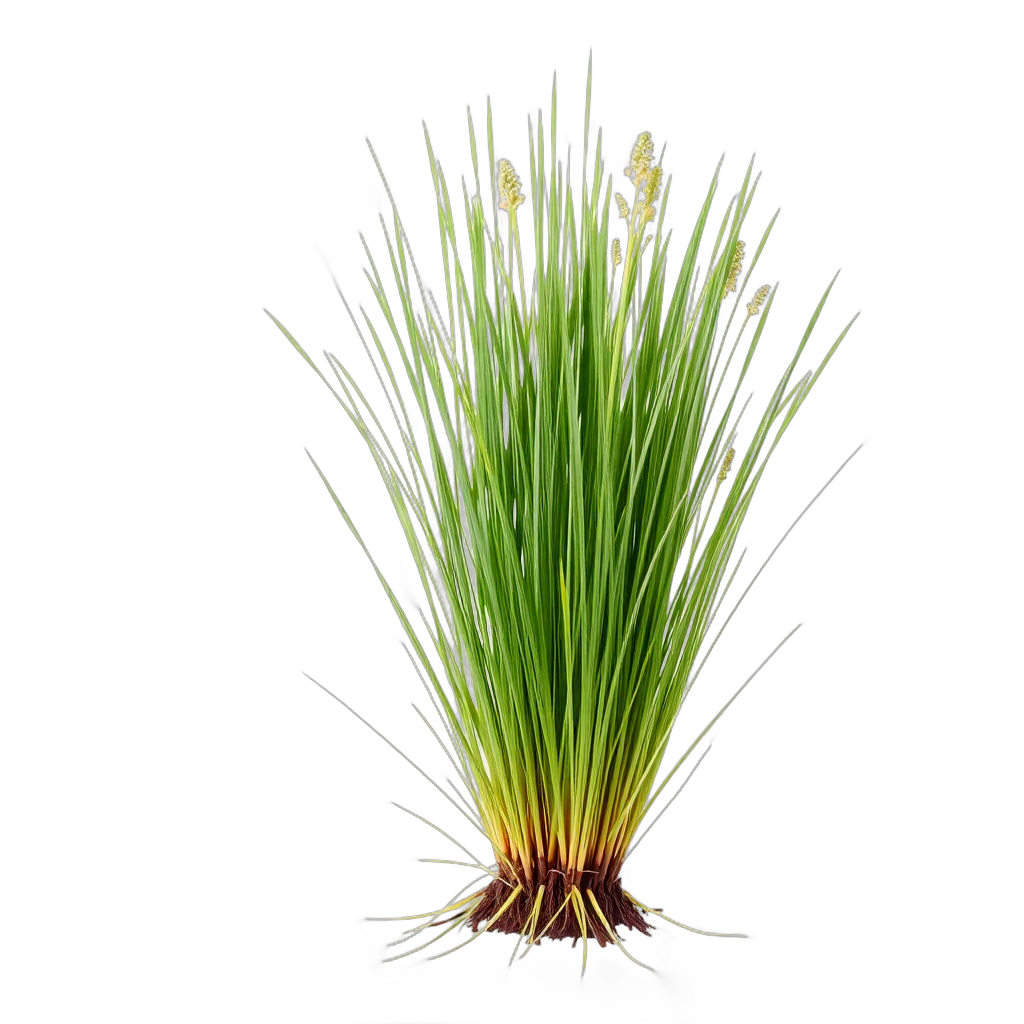
California Gray Rush
Juncus patens
low-growing ground cover, blooms in summer. Evergreen year-round.
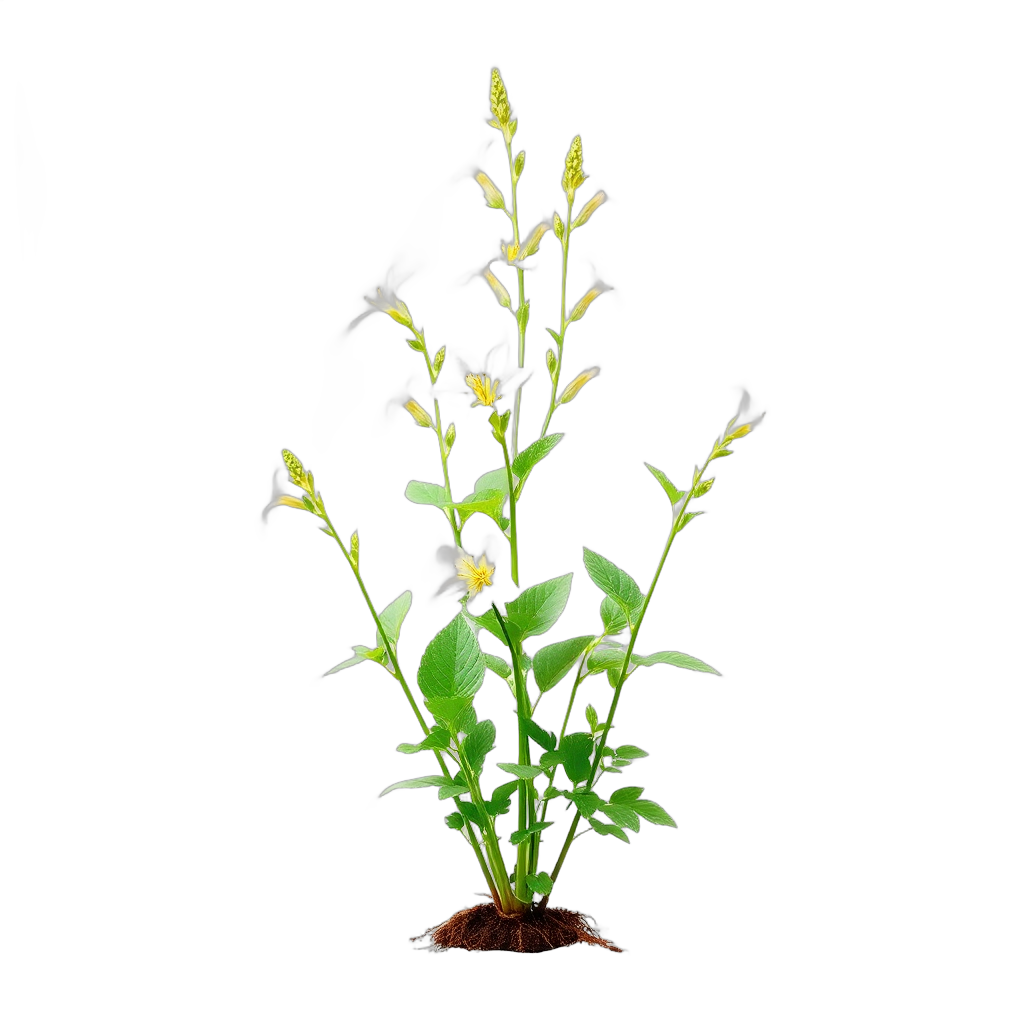
Beach Evening Primrose
Camissonia cheiranthifolia
low-growing ground cover, yellow blooms in spring. Attracts butterflies.
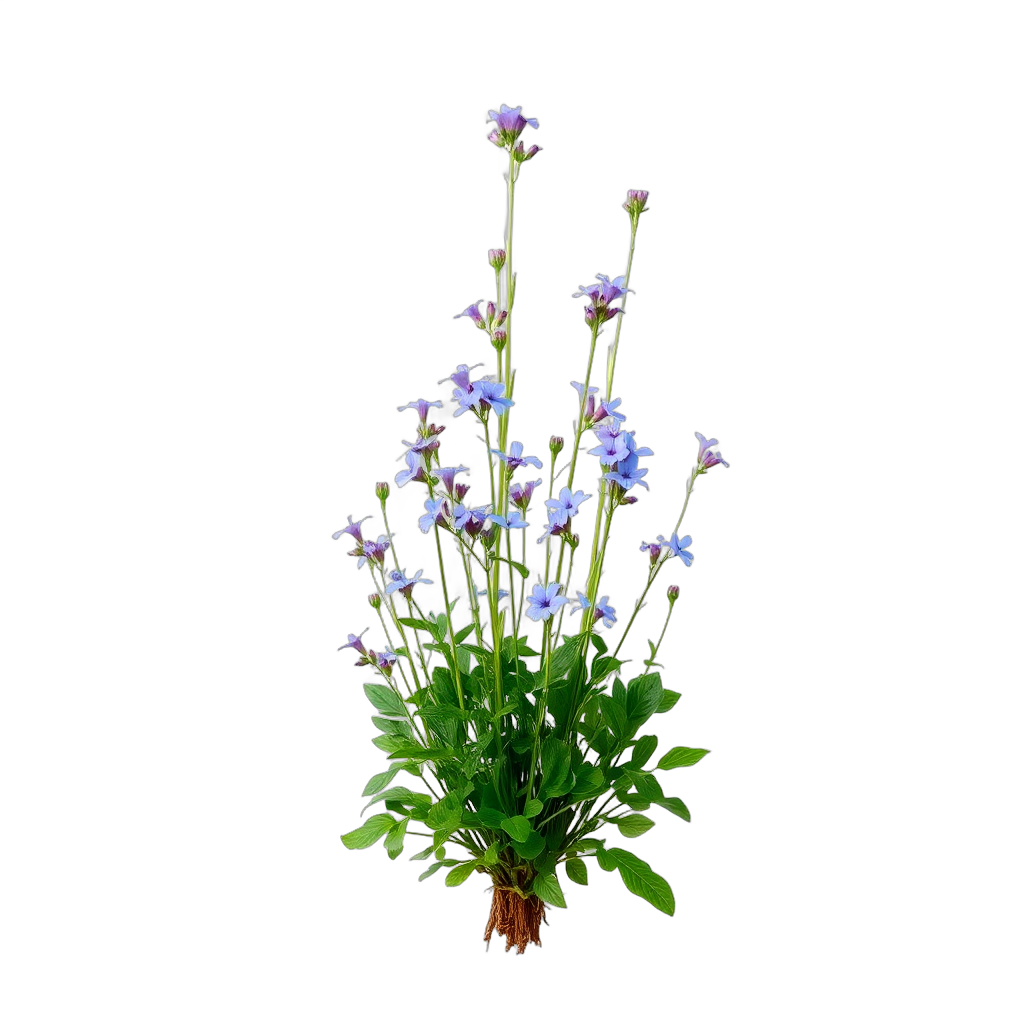
Blue Dicks
Dichelostemma capitatum
low-growing ground cover, blue blooms in spring. Pollinator-friendly.
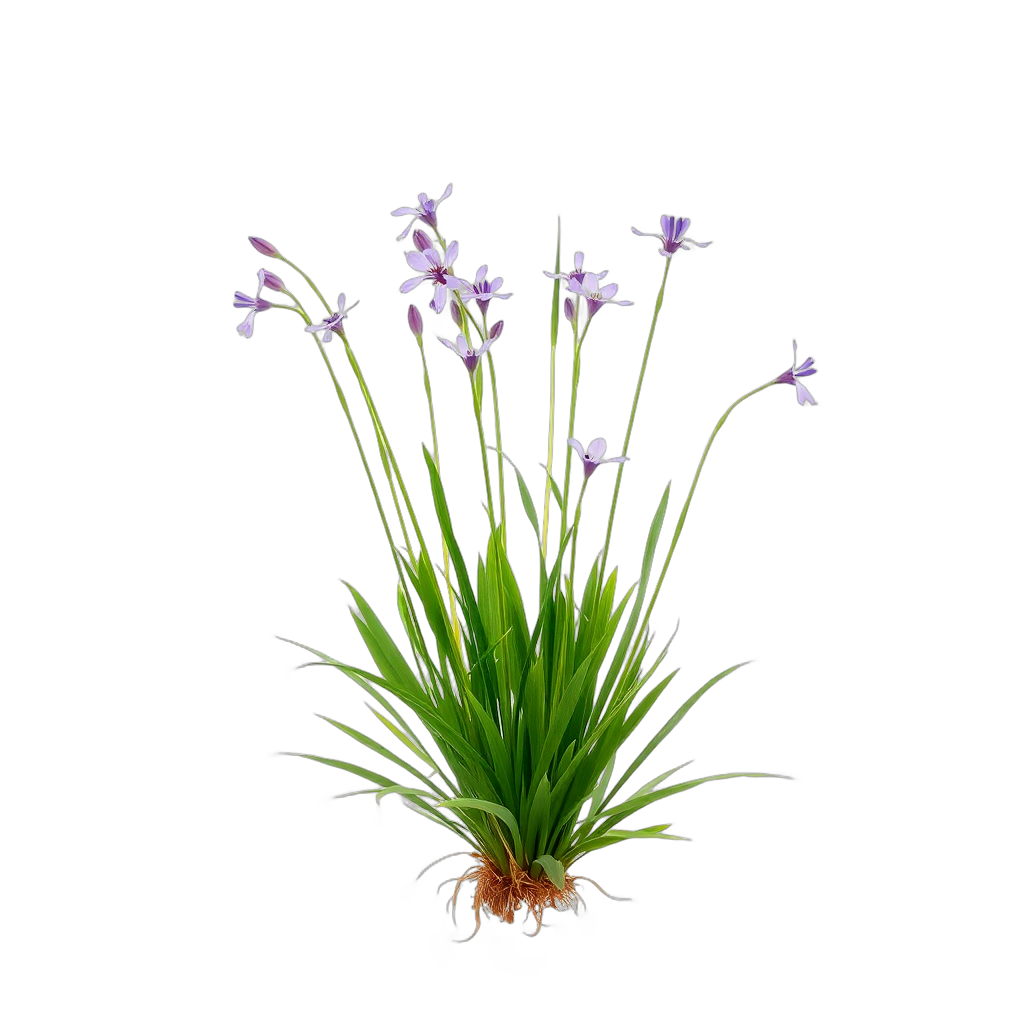
Blue-Eyed Grass
Sisyrinchium bellum
low-growing ground cover, blue blooms in spring. Attracts butterflies.
Bloom Calendar for Rancho Cucamonga
spring
Beach Evening Primrose, Blue Dicks, Blue-Eyed Grasssummer
California Gray Rush, Hooker's Evening Primrose, Hummingbird Mintfall
California Fuchsiawinter
Limited bloomsDesign Tips for Rancho Cucamonga (Zone 10a)
- Buy roses bare-root in January, not potted in May — Rosa 'Iceberg', 'Julia Child', 'Bonica' and 'Eden' all establish better through a Rancho Cucamonga winter and cost roughly a third as much
- Never mix Lavandula × intermedia 'Provence' onto the same irrigation valve as your roses; lavender rots in Tujunga sandy loam that is being watered for hybrid teas, and this single mistake kills more inland lavender hedges than heat ever does
- Amend, then mulch, then amend again — alluvial fan soil off Cucamonga Canyon holds almost no organic matter, so top-dress cottage borders with an inch of compost every autumn or the whole planting quietly thins out by year three
- Set every arbor and pergola post in a 24-inch concrete footing; Santa Ana gusts through Etiwanda and Day Creek will flatten a spike-mounted arch loaded with a mature Rosa 'New Dawn' in a single October night
- Use Buxus microphylla japonica 'Green Beauty' anywhere you want clipped structure — English boxwood ('Suffruticosa') browns out in our alkaline soil and 105°F afternoons, and Green Beauty gives the same clean edge without the sulking
- Keep the lawn small and shaped, not leftover — a defined 400–700 sqft panel of UC Verde buffalograss reads as intentional, qualifies the rest of your yard for a turf-replacement rebate, and cuts summer water dramatically versus wall-to-wall fescue
Where to Source Plants in Rancho Cucamonga
Skip the big-box stores. These independent Rancho Cucamonga nurseries specialize in the plants that make cottage/english gardens thrive in Zone 10a.
C&J Gardening Center
Grove Avenue
Wide selection of trees and plants with a specialty in exotic fruit trees and home delivery.
Dean's Greens
Etiwanda / Baseline Road
Retail nursery offering vibrant blooms, healthy vegetable starts, and lawn supplies.
Parkview Nursery
Riverside
Full-service garden center with a large stock of quality plants including California natives.
Sunshine Growers Nursery
Ontario
Large wholesale and retail nursery covering everything from bedding plants to large trees.
Cottage/English Landscaping Costs in Rancho Cucamonga
| Project Scope | Estimated Cost |
|---|---|
| Front yard cottage border conversion (400–600 sqft, soil, drip, plants) | $7,000 – $16,000 |
| Brick or flagstone entry walkway (100–150 sqft) | $3,000 – $7,000 |
| Cedar rose arch or arbor set in concrete footings | $1,800 – $5,000 |
| Drip retrofit + smart controller for mixed borders | $2,500 – $6,000 |
| Full backyard cottage garden (pergola, patio, fountain, borders) | $30,000 – $75,000 |
| AI visualization with ProScapeAI | Free to start |
Estimates based on Rancho Cucamonga, CA-area contractor rates as of 2026. Actual costs vary by site conditions, materials, and contractor.
Rancho Cucamonga Climate & Growing Zone
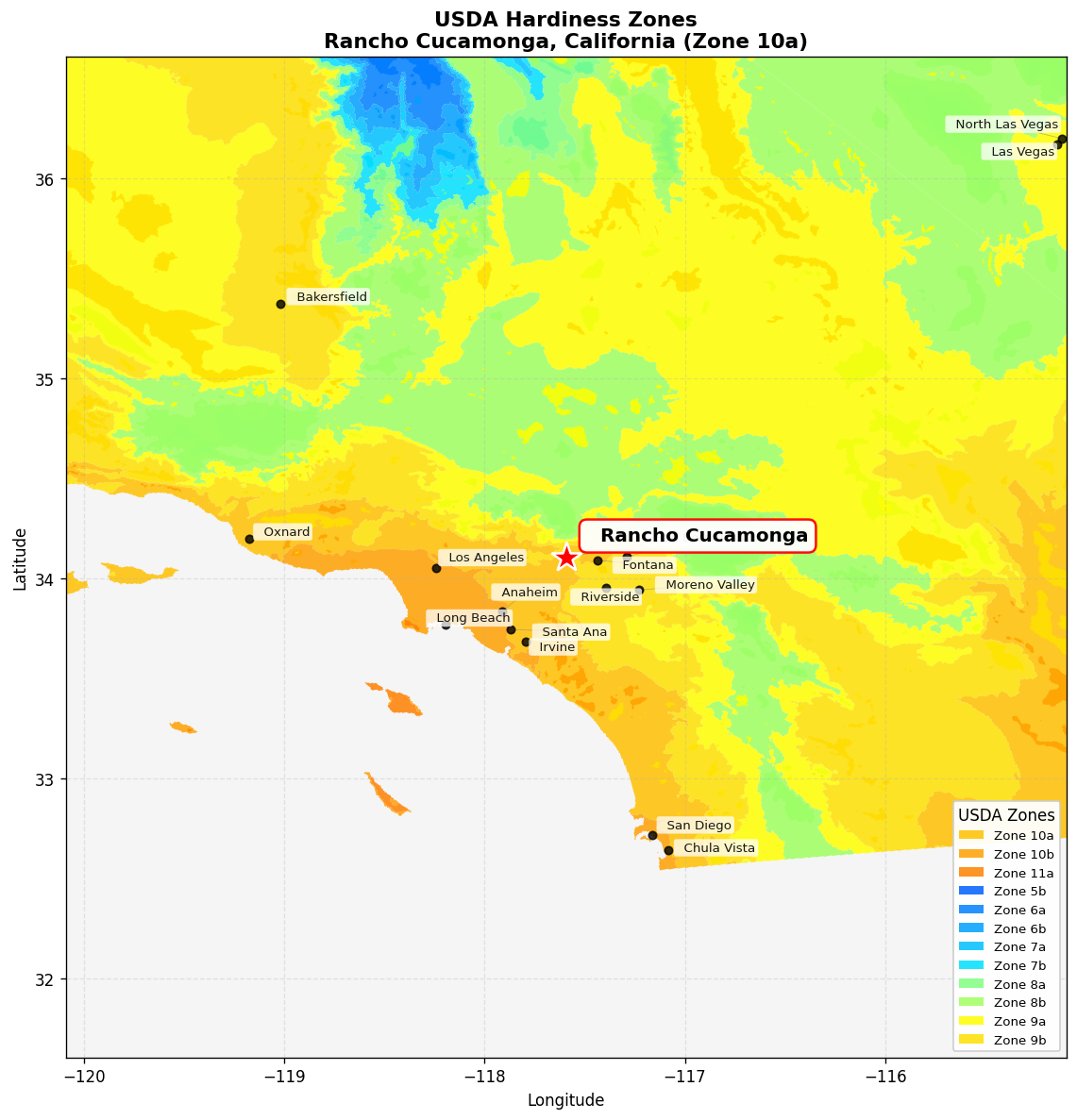
USDA Zone 10a
Hardiness zone for Rancho Cucamonga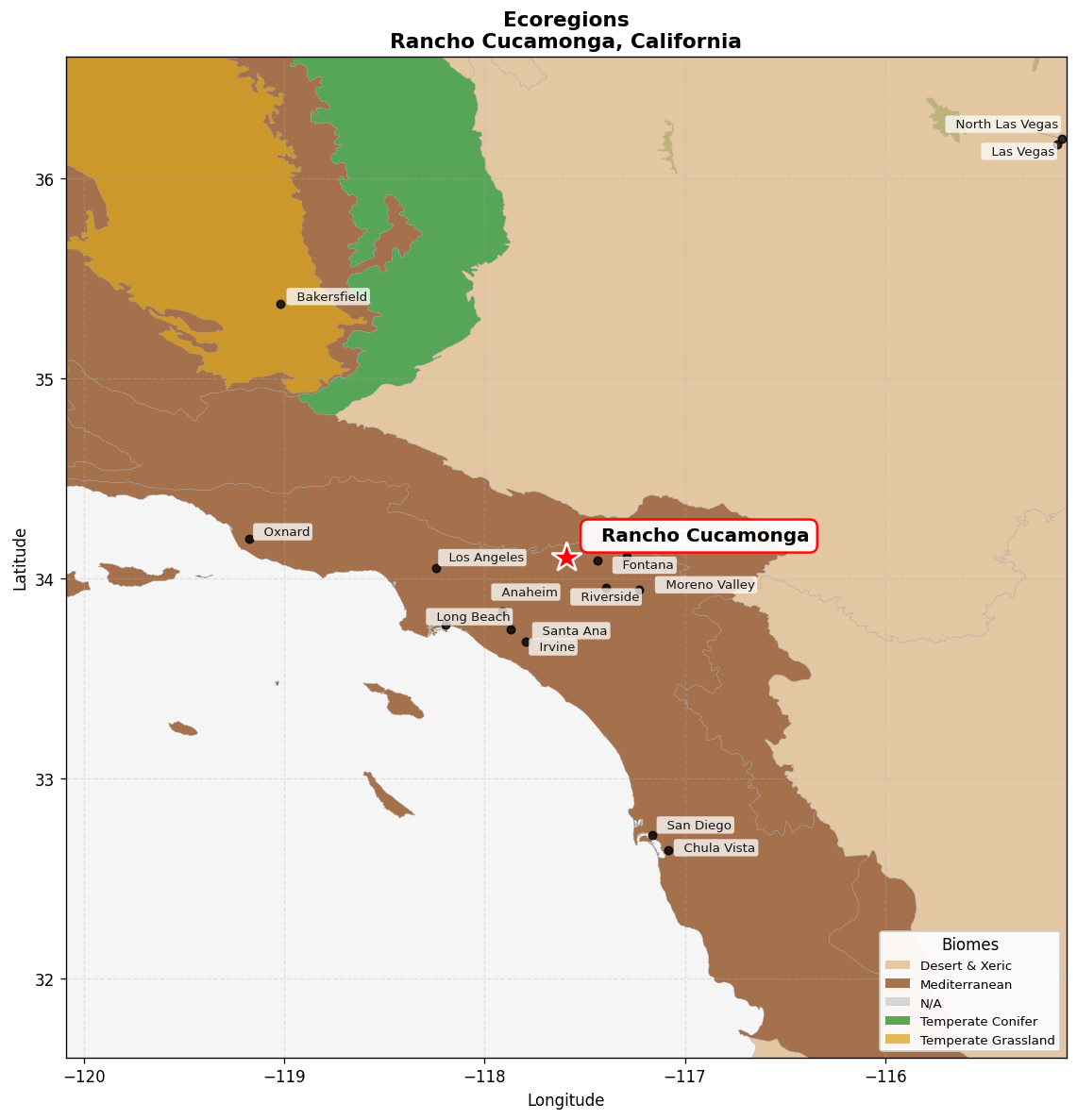
California coastal sage and chaparral
Native ecoregionFrequently Asked Questions
How much does a cottage garden cost in Rancho Cucamonga?
Inland Empire installation labor runs roughly 10–20% under coastal Los Angeles and Orange County, which helps, but cottage gardens are plant-dense and that is where the money goes. A front-yard border conversion of 400–600 sqft — soil amendment, drip, 30–50 shrub roses and perennials, mulch — lands at $7,000–16,000 installed. A cedar rose arch set in real concrete footings is $1,800–5,000. A full backyard with pergola, flagstone patio, cast-stone fountain and layered borders runs $30,000–75,000. DIY is genuinely viable here: bare-root roses bought in January from C&J Gardening Center or Parkview Nursery cost a third of what 5-gallon plants cost in May.
Which roses actually thrive in Rancho Cucamonga's inland heat?
Heat tolerance matters far more than cold hardiness at Zone 10a. The workhorses are Rosa 'Iceberg' and 'Pink Iceberg', Rosa 'Julia Child', Rosa 'Bonica' and Rosa 'Sally Holmes' — all shrug off 105°F and keep blooming into November. For climbers on an arch or pergola, Rosa 'Eden' (Pierre de Ronsard), Rosa 'New Dawn', climbing 'Cécile Brunner' and the thornless Rosa banksiae 'Lutea' are the reliable four. Among David Austins, 'Olivia Rose Austin' and 'Gertrude Jekyll' hold up; the darker 'Munstead Wood' scorches its petal edges in a September heat wave. Give everything morning sun with some 3 p.m. relief, mulch three inches deep, and prune in early to mid January — our roses barely go dormant.
How do I run a flower-heavy garden on 17 inches of rain and water rules?
Hydrozone ruthlessly and irrigate below grade. Put roses, foxgloves and Nepeta 'Walker's Low' on one inline drip valve, and Lavandula × intermedia 'Provence', Salvia leucantha 'Santa Barbara' and Erigeron karvinskianus on a separate, much leaner one — mixing them kills the lavender. Because Tujunga sandy loam drains so fast, short cycles three times a week beat one long soak. Cucamonga Valley Water District customers can typically claim a turf-replacement rebate through Metropolitan's SoCal Water$mart program (commonly $2–5 per square foot, so confirm the current rate before you demo anything), and if your project is permitted and exceeds 500 sqft of new or rehabilitated landscape, California's MWELO rules require a landscape documentation package.
What do Santa Ana winds do to a cottage garden here?
They are the single most underestimated force in Rancho Cucamonga landscaping. Gusts pouring out of Cajon Pass from October through March routinely hit 50–60 mph across Etiwanda, Day Creek and north Alta Loma. Arbors and rose arches need posts in 24-inch concrete footings, not spikes; a lattice arch bought flat-packed will fold in one event. Tie climbing roses like 'Eden' and 'New Dawn' horizontally along the structure rather than letting them plume upward, stake new standard roses low and tight, and expect the wind to desiccate leaves faster than the heat does — a deep watering the day before a forecast wind event prevents most of the burn you see on neighbors' plants.
I live above Banyan in Alta Loma — is a cottage garden safe in the fire zone?
Yes, and in some ways it is safer than what is usually there. The foothills north of Banyan and 24th Street sit in a Very High Fire Hazard Severity Zone, and California's Zone 0 ember-resistant rules target the first five feet around the structure. That means no juniper, no Cortaderia selloana (pampas grass), no woody old Salvia rosmarinus and no bark mulch against the foundation — use gravel or DG there instead. Beyond five feet, well-irrigated roses, Lavandula dentata and Nepeta are relatively low-fuel because you keep them green. Fire-wiser woody choices for the outer zone include Arbutus unedo 'Compacta', Heteromeles arbutifolia (toyon) and Rhus integrifolia; avoid Adenostoma fasciculatum (chamise) and Ceanothus massing right at the wildland edge.
When is the best time to plant a cottage garden in Rancho Cucamonga?
October through early December is the ideal window — perennials and shrubs put down roots through our cool, damp winter and arrive at spring already established, and you avoid transplant shock entirely. January is bare-root rose season and by far the cheapest way to buy 'Iceberg', 'Julia Child' or 'Eden'. Foxgloves and other cool-season fillers go in October for a March–May show. Avoid planting anything between mid-June and mid-September; even on drip, new roots cannot keep up with 100°F+ afternoons and low-humidity Santa Ana events. Hardscape — brick walkways, pergola footings, patios — can be built year-round since we have essentially no frost depth to work around.