4 Modern Landscape Ideas for Salem, OR (Zone 8b Design)
Native plants from the Willamette Valley oak savanna (Zone 8b) — Mediterranean (warm summer) climate
Why Modern/Minimalist Gardens in Salem?
Modern landscape design has quietly become the most sensible style in Salem, and the housing stock is half the reason. The city is full of low-slung 1950s and 1960s ranches through Morningside, Candalaria, Fairmount Hill and Keizer — flat rooflines, long horizontal windows, carports — that were built with modern bones and only need the landscape to catch up, and the newer contemporary builds filling in Creekside, Battle Creek, Sunnyslope and the West Salem hillsides above the Eola Hills arrive with black window frames and standing-seam roofs already in place. Salem also has serious civic modernism to reference — the 1938 Art Deco State Capitol and its marble-clad axis, and the 1972 Civic Center — so a clean-line garden here reads as local rather than imported.
The climate numbers are what make the modern palette work: Zone 8b, lows of 15–20°F, roughly 40 inches of rain a year, and under an inch and a half of that across July and August combined. A warm-summer Mediterranean pattern means grasses hold their structure into November without irrigation and evergreen form survives the winter, so a modern garden here has presence twelve months a year. Calamagrostis x acutiflora 'Karl Foerster' stands upright through a Salem autumn, Panicum virgatum 'Northwind' and Molinia caerulea 'Skyracer' catch low October light, and Yucca rostrata 'Sapphire Skies' and Agave ovatifolia hold sculptural form in February. What kills those last two here is never cold — it is five months of standing winter moisture in the crown.
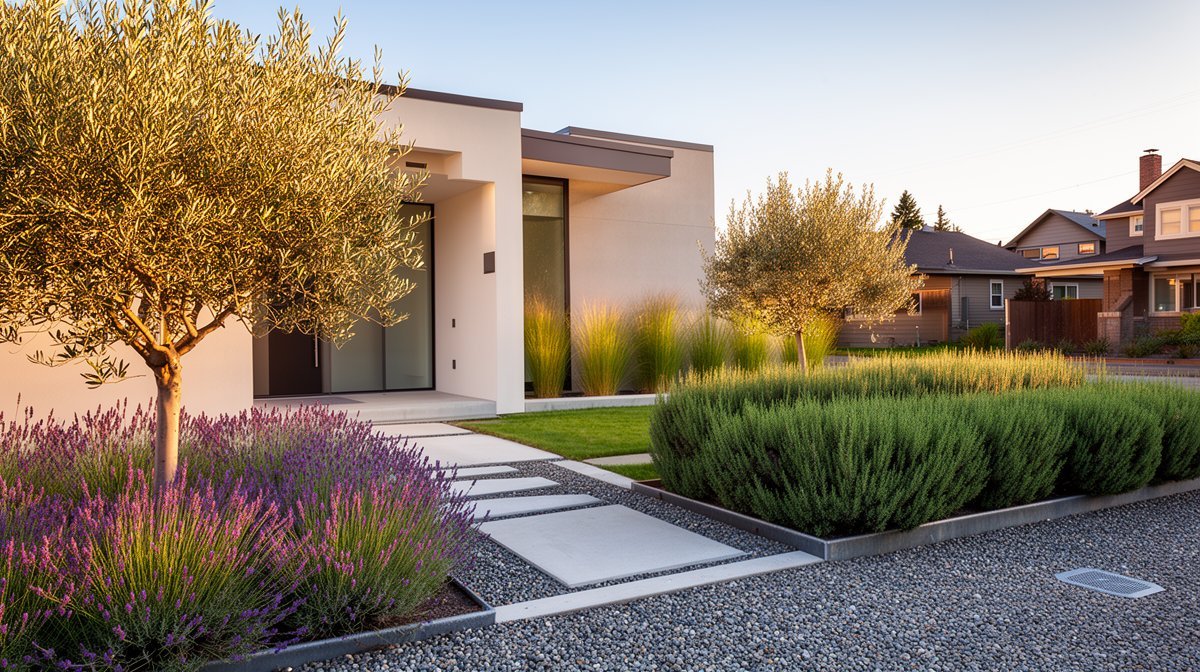
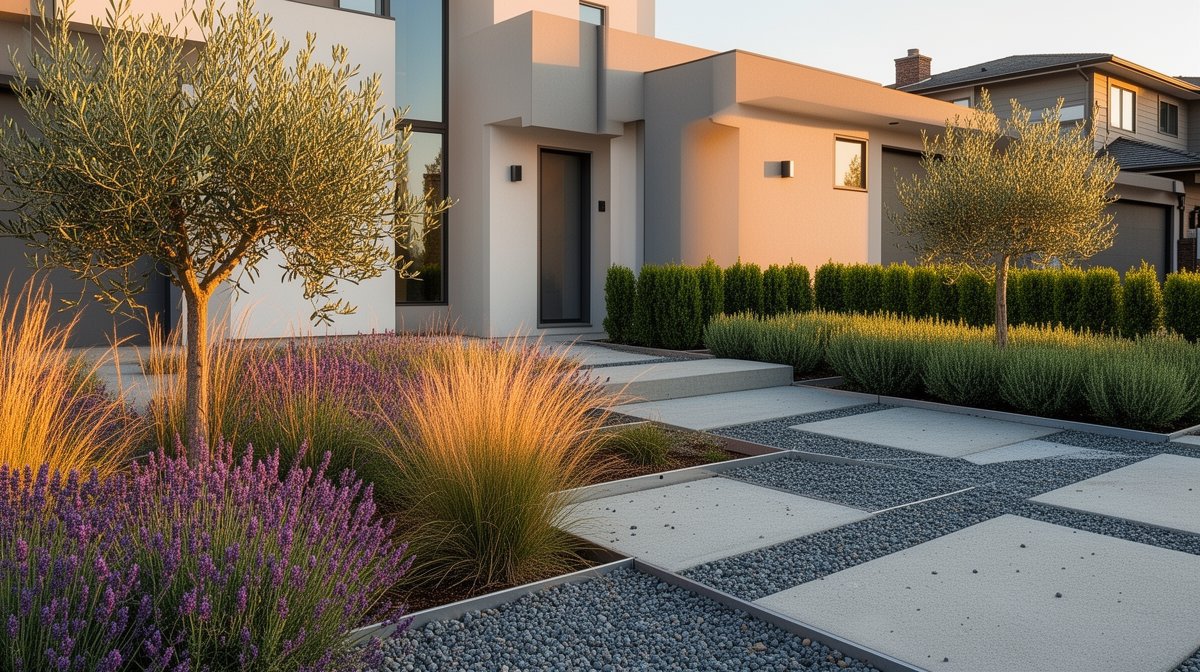
Which makes soil and base prep the real design decision. North and east Salem sit on Woodburn and Amity silt loams that hold a perched water table above a dense subsoil; South Salem, Fairmount Hill and the Eola Hills sit on Jory and Nekia red clay over basalt that swells wet and sets hard dry. Neither forgives lazy hardscape. A poured concrete terrace here wants six inches of compacted 3/4-minus and sawn control joints on a real grid, not tooled joints scratched in as an afterthought — the wet-winter, dry-summer swing will find every shortcut within three years. Gravel gardens want the beds raised and the planting mix cut heavily with pumice, which is why the crisp steel-edged island beds in the photographs are functional and not just graphic. Get that right and Agave parryi var. truncata lives in a Salem front garden indefinitely.
Water and lawn are the last piece. Salem's rain grows turf for free from October to May, which is why the modern gardens here that keep a small crisp lawn panel — rather than deleting every blade — usually look better than a wall-to-wall gravel field. The summer irrigation of that lawn is the entire bill, though: the city draws from the North Santiam through Geren Island, bills on a tiered rate that peaks in the summer season, and requires a tested backflow assembly on in-ground systems tied to the main. Shrinking turf to one geometric panel and giving the rest to grasses, gravel and Salvia yangii 'Little Spire' typically cuts summer consumption by more than half. Oregon allows roof rainwater harvesting without a water right, and an 811 locate is required two business days before you dig — do both before the first trench.
4 Modern/Minimalist Design Ideas for Salem

The Curved Concrete Walk
$12–24/sqftA low-hipped contemporary in pale stucco with a tall recessed entry and a wall of black-framed glass, fronted by a wide, broom-finished concrete walk that sweeps in one clean curve from the driveway to the door. Two crisp panels of lawn sit either side of it and everything else is planting: burgundy strap-leaved spikes and tight green domes holding the foundation, white ball-flowered shrubs beside the entry, and big loose drifts of purple lavender and coppery-green grass mounds running along the street edge to soften the frontage. It is a restrained plan that gets its power from one confident curve and about six plants repeated all the way along.

The Gravel Garden Ranch Front
$10–20/sqftA 1950s ranch with grey lap siding, a white stucco entry panel and new black window frames has had its front lawn removed entirely and replaced with a field of pale tan gravel. Set into it are long, low geometric beds edged in dark steel, each one a composition of big blue agave rosettes, tight plump succulent rosettes and blonde tufted grasses, with a few basalt boulders for weight. The mature deciduous street tree is kept and celebrated — its trunk reads as sculpture over the flat gravel plane. Zero mowing, zero summer irrigation from year two, and the whole thing looks intentional in February when a lawn would just look wet.

The Slab, the Fire Bowl and the Grass Plumes
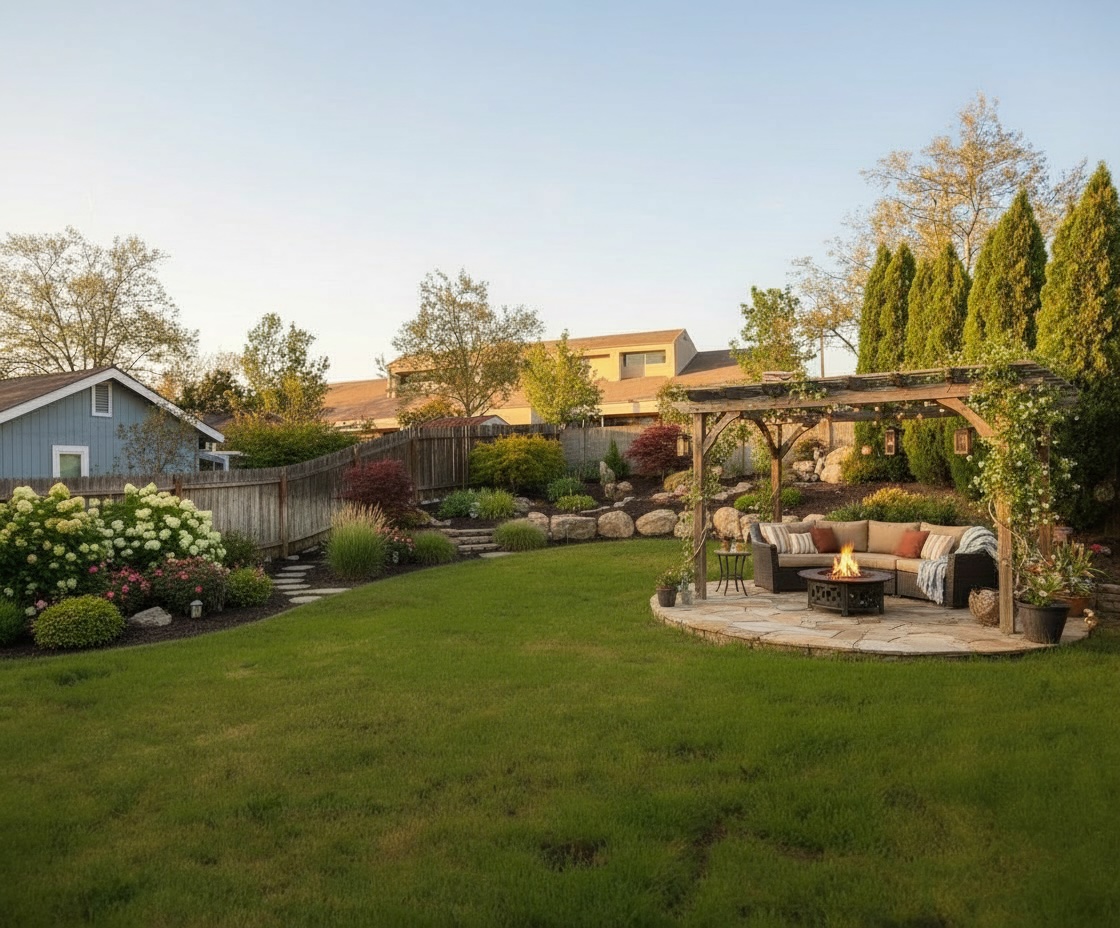
$18–34/sqftA large pale concrete terrace laid in wide sawn panels sits just off the back of a single-storey grey house with big black-framed glass, holding a low L-shaped sectional around a round black steel gas fire bowl. String lights run overhead on slim black posts, a Corten trough planter anchors one corner, and the terrace edge dissolves into drifts of tall white-plumed grasses instead of stopping at a hard line. Lawn wraps the slab on two sides and a cedar board fence closes the back. Simple, buildable, and it extends the usable Salem season from a five-month one into something closer to eight.

The Reflecting Pool Terrace
$45–90/sqft (pool area inclusive)Shot at blue hour, a two-storey white contemporary with full-height glass on both floors glows behind a rectangular pool that mirrors the whole facade. A wide pale concrete deck wraps the water in clean panels, with low lounge seating on the house side, and the planting does its work entirely at the edges: big fountains of green and burgundy grasses, uplit narrow conifers picking out the fence line, wine-red foliage shrubs on the right, an agave at the deck corner and low path lights washing the concrete. The restraint is the whole trick — three plant textures, one hard material and warm light doing the rest.
See how a modern/minimalist garden looks on YOUR property
Upload a photo of your Salem yard and visualize your dream garden in seconds.
Try ProScapeAI Free
Featured Trees & Shrubs for Modern/Minimalist Gardens
Browse all 151 plants for Salem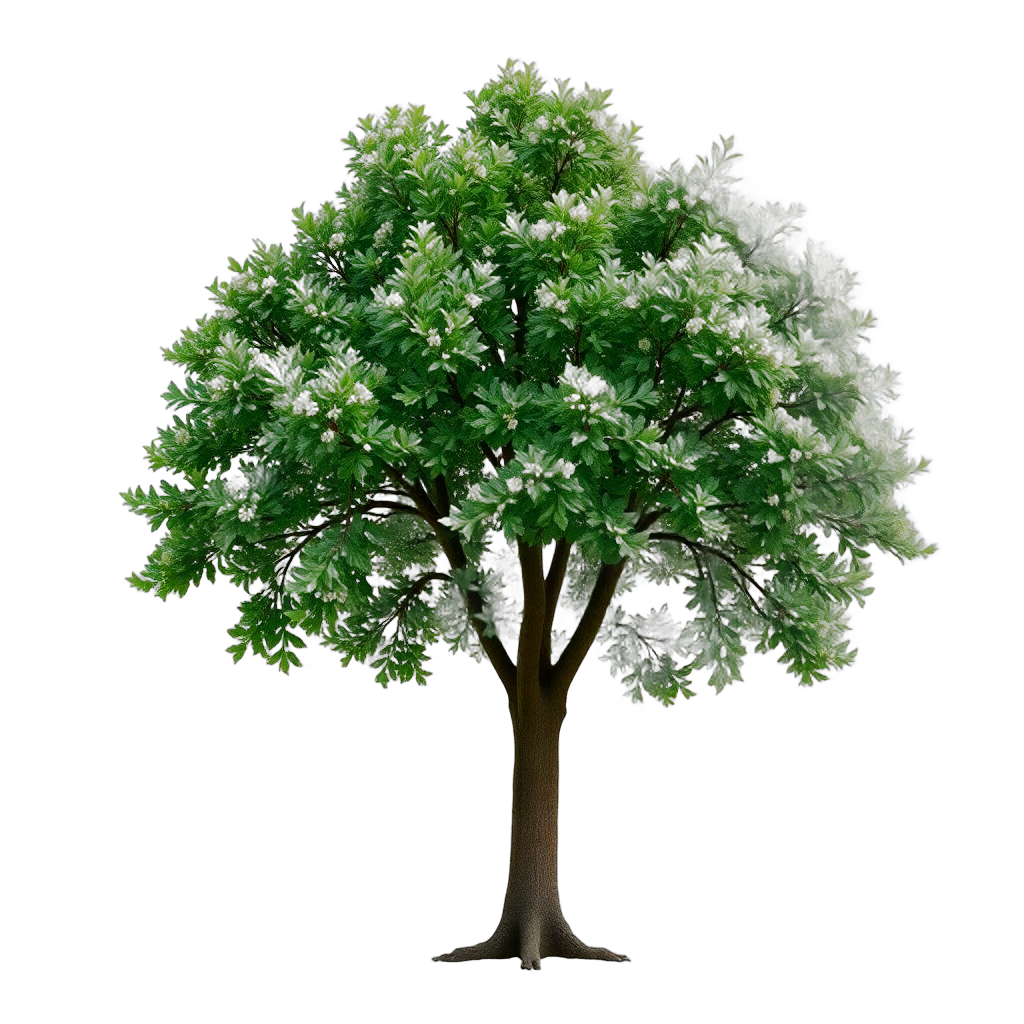
Oregon White Oak
Quercus garryana
large shade tree reaching 65+ feet, blooms in spring. Yellow fall color.
Featured Flowers & Perennials for Modern/Minimalist Gardens

Water Lettuce
Pistia stratiotes
low-growing ground cover, white blooms in summer. Evergreen year-round.

Tussock Sedge
Carex stricta
low-growing ground cover, blooms in spring. Brown fall color.

Umbrella Sedge
Cyperus alternifolius
grows to 4 feet, blooms in summer. Evergreen year-round.
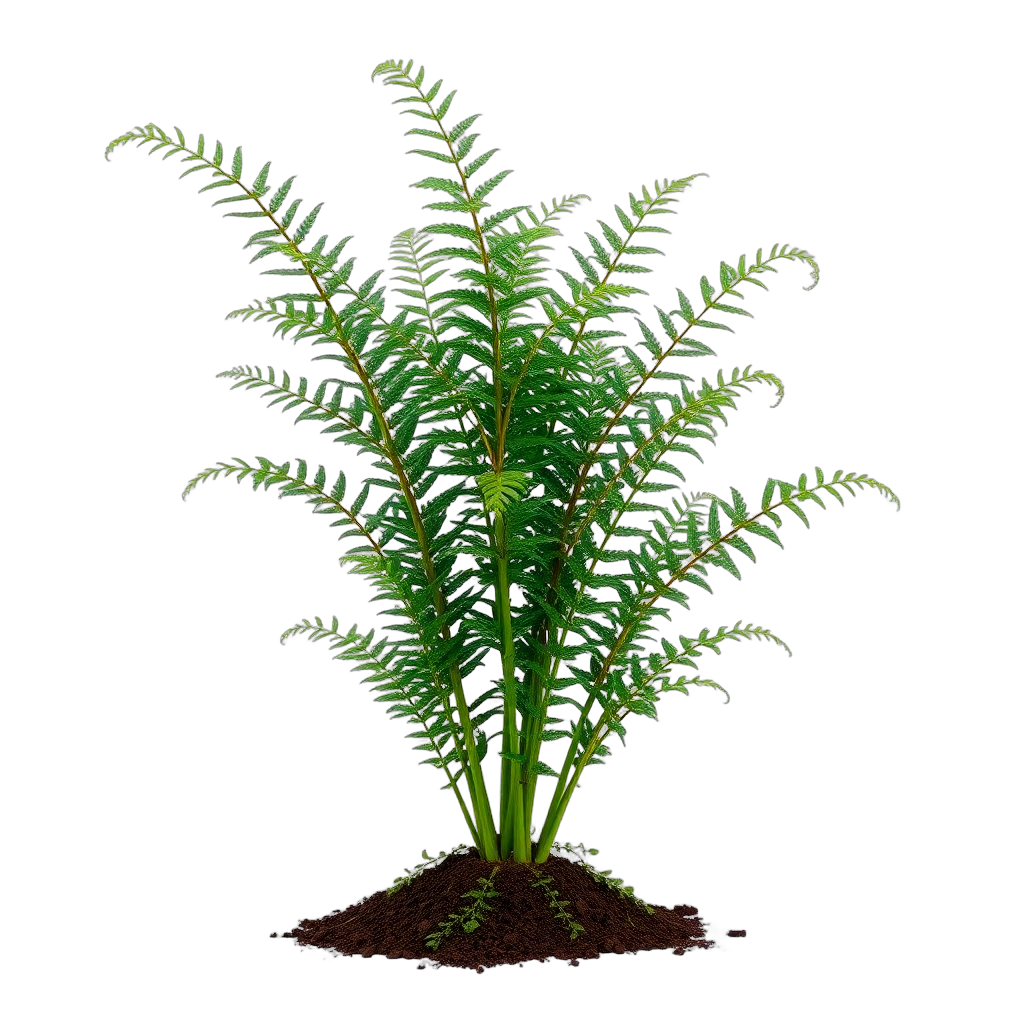
Deer Fern
Blechnum spicant
low-growing ground cover, blooms in none. Evergreen year-round.
Zone and sun checks come from our database — confirm with your local nursery before you buy.
Bloom Calendar for Salem
spring
Oregon White Oak, Tussock Sedge, Austrian Speedwellsummer
Water Lettuce, Umbrella Sedge, Alpine Sea Hollyfall
Autumn Snakerootwinter
Limited bloomsDesign Tips for Salem (Zone 8b)
- Spend the money underground: six inches of compacted 3/4-minus and sawn control joints on a real grid is what separates a Salem concrete terrace that still looks sharp in ten years from one that maps its cracks by year three
- Raise every gravel-garden bed six to twelve inches and cut the mix a third with coarse pumice — Zone 8b cold is not what kills Agave ovatifolia here, five months of winter moisture in the crown is
- Keep one crisp lawn panel rather than deleting all turf; Salem's October-to-May rain grows it for nothing, it is the cheapest surface in the design, and a single geometric shape reads far more modern than a gravel field wall to wall
- Let Calamagrostis x acutiflora 'Karl Foerster' and Panicum virgatum 'Northwind' carry the winter garden — they stand upright through Salem's grey season and one late-February cut-back is the whole year's maintenance
- Gravel-mulch the sculptural plants and bark-mulch the rest; bark against the crown of an agave or a yucca through a 40-inch winter is the single most common way these gardens fail here
- Light the grasses and the tree trunks rather than the lawn — Salem's long midsummer evenings and early winter dusks mean low-voltage uplighting earns its keep for most of the year, and grass plumes backlit at dusk are the cheapest drama available
- Keep the existing mature street tree in a mid-century front-yard conversion; a bare gravel plane in front of a 1950s ranch reads as a parking lot, and one high-limbed deciduous canopy is what turns it into a designed garden
Where to Source Plants in Salem
Skip the big-box stores. These independent Salem nurseries specialize in the plants that make modern/minimalist gardens thrive in Zone 8b.
Terra Gardens Nursery & Bark
East Salem (Cordon Road NE)
Full-service garden centre with trees, shrubs, fruit trees, figs and rare citrus, plus bulk bark, soil, gravel and decorative stone with a blowing service — the one-stop for a whole install
Godfrey Nursery
Aumsville, about seven miles east of Salem
Family-owned grower with 35+ greenhouses and an acre of outdoor stock — Pacific Northwest-grown shrubs, trees, herbs and hardy perennials, open daily
Sebright Gardens
Northeast Salem (Lakeside Drive NE)
Four-acre shade specialist growing several hundred hosta varieties plus more than 100 ferns and 100 epimediums — the go-to source for the north-side and under-oak parts of a Salem garden
Schreiner's Iris Gardens
North Salem / Keizer (Quinaby Road NE)
Bearded iris breeder since 1925 — tall, intermediate and dwarf bearded iris plus daylilies and allium bulbs, with display fields worth walking in May
Modern/Minimalist Landscaping Costs in Salem
| Project Scope | Estimated Cost |
|---|---|
| Front-yard gravel garden conversion (500–700 sqft) | $6,000 – $14,000 |
| Poured concrete terrace with sawn joints (300–450 sqft) | $9,000 – $24,000 |
| Back garden modern room with fire bowl, seating and lighting | $20,000 – $50,000 |
| Corten or steel trough planters, fabricated and filled | $900 – $2,600 each |
| Low-voltage uplighting and path lighting (12–20 fixtures) | $3,000 – $8,000 |
| Pool deck plus full modern back garden | $80,000 – $180,000 |
| AI visualization with ProScapeAI | Free to start |
Estimates based on Salem, OR-area contractor rates as of 2026. Actual costs vary by site conditions, materials, and contractor.
Salem Climate & Growing Zone
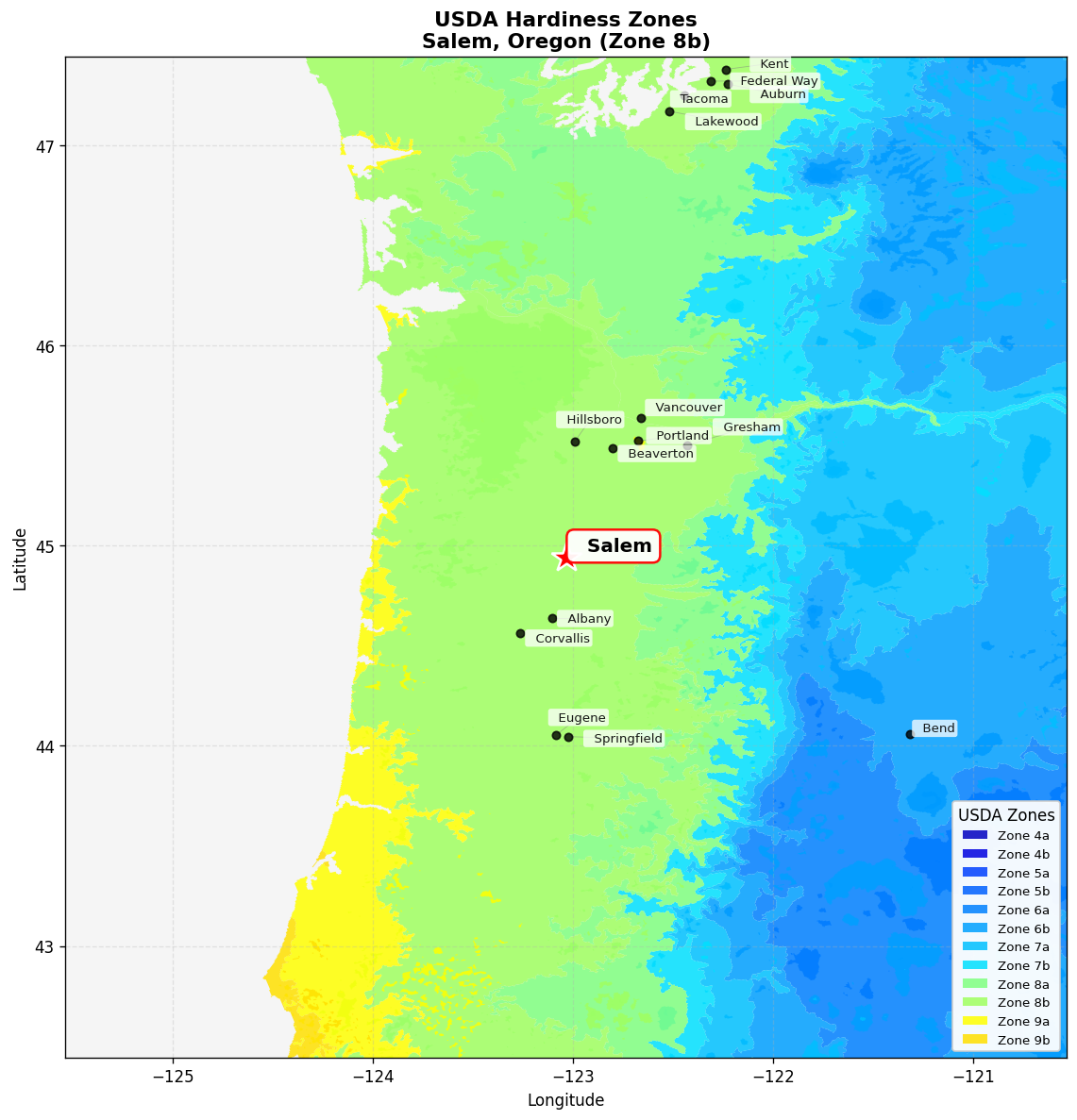
USDA Zone 8b
Hardiness zone for Salem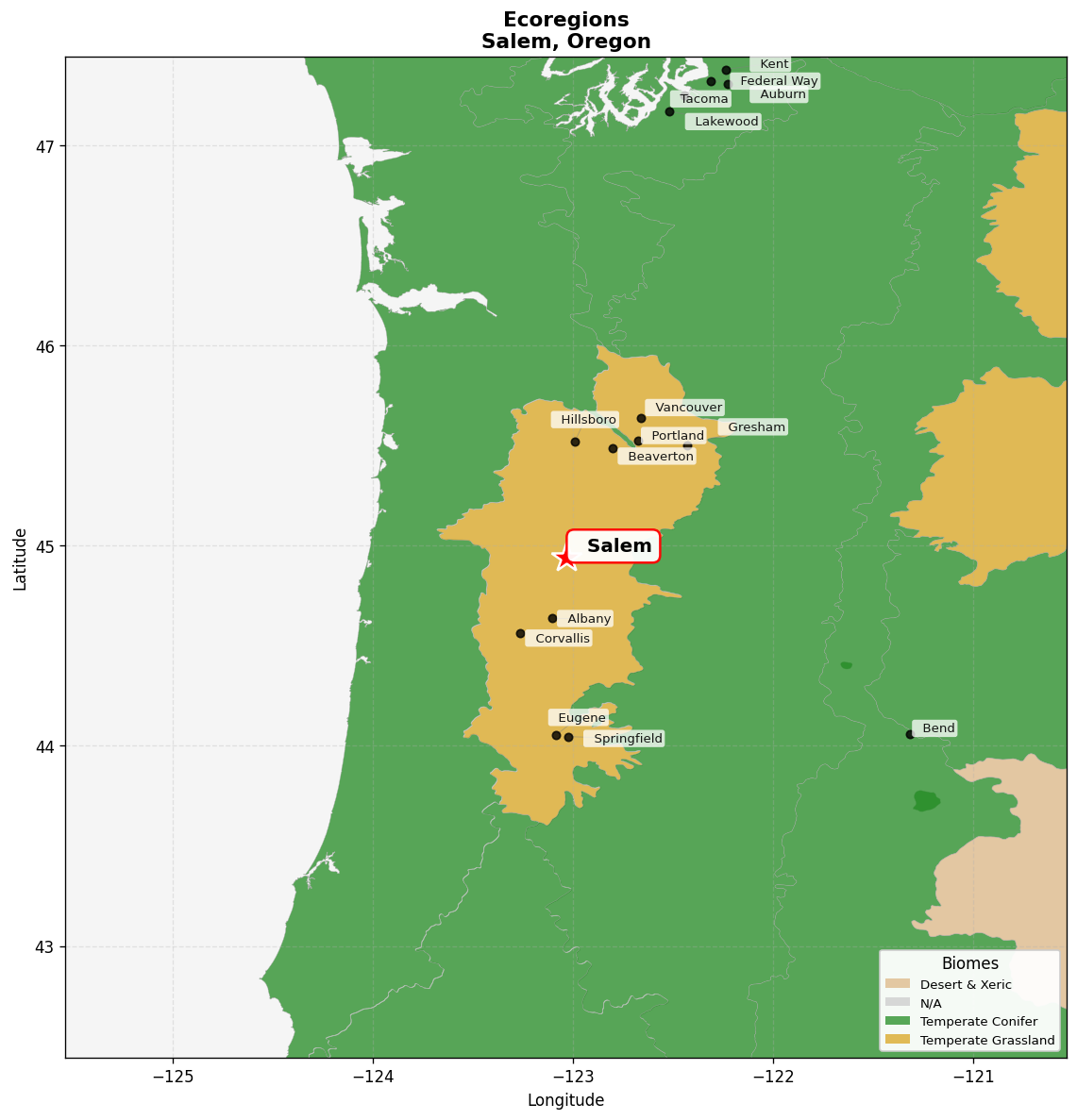
Willamette Valley oak savanna
Native ecoregionFrequently Asked Questions
How much does a modern landscape cost in Salem?
A front-yard gravel conversion — turf removal, grading and berming, gravel field, steel edging and architectural plants — runs $6,000 to $14,000 for a typical 500 to 700 square foot Salem frontage, or roughly $10–20 per square foot. A poured concrete terrace of 300 to 450 square feet with proper base and sawn joints lands at $9,000 to $24,000. A back garden with terrace, fire feature, seating-scale planting and lighting is usually $20,000 to $50,000, and a full pool-and-landscape build in Illahe Hills or West Salem runs $80,000 to $180,000. Salem pricing sits a little under Portland metro; concrete and basalt gravel are both produced locally, so material cost is modest and the money is in base prep and labour.
Can agaves and yuccas really survive a Salem winter?
Yes — the enemy is 40 inches of winter rain, not the 15–20°F Zone 8b low. Plant <em>Agave ovatifolia</em>, <em>Agave parryi</em> var. <em>truncata</em>, <em>Agave montana</em> and <em>Yucca rostrata</em> 'Sapphire Skies' on beds raised six to twelve inches, in a mix cut at least a third with coarse pumice or 1/4-inch minus, and top-dress with gravel right up to the crown so no organic mulch touches the plant. Tilt the rosette very slightly so water runs out rather than sitting in the centre. Done that way they are essentially permanent here. Planted flat in unamended Woodburn silt loam or Jory clay, they will be mush by March.
Which grasses hold up best in Salem?
<em>Calamagrostis</em> x <em>acutiflora</em> 'Karl Foerster' is the backbone — strictly upright, unbothered by wet winters, and it stands until you cut it. <em>Panicum virgatum</em> 'Northwind' and 'Shenandoah' bring height and autumn colour, <em>Molinia caerulea</em> 'Skyracer' and <em>Calamagrostis brachytricha</em> give the transparent plumes that catch low light, and <em>Pennisetum alopecuroides</em> 'Hameln' handles the low mounding role. For evergreen structure through a grey January use <em>Sesleria autumnalis</em>, <em>Carex testacea</em> and <em>Carex oshimensis</em> 'Everillo'. Cut the deciduous ones back once in late February; that is essentially the entire maintenance programme.
How should concrete be built here so it does not crack?
Budget the base as part of the job. Excavate and compact at least six inches of 3/4-minus under any slab or walk — Salem's silt loams hold a perched winter water table and the Jory clays in South Salem swell and shrink hard between a saturated February and a bone-dry September. Use sawn control joints on a grid of roughly ten feet or less rather than joints tooled into wet concrete, keep the panels close to square, and place a drainage layer or a perimeter drain where the slab sits below the surrounding grade. Concrete can be poured through most of a Salem winter, but a saturated site will slow the crew and hurt the finish.
Should I remove the lawn completely?
Usually not. Salem's rain grows turf for free from October through May, and a single crisp geometric lawn panel is often the strongest element in a modern garden — it gives the eye somewhere to rest and it is the cheapest square footage you will ever own. The cost is entirely the summer: under an inch and a half of rain across July and August means the lawn is the whole irrigation bill. The efficient answer is to shrink turf to one deliberate shape, put the rest into grasses, gravel and bermed planting, and run the remaining lawn on its own zone. That typically cuts summer water use by more than half while looking more designed, not less.
When is the best time to build and plant?
Hardscape is close to year-round in Salem, though September and October give the best combination of dry ground and open crew schedules. For planting, mid-October through November is ideal for grasses, shrubs and hardy structure — the winter rain establishes them for free and they hit April already rooted. Push agaves, yuccas and anything sharply drainage-dependent to April or May instead, so they get a full growing season before their first wet winter. Avoid planting anything from late June through August unless you are prepared to hand-water every second day.
What permits or licences apply to this kind of work?
Oregon requires a Landscape Contracting Business licence from the Landscape Contractors Board for landscape construction work over $1,000, and their online lookup verifies a contractor in about a minute. An 811 utility locate is free, statewide and required two business days before digging. Gravel conversions, planting and at-grade patios generally need no permit; retaining walls above four feet, pools, roofed structures and work in the public right-of-way do, and Salem has separate rules for trees in the planting strip. Thresholds and stormwater requirements change, so confirm the current position with the City of Salem before construction starts.