4 Mediterranean Garden Ideas for Eugene, OR | Zone 8b Design
Native plants from the Willamette Valley oak savanna (Zone 8b) — Mediterranean (warm summer) climate
Why Mediterranean Gardens in Eugene?
Eugene is one of the few American cities that can build a Mediterranean garden on the strength of its climate rather than in spite of it. Eugene's Koppen classification is Csb, warm-summer Mediterranean, the same label carried by Porto, the hills above Florence and the whole of the Willamette Valley wine country that starts twenty minutes down Territorial Highway. The architecture is already halfway there in places: the 1920s and 1930s Spanish Colonial Revival stucco houses scattered through College Hill and the streets around Fairmount and the university, the tile-roofed builds climbing the South Hills above Hendricks Park, and the newer stucco-and-terracotta homes out at Mountaingate and along Willamette Street south of 43rd. Drive out to the Lorane Valley past King Estate, Silvan Ridge and Sweet Cheeks and the hillsides already read Tuscan; a courtyard of Lavandula x intermedia 'Grosso' and clipped Teucrium chamaedrys in front of a Eugene bungalow is not costume, it is the regional landscape brought home.
The numbers are the argument. Eugene averages 40.83 inches of precipitation a year, but July delivers 0.32 inches and August 0.39 inches - roughly seven tenths of an inch across the two hottest months, which is a genuine summer drought by any definition and the exact rhythm that Cistus, Rosmarinus, Phlomis and olives evolved for. August afternoons sit in the low to mid 80s and August nights fall back into the low 50s, the big diurnal swing that keeps silver foliage tight and grey instead of soft and green. Winter is Zone 8b: typical lows of 15 to 20 degrees F, mild enough for Arbutus unedo, Cupressus sempervirens and bay laurel to hold their structure all year. The heat spikes are real too - the June 2021 heat dome pushed Eugene to 111 degrees F - so anything in the palette has to survive a week of that as well as a grey February.
What actually kills Mediterranean plants in Eugene is not cold, it is November through March, when roughly three quarters of that 40.83 inches arrives and the soil never drains. The valley floor around Bethel, Santa Clara and River Road runs to Amity, Dayton and Awbrey silt loams that hold a perched water table all winter; the South Hills sit on Jory and Bellpine silty clay loams, red clay over basalt that is deeper but no faster. Both sit at pH 5.5 to 6.2, mildly acidic, where lavender and rosemary would prefer neutral to alkaline. The fix is mechanical and it is not optional: raise every bed 10 to 14 inches on a mix of native soil and quarter-minus crushed rock, mulch with three quarter inch gravel rather than bark so the crowns stay dry, and work in dolomite lime at planting. Done that way Lavandula angustifolia 'Hidcote' lives a decade here; planted flat into unamended Awbrey silt it is dead by its second March.
Two local rules shape the design more than most homeowners expect. Eugene bills a stormwater fee scaled to how much hard impervious surface a property carries, so a permeable gravel courtyard or a decomposed granite auto court is cheaper to own than the same area in poured concrete, and Oregon lets you harvest rooftop rainwater without a water right, which pairs neatly with a cistern feeding drip lines through the dry months. Street trees in the public right-of-way need a free Urban Forestry permit before they go in or come out, and any retaining wall over four feet needs a building permit, which matters on the terraced South Hills lots where Mediterranean terracing is most tempting. One honest caveat on the picture-book plants: bougainvillea and lemons are not hardy here. Grow them in terracotta and roll them into a garage or bright shed below about 28 degrees F, or plant Clematis 'Etoile Violette' and a hardy fig instead and get the same colour without the annual gamble.
4 Mediterranean Design Ideas for Eugene

The Olive and Cypress Entry Court
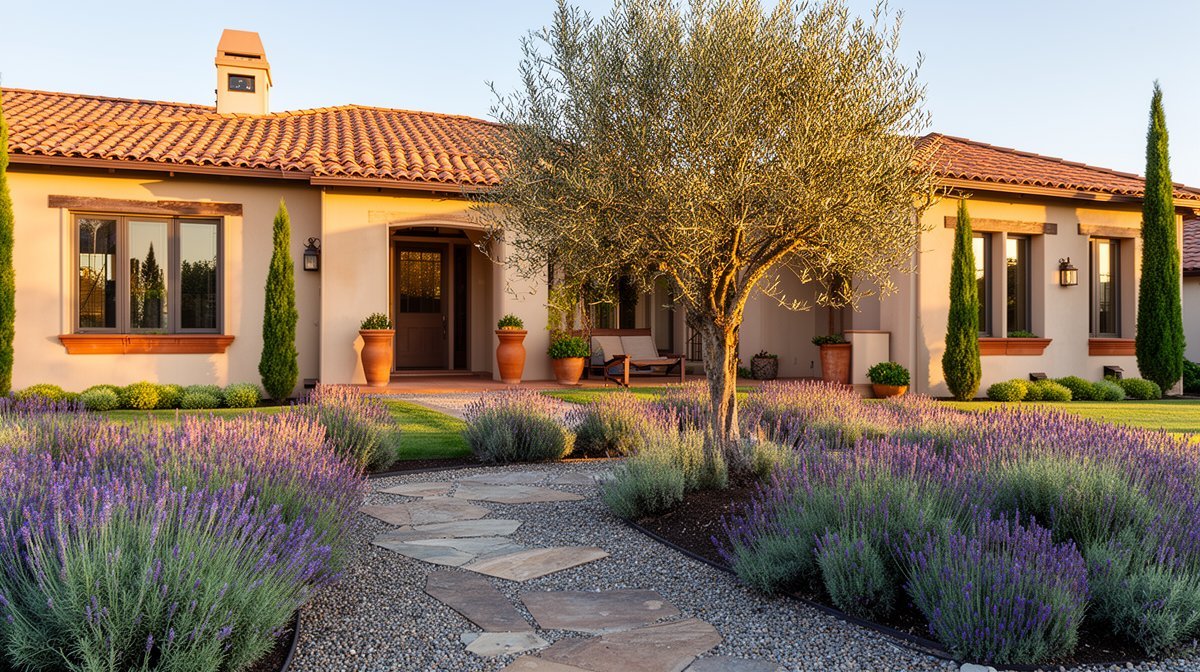
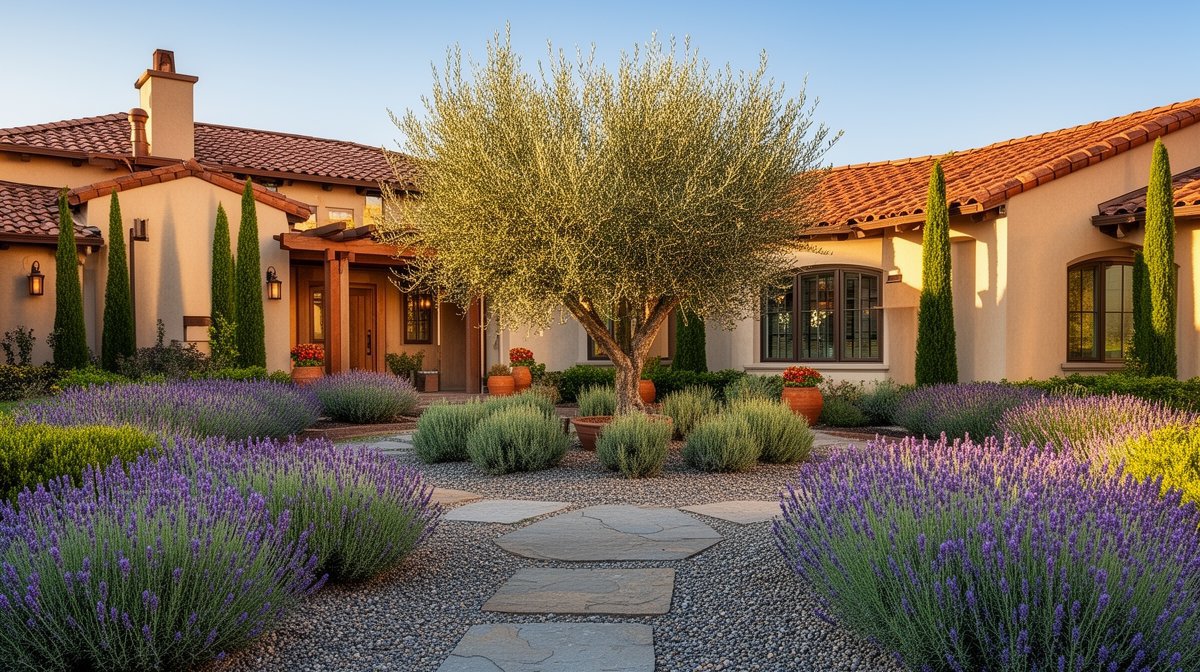
$18-32/sqftA single-storey cream stucco house with a red barrel-tile roof and an arched entry, and the front garden does the whole job with three moves. A multi-trunk olive leans in from the left with its silver canopy catching the low light. Four narrow columnar cypress stand sentry against the stucco, two flanking the arch and two out at the corners, giving the flat facade the vertical rhythm it was missing. Between them an irregular flagstone path runs from the sidewalk to the door, and the two beds either side are solid blocks of lavender in full purple flower threaded with silver mounds and clipped green globes, all set in dark mulch over raised, gritty soil. There is no lawn anywhere in the picture and nothing here needs watering after July.

The Walled Courtyard Gate
$22-40/sqftA cream stucco courtyard wall capped in terracotta tile, an ornate wrought-iron double gate standing open, and a curtain of magenta bougainvillea pouring over the tile roof above it. Two matched standard-trained lemons in the ground flank the gate piers, hung with fruit. In front, five oversized terracotta pots spill red, yellow and purple annuals with lavender and salvia behind them, and the path is a run of flagstone set loose in pea gravel that steps up to worn brick at the threshold. It is a threshold garden rather than a front yard, all the drama compressed into eight feet, which is precisely what a narrow Eugene lot can afford. The honest Eugene version keeps the bougainvillea and the lemons in those terracotta pots so they can be wheeled into a garage below 28 degrees F, and puts a hardy climber on the wall for the years you forget.

The Fountain Terrace
$28-48/sqftThe back of a white stucco house with black-framed french doors, photographed at the point in a Eugene August evening when the sky goes apricot. A field of square terracotta tile carries a round dining table for eight, and a three-tier carved stone fountain sits dead centre as the thing the whole garden turns around. Cafe string lights run overhead in long catenary sweeps. A gnarled old olive holds the left corner, a citrus heavy with orange fruit holds the right, deep lavender borders run down both sides with pink and white flowers stitched through them, a dark evergreen hedge closes the back, and two black urns with spiky foliage flank the doors. The fountain is doing acoustic work as much as visual: it covers traffic noise on the through-streets and it is the only water feature type that still reads well in a climate where you turn the irrigation off in June.

The Pergola and Lemon Pot Room
$26-45/sqftA heavy timber pergola bolted to a cream stucco house, its beams buried under magenta bougainvillea, sheltering a full outdoor living set - a long sofa, two armchairs and a low table - on square terracotta paving. Half a dozen lemon trees in terracotta pots stand around the edges like furniture, and a terracotta paver path runs out through the lawn between deep lavender borders shot with pink and purple. Lawn survives here on both sides, which is the realistic Eugene compromise: it is green and free from October to June and it goes dormant tan in August unless you feed it water it does not deserve. The pergola is the important line item. In a city that averages around 155 days a year with measurable rain, an overhead structure is what turns a patio from a summer-only asset into something you use in a March drizzle.
See how a mediterranean garden looks on YOUR property
Upload a photo of your Eugene yard and visualize your dream garden in seconds.
Try ProScapeAI Free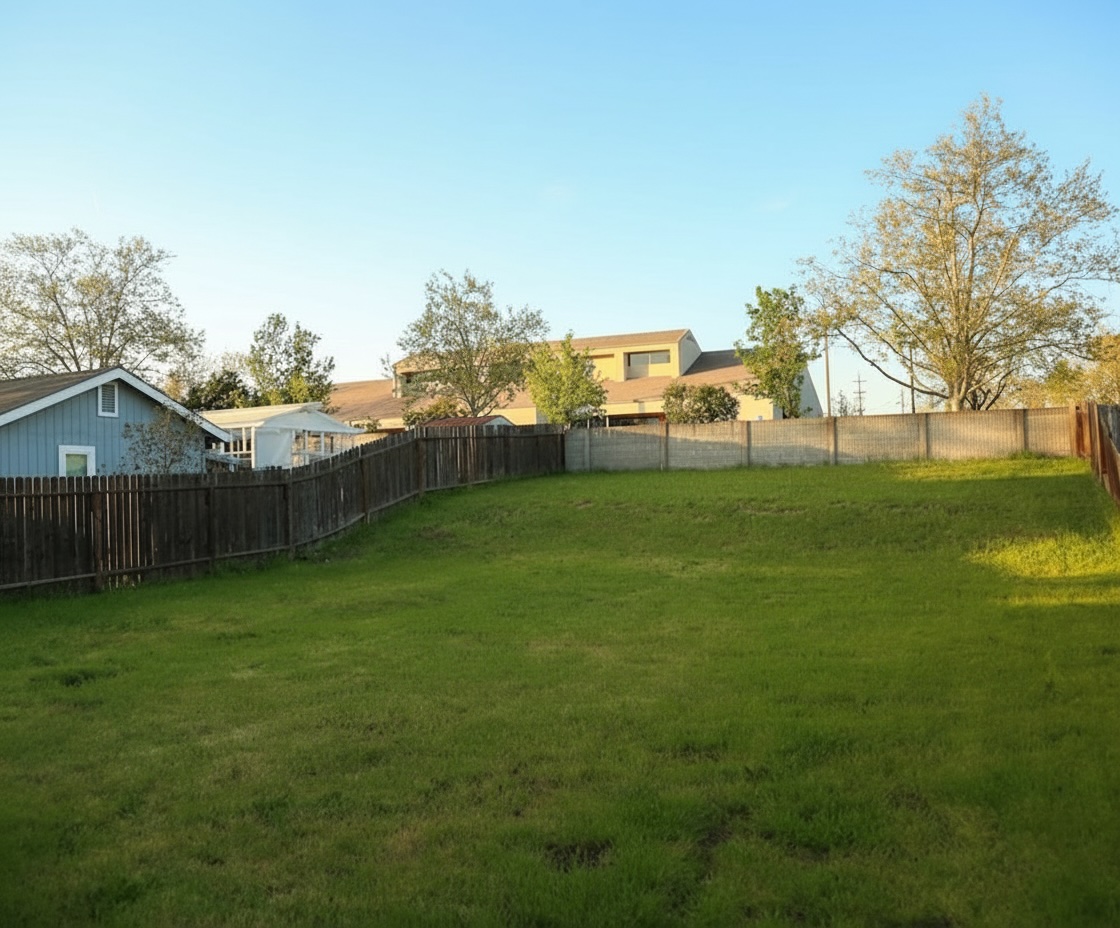
Featured Trees & Shrubs for Mediterranean Gardens
Browse all 151 plants for Eugene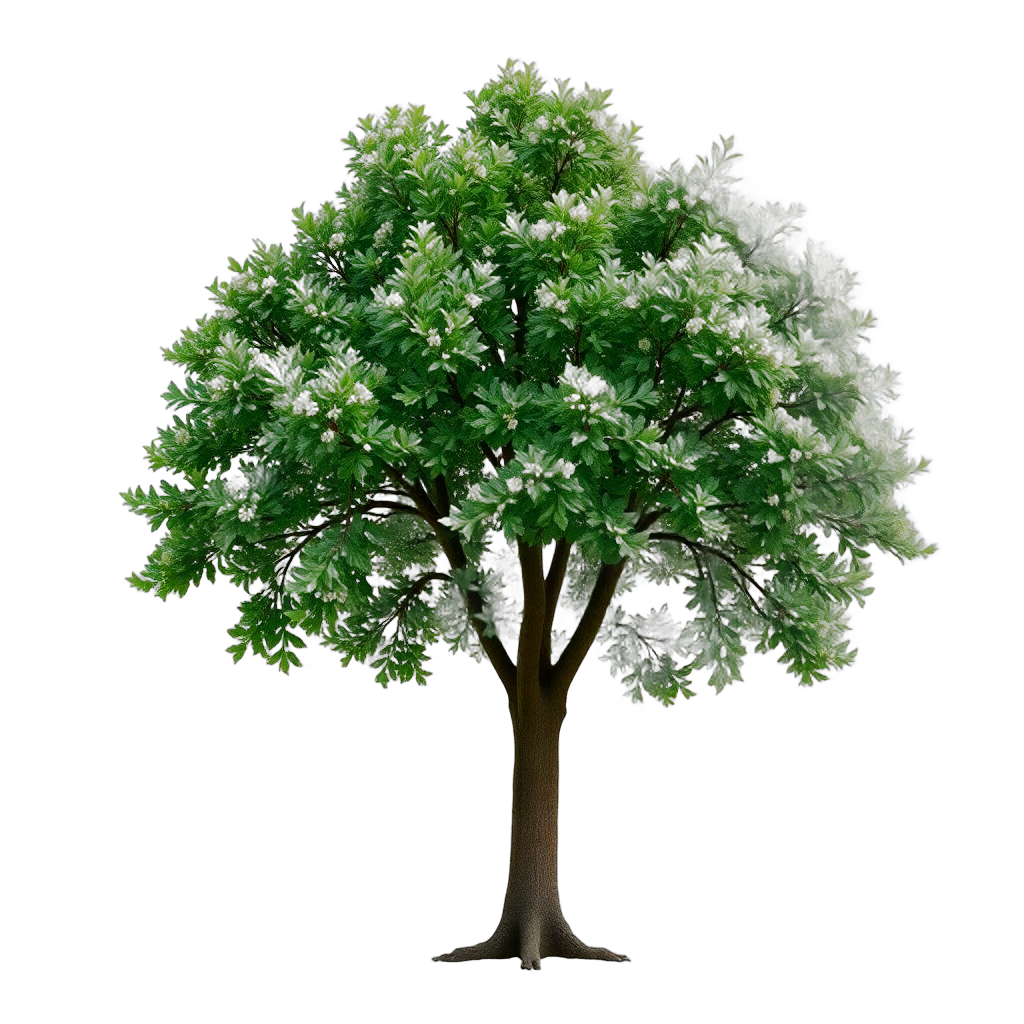
Oregon White Oak
Quercus garryana
large shade tree reaching 65+ feet, blooms in spring. Yellow fall color.
Featured Flowers & Perennials for Mediterranean Gardens

Water Lettuce
Pistia stratiotes
low-growing ground cover, white blooms in summer. Evergreen year-round.

Tussock Sedge
Carex stricta
low-growing ground cover, blooms in spring. Brown fall color.

Umbrella Sedge
Cyperus alternifolius
grows to 4 feet, blooms in summer. Evergreen year-round.
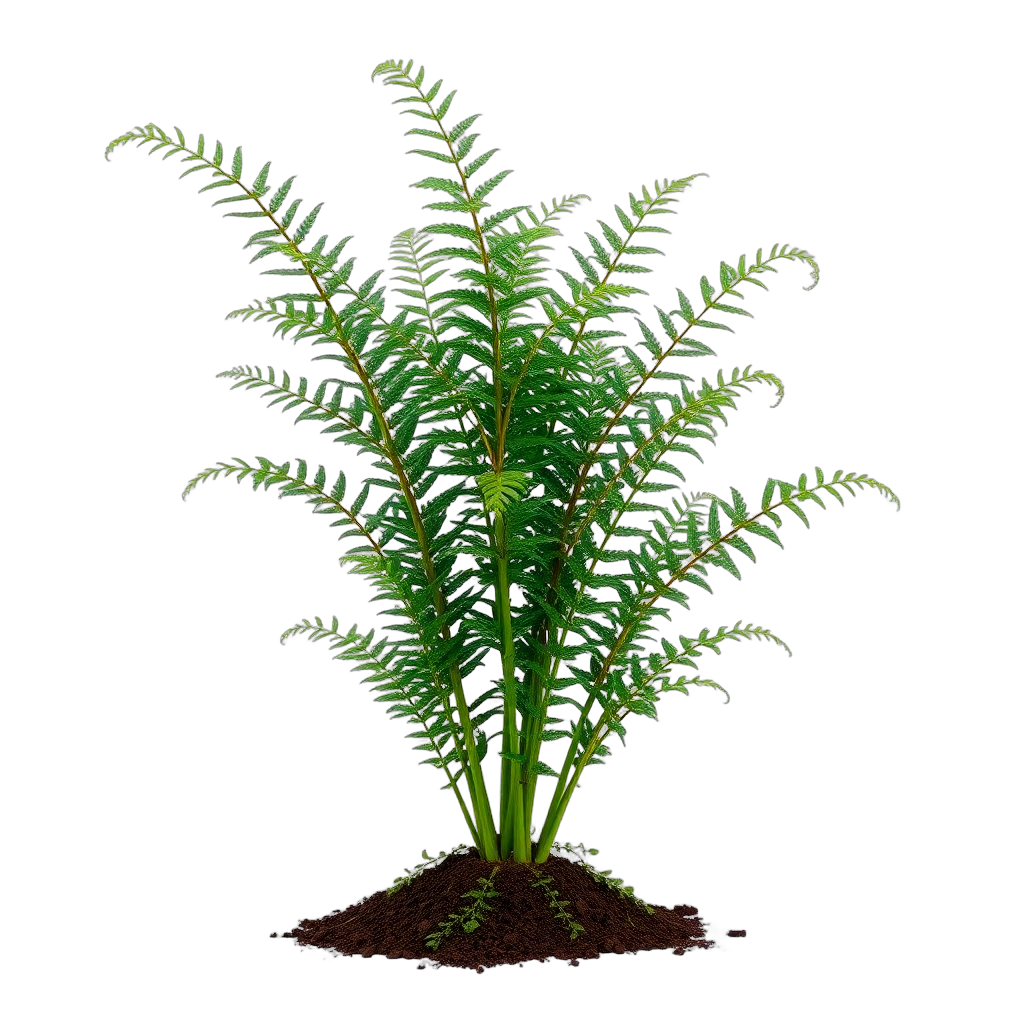
Deer Fern
Blechnum spicant
low-growing ground cover, blooms in none. Evergreen year-round.
Zone and sun checks come from our database — confirm with your local nursery before you buy.
Bloom Calendar for Eugene
spring
Oregon White Oak, Tussock Sedge, Austrian Speedwellsummer
Water Lettuce, Umbrella Sedge, Alpine Sea Hollyfall
Autumn Snakerootwinter
Limited bloomsDesign Tips for Eugene (Zone 8b)
- Raise everything. Eugene's 40.83 inches lands almost entirely between November and March on Amity, Dayton, Awbrey or Jory clay, so build beds 10 to 14 inches above grade on native soil cut 50/50 with quarter-minus crushed rock - this single decision is the difference between a lavender hedge that lasts ten years and one that rots out in its second March
- Mulch with three quarter inch gravel, not bark. Bark holds moisture against the crowns of Lavandula, Salvia officinalis 'Berggarten' and Cistus through a wet Willamette Valley winter, while a gravel mulch drains, reflects heat back into the plant and suppresses weed germination just as well
- Lime at planting. Local soils sit around pH 5.5 to 6.2 and the whole Mediterranean palette wants neutral to slightly alkaline; a dolomite lime amendment worked into the berm at install, repeated every third autumn, visibly improves flowering on Lavandula x intermedia 'Grosso' and Nepeta x faassenii 'Walker's Low'
- Keep the tender picture-book plants mobile. Bougainvillea, Citrus x meyeri 'Improved Meyer' and Punica granatum 'Nana' all belong in frost-proof terracotta on pot feet so they can be moved into a garage below 28 degrees F, and plant Clematis 'Etoile Violette' or Ficus carica 'Desert King' in the ground where you want permanence
- Design for the grey half of the year, not the golden hour. Eugene sees around 155 days with measurable rain and one of the country's dimmest Decembers, so the structural plants - Cupressus sempervirens 'Tiny Tower', Arbutus unedo 'Compacta', clipped Teucrium chamaedrys, Buxus 'Green Velvet' - are carrying the design for six months while the flowers are gone
- Turn the irrigation off, deliberately. With 0.32 inches of rain in July and 0.39 in August, established Mediterranean plantings want a deep soak once a month at most; on a shared drip zone with lawn or hydrangeas they will be watered to death, so zone the Mediterranean beds separately from day one
- Weave in the local dry natives. Arctostaphylos densiflora 'Howard McMinn', Ceanothus 'Victoria', Ribes sanguineum and Sedum spathulifolium 'Cape Blanco' come out of the same Willamette Valley oak-savanna conditions, need zero summer water, and read as perfectly Mediterranean beside Phlomis and Santolina
Where to Source Plants in Eugene
Skip the big-box stores. These independent Eugene nurseries specialize in the plants that make mediterranean gardens thrive in Zone 8b.
Gray's Garden Center
West Eugene (W 6th Ave)
Independent Eugene retail nursery growing much of its own stock; strong benches of lavender, salvia, rosemary, roses and Zone 8b shrubs and trees
Johnson Bros Garden Market
North Eugene (Coburg Road)
Second-generation family-run five-acre garden centre serving Eugene-Springfield for 35-plus years; the widest local run of perennials, shrubs, trees and herb starts
Glenwood Corner Store Nursery
Glenwood (Franklin Blvd, between Eugene and Springfield)
Lane Forest Products' nursery yard: larger established trees, shrubs and vines plus fig and citrus stock, and the crushed rock, river rock and quarry gravel a Mediterranean bed needs, bought from the same counter
Doak Creek Native Plant Nursery
South Eugene (Marlow Road)
Container-grown Willamette Valley oak-savanna and prairie species, grown without herbicides or pesticides; the local source for the dry native layer that carries a Mediterranean planting through August
Mediterranean Landscaping Costs in Eugene
| Project Scope | Estimated Cost |
|---|---|
| Front-yard Mediterranean conversion (400-600 sqft, raised gritty berms and planting) | $9,000 - $19,000 |
| Flagstone entry path with courtyard wall and iron gate | $12,000 - $28,000 |
| Terracotta terrace with cast stone fountain and cafe lighting (300-450 sqft) | $22,000 - $45,000 |
| Timber pergola over a terracotta patio (250-350 sqft) | $18,000 - $38,000 |
| Full backyard Mediterranean garden with borders, paving and drip irrigation | $35,000 - $75,000 |
| Raised gritty berm soil preparation (per 100 sqft of border) | $300 - $700 |
| Specimen olive, 15 gallon, planted | $400 - $800 |
| AI visualization with ProScapeAI | Free to start |
Estimates based on Eugene, OR-area contractor rates as of 2026. Actual costs vary by site conditions, materials, and contractor.
Eugene Climate & Growing Zone
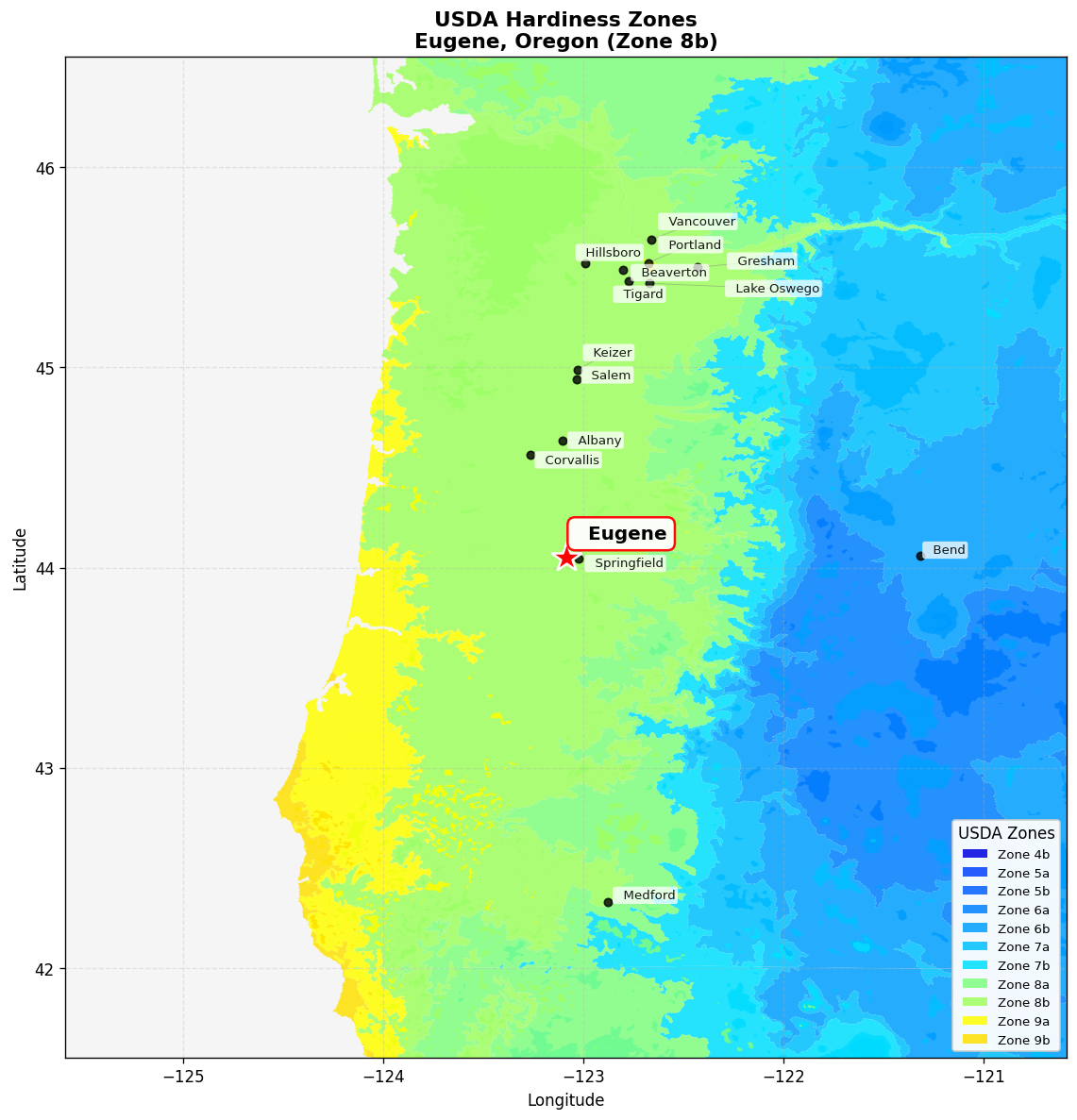
USDA Zone 8b
Hardiness zone for Eugene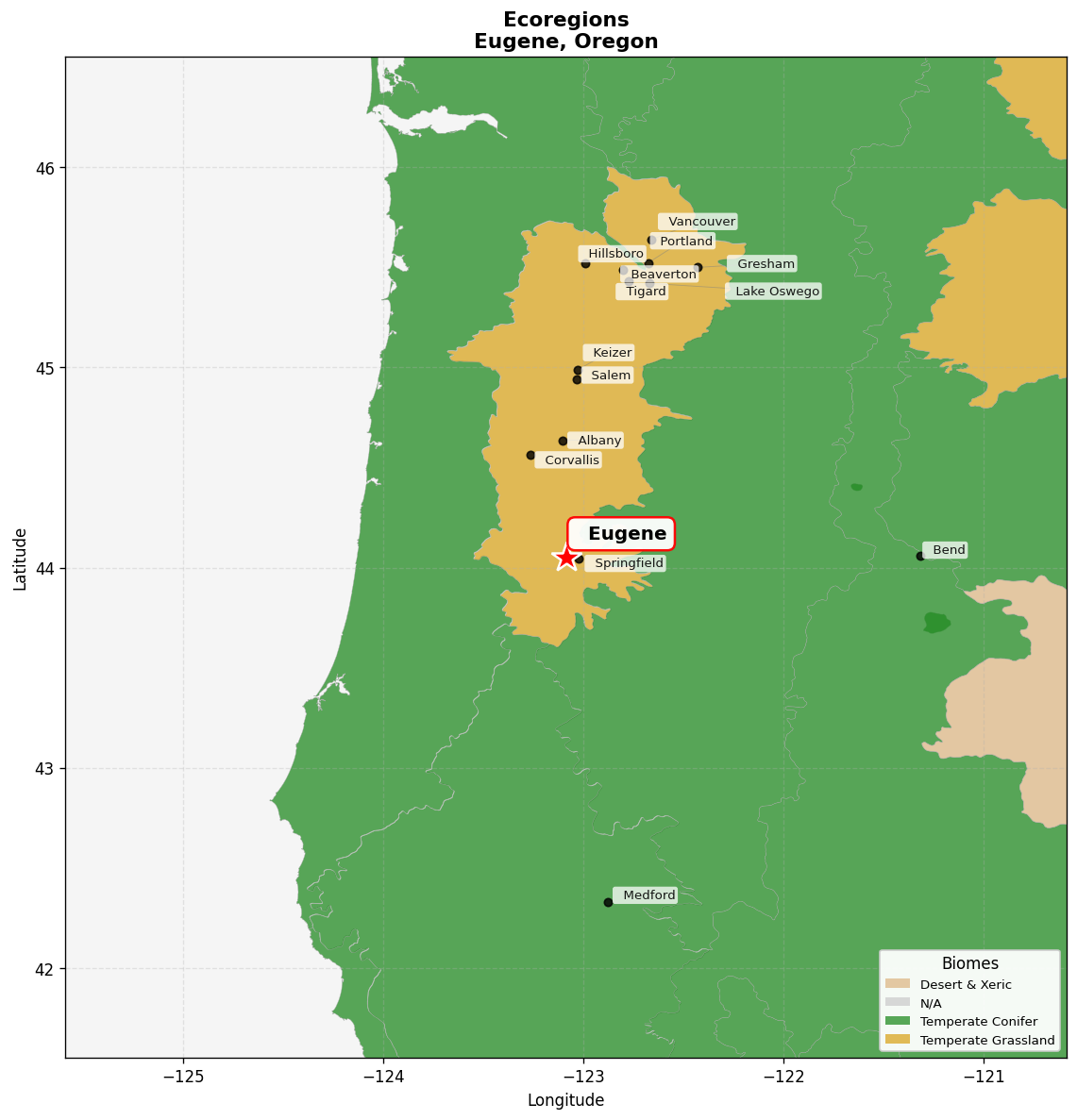
Willamette Valley oak savanna
Native ecoregionFrequently Asked Questions
How much does a Mediterranean garden cost in Eugene?
A front-yard conversion of 400 to 600 square feet - turf removal, raised gritty berms, a flagstone path, cypress, lavender and a full silver-foliage layer - typically runs $9,000 to $19,000 installed in Eugene. A stucco courtyard wall with an iron gate adds $6,000 to $15,000 depending on length and footings. A terracotta terrace with a cast stone fountain and cafe lighting lands between $22,000 and $45,000, and a full backyard with a timber pergola, paving, borders and drip runs $35,000 to $75,000. Oregon labour rates sit above the national average, so the plants are rarely the expensive part: the raised soil profile, the hardscape base and the drainage work are. A specimen Olea europaea 'Arbequina' at 15 gallon runs $180 to $350 locally, and a 5 gallon Cupressus sempervirens 'Tiny Tower' runs $60 to $110.
Can I actually grow olive trees in Eugene?
Yes, with the right cultivar and the right spot. Commercial Willamette Valley growers have been producing oil since 2008 using the hardiest Tuscan and Spanish selections - 'Arbequina', 'Frantoio', 'Leccino' and 'Pendolino' - and those are the four to buy. Plant against a south or west wall with reflected heat, on a raised berm of native soil cut heavily with crushed rock, and skip all summer irrigation after the second year. Expect defoliation and some branch dieback in a hard arctic outbreak; Eugene's Zone 8b lows of 15 to 20 degrees F are survivable but the January 2024 ice storm proved that a heavy ice load on an evergreen canopy can be as damaging as the cold. Fruit set is unreliable this far north, so buy an olive for the silver canopy and the trunk, not for the harvest.
Will lavender survive a Eugene winter?
Lavender dies here from wet feet, essentially never from cold. Eugene's 40.83 inches falls overwhelmingly between November and March onto Amity, Dayton, Awbrey or Jory clays that hold a perched water table, and lavender crowns sitting in cold saturated soil rot. Three things fix it and all three are cheap. Raise the bed 10 to 14 inches on native soil cut 50/50 with quarter-minus crushed rock. Mulch with three quarter inch gravel, never bark, so the crown stays dry. Add dolomite lime at planting to lift the soil off pH 5.5. Choose Lavandula x intermedia 'Grosso', 'Provence' or 'Phenomenal' for the big hedging blocks and Lavandula angustifolia 'Hidcote' or 'Munstead' for compact edging; skip Lavandula stoechas, which is the least reliable of the group through a Willamette Valley winter.
What can I plant instead of bougainvillea in Eugene?
Bougainvillea is Zone 9b at best and will not overwinter outdoors in Eugene, so treat it as a large potted specimen that goes into a garage or bright shed below about 28 degrees F. For the same magenta cascade over a wall or pergola with no winter drama, Clematis 'Etoile Violette' and Clematis 'Madame Julia Correvon' are the direct substitutes and both are bulletproof here. Rosa 'Zephirine Drouhin' gives thornless pink on a hot wall, Vitis vinifera 'Pinot Noir' gives a Willamette Valley pergola vine with autumn colour, and Trachelospermum jasminoides delivers the scent on a sheltered south face. Citrus is the same story - Citrus x meyeri 'Improved Meyer' is wonderful in a terracotta pot in Eugene and a dead stick in the ground.
When should I plant a Mediterranean garden in Eugene?
October through mid-November is the best window by a wide margin. Plants go in as the autumn rain starts, root through a mild wet winter and are established before the tap shuts off in June - which for a palette that wants no summer water is the whole game. Mid-March to late April is the second window, and anything planted then needs deep weekly water through its first August. Avoid planting from mid-June onwards: Eugene's last frost is typically mid-April and the first is around the start of November, so summer plantings have plenty of season, but with 0.32 inches of rain in July they need irrigation you were trying to design away. Hardscape can go in year-round, though flagstone and mortar work stalls whenever the ground is saturated, which in a Eugene winter is most weeks.
Do I need permits for a Mediterranean courtyard in Eugene?
Planting, gravel, paths and beds need no permit. A retaining wall over four feet in exposed height needs a building permit, which comes up often on terraced South Hills lots. A freestanding courtyard wall above the standard fence height threshold triggers a permit too, and stucco walls need proper footings below frost depth regardless. Removing or planting a street tree in the public right-of-way requires a free permit from Eugene Urban Forestry. Eugene also charges a stormwater fee scaled to impervious surface, so specifying permeable gravel or open-jointed flagstone rather than solid concrete lowers the ongoing bill as well as the runoff. Check anything that changes drainage across a property line with the city before you build it - that is the most commonly tripped-over requirement in Lane County.